As an Amazon Associate, we earn from qualifying purchases. Read our affiliate disclosure.
The best double camping chair should work for two people at the same time. That sounds obvious, but shared seating introduces questions a single chair does not: whether both people like the height, how the fabric responds when one stands, how much personal space each wants, and whether a load rating applies to the whole chair or each seat.
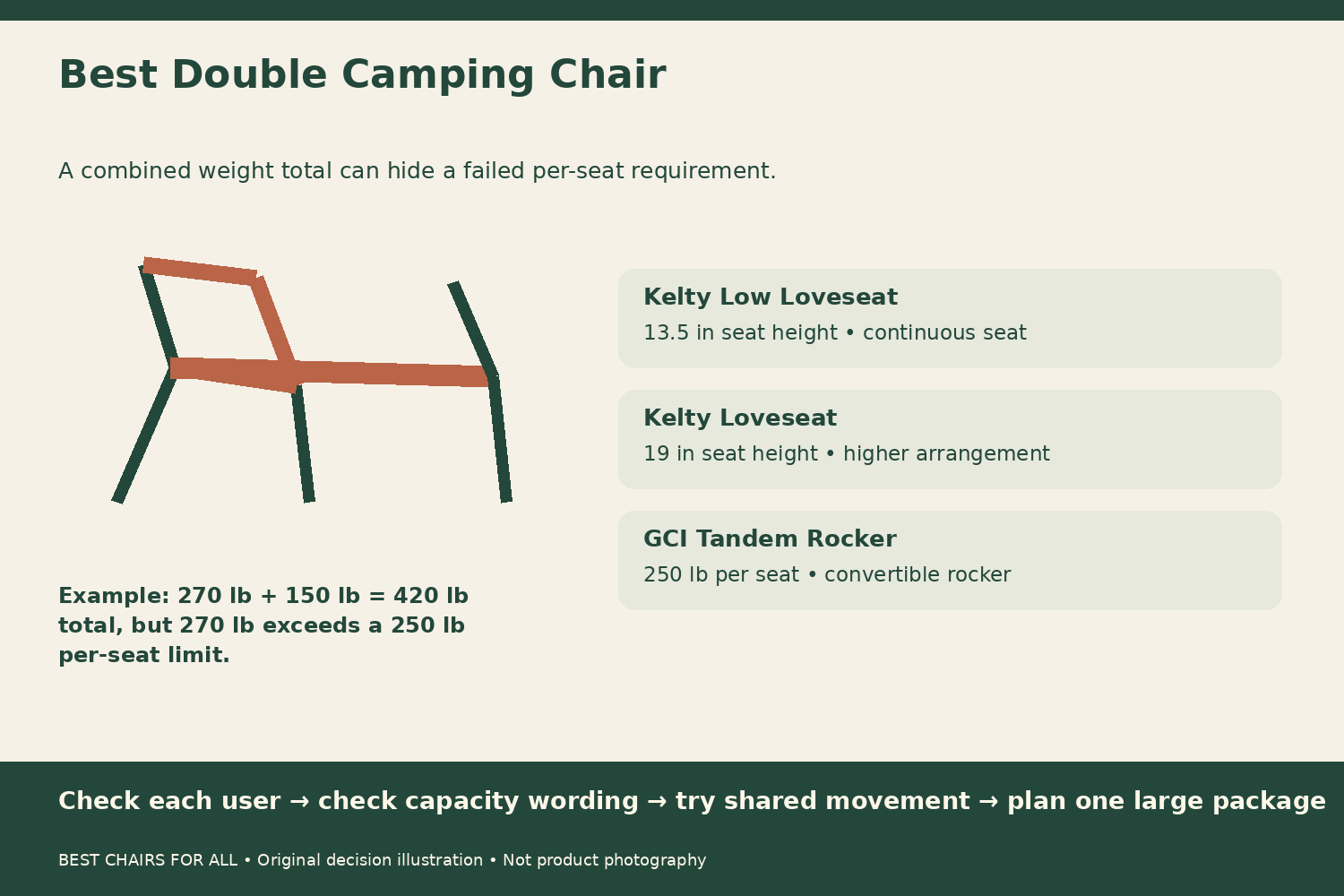
This guide compares the Kelty Low Loveseat, Kelty Loveseat, and GCI Outdoor Tandem Rocker. The Low Loveseat is the first candidate for a lower, relaxed shared seat. The standard Loveseat is the comparison when a higher seat matters. The Tandem adds rocking and a convertible arrangement for someone who also expects solo use.
The recommendations come from manufacturer research reviewed November 6, 2026. We have not tested two-person comfort, load distribution, rocking synchronization, or packed handling ourselves. Model specifications and stock can change, and retailer listings may describe earlier generations. Verify the label and selected version before buying.
Decide whether you want a shared seat or two adjacent seats
A continuous loveseat encourages sitting close together and sharing the same frame. That can be exactly the appeal for a couple around camp. It can also feel restrictive if both people want separate armrests, different chair angles, or more freedom to move independently.
Think about the ordinary evening. Does one person read while the other gets up frequently? Does one prefer a lower lounge position while the other wants an upright seat? Do you want to face the same direction throughout the outing? A double chair is strongest when those preferences align.
Two individual chairs may be a better purchase if the users need different seat heights, capacities, or support shapes. The double-chair format is a choice about shared use, not an automatic way to reduce total gear. Compare its actual folded package and handling with the two chairs it would replace.
Three models with meaningful differences
Kelty Low Loveseat: for a low shared lounge
The current Low Loveseat page lists a 13.5-inch seat height, 15.38-pound product weight, steel frame, adjustable arms, insulated adjustable beverage holders, and a carry wrap. Its published packed size is 34.5 by 11 by 11 inches. The lower and slightly reclined arrangement is the primary reason to choose this version.
It is worth trying when both users enjoy a closer-to-the-ground camping position and want a continuous shared seat. Compare where the front edge meets each person's legs. The same height can feel relaxed to one user and inconvenient to another, particularly when standing after a long sit.
The current manufacturer page lists a 600-pound capacity, while some older retailer listings show different ratings. Match the current specification to the exact generation you receive and clarify any load-distribution limits. Do not assume a whole-chair number permits every possible concentration of weight in one position.
Check matching Kelty Low Loveseat listings on Amazon (paid link). Low Loveseat Nest and other variants should be checked separately.
Kelty Loveseat: for a higher shared seat
The standard Kelty Loveseat page lists a 19-inch seat height, 600-pound capacity, adjustable armrests, two insulated adjustable beverage holders, and padded roll-tote storage. The height is 5.5 inches above the Low Loveseat's current published figure, making this a useful fit comparison rather than simply another color choice.
Choose it for consideration when the low model's entry or exit is inconvenient for either user. A higher seat may also fit a particular table arrangement better. Try both people in the chair before deciding that the height solves the problem; a shared fabric seat and individual body proportions still affect how it feels.
Its limitation is that a higher seat can be less appealing to someone who wants a low relaxed viewpoint. It also remains a loveseat, with shared space and outside arms rather than two completely separate chairs. The page's selected configuration showed sold-out messaging during research, so confirm the seller's actual delivery status.
Check matching Kelty Loveseat listings on Amazon (paid link). Check that the listing is the standard-height model.
GCI Outdoor Tandem Rocker: for shared rocking and solo conversion
The Tandem Rocker manufacturer page describes a two-seat spring rocker that can convert into a single-seat arrangement. It lists a 21.2-pound weight, two side caddies, dual carry handles, and a 250-pound limit per seat. The per-seat wording is a particularly important difference from an unqualified whole-chair rating.
Its reason for inclusion is the combination of rocking and a configuration intended to accommodate solo use. If one person often leaves early or takes the chair out alone, investigate how that conversion works under the actual instructions. A feature is useful only if you will use the intended arrangement rather than leave an unused half deployed indefinitely.
The tradeoff is a heavier chair and the need for both users to like the movement. We have not tested how independent the two seating positions feel in use, so try the motion with both people instead of assuming one person's rocking is imperceptible to the other. The selected manufacturer page showed sold-out messaging at research time.
Check matching GCI Tandem Rocker listings on Amazon (paid link). Confirm the convertible two-seat model and per-seat limit.
A capacity example that prevents a common mistake
Write each user's weight separately before looking at the combined number. For a chair with a 250-pound per-seat limit, a hypothetical 240-pound user and 180-pound user both meet that individual limit. Their combined weight is 420 pounds, but the individual check is still necessary.
Now consider a hypothetical 270-pound user and 150-pound user. The combined weight is also 420 pounds, yet the first person exceeds a 250-pound per-seat limit. A total below 500 pounds does not make that arrangement acceptable. Adding the two limits is not permission to redistribute them arbitrarily.
For a chair displaying a single overall capacity, ask the manufacturer about any per-position or load-distribution conditions. Do not invent equal per-seat limits by dividing the total in half, and do not assume the entire capacity can be placed on one side. Use the documentation for the exact frame.
Keep carried objects and intended use within the manufacturer's directions as well. A double chair is not automatically a three-person bench or a place to stack heavy camping equipment beside a seated user. The appropriate arrangement comes from the design and instructions, not from finding unused arithmetic capacity.
A two-person fit worksheet
Make one column for each person and a third for shared observations. Each person should note feet and leg position, back support, outside-arm comfort, and getting in and out. The shared column should describe space between users, movement felt through the seat, and whether the chair supports the activities you both intend.
Begin with both people seated naturally on suitable level ground. Do not compress yourselves into a pose that creates a more attractive photograph. Try your usual outdoor clothing, because bulky layers can change how much shared space feels available.
Have one person change position within ordinary intended use while the other notices the seat response. Then practice one person standing and returning, using the correct procedure. This reveals an important real-world difference from evaluating two independent chairs in isolation.
Try reaching the beverage holders. If either person has to lean across the other repeatedly, the storage arrangement may be inconvenient. A shared middle table is not always easy to place beside a continuous seat, so plan where drinks, books, and phones will go.
Finish by recording the largest disagreement. If one person likes the low height and the other cannot use it comfortably, choose a different configuration rather than averaging their preferences. A shared purchase should pass both people's essential requirements.
Compare packing burden honestly
A double chair replaces two seats with one package, but that package may be heavier, wider, or less convenient for one person to carry. Decide who will move it and what else that person carries. Two smaller chairs split between two people can be easier in some situations than one large shared bundle.
Use the Low Loveseat's current 34.5-by-11-by-11-inch packed figure as an outline for a vehicle check. Test both the storage space and the opening through which the chair must pass. A compartment can be large enough inside while its hatch still blocks the package.
For the Tandem, examine how the dual handles and closure strap are used. Its 21.2-pound listed weight should be part of the loading plan, not hidden behind the phrase portable. Try a comparable carrying load if you cannot inspect the chair before purchase.
Consider the return trip after rain or dust. A carry wrap and a fully enclosed bag behave differently as storage arrangements. Follow the manufacturer's cleaning and drying directions, and keep used seating away from bedding until it can be cleaned or packed appropriately.
Layout around a fire circle or viewing area
A continuous seat fixes the distance between two users. Place it where both have a reasonable view without twisting. In a conversation circle, compare how the low and standard-height choices align with other chairs. In a viewing row, follow the venue's chair-height and seating rules rather than assuming a low loveseat is always permitted.
Leave entry space at the sides. If a loveseat is placed tightly between coolers or other chairs, a user may have to climb around the frame to leave. A double rocker also needs room for its intended movement; plan that clearance according to its own documentation.
Keep the chair an appropriate distance from fire and cooking equipment as directed. Shared seating should not encourage reaching over another person toward a hot surface. Put frequently used items in a convenient separate location so ordinary tasks do not become a negotiation across someone's lap.
For occasional solo use, assess the documented configuration separately from the two-person trial. A convertible model should be changed only by its intended procedure; an unused seating position is not an invitation to alter the frame.
Choose the shared experience deliberately
Start with the Low Loveseat when both people prefer the lower lounge position. Compare the standard Loveseat when its 19-inch published height addresses the fit requirement. Investigate the Tandem when rocking and solo conversion are functions you actually want, while respecting its per-seat limits.
At checkout, confirm generation, capacity wording, bag or wrap inclusion, exact quantity, and delivery status. We have not validated a fixed US delivered price for every variant, so no budget promise is attached to these recommendations. A double-chair listing can also be confused with a two-pack of individual chairs.
The right purchase should pass both personal fit columns, the shared-movement check, and the packing plan. That gives you a better reason to choose a double chair than the appealing idea of two people sharing one frame.
Something unclear or out of date? Send a correction with this article’s title and the detail to check.
Sources, research & corrections policy ↗