As an Amazon Associate, we earn from qualifying purchases. Read our affiliate disclosure.
The best beach chair with canopy keeps useful shade where you need it while preserving a chair format you can carry and use. An overhead panel can be convenient, but the fabric's UV rating does not tell you whether the sun reaches your face from the side or whether your legs remain exposed. Shape and adjustment deserve as much attention as the rating.
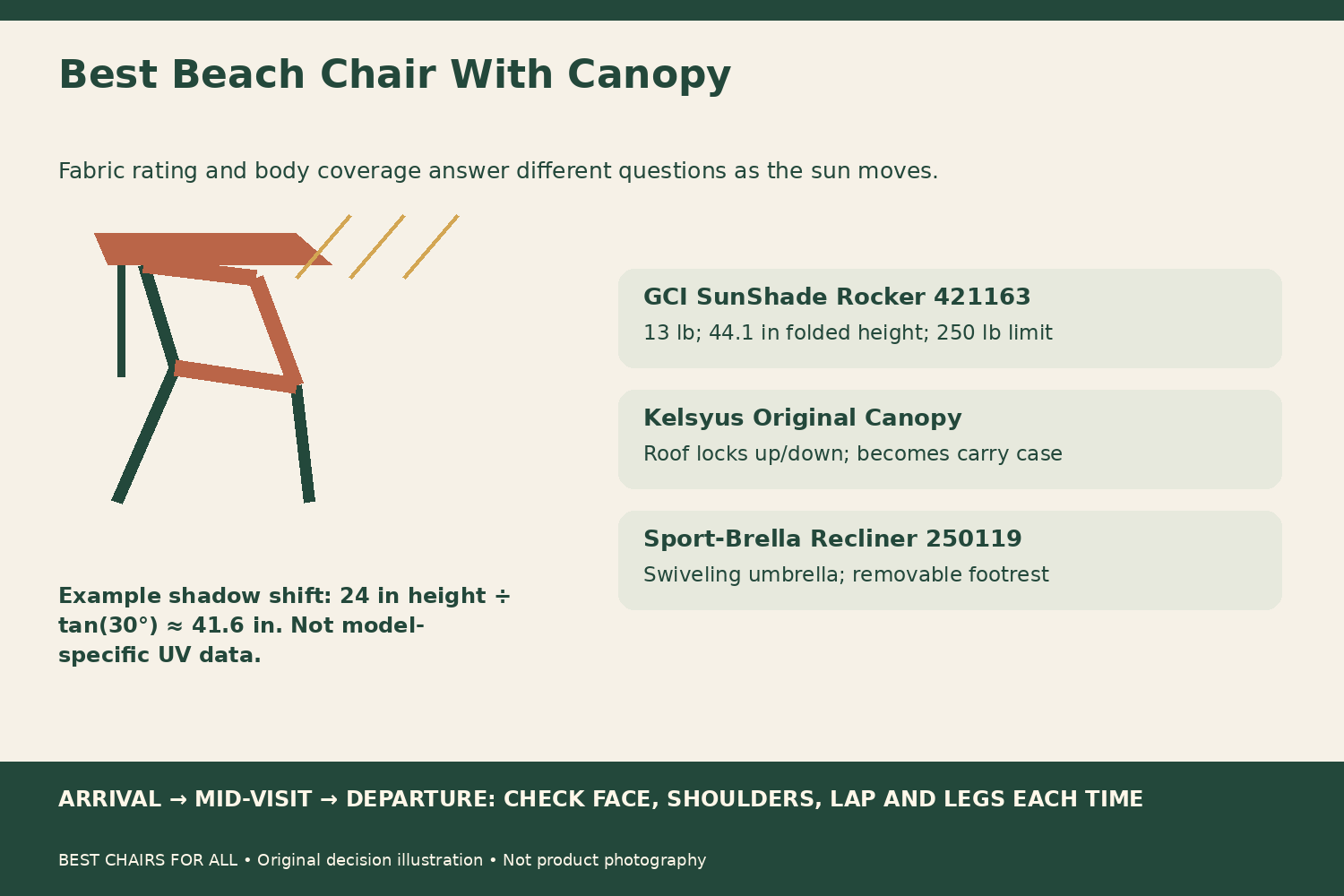
Our shortlist compares the GCI Outdoor SunShade Rocker in Neptune Blue, Kelsyus Original Canopy Chair, and Sport-Brella Recliner Chair SKU 250119, style SK018. They offer three different arrangements: a bagged rocker with an adjustable overhead canopy, a quad chair whose canopy becomes its carrying case, and a recliner with a swiveling personal umbrella.
We reviewed current manufacturer, official support, and US retailer information November 6, 2026. We have not tested UV transmission, wind performance, sand settling, or comfort. This guide uses shade as a purchasing feature, with the limitations explained below; no chair is represented as a complete sun-protection system or a weather shelter.
Distinguish fabric performance from seated coverage
A UPF statement concerns the rated fabric. It does not mean every part of the person is underneath that fabric's shadow throughout the day. Open sides, the front edge, chair orientation, and the sun's changing direction all affect useful coverage.
The CDC's current sun-safety guidance explains that UV can reach you on cloudy days and reflect from surfaces including sand and water. It recommends combining shade with protective clothing, a suitable hat, sunglasses, and sunscreen. A personal canopy should be one part of that plan rather than a reason to disregard exposed skin.
Start by naming your priority: shade over the face while reading, coverage over the upper torso, or the ability to redirect shade as you change position. Then assess the actual arrangement in that posture. The largest-looking panel in a photograph can still leave the particular area you care about outside its shadow.
Three different attached-shade arrangements
GCI Outdoor SunShade Rocker: for a firm, level beachside sitting area
The current GCI manufacturer page identifies Neptune Blue SKU 421163-GCIO001 and lists an adjustable UPF 50+ canopy, tall angled back, mesh panel, spring-action rocking, and carrying bag. Its published capacity is 250 pounds, item weight is 13 pounds, and folded height is 44.1 inches.
Consider it for a suitable firm, level beachside seating area when rocking is part of the appeal and a long bagged package fits your transport. The listed folded height is a consequential check for a small vehicle. Confirm local seating rules and the model's placement instructions before bringing it to a boardwalk or developed beach area.
It is not a low reclining backpack beach chair, and we do not claim tested rocking performance in loose sand. If your intended spot cannot provide the support conditions its instructions require, pass on this option. The canopy adds shade but does not correct an unsuitable surface.
Search matching GCI SunShade Rocker listings on Amazon (paid link). Match this rocker rather than a SunShade Backpack Beach or Event model.
Kelsyus Original Canopy Chair: for an integrated carrying case
The Lowe's Kelsyus Original listing describes a powder-coated steel quad chair with a 250-pound capacity, cup holder, and UPF 50+ canopy that locks up or down. The canopy folds around the chair and buckles into its carrying case, with the armrests serving as backpack straps.
It is a candidate when you dislike managing a separate loose bag and want the shade and chair to remain together. The Spin Master SwimWays support page provides model-specific Kelsyus folding and instruction resources, useful for confirming the correct sequence before a trip.
The tradeoff is that it is a general outdoor quad chair with a different motion and packing arrangement from the GCI rocker. Its retailer measurement panel contains questionable repeated dimensions, so we do not use those numbers to establish seat fit. Ask for reliable current measurements and evaluate whether its support arrangement suits your intended beach site.
Search matching Kelsyus Original Canopy Chair listings on Amazon (paid link). Adult Original and Kids versions are different products.
Sport-Brella Recliner Chair 250119: for a swiveling umbrella and footrest
The Implus US manufacturer listing identifies Sport-Brella Recliner Chair SKU 250119, style SK018. It documents three recline positions, a swiveling umbrella with 360-degree adjustability and UPF 50+ fabric, a removable adjustable footrest, and a 250-pound capacity. It includes a carrying bag and folds with the umbrella attached.
Consider it when redirecting a personal umbrella and stretching out with a footrest matter more than a low flat-fold beach-chair silhouette. The manufacturer describes beach use, but that is not a measured comparison of how its feet behave on different sand.
The limitation is complexity: the backrest, footrest, umbrella, and folding arrangement each need to work for you. We do not quote the page's case weight as the chair's carrying weight. Confirm the current packed weight and supplied manual with your seller before comparing transport burden.
Search matching Sport-Brella Recliner Chair 250119 listings on Amazon (paid link). Match the complete chair and umbrella.
Make a three-time coverage card
Draw a simple plan of your usual beach arrangement: chair, water-facing direction, neighboring belongings, and the route past the seat. Mark where the sun is likely to be during your intended arrival, middle, and departure periods. Use your real location and date rather than assuming a universal beach orientation.
For each time, record whether the shade can move in the needed direction while the chair remains in a usable position. An adjustable overhead panel, a swiveling umbrella, and an up-or-down roof do not establish the same movement range. Ask for a demonstration when the manufacturer does not quantify that range. A list that simply marks all three adjustable conceals that difference.
Then add body zones: face, shoulders, lap, and lower legs. Record actual shadow observations during a suitable trial, not a percentage inferred from the UPF label. A shaded face does not establish that the rest of the body is covered.
Finally, record the action needed to restore coverage. Can you use the documented shade adjustment, must you reposition the whole chair, or will that time of day require another shade arrangement? This card turns an appealing feature into a realistic plan for the visit you actually take.
Why low-angle sun changes the result
A small geometry example explains the problem without pretending to predict any model's protection. For a flat horizontal shade edge 24 inches above a target plane, a sun angle of 60 degrees above the horizon gives a horizontal shadow displacement of about 13.9 inches. At 30 degrees, the displacement is about 41.6 inches. The calculation is height divided by the tangent of the angle.
Those are invented example dimensions and simple geometry, not measured chair data or a UV exposure calculation. They show why a panel directly overhead may cast its useful shadow far to one side when the sun is lower.
Real canopies are curved or tilted, and your head, shoulders, and legs occupy different heights. Treat the example as a reason to inspect adjustment and actual coverage, not as a formula that certifies a purchase. The chair's usable shadow should be assessed with the person in the intended position.
If your preferred view and the sun direction conflict, consider that before ordering. Continually turning away from the water to chase shade may defeat the main activity. A different shade arrangement can be more useful than another recline position.
Evaluate the chair with the shade deployed
The shade changes how the chair is experienced. During a fit trial, check headroom as you sit down and stand up, your view toward companions, and access to the controls. A canopy that feels unobtrusive when seated may still complicate entry.
For a recliner, evaluate the relationship between backrest movement and the canopy or umbrella. Follow the product's instructions for adjustments and clearance. Do not infer that a shade can be moved while occupied just because its handle appears reachable.
Check whether you can reach your belongings without leaning on shade supports. A support arm is not an improvised handhold, towel rail, or bag hanger unless the manufacturer specifically permits that use. Added items can change the system beyond the configuration being compared.
If several people will share one chair, repeat this assessment for each intended user. Head position and preferred recline can change where the same shadow falls. Mark separate settings on your coverage card instead of treating the first person's successful trial as evidence that everyone else will have the same coverage or headroom.
Also assess the shade-free position. Some visits move from shade to evening use, and you may want an unobstructed view then. The folded-back canopy should occupy a position allowed by the instructions rather than one improvised to suit a crowded space.
Beach conditions and adjustment limits
None of the sources used here establishes a permissible wind speed for these complete chair systems. Do not invent one from the umbrella diameter or assume that sitting in the chair turns it into an anchor. Follow the current manufacturer instructions when conditions require closing, removing, or storing shade components.
The Sport-Brella instruction booklet provides product-specific warnings, including even-surface placement, clearance around the umbrella during opening, and not adjusting the chair while occupied. The available booklet is an older document; verify that it matches the current model and follow the instructions supplied with your purchase.
A beach label also does not mean every patch of soft or sloping sand is suitable. Place the chair where its required support conditions can be met. If you cannot achieve those conditions, move the setup rather than attaching unapproved supports or weights to the frame.
Rehearse packing while the chair is clean and dry
Practice the documented folding sequence before carrying the chair to the beach. Kelsyus's canopy-as-case system, GCI's long bagged rocker, and Sport-Brella's chair-and-umbrella bag create different storage tasks. A feature is useful only if you can repeat the process comfortably.
Check the packed shape against the vehicle and the rest of the beach kit. Include the shade in the comparison rather than weighing an unshaded version of the same chair family. If the manufacturer or seller cannot establish a model-specific packed measurement, leave that cell unknown until you obtain it.
At home, the shade fabric and mechanisms need their specified cleaning, drying, and storage routine. Keep sand away from moving parts as directed and inspect the relevant attachments before the next trip. Do not use a forceful fold to overcome grit or an incorrectly positioned support.
Choose GCI when a firm, level beachside location and its rocker format fit your trip, Kelsyus when the integrated case and quad-chair format suit you, or Sport-Brella when its directional umbrella and footrest justify the extra mechanisms. Base the decision on your coverage card and the exact supplied system rather than treating all overhead fabric as equivalent.
Something unclear or out of date? Send a correction with this article’s title and the detail to check.
Sources, research & corrections policy ↗