As an Amazon Associate, we earn from qualifying purchases; see our affiliate disclosure.
The best backpack beach chair should solve the whole carry arrangement: the folded frame, the shoulder straps, the supplies, and the route back to the car. Shibumi’s Classic Chair is a useful starting point for an eight-pound, four-position option. SUNFLOW’s Shore Thing offers a thirteen-inch seat and a different folded shape at the same listed bare-chair weight. GCI Outdoor’s Backpack Beach Chair is a third practical comparison, with a four-position back and published folded dimensions that help you plan a crowded trunk.
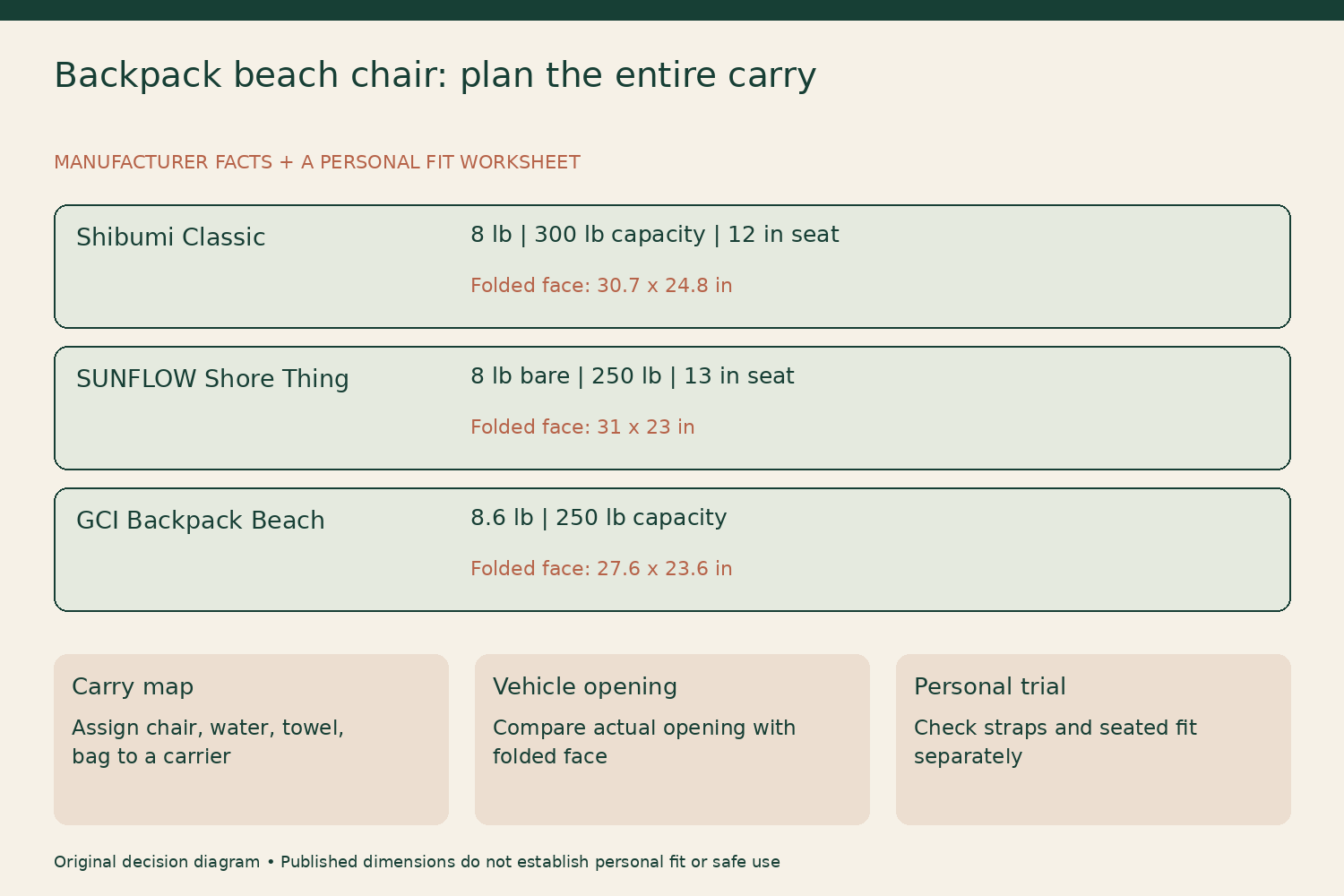
These are research-based selections from manufacturer information reviewed in November 2026. We have not worn these chairs on a measured walk or tested their straps. There is no promise that one will feel comfortable to every user, and no price or stock claim. Exact model identification matters: GCI’s shaded beach products, Shibumi’s Tall Chair, and SUNFLOW’s Tall Sand Dune are separate products. A marketplace result containing a familiar brand name is not enough to confirm the reviewed model.
What makes this a backpack shortlist
Every chair below has manufacturer-described backpack shoulder straps. That distinguishes it from a light chair with a single carry strap or a pole-chair case you might put inside your own bag. Integrated straps leave the frame on your back, while your hands can carry other items within your own manageable load. They also occupy the space where a conventional daypack would normally sit. Plan that conflict before paying for a carrying feature you cannot combine with the rest of your equipment.
A backpack chair is still furniture with a carrying arrangement, rather than a hiking pack engineered around your particular torso. Published chair weight does not tell you strap spacing, pressure against your back, or whether the folded frame contacts your legs. Ask about adjustable strap range and permitted loading. Do not assume a storage pocket has the same load rating as the seat, or attach extra bags to the frame without manufacturer approval.
Current specifications that distinguish these three
The Shibumi Classic Chair page lists an eight-pound chair, a twelve-inch seat height, a 300-pound capacity, four reclining positions, and padded backpack straps. Its folded size is 30.7 by 24.8 by 3.75 inches. The official carry clip can connect two Classic chairs or a Classic and a Tall, but not two Tall chairs; that feature does not erase the combined mass or establish whether one person should carry the pair.
The SUNFLOW Shore Thing page specifies eight pounds without accessories, a 250-pound recommended seated weight, a thirteen-inch seat, and three positions. Its folded size is 23 by 31 by 6 inches. Seat dimensions are 19.5 inches wide and sixteen inches deep. The distinction between an unaccessorized chair and a stocked bundle is central to an honest backpack comparison.
The official GCI Backpack Beach Chair listing gives 8.6 pounds, a 250-pound capacity, and four back positions. It folds to 23.6 inches wide by 3.7 inches deep by 27.6 inches high. Its mesh back, head pillow, drawstring pouch, phone pocket, and beverage holder create a useful organizational option, but the pouch is not a substitute for checking what load its instructions permit.
1. Shibumi Classic Chair
Best for: Capacity advantage in this group.
A useful first comparison for someone who wants integrated backpack straps without moving to a tall-chair format.
The four-position chair sits twelve inches from the ground. Confirm actual seating clearance if width is critical.
Product Details
| Brand | Shibumi |
|---|---|
| Weight | 8 lb |
| Capacity | 300 lb |
| Folded | 30.7 x 24.8 x 3.75 in |
Pros
- 300-pound published capacity.
Cons
- Folded width does not establish usable seat width.
Consider its carry clip only within the officially compatible chair combinations.
2. SUNFLOW Shore Thing Chair
Best for: Published seat dimensions.
This option gives buyers more information about the seating surface before arranging a trial.
Its three positions and backpack straps suit a conventional folding beach setup, with accessories counted separately.
Product Details
| Brand | SUNFLOW |
|---|---|
| Bare weight | 8 lb |
| Seat | 19.5 W x 16 D x 13 H in |
| Recommended seated weight | 250 lb |
Pros
- Useful published seat width and depth.
Cons
- Six-inch folded depth requires storage room.
Build the load around the purchased configuration, including any added bundle components.
3. GCI Outdoor Backpack Beach Chair
Best for: Shallower folded profile.
A practical option to compare when the front-to-back thickness of a stored chair is the limiting dimension.
The pouch and small-item holders can simplify organization within the permitted load. They are not unrestricted luggage storage.
Product Details
| Brand | GCI Outdoor |
|---|---|
| Weight | 8.6 lb |
| Capacity | 250 lb |
| Folded | 23.6 W x 3.7 D x 27.6 H in |
Pros
- Four back positions and padded shoulder straps.
Cons
- Low-profile seat needs a personal fit check.
Use the official US model specifications and confirm current seller availability.
Build a carry map rather than a feature list
Use a sheet with four columns: item, dry weight, carrier, and return-trip location. Enter the chair as one item, then list water, snacks, towels, shoes, keys, and shared gear separately. For each item write whether it rides on your back, in a hand, in an approved pocket, or with another person. The map should have one clear home for everything. If the same back space is assigned to both the chair and a daypack, revise the plan before choosing a model.
This worksheet reveals why a lighter chair does not always create a lighter outing. A hypothetical eight-pound chair plus a five-pound bag and four pounds of water totals seventeen pounds distributed across the person. A 0.6-pound difference between the listed Shibumi and GCI chair weights is small relative to that whole load. That arithmetic does not determine what an individual can carry; it identifies where changes in equipment or division of supplies could make the larger difference.
Make a second line for the exit. A wet towel needs a permitted contained location, keys need to remain reachable, and shoes should not hang where they strike the frame or legs. The ability to find a phone without putting down the whole load is an organizational preference, not a reason to overload a tiny pocket. Treat accessory capacity as a separate question and keep straps out of moving parts when the chair is opened.
Use the folded face to check body clearance
Make a paper or cardboard outline of each folded face for storage planning. Shibumi’s 30.7-by-24.8-inch outline, SUNFLOW’s 31-by-23-inch outline, and GCI’s 27.6-by-23.6-inch outline differ enough to matter around a narrow car opening. These are published outer sizes, not the distance between shoulder straps. Do not infer the strap position or wearer fit from the outline alone, and do not strap a rigid mock-up to yourself as a substitute for trying the real chair.
At a permitted trial, put on the empty folded chair using its instructions. Check whether you can look around, move your arms normally, and walk through a clear doorway without the frame contacting it. Assess the frame’s relationship to your hips and legs. Then repeat only with the loads and configurations the manufacturer allows. A trial indoors cannot reproduce soft sand or wind, but it can expose an obvious strap or frame conflict before the return period expires.
The chair’s own pockets can shift where small objects sit against your back. Check access while the chair is carried and while it is open, since a pocket convenient in one configuration may be awkward in the other. Never put hard or sharp objects where the instructions prohibit them or where they press against a person. Pockets are useful when their purpose and contents are deliberate; an unplanned collection of items makes the package harder to manage.
Match the beach position to the seated user
Shibumi’s twelve-inch seat and SUNFLOW’s thirteen-inch seat are both low relative to many everyday chairs. GCI describes its seat as low-profile; obtain the exact current seat-height measurement if it determines your choice. The overall height of a folded or open chair cannot answer how far you must lower yourself into it. Ask the manufacturer rather than borrowing an unlabeled dimension from a marketplace diagram of a similar model.
For seated width, SUNFLOW publishes a 19.5-inch seat. Shibumi’s folded width is not a usable seat-width specification, and GCI’s 23.6-inch overall width includes more than the seating surface. Buyers who need precise hip or thigh clearance should request the narrowest usable space between the frame and arms. A chair that rides well on your back can still be unsuitable once unfolded; keep carrying fit and seated fit as two separate decisions.
Capacity can eliminate a model before either trial. Shibumi Classic’s published limit is 300 pounds, while these SUNFLOW and GCI listings specify 250 pounds. The higher Shibumi Tall capacity does not apply to the Classic. Do not average conflicting retailer numbers or use a broad brand claim to override a current model limit. If your intended use falls outside the published constraint, choose a different product with documented suitability rather than improvising reinforcement.
Three positions versus four positions
A higher count of reclining settings is not a direct comfort score. Shibumi and GCI list four positions; SUNFLOW lists three. What matters is whether one permitted position suits the task you actually do: reading, talking, looking toward the water, or resting. Ask whether the back reaches the angle you need, how adjustment works, and whether a particular position changes the footprint. Do not assume that any of these counts means the chair lies flat.
If you often supervise children near water, treat active supervision as its own responsibility, not a reason to select the deepest recline. For ordinary furniture use, arrange the chair according to its instructions with all support points appropriately placed. A backpack label describes transport and says nothing about approval for submerged use, uneven rocks, or slippery decks. Choose a model and site that fit the intended activity rather than extending beach marketing to every waterside surface.
Buy the carrying arrangement you will actually use
Choose Shibumi Classic first when its 300-pound capacity, four-position back, and eight-pound listed weight match your needs, and confirm missing seat-clearance details if required. Choose Shore Thing when the published seat dimensions and thirteen-inch height are particularly useful, while accounting for every accessory. Choose the GCI when its shallower folded profile and organizational features suit your packing plan and its current low-seat geometry works for the user.
Before checkout, compare the manufacturer identity with the listing you intend to buy, and check current shipping, returns, and stock independently. Matching Amazon searches below can include accessories and other versions. The final decision should survive a simple rehearsal: everything has a carrying location, the folded frame fits the vehicle, the user can wear the actual chair, and the opened seat suits the day. That is a more useful definition of a backpack beach chair than the presence of two straps alone.
Something unclear or out of date? Send a correction with this article’s title and the detail to check.
Sources, research & corrections policy ↗