After saltwater exposure, rinse and dry a beach chair according to its manufacturer’s instructions before folding it for storage. Cleaning the visible seating surface alone can leave salty residue on the frame and hardware. Start by identifying the materials and the product’s approved care method, then give the underside, contact points, and storage bag their own attention. The word ‘rust-resistant’ does not mean the entire assembled chair can be packed away wet indefinitely.
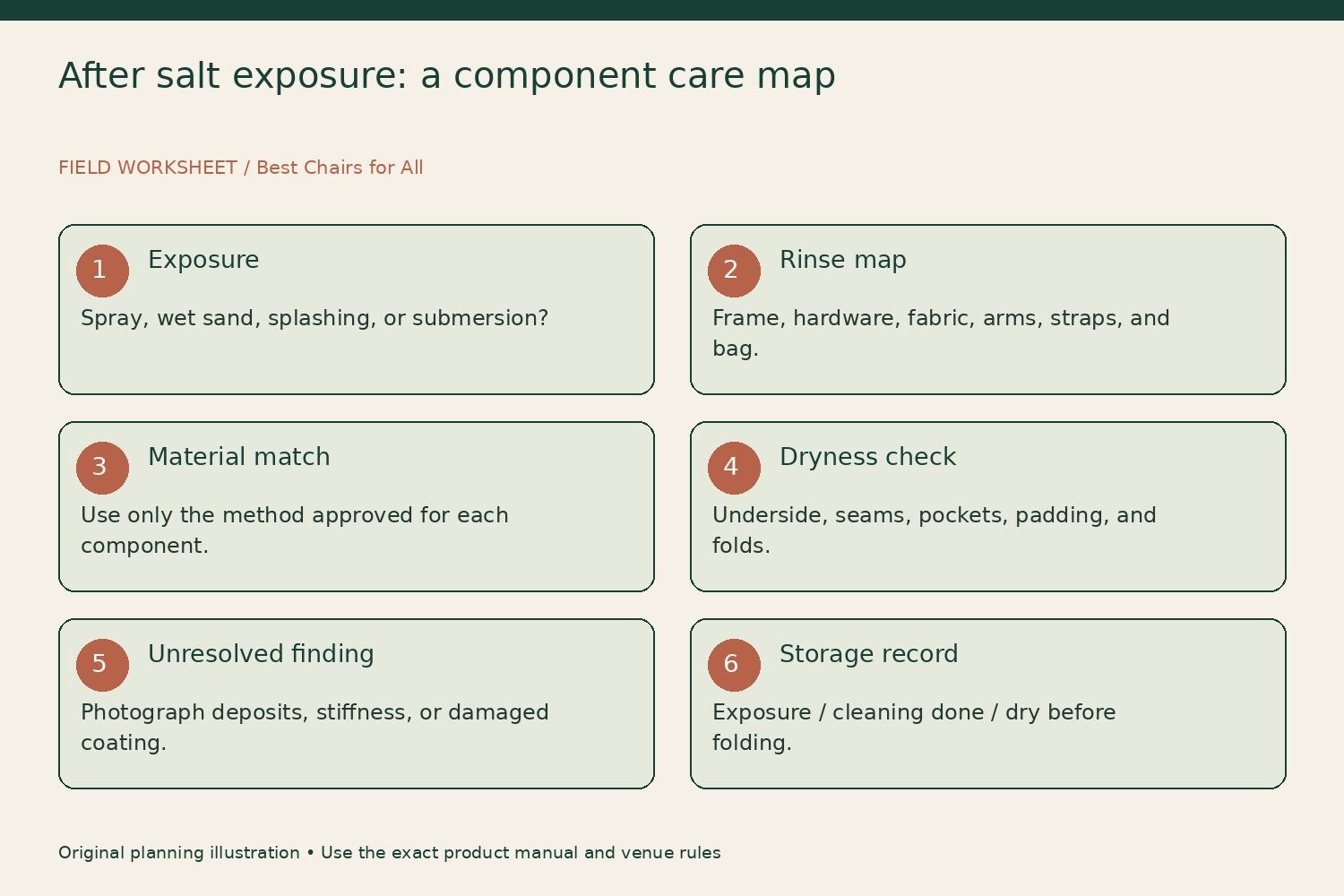
This guide provides a component-by-component rinse and drying plan using named manufacturer instructions. It does not offer a universal chemical treatment for every chair, nor a way to restore a structurally corroded frame. Red-brown staining, white deposits, damaged coatings, stiff hardware, and weakened fabric require different observations. Document what you see and ask the manufacturer when damage remains after routine permitted cleaning.
Identify everything that was exposed
Record the frame material, finish, fasteners, fabric, arm material, straps, padding, and any removable bag. A chair advertised with an aluminum frame may still contain steel fittings or other materials. Do not assume that a single material description covers every component. Photograph the product label and save its care guide so the next cleaning session does not depend on a remembered generic recipe.
Note the type of exposure: airborne spray, wet sand, brief splashing, or actual submersion. A chair intended for beach use is not necessarily intended to sit in moving seawater. Follow any restriction on water exposure in the manual. If the chair was used outside those limits, tell support exactly what happened instead of treating a freshwater rinse as proof that no damage occurred.
Separate sand removal from salt removal
Loose sand and dissolved salt present different cleaning tasks. Follow the maker’s method for removing loose grit without grinding it across the finish or forcing it into a hinge. Work in a location where rinse water can drain appropriately. Keep the chair unoccupied during cleaning and avoid operating a stiff joint simply to push trapped particles out through force.
The Helinox Beach Chair (re) care FAQ gives a specific example: remove loose sand by brushing or rinsing, rinse the frame with fresh water, spot-clean the seat with warm water, and dry everything before packing. These steps apply to that product’s materials and construction. They do not establish that another chair’s fabric should be immersed or treated with the same cleaner.
Use the approved freshwater rinse
GCI’s product-support guidance calls for fresh-water washing after beach use and drying before storage, alongside its mild soap-and-water cleaning advice. Use the current instructions relevant to your GCI product and any additional model restrictions. Do not substitute seawater for the final rinse or assume that a splash from a bottle has reached every exposed component.
If your own manufacturer permits hosing, use the method it specifies. Do not turn permission to rinse into permission to pressure-wash, submerge, or direct water into an enclosed mechanism. Remove only the parts the manual identifies as user-removable. A hidden tube opening or a factory bearing assembly is not an invitation to dismantle the chair so you can clean an area you cannot otherwise see.
Build a rinse map
Draw the chair from the rear and underside, then mark exposed legs, frame joints, hardware, arm brackets, seat edges, and strap anchors. Add the permitted treatment beside each: fresh-water rinse, damp cloth, spot-clean, or another documented method. Leave unknown materials unresolved until you obtain guidance. This map is more useful than spraying every surface with the same product and hoping the materials react similarly.
After rinsing, use the map to check what you actually reached. A folded chair can conceal contact surfaces, so follow the approved open cleaning arrangement rather than rinsing only the outside of the folded package. Check the carrying bag separately. Salty sand in a bag can recontact a cleaned chair during storage, and a dry-looking outer panel does not establish that the bottom of the bag is clean and dry.
Match soap and stain treatment to the component
A frame’s soap instruction does not necessarily apply to a coated textile, wooden arm, or padded pocket. Read the fabric label and manufacturer guidance before addressing sunscreen or food stains. Do not use bleach, solvent, rust remover, or abrasive polish simply because the stain is stubborn. A cleaner can remove discoloration while harming the coating or material that protects the component.
The Cape Cod Beach Chair warranty and care page discusses its wooden furniture and recommends rinsing metal components after saltwater submersion. That is a different material arrangement from a collapsible all-mesh chair. Use its instructions for the applicable product instead of copying a metal-frame cleaning routine onto wood, or applying wood refinishing products to synthetic fabric and mechanical fittings.
Verify drying before folding
After the approved cleaning method, allow the chair to dry in the orientation and conditions the maker specifies. Check the underside, seams, folds, strap padding, and pockets. Do not rely only on a warm armrest or a dry top panel. A chair can have several materials with different drying behavior, and a pocket with a lining can retain moisture after exposed mesh feels dry.
There is no reliable universal drying time. Humidity, airflow, shade, fabric thickness, and the amount of water all change the process. Use the actual condition of the components and the manufacturer’s storage requirements. If rain interrupts drying, move the chair to a suitable protected location and continue the process. A cover that keeps off new rain does not remove water already enclosed within the chair.
Inspect deposits without guessing their cause
Describe residue by color, location, and texture: orange stain around a fastener, white powder along a frame joint, or a dark mark beneath a strap. Photograph it before applying a new chemical. Color alone does not establish which material is corroding, whether a stain transferred from another object, or how deep any damage extends. A product’s finish may also change how deterioration appears.
If residue remains after approved cleaning, send the manufacturer an overall photograph and a close-up. Ask which component is affected and what treatment, replacement, or assessment is required. Do not sand through a protective finish to find bright metal or paint over a suspect connection before review. Surface appearance and structural condition are separate questions, particularly at joints and fittings that carry the user’s weight.
Treat stiffness as a separate finding
A hinge that remains gritty or a recline bracket that fails to engage after cleaning needs attention. Do not add oil as an automatic second step. The correct lubricant, if any, depends on the mechanism and surrounding materials. Ask the manufacturer whether lubrication is permitted, which product category is appropriate, and exactly where it should be applied. A general frame-care instruction does not answer those questions.
Avoid forcing the joint, enlarging a hole, bending a bracket, or replacing a fastener with an unverified alternative. Record which movement is affected and whether the issue began after saltwater exposure. Keep the chair out of use if its lock, frame, or support arrangement is uncertain. A cleaner hinge sound is not proof that a damaged connection or corroded structural component has regained its original condition.
Distinguish regular care from refinishing
A freshwater rinse and an approved wipe-down are routine care. Removing a coating, applying a new finish, or replacing structural hardware is a different task. Obtain the correct product-specific procedure and assess warranty implications before starting. Do not choose a treatment because it is suitable for boats, cars, or another beach chair; compatible materials and intended use still need confirmation.
If the maker approves touch-up of a small finish chip, document the location first and follow its preparation, application, and curing instructions. Keep paint and protective products off fabric, gripping surfaces, and moving parts unless explicitly directed. Do not describe cosmetic touch-up as a repair for deep corrosion, cracked tubing, or distorted hardware. Those findings need assessment and the specified remedy.
Set up a post-beach station
Create a practical place at home for the tasks your particular chair requires: an approved rinse location, a clean cloth, the permitted cleaner, and a drying area. Keep the care map and product identity nearby digitally. The station need not be elaborate; it should simply make it easy to complete rinsing and drying before the chair is forgotten in the trunk or folded into a crowded shed.
For multiple chairs, label the care map by model rather than making one household recipe. A wooden chair, a padded backpack chair, and a mesh collapsible chair can have different instructions. Clean the carrying bags and removable accessories using their own guidance. Storing each clean, dry chair in a dirty or damp sleeve undermines the purpose of preparing it for the next trip.
Keep storage conditions in the plan
Choose the storage location according to the maker’s instructions and actual moisture conditions. GCI notes that some of its furniture contains steel and recommends indoor storage after use. Apply the relevant advice to your product instead of assuming a garage, deck box, or covered porch is automatically dry. Inspect the storage surface and bag after heavy rain or a damp season.
Avoid storing the chair beside wet towels, sandy beach toys, or leaking containers. Keep it from rubbing against sharp or rusty objects. A chair can be clean when put away and acquire transferred stains or moisture during storage. Before the next trip, inspect the folded contact points and open the chair as instructed, checking that the frame and locking arrangement remain in their documented condition.
Use a three-stage care record
Write three dates or checkboxes for each outing: exposure noted, approved cleaning completed, and dryness confirmed before storage. Add a short exception note if a stain, stiff mechanism, or damaged finish remains. That record distinguishes an unfinished drying task from a chair ready to pack and makes recurring trouble easier to recognize without inventing a rigid maintenance calendar.
The goal is not a promise that beach-chair rust can always be prevented. It is a repeatable, material-specific process that removes exposure residue, avoids trapping moisture, and catches unresolved damage. When the chair’s own instructions are clear, follow them. When the material or mechanism is uncertain, identify it before selecting a stronger treatment. A properly documented rinse-and-dry plan is more useful than a universal spray-on solution.
Something unclear or out of date? Send a correction with this article’s title and the detail to check.
Sources, research & corrections policy ↗