Maintain teak chairs by identifying their existing finish, cleaning according to the maker’s instructions and choosing deliberately whether to accept natural weathering or follow an approved color-maintenance system. Do not begin with a bottle of teak oil. Some manufacturers prohibit added finishing products on their natural teak, while others offer specific optional sealers or protectors for appearance and stain management.
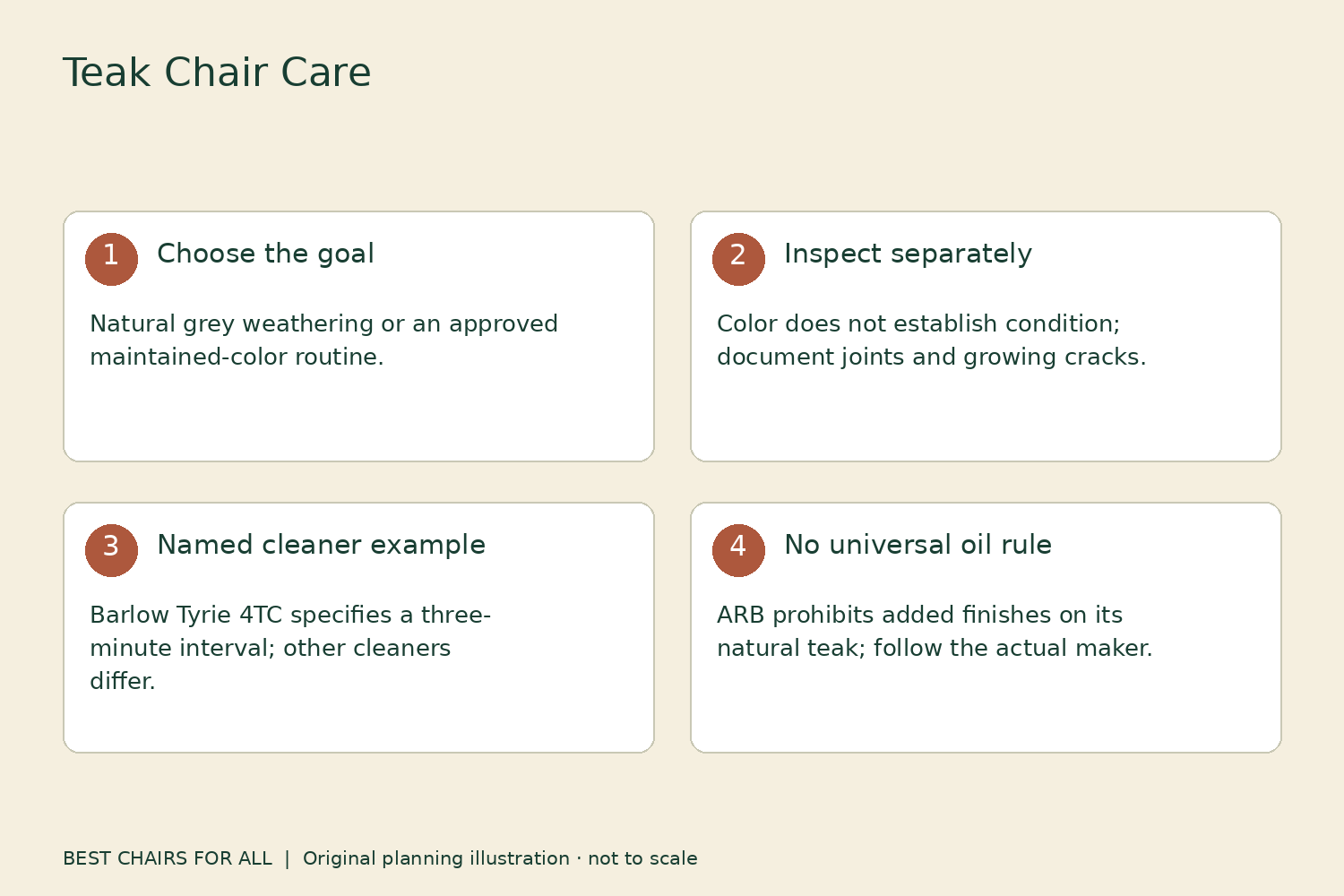
Care should also include the chair’s joints, hardware and support condition. A silver-grey surface can be normal weathering, but color alone does not establish whether a chair is sound. The condition-and-appearance record below separates those questions so cleaning does not become an attempt to conceal damage or erase every natural change in the wood.
Identify the finish history
Find the chair model, original care guide and any record of previous treatment. Determine whether the surface is natural, buffed, oiled, sealed, painted or coated with an unknown product. A chair bought secondhand can have a treatment history that differs from the manufacturer’s original specification. Tell support about that history before selecting a cleaner or new finish.
Do not assume a darker patch proves the chair needs oil, or that every warm brown surface is bare teak. Look for evidence of a coating without scraping aggressively. If identification remains uncertain, ask the maker or a suitable furniture-care professional. Starting with sanding or stripping can remove useful evidence and commit you to a larger restoration project.
Record mixed materials as well. Teak arms on an aluminum frame, a teak folding chair with metal hinges and an upholstered teak lounge chair need separate component care. Remove cushions only as their design allows and protect nearby materials from cleaners. A wood-care product’s label does not automatically cover fabric, metal finishes or patio stone.
Decide the appearance goal before treatment
Gloster’s teak guidance describes natural and buffed teak gradually weathering silver-grey outdoors. It recommends natural weathering with its cleaning routine and offers a sealer for customers who want to retain a brown appearance. That distinction helps you choose a coherent plan instead of reacting to each new color change.
Accepting weathering still involves cleaning spills and removing dirt. It does not mean leaving food residue, algae-like staining or wet leaves on the surface. Likewise, preserving a brown appearance creates an ongoing product-specific routine. Ask what preparation and reapplication the chosen system needs, and whether it is compatible with any existing treatment.
Avoid mixing appearance goals across one chair without understanding the result. An arm that receives a new color treatment while the seat remains weathered can look different. If that contrast is intentional, confirm the product’s application limits. If you want a consistent result, plan the full approved process and adequate drying space before beginning.
Inspect the chair while it is dry
Look at the seat slats, back, arms, joints and lower legs in good light. Photograph any crack, loose connection, soft area, splinter or change in alignment. Do not test questionable joints by bouncing in the chair. Keep it out of use if it is unstable or structurally damaged while you obtain the maker’s assessment.
Distinguish a surface observation from a diagnosis. A small visible check may be part of wood movement; a growing crack near a joint raises a different question. A photograph with a date and a fixed reference point can help support evaluate change. It does not prove internal condition, but it is more useful than a memory that the mark has “always been there.”
ARB Teak’s care guidance specifically separates ordinary color change from concerns such as a growing crack, loose joint or instability. Follow that principle with the actual manufacturer’s advice. Do not apply filler or finish over a concerning joint before documenting it, because a cosmetic repair does not establish restored strength.
Set up a controlled cleaning area
Choose a suitable location with enough space to reach the underside and rinse as directed. Protect the ground and adjacent materials according to the cleaner label. Keep cushions elsewhere. Arrange the chair so it remains stable and does not rest on a delicate arm or back slat while you work.
Use clean tools reserved for the wood-care task. A brush carrying grit from paving or metal filings from another job can damage the surface. Select the tool type the maker permits. Do not assume the most abrasive pad provides the best cleaning merely because it produces an immediate color change.
Plan the drying interval and weather protection before wetting the chair. A short clear period may be enough for a gentle wash but insufficient for a subsequent treatment. Read the current product label for conditions, protective equipment, application and disposal. Do not combine steps from different brands into a new cleaner or finish recipe.
Start with the maker’s routine clean
ARB Teak describes fresh water, a little mild dish soap and a soft-bristle brush, working gently with the grain, followed by rinsing and drying the top and underside. That is a named natural-teak example. Use it for the relevant ARB product; a chair with an unknown coating may need a different method.
Work through accessible surfaces systematically: upper back, arms, seat, lower frame and underside. Remove contamination without repeatedly grinding a dirty brush into the same patch. Refresh the cleaning tools or water when needed. The underside deserves attention because dirt and retained moisture can be hidden when the visible seat looks clean.
Do not use a pressure washer as a general teak-cleaning shortcut. Gloster explicitly warns against it because it can erode the surface. An aggressive jet can make wood appear newly pale while leaving it rough. Permission to pressure wash a polymer chair or patio surface does not transfer to the teak chair beside it.
Use stronger cleaners only within their system
For a documented product-specific example, Barlow Tyrie’s Teak Cleaner 4TC sheet instructs users to moisten the furniture, apply the shaken cleaner with a soft cloth or sponge, allow three minutes, brush with its pad in the grain direction and rinse. Follow the current product label and protect eyes, hands and the working area as directed.
That three-minute interval belongs to the named cleaner, not every teak-care product. Do not extend it indefinitely because a stain remains or combine it with bleach or another cleaner. Ask the chair or cleaner manufacturer about the actual stain and previous finish. The correct next step may be a different approved process or professional care rather than more force.
Keep the cleaning objective clear. Removing contamination, brightening a weathered surface and changing the chair’s color are related but different tasks. A brightener can alter appearance beyond a routine wash. If you like the grey patina, ask how the proposed product affects it before applying it across the whole chair.
Sand only when the instructions support it
Some teak makers permit light sanding for raised grain, with a specified abrasive and direction. That is not blanket permission to power-sand a weathered chair until every mark disappears. Sanding removes material and can affect edges, joinery and surface shape. It is also a poor way to investigate a structural crack.
If the manufacturer allows a light smoothing step, follow the exact guidance and keep the work limited to its purpose. Protect yourself and the surrounding area under the abrasive and product instructions. Remove dust before any approved finishing treatment. Do not sand metal fittings or force abrasive paper into a joint to make its gap look more even.
For a heavily worn, coated or historically valuable chair, obtain an assessment before extensive restoration. A surface that feels rough can have several causes, and an old coating can change the procedure. A professional may recommend cleaning, repair or replacement of a component rather than uniform sanding of the whole chair.
Apply no finish by default
ARB Teak says not to apply teak oil, varnish, paint, stain, wax, sealants or other finishing products to its natural teak. Gloster offers specific appearance products for its teak. These documented differences mean “all teak needs oil” and “all teak should be sealed” are both unreliable universal rules.
If your maker permits a treatment, identify its role. A color sealer and a stain protector may have different preparation and maintenance requirements. Use the approved product on clean dry wood under the label’s conditions. Test appearance where instructed and keep the treatment record, including date and product version.
Do not apply a new finish over dirt or an incompatible earlier treatment. If you cannot establish compatibility, pause and ask. Repeated layers can make later maintenance harder and obscure the wood’s appearance. A product marketed as natural is still a chemical treatment with instructions and limitations, not an automatic safe choice for every chair.
Keep a condition-and-appearance record
| Record field | What to write |
|---|---|
| Chair identity | Model and known finish history |
| Appearance goal | Natural weathering or maker-approved color system |
| Condition findings | Dated photographs of joints, cracks and support |
| Cleaning method | Approved cleaner, tool and procedure |
| Treatment if permitted | Exact product and application date |
| Next action | Routine observation, specified reapplication or support assessment |
Use the record to avoid treating every seasonal change as a new problem. A chair’s sun-facing arm can weather differently from its underside. That variation does not by itself justify sanding or oiling. Check condition first, then decide whether appearance work remains consistent with your chosen plan.
Protect the result through ordinary use
Wipe spills promptly using the permitted method and avoid leaving damp cushions against the wood for long periods. Keep the chair on a suitable surface and inspect feet and hardware under the model instructions. A clean wooden surface does not compensate for a missing glide or a loose folding connection.
For seasonal storage, follow the maker’s temperature, dryness, cover and orientation advice. Keep ventilation available and avoid wrapping wet furniture tightly in plastic. Before the next use, check the chair again rather than assuming last season’s cleaning established permanent condition. Teak care works best as a modest documented routine with a deliberate finish choice, not a series of increasingly aggressive attempts to keep every surface looking new.
Something unclear or out of date? Send a correction with this article’s title and the detail to check.
Sources, research & corrections policy ↗