Ice fishing chair seat insulation depends on what is actually between you and the cold surroundings, not on an ‘ice chair’ label or fabric weight alone. Compare the seat’s construction, padding, coverage, moisture handling, and any documented thermal information. A durable textile can still be a thin sitting surface, while a padded backrest says little about the insulation beneath your seat. Read the parts separately before deciding whether an approved accessory is needed.
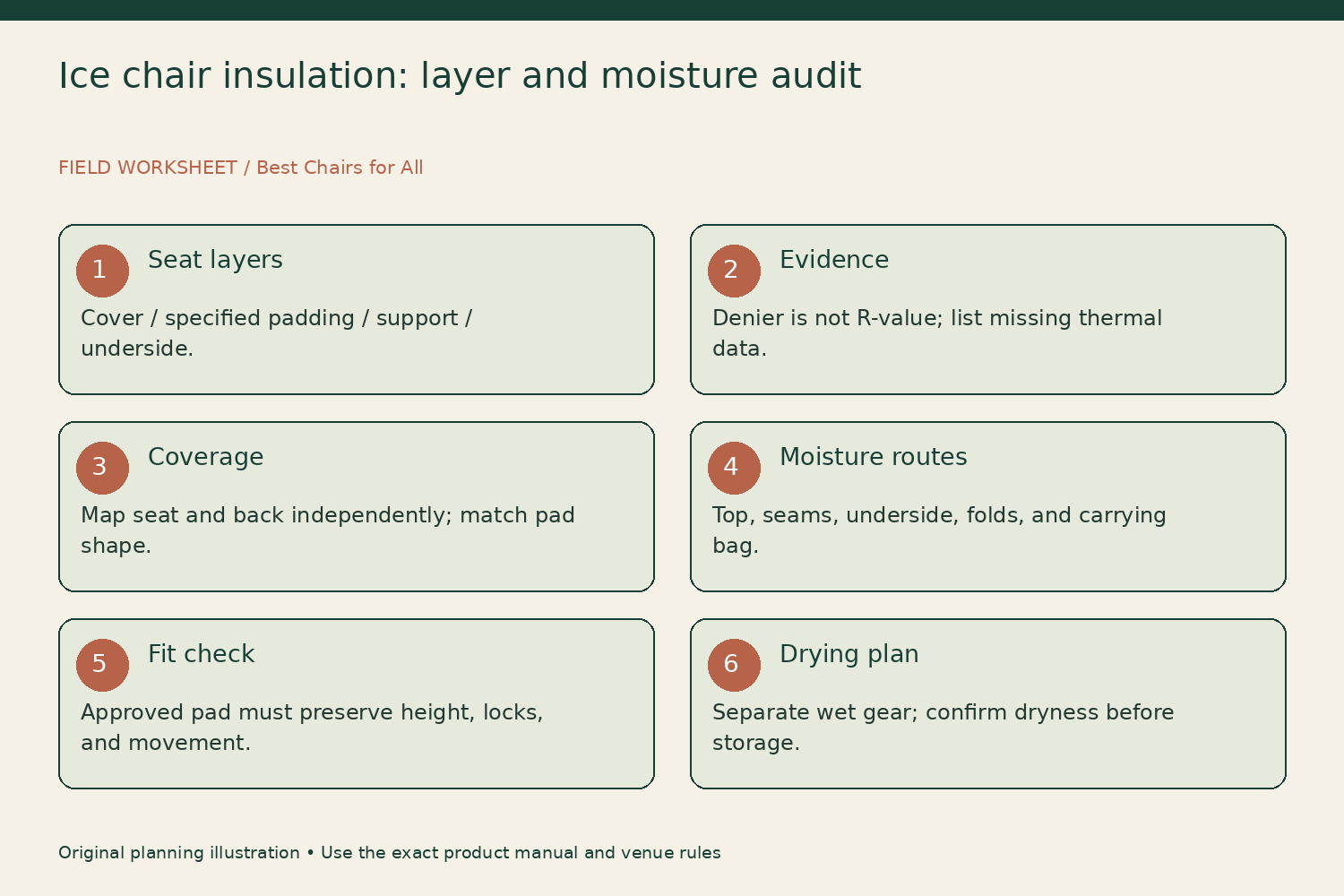
This guide offers a layer audit and moisture-route worksheet. It does not assign a temperature rating to an unrated chair, promise protection from cold exposure, or recommend a heater placement. Seating is only one part of a winter outing. Use appropriate clothing and local safety guidance, and assess ice conditions independently of the chair. A warm-feeling seat cannot establish that the ice beneath it is suitable.
Identify the seat layers
Write the construction from top to bottom: cover fabric, padding if specified, supporting sling or panel, and the air space or structure underneath. Include a separate backrest list. Do not count a storage pouch or cooler beneath the chair as seat insulation unless the manufacturer explicitly describes that function. A nearby insulated compartment can be designed for its contents rather than to insulate the occupant.
Use the product’s actual material terms. Foam, fiber fill, fleece, and mesh describe different components, and ‘padded’ may not identify the thickness or material at all. Mark those details as unknown and ask the maker. The absence of a detailed layer description is a research limitation, not permission to assume a familiar material from a similar-looking product photograph.
Separate fabric durability from thermal performance
Denier describes yarn linear density; a 600-denier fabric statement does not provide an R-value or a temperature limit. The Eskimo Plaid Folding Ice Chair page identifies 600-denier fabric and nineteen-millimeter steel poles. Those are material and frame details. They do not establish a measured insulation value for the seating surface, so do not turn them into a claim about how long the chair keeps someone warm.
Likewise, ‘weatherproof’ and ‘water-resistant’ need interpretation within the product’s instructions. They are not automatically thermal ratings. The Clam Folding Cooler Chair page describes a polyester seat and a cooler or storage compartment underneath. The presence of that compartment does not quantify insulation under the user. Compare the seat construction itself rather than transferring the cooler’s implied purpose to the chair surface.
Understand padding under an occupant
A thick-looking unoccupied cushion can compress when someone sits on it. Its appearance in a product photograph therefore does not reveal the remaining layer beneath the body. Ask whether the manufacturer provides material, thickness, density, or thermal data relevant to the seat. Avoid comparing two products by an unloaded edge measurement alone when the interior construction is unknown.
During a permitted trial, note the ordinary seating feel and where you contact a frame or firm edge. These observations can reveal a fit issue but do not measure insulation. A cushion that feels soft indoors is not thereby validated for a particular outdoor temperature. Keep comfort observations, dimensional measurements, and manufacturer thermal information in separate worksheet columns so none becomes a substitute for the others.
Look for documented closed-cell foam
Closed-cell foam is one construction used in portable sitting pads, but the specific product’s dimensions, properties, and instructions still matter. The Therm-a-Rest Z Seat page from Cascade Designs identifies closed-cell foam and a folding format. That is evidence about that pad, not proof that an unlisted chair contains the same material or that the pad is approved for every chair.
If considering an added pad, ask both about its own intended use and its compatibility with your chair. Check whether it shifts, obstructs folding, changes effective seat height, or interferes with a belt or other required component. Do not insert rigid boards or stack loose layers into a high seat. An accessory should preserve the seating arrangement the chair maker actually supports.
Do not borrow a sleeping-pad rating
An R-value from a named sleeping pad belongs to the tested product and stated conditions. It should not be transferred to an ice chair because both contain foam or use similar marketing language. Nor can you calculate a chair’s thermal rating from its cover denier, total weight, or the number of padded panels. Without documented comparable data, describe the construction and uncertainty honestly.
When a seller gives a temperature claim, ask what it means and how it was established. Is it a material service limit, a comfort claim, or a measured insulation result? Those are different statements. Record the source and any test conditions. Do not turn an unexplained ‘winter ready’ description into a guarantee that a person can remain outside comfortably or safely for a particular number of hours.
Map moisture entry points
Draw the seat and label the top surface, front edge, seams, underside, fold, and storage bag. Add the ways water can reach them: snow on clothing, spray from hole preparation, slush on gear, condensation, or wet items packed against the chair. This identifies practical tasks without assuming every fabric absorbs water in the same way. Use the model’s care instructions to decide how each component may be cleaned and dried.
The Minnesota DNR introduction to ice fishing notes that water and slush can wet equipment and clothing during an outing. Apply that environmental observation to your packing plan: keep a clean dry seating surface separate from wet auger and scoop equipment where the chair’s transport arrangement permits. Do not assume a sheltered seat remains dry simply because it is under a roof.
Keep transport moisture separate from use moisture
A chair can begin the session damp from storage even before any ice-side exposure. Check the bag, folds, and padding before packing. Do not enclose wet clothing with the chair overnight. Follow the maker’s drying instructions after each outing, including any removable pad or cover. If a component remains wet, finish drying it before long storage rather than relying on a closed bag to keep everything tidy.
During transport, protect the seat using the manufacturer’s intended case or arrangement. Do not tightly wrap a damp padded chair in an impermeable sheet and leave it that way. If temporary transport protection is needed, reopen and dry the equipment promptly in a suitable place. The worksheet should show where drying will happen at home, especially when a large padded chair does not fit in your usual gear area.
Compare coverage, not just thickness
Measure the usable sitting area and compare it with any approved pad. A small pad can leave contact areas at the sides or front edge uncovered, while an oversized one can fold, slide, or obstruct the frame. Record width, depth, shape, and the maker’s attachment method. A triangular ice chair and a rectangular camp chair may need very different accessory outlines.
Include the backrest separately if that is part of the intended cold-weather arrangement. A seat-only pad does not cover the back, and a padded back does not establish the seat’s construction. Use a simple top-and-side drawing to show the actual covered areas. Avoid describing the whole chair as insulated when the evidence identifies only one small panel or an accessory that must be bought separately.
Preserve fit and normal movement
Added padding can raise the occupied position and change your relationship to the backrest. Check ordinary tasks in a permitted setting: sitting, reaching the rod, standing, and leaving the chair. Do not use a loose pad that creates an unstable or slipping contact. Ask for an approved accessory when the chair’s shape or folding mechanism makes a generic layer uncertain.
Gloves, bulky clothing, and boots can also affect setup and movement. Practice the documented folding and locking sequence in suitable conditions before relying on it during an outing. A thermal preference should not lead you to cover a release, pinch point, or engagement indicator. Keep the chair’s operating parts visible and usable as its instructions require.
Distinguish seating from shelter heating
A padded chair does not establish where a heater may be placed. Follow the heater and shelter instructions, their required clearances, ventilation, and permitted use. Do not drape seating fabric over a heat source, place a pad against a hot component, or use an unapproved heated accessory to compensate for an unsuitable chair. Heat resistance and insulation are different properties.
If considering a powered heated seat, research that exact product separately, including its intended chair, battery arrangement, wet-use restrictions, and care instructions. Do not infer compatibility from a USB connector or a familiar battery. This article’s layer audit is useful for nonpowered construction; it does not approve combining electrical equipment with any chair used around snow and water.
Keep ice safety outside the comfort score
The Minnesota DNR ice-safety guidance explains that ice strength depends on multiple conditions and that ice is never completely safe. Consult current local guidance and assess the destination independently. A broad chair foot, insulated seat, or heavier frame is not evidence that the ice can support the outing. Do not let furniture comfort become part of an ice-safety calculation it cannot establish.
Keep the travel and emergency plan separate from the seat comparison. If conditions require leaving, a chair’s comfortable padding is irrelevant to that decision. Choose equipment you can transport and pack as instructed without obstructing the route or burying necessary safety items. The practical chair comparison should fit within a sound outing plan, not become a reason to remain in changing conditions.
Finish the layer-and-moisture worksheet
For each candidate, record seat layers, back layers, documented thermal data or its absence, occupied fit observations, approved accessories, moisture entry points, and drying requirements. Add packed size and weight only after including the accessories you actually need. This makes an apparently simple chair comparable with a padded system without assuming they provide equal insulation.
Choose from verified construction and the practical care routine you can maintain. When no thermal rating is supplied, say so and avoid numerical warmth claims. Ice fishing chair seat insulation is best assessed as a specific combination of materials, coverage, fit, and dryness. A clear layer audit gives you a useful basis for that decision while preserving the separate requirements for clothing, shelter operation, and ice safety.
Something unclear or out of date? Send a correction with this article’s title and the detail to check.
Sources, research & corrections policy ↗