A folding chair locking mechanism must be identified from the exact product instructions before you decide how to engage, release, or check it. A push button, folding brace, transport latch, reclining stop, and side-table lock can look similar while controlling different movements. Start by naming what each device holds in place. Then use the manufacturer’s pre-use check, with the chair unoccupied and fingers clear of the folding areas.
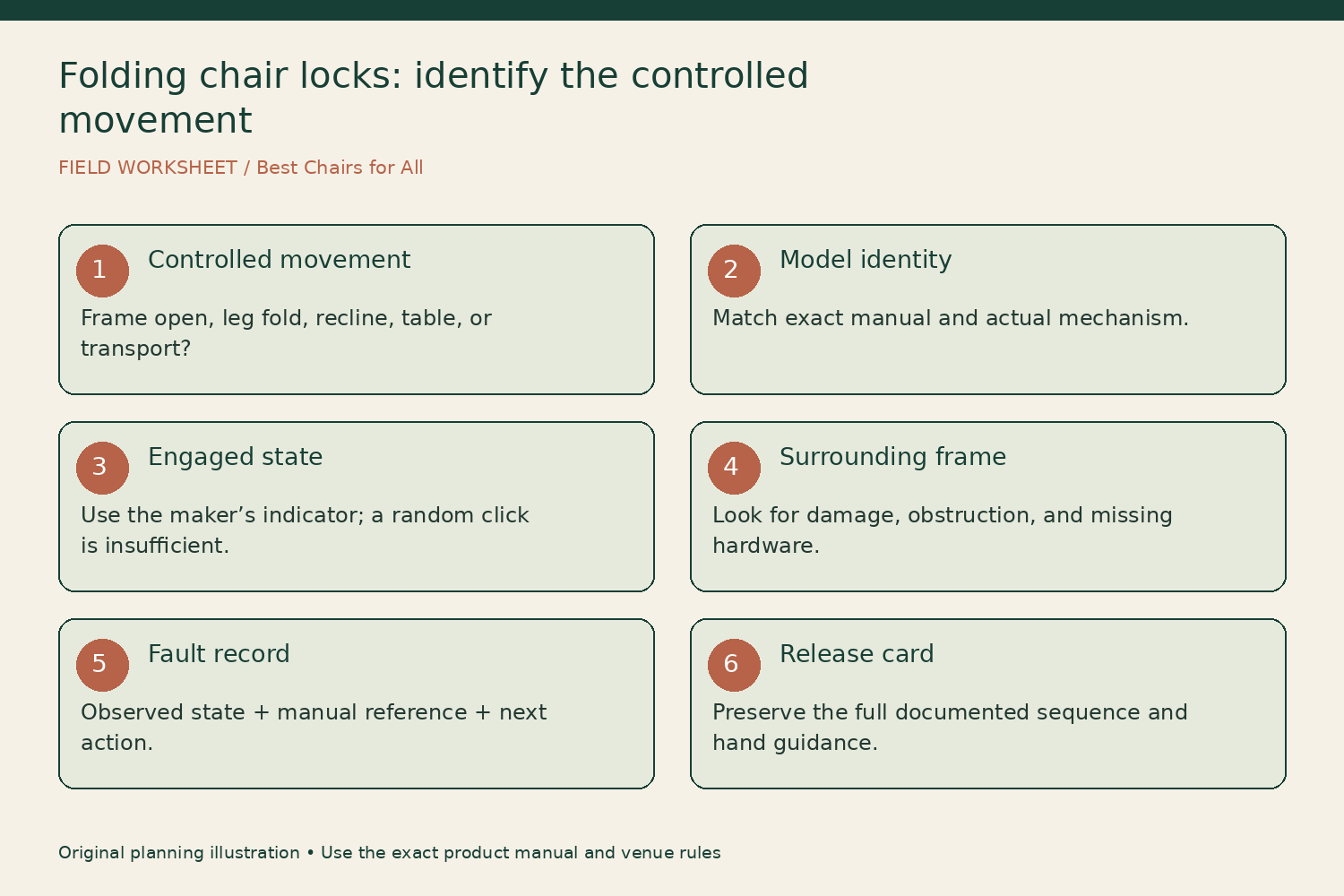
This guide provides a lock-identification map and a fault decision record. It does not offer a universal release sequence or a home proof-load test. If a required lock is missing, damaged, slipping, or unable to engage as shown, stop using the chair and obtain the specified remedy. Do not bypass it with a cable tie, wedge, extra screw, or a different latch because the frame appears to stay open without it.
Identify the chair and its intended configuration
Find the brand, model, label, and manual. Compare the open frame with the drawings, including any accessories supplied with it. A chair family may include several mechanisms across different versions, and an old instruction sheet may not match a newly purchased model. Record the exact identity before using a search result or video as an operating guide.
Place the chair on a suitable surface and follow the documented opening sequence. Do not put a hand in a joint to feel whether it is locking while someone else opens the frame. Keep bystanders, especially children, clear of the movement area. If you cannot open the chair as described without force, stop and identify the obstruction or ask the manufacturer rather than treating resistance as a normal part of engagement.
Name the movement controlled by each lock
Make a simple diagram showing frame opening, leg folding, backrest adjustment, accessory movement, and transport closure. Mark which device controls each movement. Some chairs have only a documented fully open geometry; others have a positive latch. Do not invent a missing button when the design uses another arrangement, and do not assume a frame is ready simply because no obvious latch is visible.
Write ‘unknown’ beside a device whose purpose you cannot establish. A small lever under the seat could be a release, adjustment, or unrelated fitting. The correct next step is identification, not experimentation with an occupied chair. A diagram that distinguishes every controlled movement is a useful reference for a household with several different folding-chair models.
Separate open locks from transport locks
An open-position lock holds the furniture in its use configuration. A transport lock holds the folded package closed. A chair may provide one, both, or another documented system. A carry strap or storage buckle is not automatically an open-position safety device. Do not assume that fastening the folded closure somewhere around the frame creates a substitute use lock.
The Kijaro Dual Lock Chair page explicitly describes locking in both open and closed positions. That is a named-product feature, not a definition of every folding chair. Obtain the current operating instructions for the exact Kijaro version before deciding how to release or confirm either state. A product description establishes the intended functions but may not show every operating detail.
Distinguish accessory locks
A side table can have its own supporting arm or lock independent of the chair frame. Engaging the table does not establish that the seating frame is ready, and folding the table does not necessarily release the chair. Keep these checks separate. Likewise, a recline stop controls back position rather than all the movements of the base and legs.
GCI’s product-support page provides a specific procedure for its folding side-table support lock. That example illustrates why component identification matters: the support-arm instructions are not a general chair-lock release. Match the furniture and accessory to the maker’s current guide, and ask for a diagram when you cannot tell which part a support article describes.
Locate the documented engagement indicator
Look for the way the manual says to confirm the lock: a visible position, a fully seated part, a protruding button, a specified click, or another check. Use that indicator exactly as described. Do not assume that any click means every lock is engaged. A sound can come from another moving part, and some designs may not use a click as their confirmation at all.
If there are two sides, check whether each requires separate engagement. Record left and right on your diagram when relevant. Do not average a good-looking side with an uncertain side into an overall pass. If a required part does not reach its shown state, the chair is not ready for use. Keep the problem visible and resolve it rather than relying on the remaining structure.
Inspect the surrounding structure
Look beyond the latch itself for bent braces, cracked plastic, loose connections, missing hardware, damaged rivets, or fabric trapped in the mechanism. A lock can appear engaged while the part it attaches to is compromised. Photograph the full frame and the detail so the manufacturer can locate the issue. Keep fingers away from closing gaps while inspecting.
Do not scrape, file, or bend a component to make it fit the engagement position. A hole that no longer lines up can indicate a wrong setup, obstruction, or damaged part. Correct assembly through the manual where appropriate, but do not force a distorted frame back into alignment. The cause matters, and a latch made to close by deformation is no longer evidence of the original designed arrangement.
Use a symptom-and-action record
Create columns for controlled movement, observed state, instruction reference, and next action. An example might read: ‘rear leg fold; button does not protrude as shown; manual page three; stop use and contact support.’ Another might read: ‘transport closure; strap trapped in frame; opening diagram; remove only the loose obstruction as instructed and repeat the documented sequence.’ These examples are record formats, not instructions for an unidentified chair.
Keep observations separate from diagnoses. ‘Will not engage’ is more accurate than ‘spring broken’ unless the fault has been confirmed. Send the model identity and photographs with the record. A useful service question asks which part or procedure applies rather than proposing a homemade replacement and asking whether it seems strong enough.
Handle stiffness without automatic lubrication
A stiff release may involve dirt, misalignment, damage, or a procedure that is being attempted in the wrong configuration. Read the instructions before applying a product. A latch or gripping surface may have different care requirements from a freely moving hinge. Do not assume oil helps every moving part or that a dry lubricant cannot affect the mechanism’s intended engagement.
Ask the manufacturer whether lubrication is permitted, the exact type, application point, and any surfaces to protect. Clean only through the approved method first where directed. Do not flood an enclosed device, pull out a factory pin, or use a screwdriver as extra leverage on a hand-operated release. If normal documented operation remains impossible, obtain assessment rather than escalating force.
Avoid load tests as a confirmation method
Do not confirm an uncertain lock by bouncing, rocking, leaning far back, or adding a heavy load. These actions can produce a failure without explaining its cause. A product’s stated capacity does not instruct an owner to proof-test it at that weight. Use only the manufacturer’s specified pre-use check and keep a suspect chair unoccupied until the issue is resolved.
Likewise, do not ask a lighter person to try the chair first. An unresolved structural or locking issue is not made acceptable by changing the test occupant. If the chair folds unexpectedly, document the event and contact the maker without recreating it. The goal is a verified assembly and correct parts, not evidence that an uncertain connection survived one attempt.
Treat child seating as a separate product category
A small folding chair is not simply an adult chair with a lower capacity. The CPSC guidance on children’s folding chairs and stools describes category-specific safety requirements, including folding, latching, locking, and pinch-related provisions. Consult the current official information for that category. Do not infer compliance or suitability from the presence of a visible latch alone.
Choose seating intended for the actual user and follow its supervision and age-related instructions. Keep children away while an adult folding chair is opened or closed. A transport lock does not make the folding mechanism a toy or remove pinch points. If researching a child’s product, use its exact model, labels, and manufacturer documentation rather than a generic folding-chair checklist.
Check current recalls by identity
Use the CPSC recall database to search the chair brand, retailer, model, and seating type, especially for a used product or a chair returning from storage. Match the identifying details in the notice. A similar-looking chair may be a different model, while a changed cushion may conceal the same recalled frame. Save the label photographs to support the comparison.
Follow the current official remedy if the chair matches. Do not add a stronger latch or modify the lock as a personal alternative. An unsuccessful search does not certify the chair or replace the physical checks. Product identity, correct assembly, condition, and recall status are separate pieces of evidence that need to be considered together before use.
Keep release instructions available to other users
Write a short operating card identifying the open-state check, the documented release, transport closure, and relevant manual page. Keep the original instructions accessible. Do not create an unofficial shortcut that omits unloading, accessory folding, or a hand-placement warning. A helper should be able to follow the manufacturer’s sequence without guessing which of several levers to pull.
After an approved replacement or manufacturer revision, update the card and retain the service record. Keep old parts labeled and out of circulation until the maker tells you what to do with them. Mixing a spare latch from one chair with another because it fits a hole is not a documented repair. The mechanism needs the specified component and installation arrangement.
Finish with an identified state
A useful inspection result says which movement is locked, how engagement was confirmed, and whether every required component matches the manual. It also records any unresolved finding and the action taken. Avoid a broad ‘chair checked’ note that hides whether you examined the open lock, backrest, side table, or folded closure.
Folding chair locks are easier to understand when each is tied to a specific movement and a documented state. Identify the design, follow its sequence, inspect the surrounding parts, and stop when a necessary engagement is uncertain. That method provides a repeatable check without inventing a universal latch procedure or treating an improvised restraint as a substitute for the chair’s intended mechanism.
Something unclear or out of date? Send a correction with this article’s title and the detail to check.
Sources, research & corrections policy ↗