Store an office chair clean, fully dry, supported on its intended base, and protected from dust without loading its upholstery or adjustment controls. Choose a stable indoor environment consistent with the manufacturer’s requirements. A corner that is acceptable for a few days during decorating may be unsuitable for months of storage if it is damp, exposed to sunlight, or used to stack boxes.
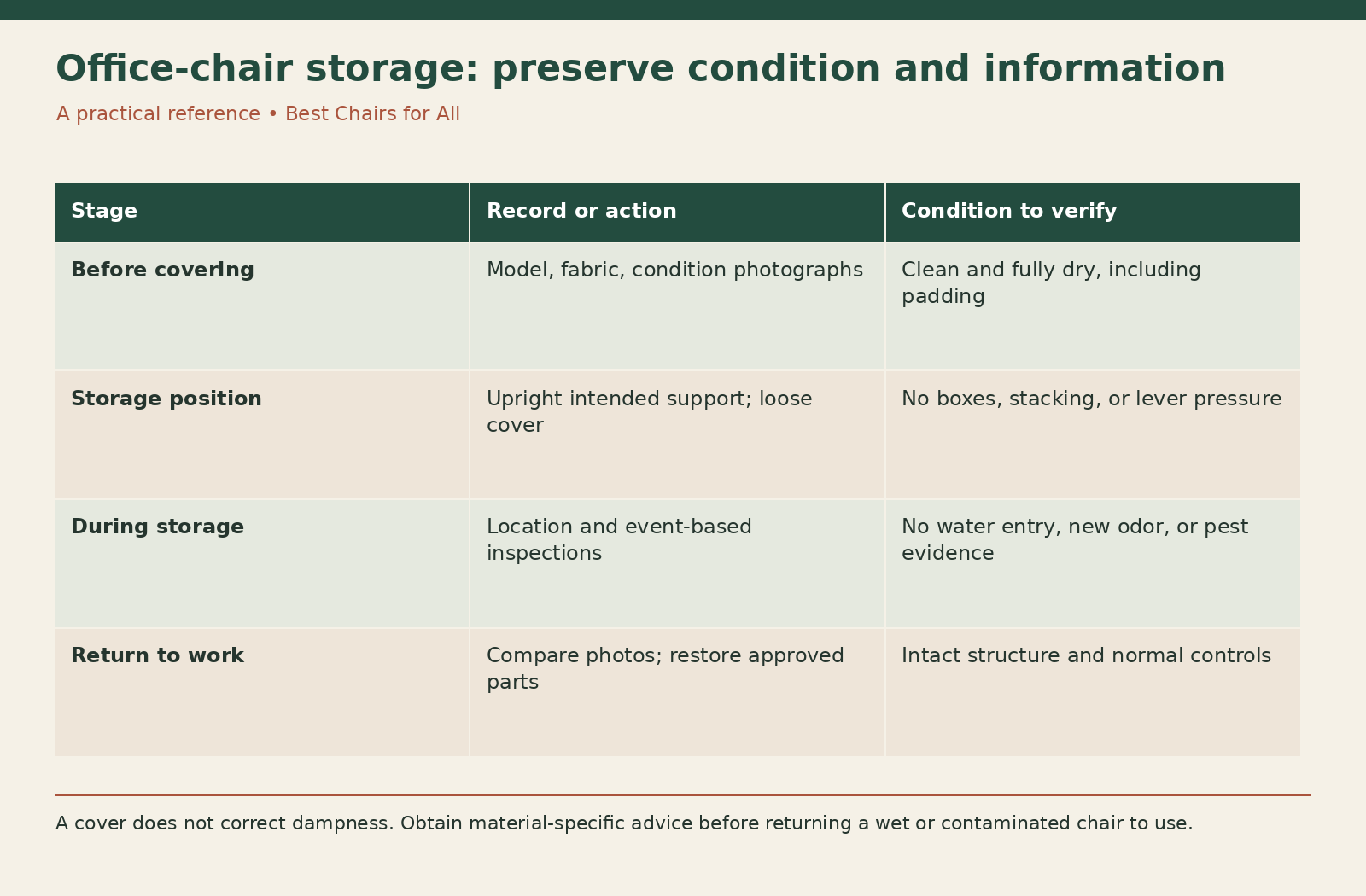
A useful storage plan has three stages: a condition record before packing, a documented storage position and environment, and an inspection before the chair returns to work. The checklist below focuses on upholstery, support surfaces, and controls rather than promising that a cover or a climate-control label prevents every kind of damage.
Decide whether storage is the right next step
Record why the chair is being stored and when you expect to use it again. A temporary spare for a known desk has a clearer purpose than a damaged chair with no repair plan. Identify missing parts, loose attachments, or a failed adjustment before the chair disappears behind other furniture.
If a structural fault is unresolved, mark it clearly in the inventory and prevent the chair from being used as a spare. A dust cover can make a damaged chair look available. Keep any recall or repair instruction with the record and follow its requirements rather than postponing the decision indefinitely.
For paid storage, compare the actual space and handling cost with the chair’s likely future usefulness. This is a practical planning comparison, not a requirement to discard an older chair. A supported repair or a suitable reuse destination may be better than storing a chair you no longer intend to use.
Identify every upholstery surface
List the seat, back, arm pads, headrest, and any loose cushion. Record material or fabric codes and find the applicable care instructions. A mesh back with a foam seat needs different preparation from an all-suspension chair or leather-upholstered executive chair.
Use the manufacturer’s guide for each surface. For example, Herman Miller’s Aeron care guide distinguishes suspension material from frame and arm-pad surfaces and restricts the brushing method. That matters during pre-storage cleaning; storage is not a reason to perform a more aggressive deep clean than the material permits.
If the chair has replacement upholstery, identify that covering separately. The original order code may no longer describe it. Ask the refurbisher or supplier rather than guessing from a visually similar sample. Keep any uncertainty in the storage record so a future cleaner does not treat an unverified fabric as a documented one.
Remove soil and allow complete drying
Remove loose dust, crumbs, and hair with the appropriate tools. Treat known spills only through the approved material method. Keep cleaning products away from controls and hidden filling unless the instructions specifically support the process. Do not soak the chair immediately before wrapping it for storage.
Inspect seams, the underside, and padded areas after cleaning. A surface can look dry while moisture remains in filling or folds. Leave adequate time under suitable conditions and do not use a universal overnight rule. The quantity of moisture and the assembly construction affect the result.
Avoid fragranced sprays as substitutes for cleaning or drying. A pleasant smell does not establish that the cushion is ready to cover. If a chair has a persistent unexplained odor, investigate before storage instead of sealing the condition into a bag for a later user to discover.
Choose a storage environment that you can assess
Look for a clean indoor space without leaks, condensation, strong direct sun, or nearby heat sources. Ask a storage provider what its environmental service actually includes. A climate-controlled description is not a complete specification for temperature stability, humidity, monitoring, or the conditions inside your individual space.
For textile context, the Canadian Conservation Institute’s textile-care guidance identifies dust, light, and environmental conditions as deterioration concerns and discusses suitable protective materials. It is conservation guidance rather than an office-chair warranty specification, but it explains why a clean dust cover and a stable location matter.
Do not assign one universal storage temperature or humidity range to every chair. Materials and manufacturer requirements differ, especially when foam, coatings, wood trim, and electronics are present together. Ask the maker for limits when storage will be prolonged or conditions depart from normal indoor use.
Select a cover for dust rather than compression
Use a clean suitable furniture cover or a soft dust cover that will not transfer color, shed grit, or catch on the upholstery. Keep it loose enough to avoid pressing a seam, pad, or mesh panel into a distorted position. Secure it only in a way supported by the covering and chair materials.
Avoid placing adhesive tape directly on finished surfaces. A cover should not depend on pulling wrap tightly across an arm pad or lever. If a carrier or manufacturer specifies protective plastic for a particular packing task, follow that application; do not generalize it into sealing a damp chair for long-term storage.
The textile guidance discusses clean protective materials such as cotton muslin in its conservation context. For a modern chair, choose a practical compatible dust barrier and verify that the chair is dry first. No cover can compensate for ongoing water entry or an unsuitable storage room.
Keep the chair on its intended support
For an ordinary task chair, plan storage upright on a suitable level surface unless its maker specifies a different supported packing arrangement. Do not rest the full chair weight on the backrest, arm pads, controls, or suspended mesh to save floor space.
Do not stack office chairs unless the specific model is designed and instructed for stacking. A task chair with five casters is not automatically stackable because one seat can be balanced on another. Stacking can concentrate loads on upholstery and make retrieval unpredictable.
Keep boxes and other stored items off the seat, even when the chair appears to offer convenient shelf space. Long-term compression and accidental loading of arms or controls are avoidable. Reserve enough access around the chair to inspect it and remove the cover without pulling it through a pile of other items.
Do not disassemble just to reduce the footprint
Check manufacturer guidance before removing a headrest, arm, back, or base. Some components can be removed under an owner procedure, while others require service. Keep the cylinder and tensioned mechanism intact unless qualified service and the applicable instructions require otherwise.
If approved accessories are removed, label the parts and store hardware in a separate secured bag linked to the chair’s identifier. Keep sharp or metal pieces away from upholstery. Photograph the assembled condition before removal and retain the instruction revision used.
A labeled hardware bag on a separate shelf is better than loose bolts placed on the seat beneath a cover. Small components can mark surfaces or disappear into the assembly. Make the storage plan preserve the information needed for correct reassembly as well as the parts themselves.
Create an intake card with photographs
Use fields for chair model, label image, upholstery identifiers, existing condition, normal adjustment function, cleaning method, full-dry confirmation, storage location, and date. Add any parts removed under an approved procedure and their bag or box location. Keep a copy outside the storage space so a missing label or misplaced hardware bag does not erase the only available identification record.
For a worked example, an intact mesh-back chair with a fabric seat might have separate photos of the fabric condition, caster set, arm pads, and label. The card could state “seat cleaned under verified W guidance and fully dried; upright storage; loose clean dust cover; no objects on seat.” This is a hypothetical record, not a prescription for an unidentified textile.
Include a retrieval reminder that names the checks to repeat. A simple photograph of the covered chair is less useful than knowing which function was working at intake and which mark was already present. This prevents old wear from being confused with new storage damage.
Check the space during storage
Choose an inspection interval appropriate to the location, storage period, and manufacturer or provider advice. Recheck after a leak, building work, power loss affecting environmental control, or another event that could change conditions. Do not rely solely on a calendar if a known water problem occurs.
Look for water entry, condensation, new odor, pest evidence, a shifted cover, or objects placed on the chair. Keep the inspection external and avoid disturbing suspected contamination unnecessarily. If the chair is wet or mold is suspected, pause its return to use and obtain an appropriate assessment.
The EPA moisture and mold guide emphasizes controlling moisture and responding promptly to water damage. It is not a material-specific cleaning procedure for chair foam. Use it to guide the environmental response and obtain suitable advice about affected porous materials rather than assuming a surface wipe resolves hidden moisture.
Prepare a deliberate return-to-use check
Move the chair through a clear route and remove its cover carefully. Compare the uncovered condition with the intake photographs. Check accessible frame and upholstery surfaces, caster retention, base condition, arm attachment, and any evidence of contamination before anyone sits.
Reinstall approved removed parts under the exact instructions. Verify normal height, recline, seat-depth, and arm adjustments as applicable. Do not test a suspect chair with forceful rocking or improvised loading. If a control no longer behaves normally, seek service rather than trying to restore it with an unspecified lubricant.
Set the chair up for the current desk, user, and floor. A chair that was correctly adjusted before storage may be moving into a different room or workstation. The storage job is complete when the chair is clean, dry, intact, correctly assembled, and ready for that actual use, with any unresolved condition clearly documented.
Something unclear or out of date? Send a correction with this article’s title and the detail to check.
Sources, research & corrections policy ↗