Protect floors under a rocking chair by keeping the contact path clean and using protection compatible with both the floor and the rocker. A suitable rug and pad or manufacturer-approved runner strips can help, but neither is a universal fix. The protection must cover the full moving contact area, remain secure, and preserve the chair’s normal motion.
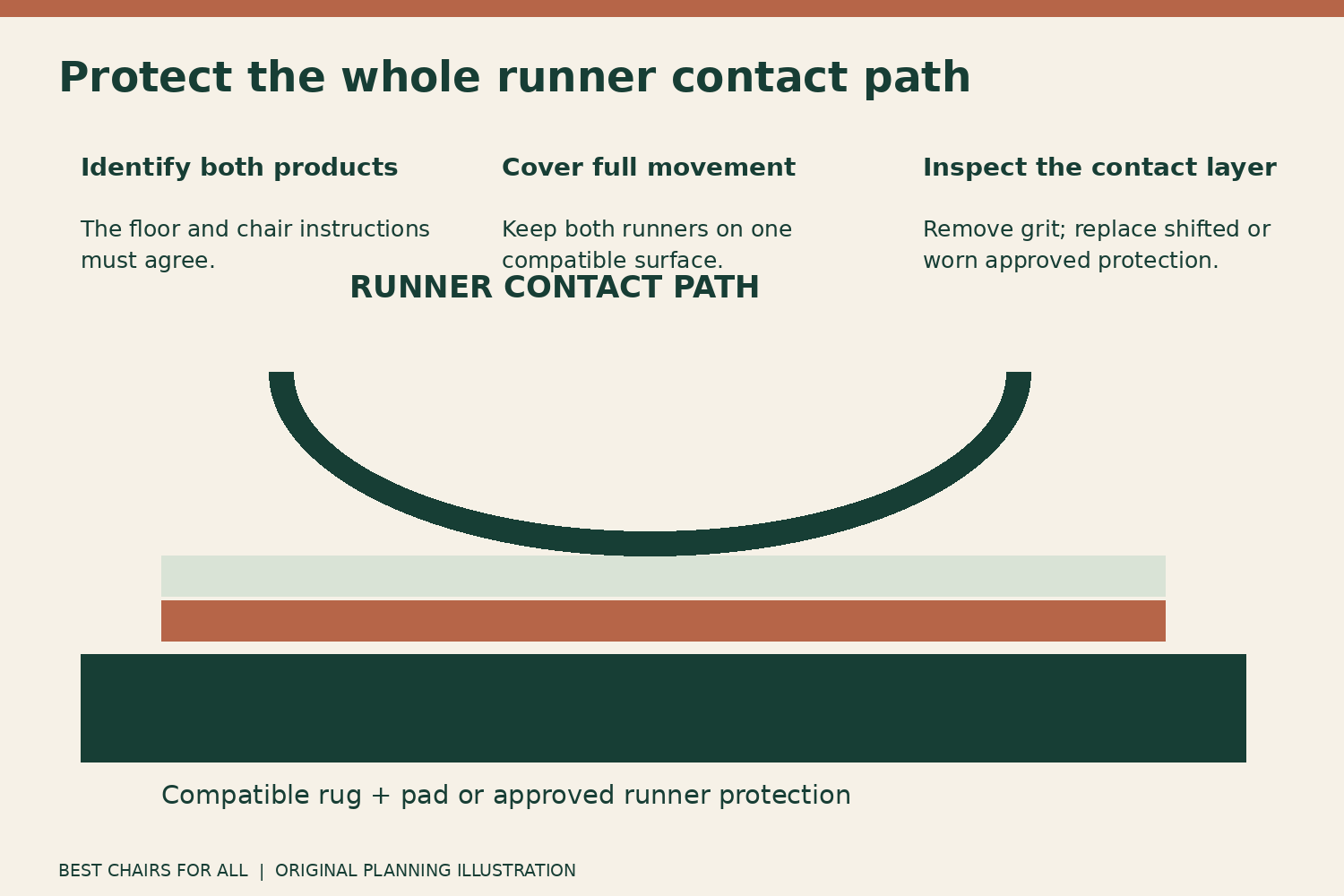
Start by identifying the floor product and the chair model. Wood finish, vinyl chemistry, rug backing, adhesive, and runner shape can all affect the result. Do not attach random furniture dots to curved runners or assume a rubber-backed mat is harmless on every floor. Protection that scratches less but changes the rocking action is not a successful solution.
Inspect before adding anything
Move the empty chair safely according to its handling instructions, with assistance where needed. Inspect the floor and accessible runner surfaces. Look for grit, rough edges, exposed fasteners, damaged existing strips, or adhesive that has collected dirt. Do not reach beneath the chair while someone is seated or while it can move.
Clean loose debris from the floor using the flooring manufacturer’s permitted method. Clean the runner contact surface according to the furniture’s care directions and let it dry as required. A new protective strip placed over dirt or old loose adhesive may not sit evenly or remain attached.
If a runner is cracked, a joint is loose, or a fastener projects, stop using the chair until it is assessed. A pad should not conceal structural damage. Do not sand or reshape a runner to remove an unexplained high spot; changing the curve can affect the motion and deserves manufacturer or professional guidance.
Understand how the contact path differs from chair legs
A stationary chair normally rests on fixed points beneath its legs. A runner rocker changes its contact point along a curved surface as it moves. Protection for that moving path needs a different assessment from a small pad attached beneath one flat foot. A few isolated dots can create abrupt transitions where the runner rolls onto or off them.
Gary Weeks & Co.’s floor-protection guidance describes industrial felt-and-adhesive strips fitted beneath its rocking-chair runners and offers a replacement route for Weeks Rocker strips. That is a concrete manufacturer-supported approach for those chairs, rather than evidence that any felt product fits every rocker.
Ask your chair maker whether it approves a runner covering, which material and thickness it recommends, and how it should be fitted or replaced. If the maker supplies strips, use the specified part and instructions. A general pad sold for dining-chair feet may not be suitable for a long curved contact surface.
Check the floor manufacturer’s compatibility rules
For wood floors, the finish can matter as much as the wood species. The National Wood Flooring Association’s homeowner handbook recommends protective pads at furniture contact points and using cleaning products recommended for the floor or finish. It does not mean every adhesive, rug backing, or pad material is approved for every finished wood floor.
For resilient flooring, consult the exact product’s care information. Mannington’s resilient-floor guidance calls for non-staining protectors and warns against latex-backed and coco-fiber mats in that flooring context. A mat that protects against abrasion can still be chemically unsuitable for the surface beneath it.
Keep the chair and floor instructions together. If one manufacturer approves a material and the other does not, choose an alternative both support or request clarification. Avoid treating a generic non-slip claim as proof of non-staining compatibility. The backing or pad is in contact with the floor even when the rug’s face looks like a harmless natural fiber.
Choose between a rug arrangement and runner protection
A rug can separate the rocker from the hard floor across a broad area and help define the seating space. It also changes resistance under the runners, so test the chair’s ordinary motion after confirming compatibility. A thick or soft surface may feel different from the floor on which you first tried the rocker.
Runner strips preserve a more exposed floor arrangement and may provide a quieter, softer contact where the chair maker approves them. Their condition must remain visible enough to inspect. A shifted edge, worn patch, or embedded grit can defeat the purpose even while the rest of the strip appears intact.
Neither option eliminates routine cleaning. A rug can hold debris and transfer it beneath the chair, while felt can retain grit at a concentrated contact point. Choose the arrangement you can inspect and maintain in the actual room rather than the one that sounds maintenance-free in a product description.
Size a rug for the whole movement
Measure the runners’ full contact path through normal permitted motion, not just the chair’s parked outline. Keep both runners fully on the same suitable surface throughout that path. A rug edge beneath one runner or across the forward travel can create uneven resistance and an abrupt change in support.
As a hypothetical planning example, suppose each runner’s contact path extends along a 36-inch floor span during ordinary use. A 30-inch-deep rug cannot contain that span even if the chair looks centered while resting. Select a compatible rug arrangement that covers the verified movement and still leaves the entry and standing area practical.
Also measure width between the outer runner edges and allow for the chair’s observed position. A narrow decorative rug may fit the seat visually while leaving a runner near the border. If the chair migrates during use, diagnose that condition rather than relying on a larger rug to hide the movement.
Use a protection-selection worksheet
This original worksheet organizes the two manufacturers’ requirements and the physical layout. Complete it before buying accessories. It is more useful than choosing solely by pad color or a general promise of scratch prevention, because it shows whether the proposed system is compatible and inspectable.
| Question | Record |
|---|---|
| Floor identity | Brand, product, finish, and care document |
| Chair identity | Model and existing runner protection |
| Permitted contact material | Approved strip, rug backing, and pad |
| Contact path | Full runner travel and outside width |
| Attachment or placement | Manufacturer procedure and curing limits if relevant |
| Inspection access | How to check both runners and floor safely |
| Stop condition | Shifted protection, new marks, instability, or damaged runner |
For a worked choice, imagine a chair maker approves felt strips, but the floor is a resilient product with strict non-staining requirements. Verify the exact strip and adhesive with the floor guidance rather than assuming felt’s soft face settles the question. Alternatively, investigate a compatible rug-and-pad system without adding anything to the chair.
Fit approved strips without changing the runner profile
When manufacturer-approved replacement strips are available, follow the supplied preparation, placement, and curing instructions. The strips should not introduce an unintended ridge, folded edge, or uneven thickness between the runners. Do not layer new material over a failing old strip unless the maker specifically instructs that method.
Keep adhesive off the floor and away from upholstery. Do not use screws or nails as improvised attachments where they could become floor-contact points. If the instructions require a fitting process beyond your tools or experience, have the manufacturer or an appropriate furniture professional handle it.
After the specified fitting and curing process, check the empty chair’s placement and then its normal occupied motion in a clear area. Stop if it rocks unevenly, catches at an edge, or shifts unexpectedly. A floor-protection change should not be used to alter the intended motion or compensate for a damaged chair.
Maintain the protection as a wear component
Create an inspection routine based on how frequently the chair is used and how much grit enters the room. As an owner-created plan, check soon after installation, during regular floor cleaning, and whenever the rocker sounds or feels different. The exact replacement interval should follow the maker’s guidance and observed condition rather than an invented universal schedule.
Look for embedded particles, thinning felt, exposed adhesive, lifted ends, and unequal wear. Check the floor underneath for new marks without dragging the chair across it. Replace a damaged approved component according to its instructions rather than trimming a loose edge and continuing indefinitely.
For a rug arrangement, lift and inspect the underside as appropriate for the floor and rug, remove debris, and check the pad for deterioration or transfer. Keep the system dry according to its care directions. A spill that reaches the floor beneath a rug needs attention rather than being left trapped under the rocker.
Respond correctly when a mark appears
Stop using the affected location and determine whether the mark is removable soil, a scuff, a scratch in the finish, an indentation, or discoloration. Do not scrub an unknown mark with a strong solvent or abrasive tool. Consult the exact flooring care instructions and ask the floor manufacturer or installer when identification is uncertain.
Photograph the mark and the corresponding runner area. Matching their position can help identify grit, an exposed edge, or a shifted strip. A new rug can conceal damage but will not identify its cause. Resolve the contact problem before returning the chair to normal use.
If the damage is an indentation rather than a scratch, a softer pad is not automatically the answer. Load distribution and the floor product’s requirements may be relevant. Obtain advice specific to the flooring and chair instead of increasing pad thickness until the rocker sits unevenly.
Keep motion and floor care working together
A successful setup uses an approved contact material, covers the complete runner path, stays secure, and can be cleaned and inspected. Keep the final worksheet and replacement-part information with the chair documents. Floor protection is an ongoing contact system, not a one-time accessory that guarantees every surface remains unmarked.
Something unclear or out of date? Send a correction with this article’s title and the detail to check.
Sources, research & corrections policy ↗