A refurbished massage chair can be a sensible purchase only when its condition, inspection work, warranty, delivery, and return terms are clear for the exact unit. The word refurbished is not a universal inspection standard. Factory renewed, certified pre-owned, open box, floor model, and privately used can describe very different histories and service commitments. Compare the evidence behind the label rather than assuming a discount creates equivalent value.
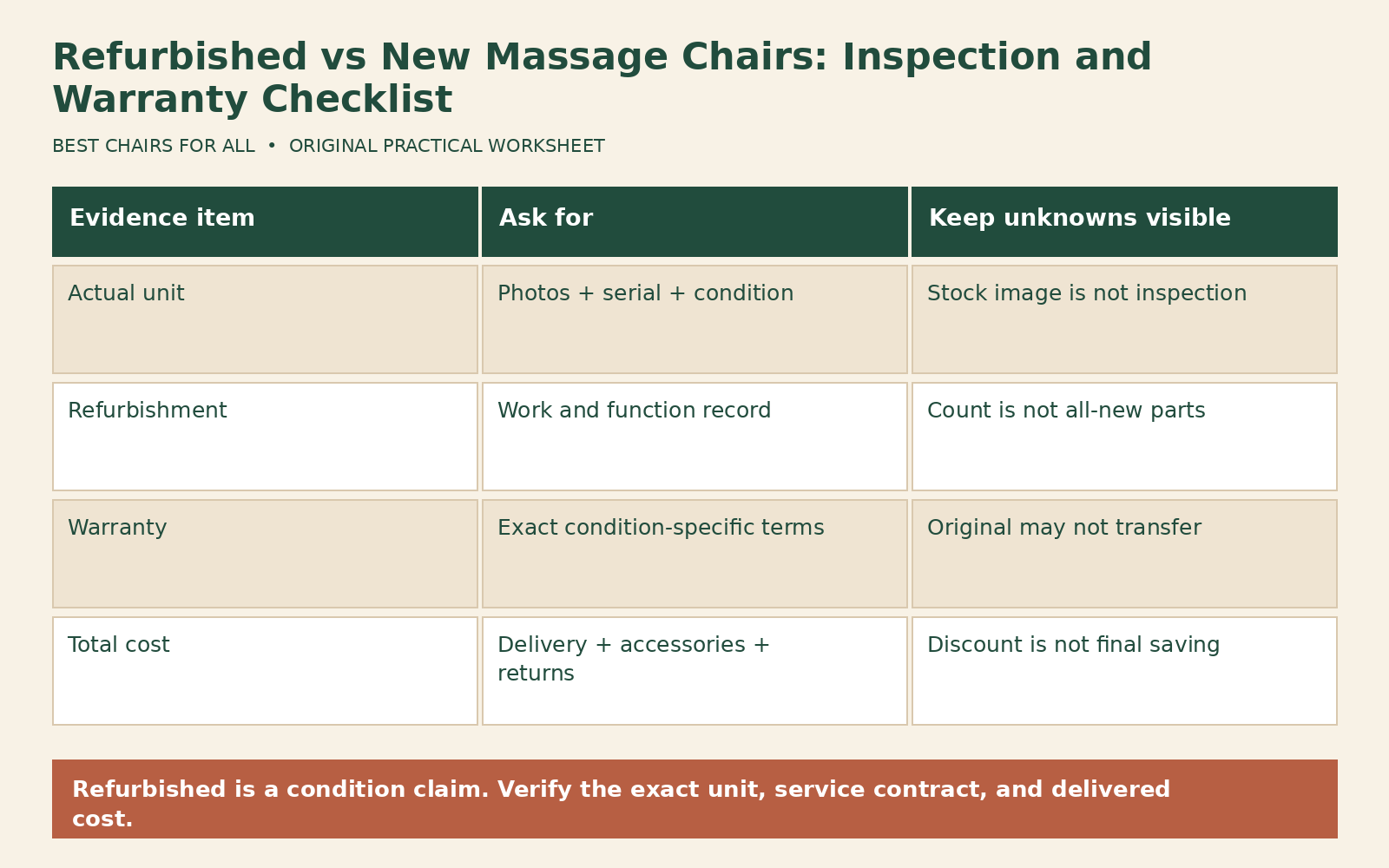
This is an inspection-and-contract checklist, not a recommendation of a particular chair or a report of hands-on testing. Manufacturer and seller examples were checked on November 6, 2026. Condition and availability are unit-specific. Ask the manufacturer and seller for written confirmation before paying, especially when warranty summaries conflict or a private seller promises that original coverage transfers.
Define the condition category precisely
Ask who owned or used the chair, why it was returned, whether it was a showroom unit, and who performed refurbishment. The seller may not know the full history; an honest unknown should stay visible. Do not turn “open box” into a claim of zero use unless the seller can substantiate it. Likewise, a clean exterior does not establish the condition of internal mechanisms or controls.
Request the exact model, generation, serial identifier, regional electrical rating, included accessories, and photographs of the actual unit. Stock photos cannot document scuffs, upholstery wear, missing liners, or a replacement remote. Ask whether the delivered unit is the one shown and whether parts have been substituted. A similar-looking control panel can belong to a different revision with different features.
Create separate condition rows for appearance, operation, accessories, and service eligibility. A cosmetic grade does not establish mechanical inspection, and a working demonstration does not establish warranty. Keep these categories separate so a favorable result in one does not silently fill gaps in another. The purchase should remain understandable even after the listing has disappeared.
Ask what refurbishment actually included
The Massage Chair Store certified pre-owned page says its factory-trained technicians perform a 37-point inspection, cleaning, and necessary repairs, and publishes condition-specific warranty terms. That is a seller’s description of its program, not an independent certification by this site. Ask for the inspection record for the unit and the specific warranty attached to the order.
A useful record identifies tested functions, observed faults, replaced parts, completion date, and the organization responsible. Ask whether upholstery and removable foot liners were cleaned or replaced, whether controls and safety-related operating behavior were checked, and whether all accessories are present. Do not assume a numbered inspection means every component was renewed or that the chair is equivalent to new in every respect.
Ask how replacement parts were sourced and whether the manufacturer recognizes the refurbishment. Do not seek internal access or attempt to verify wiring yourself. If the seller cannot explain a repair, a qualified authorized inspection may be needed before purchase or the uncertainty may make the unit unsuitable. A buyer’s checklist is not a service manual for opening powered equipment.
Verify warranty by condition and seller
Human Touch’s consumer warranty page distinguishes new, factory-renewed, and resale-related information, and its summaries contain different condition descriptions. Do not assume those categories are interchangeable. The manufacturer’s current support warranty text specifically describes authorized-reseller refurbished or resale purchases as eligible for a limited 90-day parts-only period, without labor or in-field service.
That example is a reason to obtain the exact condition-specific document, not to apply one short term to every renewed chair from the brand. Ask whether the unit is factory renewed under a separate program, authorized resale, a floor model, or a private sale. Request the start date, term, components, labor, travel, freight, and exclusions in writing. Resolve inconsistent page summaries before purchase.
A private seller’s original invoice does not automatically transfer warranty. Ask the manufacturer whether coverage follows the chair or remains with the original purchaser. Get confirmation tied to the serial identifier and proposed transaction when possible. Do not advertise or pay extra for remaining coverage based solely on the seller’s assurance. An extended service contract may have its own transfer rules separate from the manufacturer’s warranty.
Inspect the exterior without dismantling
Look for tears, peeling, loose seams, uneven padding, damaged plastic, missing covers, and signs of liquid exposure. Check accessible cords and plugs for damage without opening the chair. Photograph concerns and ask the seller to identify them in the condition report. Do not power a unit with visible electrical damage just to see whether it still works.
Check the foot and calf compartments for intact removable liners and secure attachments. Confirm that cleaning instructions and replacement liners are available for the exact model. A generic fabric sleeve may not match the intended fit or fastening. If odors or contamination are a concern, ask what cleaning was performed and what the manufacturer permits; do not assume strong fragrance proves a deep clean or that disinfectant spraying is appropriate.
Look at controls, labels, and identifiers. Worn buttons, a cracked remote, an unreadable serial label, or an incorrect power supply can affect use and support eligibility. Ask for replacement costs and availability before purchase if a component is missing. Do not substitute a visually similar adapter or remote without manufacturer confirmation. Compatibility is a documented requirement, not a plug-shape guess.
Request a controlled operational demonstration
Have the seller demonstrate normal startup, stop, restore, and the documented major functions under the manual’s safety instructions. Keep people and objects out of the moving area. A buyer need not sit through an intense program to verify that controls respond and the chair returns as intended. Stop the demonstration if operation is abnormal, noisy beyond the manufacturer’s expectations, or unstable.
Confirm which functions are present: shoulder setup, back mechanism, air zones, foot rollers, legrest extension, heat controls, and any connected features included in the model. A single automatic program may not exercise everything. Use a written function list and mark demonstrated, documented only, or unresolved. Do not describe an unresolved function as tested because the chair completed a different routine.
A personal fit trial is separate from mechanical demonstration and must follow the manufacturer’s safety information. Shoulder alignment, calf room, foot contact, control reach, and entry/exit can differ from your experience in a similar chair. For health-related suitability, consult a qualified clinician. A refurbished chair’s inspection does not establish that its massage is appropriate for every potential user.
Compare total cost with a new unit
Use the current price of the same or genuinely comparable new model, not an inflated historical reference price. Add delivery, assembly, required accessories, confirmed repairs, and any service-plan cost to the refurbished quote. Keep taxes and financing terms separate. A discount percentage can look large while missing components and transport reduce the practical saving.
Here is a hypothetical cost worksheet. A refurbished unit costs $2,500, delivery and setup add $300, and a required approved replacement accessory costs $100. The confirmed acquisition total is $2,900. A comparable new quote is $3,500 with the required delivery included, so the nominal difference is $600 before considering warranty and return differences. These invented numbers demonstrate arithmetic, not current market prices or a recommendation.
Now add the risk questions without assigning fabricated probabilities. Is labor covered? Is the model discontinued? Are important parts available? Is return freight payable? Does the seller accept returns on that condition category? You do not need to invent an expected repair cost to see that two quotes carry different obligations. Leave unknown costs explicit and request answers before deciding whether the saving is enough for you.
Keep delivery and returns unit-specific
Ask whether the refurbished chair is packed in original or approved replacement packaging and whether a pallet is included. Confirm the delivery service level, doorway plan, and who handles assembly. A previously assembled unit can be difficult to move through a narrow route without an approved configuration. Do not assume a seller will dismantle it safely or that the buyer can repeat the process later.
Read the return policy for refurbished items specifically. A general new-chair trial may exclude clearance, floor, or pre-owned stock. Confirm any restocking fee, return freight, packaging requirement, and condition deduction. Photograph the chair at delivery and report discrepancies promptly under the seller’s procedure. The condition report should make it possible to distinguish disclosed marks from new transit damage.
Keep all included accessories and packaging until the purchase is accepted under the applicable terms. Do not modify the chair to improve fit during a return evaluation. If a promised repair or replacement part is outstanding, obtain a dated written commitment and ask how it affects the return window. A verbal assurance should not become a reason to let an important deadline expire.
Make the final evidence checklist explicit
Before paying, collect the actual-unit condition report, inspection record or explanation, correct manual, serial and model information, condition-specific warranty, delivered-price quote, and return terms. Mark each as received, unclear, or unavailable. A missing item is not automatically disqualifying in every private transaction, but it changes the uncertainty you are accepting and should affect the decision openly.
For a discontinued model, ask about the availability of essential controls, upholstery components, foot liners, and major service parts. Availability today does not guarantee indefinite supply, but an immediate known shortage should enter the decision. Ask whether the seller’s promised warranty is fulfilled through the manufacturer or the seller’s own stock and service network. Keep the administrator’s identity explicit. A low price is less useful if an already missing component cannot be sourced through an approved channel.
A new chair can also have defects, and a refurbished chair can have well-documented service. The useful distinction is the evidence and obligations attached to the specific unit. Buy only when the documented condition, fit, service route, and total cost work together for your needs. If the saving depends on assuming transferable coverage, hidden repairs, or free freight that nobody has confirmed, resolve those assumptions before the chair enters your home.
Something unclear or out of date? Send a correction with this article’s title and the detail to check.
Sources, research & corrections policy ↗