Clean massage-chair upholstery and foot liners as separate components, using the exact model’s care instructions. Disconnect power as directed before cleaning, keep liquid away from controls and openings, and remove only inserts designed to come out. A washable foot liner does not make the powered foot unit washable, and a zipper does not automatically mean every upholstered panel can be removed.
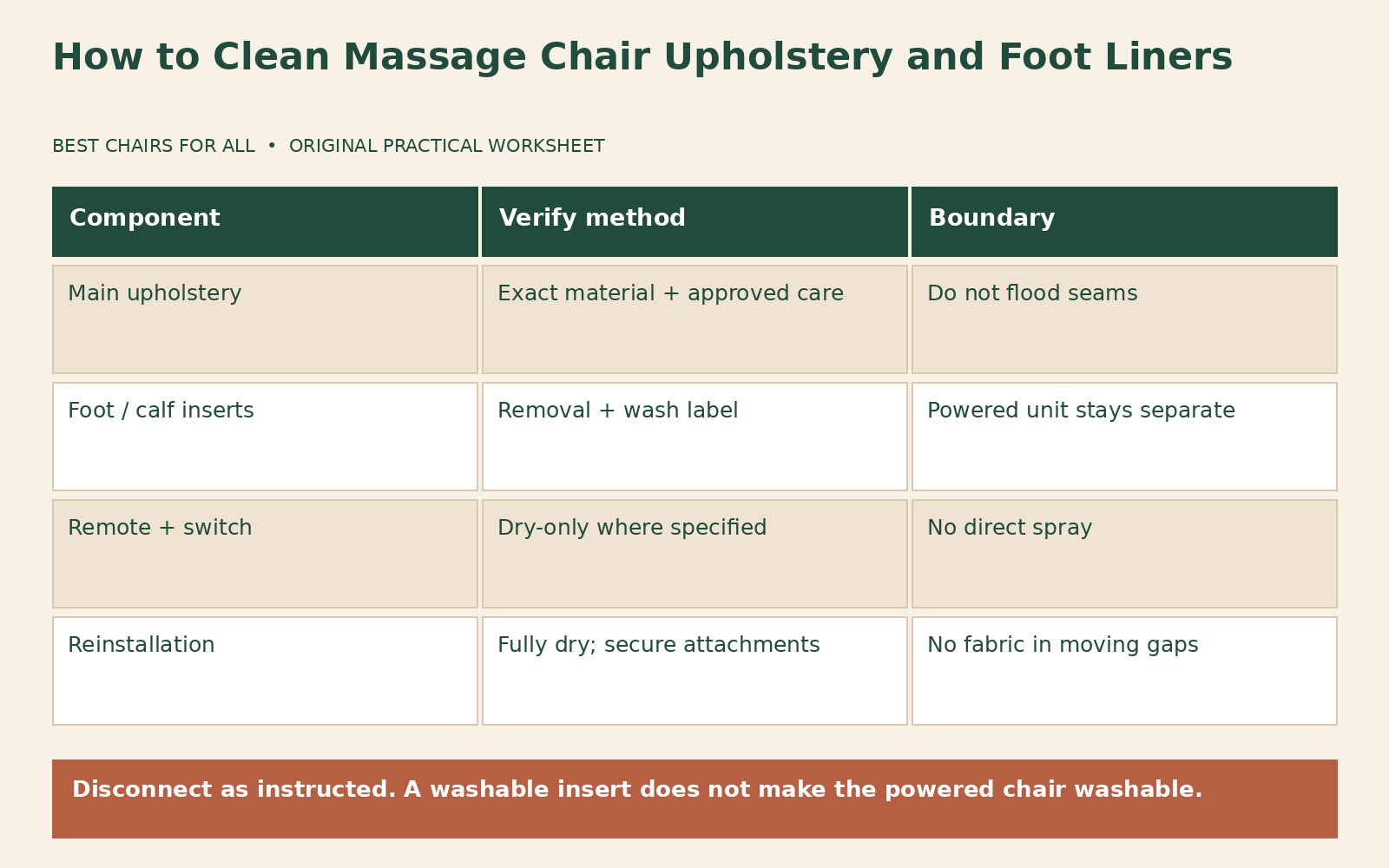
Begin with a component care map rather than a bottle of cleaner. Identify synthetic leather or fabric upholstery, removable inserts, plastic trim, remote, power switch, and any accessory cover. Record the approved method for each. This guide explains manufacturer examples and a practical care record; it does not certify a disinfecting process or replace product-specific electrical and maintenance instructions.
Match the model and material first
Find the model label and current manual. Similar-looking chairs can use different upholstery and liner construction. Do not apply a genuine-leather conditioner to synthetic upholstery solely because the product headline says leather. Ask the manufacturer to identify the material and suitable products if the care section is unclear. Keep the answer with the manual so future cleaning begins with the same verified information.
The Human Touch Super Novo 2.0 manual identifies a W cleaning code, water-based upholstery care, separate dry-only cleaning for the controller and power switch, and hand-washing for removable foot/calf well inserts. Those are instructions for the named model. Do not extend them to an older Human Touch chair or a different brand without checking its own documentation.
Infinity’s current cleaning guidance also separates upholstery, remote, and removable foot inserts. Its cleaning-guidelines PDF emphasizes disconnecting power and preventing liquids from entering electrical openings. Read current model instructions alongside the general guide, and ask support to resolve differences rather than selecting whichever method seems easiest.
Make the chair ready without moving it unsafely
Use the normal restore sequence before cleaning if the manual requires a particular position, then disconnect power as instructed. Do not reach through a moving gap to retrieve the remote or begin wiping while the chair is still returning. Place the plug and cord where they remain dry and undamaged. Never pull the appliance by the cord or use a wet hand to handle the plug.
Arrange good lighting and a clean work area. Keep cleaner containers on a separate stable surface, not on the seat or footrest where they could spill into mechanisms. Use separate cloths for dry dusting, approved upholstery treatment, and drying. A cloth used on greasy furniture polish elsewhere in the room is not a clean upholstery cloth. Check vacuum attachments for grit before using them.
You do not need to lift or turn the chair to perform ordinary surface care unless the manual explicitly directs it. Heavy-chair movement has its own handling procedure and may require more than one person. If debris has fallen into an inaccessible gap, ask support for a permitted retrieval method. Do not insert tools into the mechanism or remove covers simply to reach a crumb.
Remove loose debris before moisture
Dust accessible surfaces and use a soft vacuum attachment where approved. Pay attention to seams and the foot wells without pulling fabric away from its attachment. Dry debris removal makes later wiping more controlled and avoids spreading crumbs into a damp paste. Do not use strong suction to lift a loose seam or draw a liner into the nozzle.
Inspect the surface while it is dry. Record peeling, cracks, tears, loose stitching, or an exposed component before treating a mark as dirt. Cleaning does not repair damaged upholstery, and aggressive rubbing can worsen it. If the cover is damaged near moving massage parts, stop use and ask the manufacturer about repair. Do not conceal the damage under a new slipcover and assume the chair is ready to operate.
For a fresh spill, remove free liquid with a clean absorbent cloth and follow the model’s next step. Avoid flooding seams or spraying directly into gaps. If liquid may have entered controls, a power inlet, or internal components, leave the chair disconnected and contact support. A dry-looking outer surface does not establish that powered parts are safe to energize.
Clean upholstery within its approved method
For the Super Novo 2.0, the manual’s water-based upholstery instructions and small inconspicuous compatibility test are the relevant starting points. Follow the cleaner label as well as the chair instructions. Apply only the approved amount through the specified method. Do not assume extra concentration or extended soaking improves the result. Keep treatment away from the dry-only controls and switch.
Infinity’s general guidance permits gentle damp-cloth spot care under its stated conditions and warns against harsh chemicals, alcohol, and heat drying. It also discusses a follow-up conditioner for its synthetic surfaces. Do not transfer that recommendation automatically to Human Touch upholstery or another coating. Ask for the named compatible product if a broad conditioner category leaves uncertainty, especially where the model manual differs.
Do not combine cleaners, stain removers, solvents, and disinfectants to chase a mark. Write down what has already been applied and stop if color transfers or the surface texture changes. A compatibility test within an approved method is not a way to authorize an otherwise prohibited chemical. If the stain remains, send the manufacturer a description and photograph before escalating treatment.
Wash foot liners only when removal is intended
Read the removal procedure for the exact insert. Confirm which zipper or attachment belongs to the removable liner and which belongs to the structural upholstery. Remove the insert with the chair disconnected and stationary, without reaching into the mechanism. If removal requires force, stop and check the instructions rather than pulling harder. Keep left and right pieces identified if their shape or attachment differs.
The Super Novo 2.0 manual specifies hand-washing its foot/calf well inserts with mild detergent and line drying. Infinity’s current general guide likewise describes unzipping removable foot inserts, hand-washing, and line drying. Neither is permission to machine-wash the powered foot unit or tumble-dry every removable textile. Follow the actual insert label if it supplies additional model-specific requirements.
Inspect the detached liner for damage and check that no small items remain inside. Use the prescribed washing method without adding bleach, fragrance treatments, or fabric softener unless approved. Rinse and dry as directed, and do not reinstall damp material. The time needed varies with fabric, room conditions, and the amount of water retained; do not promise that a fixed number of hours is sufficient for every liner.
Keep controls on their own care track
Use the dry-only method specified for the Super Novo 2.0 controller and power switch. Infinity’s current general guidance also calls for a dry cloth on the remote. Do not spray a touchscreen or button panel directly. Cleaner can enter edges and openings even when the front surface looks sealed. A protective film is not evidence of a waterproof control.
If an older manual seems to permit a different remote-cleaning method, ask the manufacturer which instruction applies to the current component. Replacement remotes and product revisions can differ. Do not choose the wetter method simply because it removes a fingerprint faster. Keep cloths used on upholstery away from controls so the dry-only rule remains practical during the session.
Clean charging areas and speaker grilles only through their documented surface method. Do not probe openings or use liquid to flush out dust. If a port is contaminated or damaged, contact support. Ordinary cleaning should not become electrical servicing, and a consumer care article cannot establish how to repair a connector or remove a control panel safely.
Use a component-by-component care record
Make rows for main upholstery, seams, foot inserts, remote, switch, and accessories. Columns should show material, approved product or method, removal permission, drying requirement, and completion date. Add a note for any unresolved stain or damage. This is especially useful when one household member wipes the chair while another launders the liners, because the record prevents incompatible assumptions between tasks.
A hypothetical completed row might read: foot/calf insert; removable textile; manufacturer-directed hand wash; line dry fully; reinstall by documented attachments. A remote row might read: electronic control; dry cloth only; no disassembly; no damp treatment. The contrast is deliberate. “Chair cleaned” is too broad a record when different components follow different rules.
Plan liner washing around complete drying rather than the next intended session. If the household uses the chair frequently, leave a visible note that the inserts are removed and the chair is unavailable until reassembled as instructed. Do not operate it with the liners missing unless the manufacturer explicitly permits that configuration. An empty-looking compartment may expose attachment points or contact surfaces not intended for direct use.
Store the clean detached inserts on a dry surface away from heat, pets, and household cleaning chemicals. Keep the left/right labels and any approved attachment pieces together. Before reinstallation, compare their shape and fasteners with the removal notes. If a zipper, seam, or hook-and-loop section was already weak, ask about replacement rather than forcing it closed. A liner that cannot stay in its intended position is a fit and operating issue as well as a cleanliness issue. Add that observation to the care record so it is not lost when another person returns the chair to service.
After reinstalling fully dry approved inserts, check that attachments are secure and material is not folded into a moving gap. Reconnect and operate only under the manual’s sequence. If a liner bunches, shifts, or prevents normal fit, stop and correct it through the documented method. Do not use powered motion to pull fabric into place. A successful care session leaves the chair dry, intact, and assembled as intended, with no new uncertainty hidden beneath a clean surface.
Something unclear or out of date? Send a correction with this article’s title and the detail to check.
Sources, research & corrections policy ↗