As an Amazon Associate, we earn from qualifying purchases. Read our affiliate disclosure.
The best Adirondack chair is the one whose low seat, reclined back, and wide arms fit the person who will use it. Those familiar shapes are the appeal, but they also explain why two chairs that look similar can feel quite different. Start with usable seat dimensions and the way you rise from the chair, then compare material and outdoor placement.
This guide focuses on fixed-frame candidates: POLYWOOD Classic Adirondack AD4030, Trex Cape Cod Adirondack TXAD4031, and Lifetime Adirondack 60064. They are appropriate comparisons for an established patio or garden seating area. A folding or adjustable Adirondack adds a different storage or movement requirement and should be checked as its own design.
We reviewed manufacturer information November 6, 2026. No comparative sitting, load, weathering, or durability testing was performed by us. The recommendations are conditional fit choices, and we do not promise a fixed price or current seller inventory. Amazon links search the model name and should be checked against the manufacturer identifier.
Understand the seat before choosing the silhouette
An Adirondack is usually a more relaxed seat than an outdoor dining chair. The lower position and inclined support can be inviting for conversation or looking across a garden while being less convenient for eating at a tall table. Choose the category for the activity you actually want.
The seat's front height is only one useful dimension. Usable depth, the shape of the front edge, and where the back contacts your torso all influence the experience. Manufacturer measurements may describe a reference point on the seat rather than exactly where your body settles.
The arms also deserve a trial. Their width and position affect how your forearms rest and how the chair feels during entry and exit. An arm wide enough to hold a closed bottle still should not be treated as a separate seat or a substitute for an appropriate side table.
Three fixed Adirondacks with documented differences
POLYWOOD Classic AD4030: for a conventional HDPE-lumber reference
The Classic AD4030 page lists a 20-inch seat width, 16.9-inch seat depth, 13.9-inch seat height, 34.5-pound chair weight, and 300-pound capacity. Overall width is 28.8 inches. The manufacturer's current specification table should take priority over older answers or retailer pages with slightly different dimensions.
Use it as a reference if you want the classic low, relaxed form in HDPE lumber. Its fixed format makes sense where the chair will usually stay in a garden or patio grouping. Try the actual front edge and back angle rather than assuming every chair with this silhouette provides the same contact points.
The limitation is that the low reclined position may not suit someone who needs a higher or more upright seat. It is also a substantial object to relocate. If compact storage is the central requirement, the separate Classic Folding AD5030 belongs in that comparison; it is not the chair reviewed in this section.
Check matching POLYWOOD AD4030 listings on Amazon (paid link). Verify fixed AD4030 rather than folding AD5030.
Trex Cape Cod TXAD4031: for a slightly different footprint and seat relationship
The Cape Cod Adirondack page lists a 20-inch seat width, 16.9-inch seat depth, 13.5-inch seat height, 34-pound weight, and 300-pound capacity. Overall width is 27.9 inches. Trex uses genuine POLYWOOD lumber; this is not a comparison of two unrelated material technologies merely because the brands differ.
Its reason for inclusion is the particular frame and seat geometry, along with finish coordination for an existing outdoor space. Compare the slightly lower published seat and narrower overall outline with the AD4030. Small differences can matter at a tight grouping, but they are not a substitute for sitting in the actual chair.
The tradeoff is that similar construction can create little reason to switch if one already fits you well. Do not assume matching a Trex deck makes the chair immune to surface scratching or removes the need to inspect contact points and follow care guidance. Choose by fit and arrangement before color coordination.
Check matching Trex Cape Cod TXAD4031 listings on Amazon (paid link). Cape Cod folding models use different identifiers.
Lifetime Adirondack 60064: for a polystyrene alternative
The Lifetime 60064 specification identifies UV-protected polystyrene, a 20.7-inch seat width, 14-inch seat height, 31.1-inch overall width, 37.4-pound weight, and 300-pound capacity. The material is specifically polystyrene, so it should not be relabeled HDPE simply because it resembles synthetic wood.
It is worth comparing when you prefer this model's broader overall shape and slightly wider listed seat. The additional outside width is much larger than the seat-width difference, which is a useful reminder to separate the frame envelope from the space available to your body.
Its limitation is a wider footprint and a chair weight that still calls for a realistic moving plan. Avoid interpreting the Lifetime brand name or weather-resistant description as a promise that the chair never needs inspection or cleaning. Read the actual 60064 instructions and warranty instead of transferring claims from the brand's folding tables or other chairs.
Check matching Lifetime 60064 listings on Amazon (paid link). Confirm the model and material description.
A seat-envelope worksheet
Make two columns: the chair's usable seat and its outside frame. Record width, depth where clearly defined, front seat height, overall width, overall depth, and arm height when supplied. Keeping these separate prevents a broad-looking chair from being mistaken for a much wider seat.
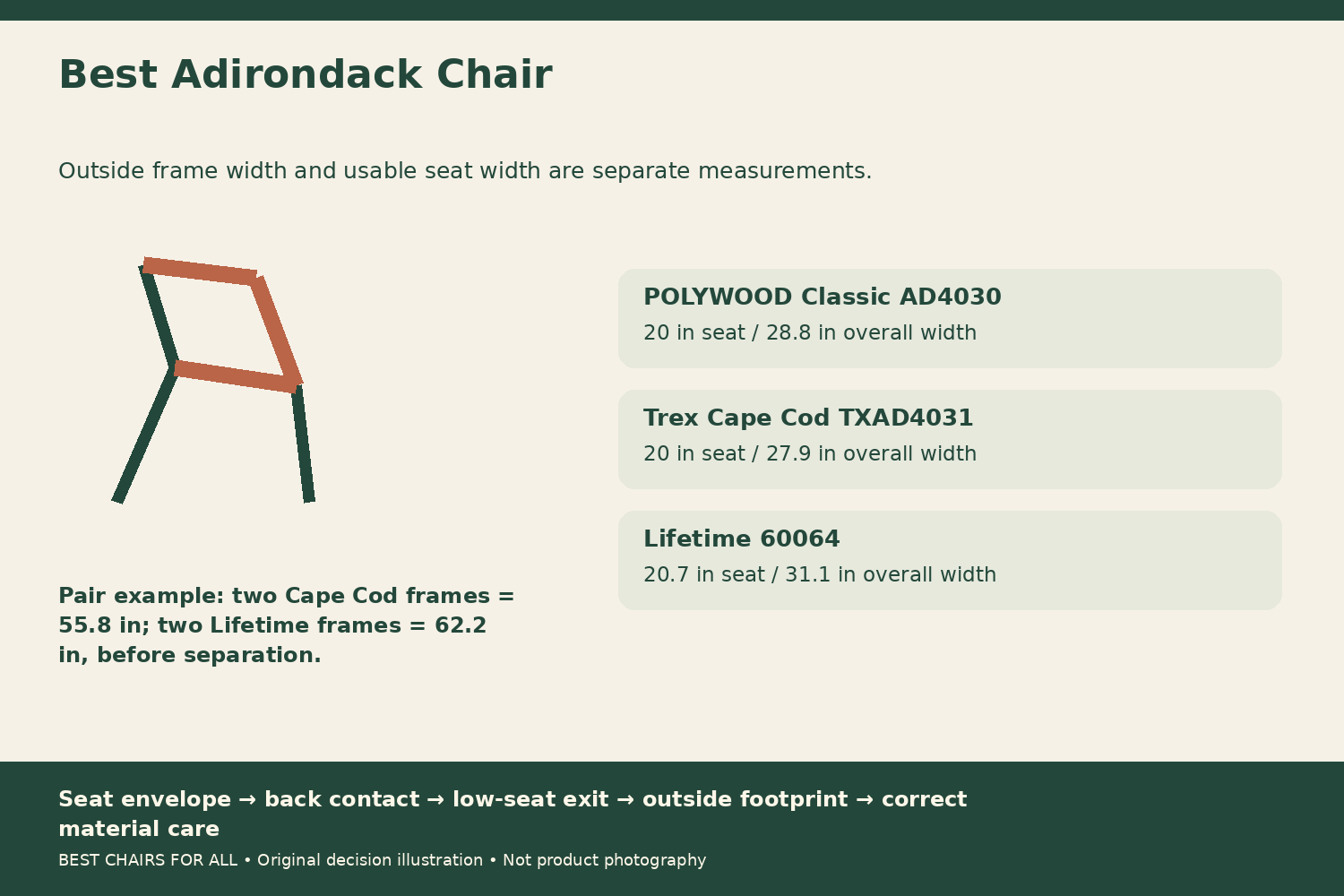
The three current seat widths provide a worked comparison. POLYWOOD and Trex each list 20 inches; Lifetime lists 20.7 inches. Their overall widths are 28.8, 27.9, and 31.1 inches respectively. The Lifetime's outside frame is 2.3 inches wider than the POLYWOOD's while the listed seat is only 0.7 inch wider.
Now take a hypothetical clothed seated-width measurement of 18.5 inches, without squeezing against a rigid surface. A 20-inch nominal seat leaves 1.5 inches of total difference, and a 20.7-inch seat leaves 2.2 inches. These are arithmetic comparisons, not prescribed clearances or proof that either seat will be comfortable.
Real fit also depends on the shape of the seat sides and the user's preferred position. Do not divide the total difference into guaranteed equal gaps on both sides or assume you will sit precisely centered. Use the worksheet to identify what to test, not to declare a chair suitable without a trial.
Measure a chair you already enjoy as a personal reference. Note where it supports the back and whether its arms are easy to reach. That reference is more useful than relying on an overall height that says little about where your own shoulders will meet an Adirondack's backrest.
A low-seat entry and exit trial
Approach the correctly assembled chair on suitable level ground. Sit using its intended procedure and check the position of your feet and knees. The goal is a natural movement, not a technique invented to make an unsuitable chair seem manageable.
Remain seated for an ordinary relaxed activity, such as conversation or reading, before standing. A quick sit may not reveal how far you settle into the reclined shape. If you need a specific transfer arrangement or assistance, evaluate it with appropriate individual guidance rather than assuming a broad armrest makes every Adirondack suitable.
Check the seat edge behind your thighs and knees. A deep seat can encourage a shorter user to slide forward, losing back contact. A short seat can feel incomplete to a longer-legged user. A listed height close to another chair's height does not resolve that depth relationship.
Try the intended cushion only if it is appropriate for the chair. It may raise you, move you forward, or change arm height relative to the body. A cushion should improve a sound fit rather than serve as an improvised structural modification. Keep attachment ties clear of any moving or serviceable parts.
Draw the garden grouping at full size
Place an outline of each overall chair on the ground using removable tape or another appropriate temporary marker. Add the side table and the space people need to approach and stand. The empty frame footprint is only the first part of a usable arrangement.
For a pair, compare the combined widths before adding separation. Two Cape Cod chairs total 55.8 inches of nominal frame width; two Lifetime chairs total 62.2 inches. The 6.4-inch difference can matter on a narrow porch, but neither total is a recommended total area for the pair.
Leave the required routes open and check door swings, steps, plant pots, and table legs. Do not create a narrow passage behind a relaxed seat simply because the chairs fit in a photo. If the area needs frequent reconfiguration, reconsider whether a fixed-frame chair is the right type.
Choose stable level ground within the manufacturer's intended conditions. The traditional Adirondack appearance is not evidence that a modern chair is approved for a slope. Do not level a leg with loose stones or use soft ground that leaves the frame unsupported.
Material names should lead to the correct care plan
HDPE lumber and polystyrene are different material descriptions. Follow the maker's instructions for the model you own rather than buying a cleaner because a retailer calls every product poly furniture. Neither synthetic appearance requires a conventional wood-staining routine unless the manufacturer specifically calls for one.
POLYWOOD and Trex describe cleaning with soap, water, and a soft-bristle brush. Use that as the starting guidance for their lumber and consult the current care documentation for harder-to-remove residue. Lifetime's material and assembly instructions should guide the 60064 instead of a borrowed procedure from another brand.
Inspect hardware, joints, and feet as part of seasonal use. An outdoor durability claim does not make damage irrelevant or establish a safe repair method. Obtain matching replacement parts or manufacturer advice if a structural component is damaged.
Keep cushions and accessories on their own drying and storage plan. A chair frame that remains outdoors does not mean every pad placed on it should remain wet or covered indefinitely. Record the recommended cushion model if you expect to replace it later.
Choose the seat you will use most
Start with the AD4030 as a fixed HDPE-lumber reference, compare the Cape Cod TXAD4031 for its particular footprint and seat relationship, and investigate the Lifetime 60064 for its polystyrene construction and wider listed seat. All three still need a personal fit check.
Compare exact model, finish, assembly, quantity, and return terms rather than treating a search result's headline as an all-in budget. A chair package can exclude the cushion shown in the image, and similarly named folding models can appear beside the fixed versions.
The seat-envelope worksheet and entry-and-exit trial should establish the reason for your choice. A familiar silhouette is a useful starting point, but your actual body position, outside space, and ownership routine determine the Adirondack worth bringing home.
Something unclear or out of date? Send a correction with this article’s title and the detail to check.
Sources, research & corrections policy ↗