A hunting chair’s swivel noise may come from the rotating assembly, but it can also come from clothing, a loose carry strap, the blind wall, a floor surface, or a frame connection. Before applying lubricant, identify when the sound occurs and which parts are moving. A quietness claim in a product description does not replace inspection, and reducing a sound does not establish that a damaged chair is fit for use.
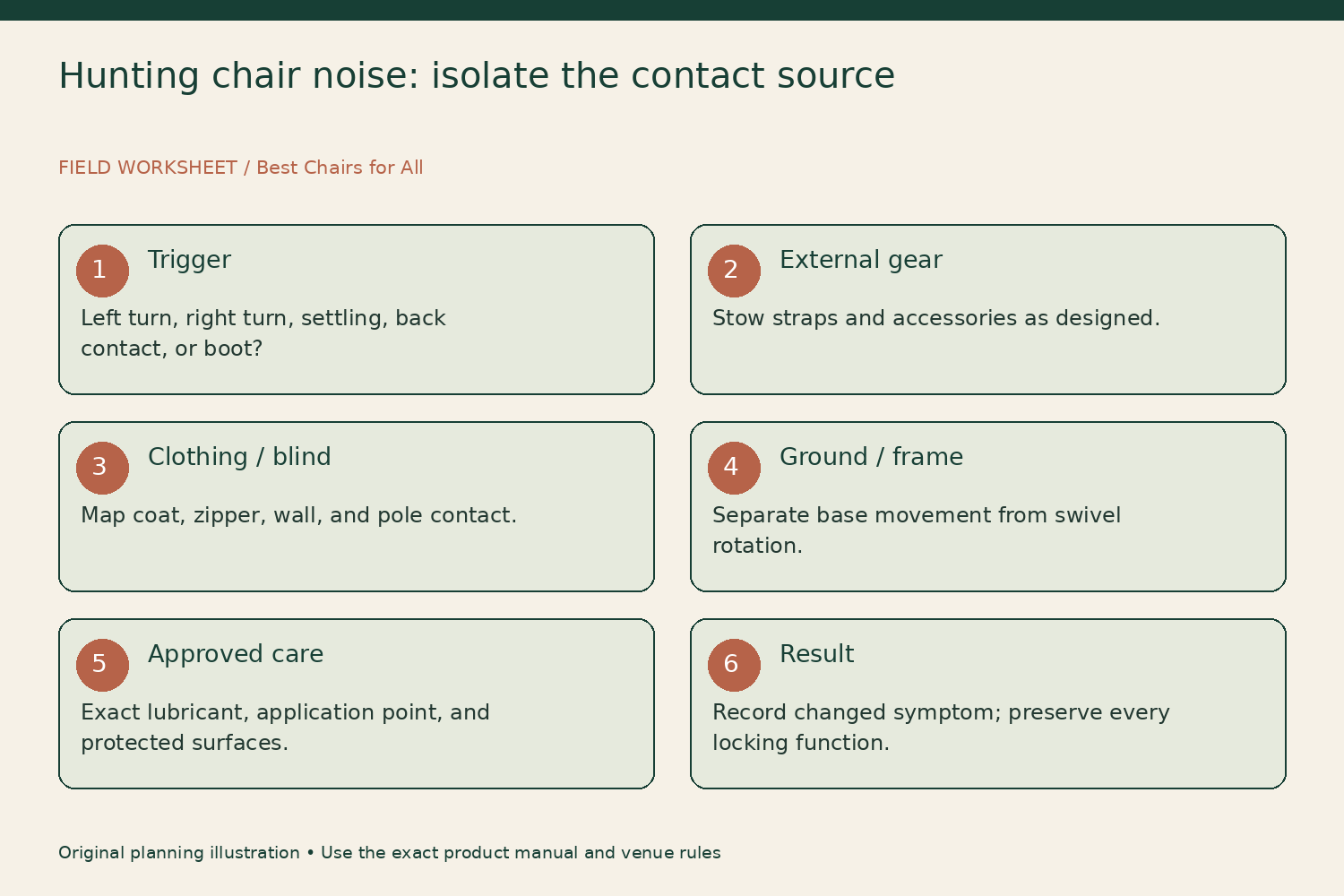
Use the chair’s exact manual for assembly, care, and any permitted lubrication. This guide provides a contact-isolation worksheet tailored to a chair inside a ground blind. It does not instruct you to open enclosed bearings, alter leg locks, or substitute hardware. Perform the checks in a clear suitable setting without weapons, and stop if you see structural damage, unexpected separation, slipping adjustment, or instability.
Record the sound as an event
Write a short description of the trigger: turning left, turning right, settling into the seat, leaning against the back, or moving a boot. Note whether the sound appears once per rotation, continuously, or only at a particular chair position. These details are more useful than a general statement that the chair squeaks. They also help distinguish rotation from ordinary movement elsewhere in the setup.
Record the surroundings: inside a blind or in an open area, on a platform or ground, with a coat or light clothing, and with straps stowed or hanging. Do not interpret the sound’s loudness as a measure of how far wildlife can hear it. A phone recording may help a manufacturer recognize the symptom, but it is not a calibrated acoustic test or a prediction of hunting results.
Identify the actual chair version
Find the model, production information, and assembly guide. Several chair generations can share a familiar product name while using different legs, fabric, or central connections. Photograph the underside in a supported safe arrangement without crawling beneath a chair someone is using. Include the carry straps and any accessories in the image so support can see potential contact sources.
The Millennium G100 product page describes a swiveling chair with a removable tripod base. That is a specific arrangement, not a diagram of every hunting swivel chair. Match the manual to the received model before deciding how the base should seat, which parts are removable for transport, or what apparent movement is intended.
Confirm assembly before chasing silence
Compare the chair with the parts and setup drawings. Check that the base is installed, legs spread, and required locks engaged as instructed. Do not use a noise problem as a reason to skip a missing fastener or accept a partly engaged connection. A chair may rotate while still being incorrectly assembled, and a visible gap can require manufacturer assessment rather than a spray.
The Millennium G-100/G-400 use instructions specify complete insertion of the base connection and full spreading of the legs for those models. Follow that document only for the matching product. If your chair’s assembly does not resemble the drawing, obtain the correct instructions rather than treating a shared swivel feature as evidence of identical construction.
Isolate external contact first
In a suitable clear setting, keep the chair in its documented setup and look for loose straps touching the frame, a bag rubbing the underside, or an accessory contacting a leg. Stow each item through the manufacturer’s intended arrangement. Change one external condition at a time so you can tell which contact affected the sound. Do not remove a required restraint, lock, or structural component during the comparison.
Inside the blind, inspect where the chair back, arms, or clothing approach fabric, zippers, and poles. A chair that turns quietly in open space can sound different when its outer edge brushes the wall. Map that contact rather than lubricating the swivel to solve a fabric-rubbing problem. If there is insufficient clearance, change the permitted layout or chair choice; do not cut blind fabric or bend the chair.
Compare clothing contact deliberately
A jacket hem, pocket, buckle, or textured fabric can rub against a mesh seat or arm during rotation. Record which item touches which surface. Try the same ordinary movement with loose clothing adjusted safely away from the contact, without changing the chair’s structural setup. A changed sound helps identify the contact source, though it does not prove that no other issue exists.
Keep the observation relevant to the actual outing. A quiet trial in thin indoor clothing may miss contact from a bulky hunting coat. Conversely, removing a required safety item or needed clothing is not a sensible long-term noise solution. The point is to locate the source and choose a workable arrangement, not to optimize a sound recording under conditions you will never use outdoors.
Separate foot movement from swivel movement
Observe whether the whole base shifts when the sound occurs. A foot on a hard platform, loose debris, or an uneven surface can make noise independently of the central swivel. Follow the chair’s ground and leveling instructions. If a foot settles or a leg adjustment slips, treat that as a support problem requiring correction or assessment before further use.
Do not add thick improvised pads beneath selected feet or wedge the base against the blind to suppress movement. Those changes can alter the support arrangement and conceal a poorly chosen location. If the manufacturer offers approved feet or floor-protection accessories, check their exact compatibility. A floor-contact solution should address the actual surface through documented parts rather than turning silence into the only measure of success.
Use a contact-isolation worksheet
Create rows for external gear, clothing, blind wall, floor contact, frame connection, and swivel assembly. Add columns for trigger, observed contact, one permitted change, result, and next action. An example entry might read: ‘turning right; coat pocket touches arm; pocket moved clear; scraping disappears; check final clothing layout.’ This records evidence without claiming that a bearing was diagnosed or repaired.
A different entry might say: ‘unloaded rotation catches at one point; no external contact visible; no further manipulation; send video to support.’ Leave uncertain findings uncertain. The worksheet should narrow the question for the manufacturer, not give every sound a guessed cause. Avoid performing loaded stress tests or increasingly forceful rotations to move an unresolved item into a more confident category.
Clean according to the identified materials
Dust, mud, and plant debris can collect around folding and rotating areas. Use the model’s approved cleaning procedure, keeping any protected areas dry as directed. Do not pressure-wash a central mechanism or spray solvent through gaps without permission. Cleaning an accessible surface is different from flushing a bearing assembly, and a wet outdoor chair still needs its documented drying and storage process.
The ALPS Brands FAQ recommends spot washing where possible and emphasizes drying, while warning against leaving its furniture continually exposed to weather. It also discusses coating wear around joints. These are ALPS care principles, not a universal mechanical repair procedure. Obtain model-specific advice if the issue is inside a swivel rather than on the exposed fabric or finish.
Read lubrication wording precisely
The Millennium G-100/G-400 instruction sheet names a lubricant in its care section. Before buying, confirm the exact current product with the manufacturer if the wording or available formulations are ambiguous. Brand names can cover more than one formula. Do not assume that another silicone, penetrating spray, oil, or grease is interchangeable merely because it is commonly recommended in online comments.
Ask where the product should be applied, what preparation is required, and what surfaces must be protected. Use only the documented procedure and the lubricant label. If the application point is unclear, request a marked diagram. Do not open an enclosed swivel, remove a factory fastener, or flood the underside to reach a point you cannot identify. The correct product and the correct location are separate requirements.
Preserve the locking functions
A detent, leg clamp, transport release, and swivel joint do different jobs. Do not lubricate a gripping or locking surface unless the manufacturer directs it. Likewise, do not loosen a central connection to make the chair turn more freely. A reduction in resistance can be undesirable if it comes from a connection no longer seated as designed.
Check each required engagement after the approved care step using the manual’s method. If an adjustment begins slipping, a lock fails to engage, or the chair develops unusual play, stop using it and request assessment. Do not trade stability for quietness. A chair that makes less sound but has a new movement problem has not reached a satisfactory maintenance outcome.
Avoid unverified noise modifications
Felt, tape, rubber washers, and extra bushings can change contact between structural parts. They may also trap moisture, alter bolt engagement, or obstruct folding. Do not add them at load-bearing connections simply because another owner reported success. Ask the manufacturer whether an approved replacement or revision exists for your model. Keep original parts and documentation until the issue is resolved.
For an external nonstructural contact, use only a solution that preserves the intended setup and follows the relevant chair or accessory instructions. Stowing a carry strap in its provided holder is different from inserting a homemade washer into the swivel. The contact map helps keep those categories distinct. A furniture technician or manufacturer can assess an unresolved mechanism more appropriately than a series of trial modifications.
Review the result under ordinary conditions
After approved care and resolution of any structural concern, repeat only the ordinary permitted movements that originally revealed the sound. Keep the comparison conditions consistent and record what changed. Do not claim a decibel reduction from an uncalibrated phone or promise silent operation at every temperature and load. A useful record says which symptom remains and what approved action has been completed.
Recheck the final blind layout with the actual clothing, stowed straps, and equipment you intend to bring. If contact appears only when the chair is in a particular corner, the layout may need revision. Keep the support response and any replacement-part information with the model record. The outcome should be an understood, properly assembled chair and a manageable contact arrangement, with unresolved mechanical noises directed to the manufacturer rather than hidden beneath extra lubricant.
Something unclear or out of date? Send a correction with this article’s title and the detail to check.
Sources, research & corrections policy ↗