You cannot make a recliner childproof by adding a cover, hiding its remote, or unplugging one cord. Recliners contain openings and moving parts that can trap or crush, and some mechanisms can move through manual force or stored power. Follow the exact manufacturer’s warnings, keep children and pets away from the operating area, and use the model’s specified storage and control-locking procedures. If the household cannot reliably maintain those conditions, reconsider whether and where the chair is used.
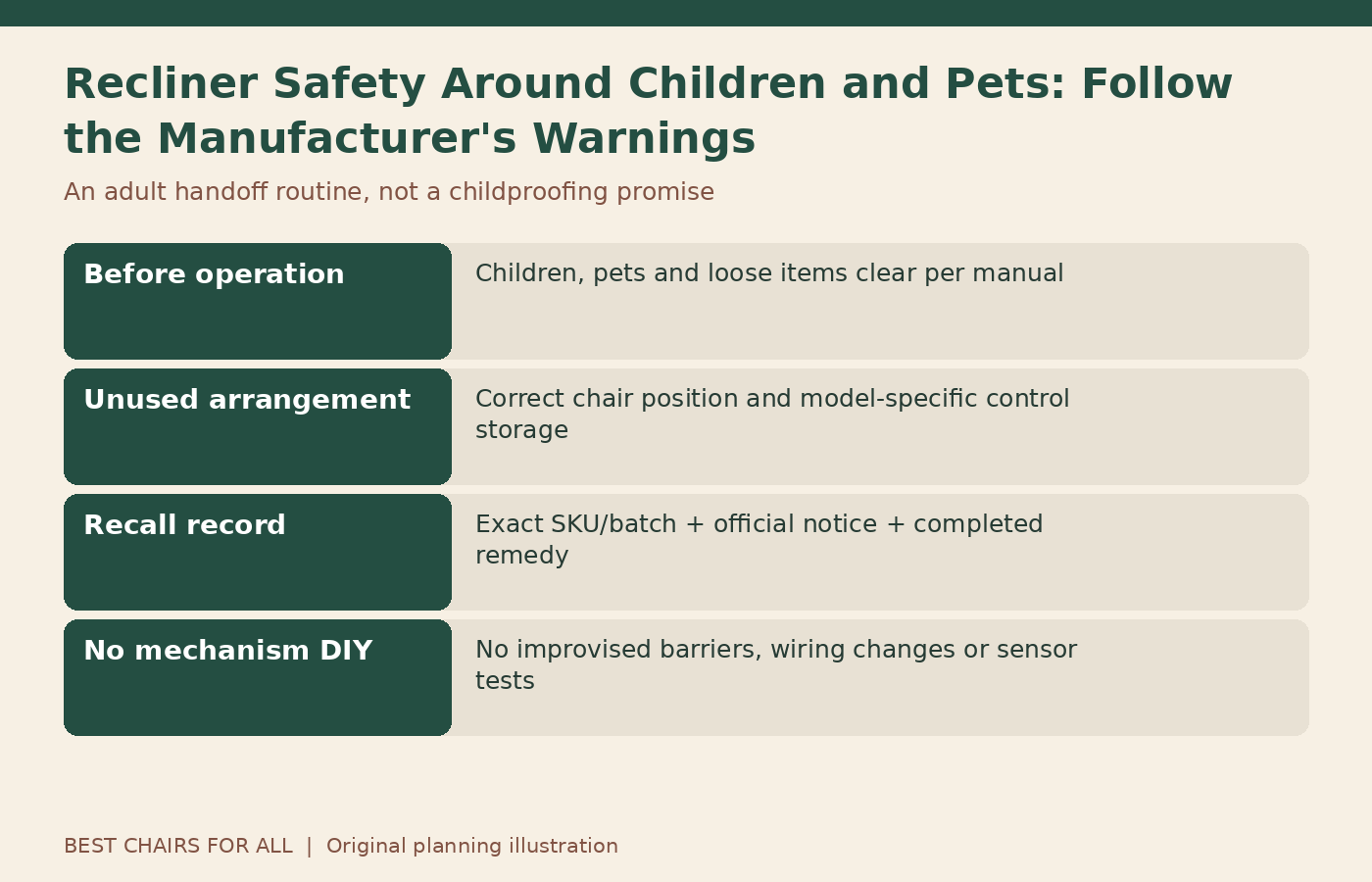
This guide provides a household handoff card for adults and visitors. It focuses on recognizing movement areas, preventing unintended operation, checking recalls, and responding appropriately to a concern. It does not certify a furniture arrangement as safe or offer a DIY barrier design for a recliner mechanism.
Understand why a gentle motion still needs separation
A footrest may move slowly and quietly while its linkages create pinch or crush areas beneath upholstery. A rocker or glider adds other movement, and a lift chair raises and tips a larger assembly. Children and pets can enter spaces that an adult does not easily see from the seat. A soft cushion does not reveal the forces or openings below it.
CPSC staff’s 2023 recliner-entrapment letter describes serious incident patterns involving foot supports and underlying mechanisms. It is a staff document, not a claim that every recliner has the same design or that a particular home setup meets a current standard. Its practical relevance is the need to take concealed movement areas seriously.
Find the exact warnings for the actual chair
Keep the model, serial or product ID, main manual, and optional-control guide together. Read the instructions for children, pets, hand-control storage, power isolation, and leaving the chair unused. A manual rocker, powered recliner, and lift chair may require different procedures. Do not transfer a lock or disconnect instruction from another model merely because its remote looks similar.
The Pride nonmedical lift-chair manual includes warnings to keep children and pets away from moving parts, prevent unintended control operation, and leave covered chairs upright and closed when unused. Use the matching manual for your furniture. If you cannot identify it, ask the retailer before relying on an assumed storage procedure.
Map the operating area from outside
Draw the back’s movement, footrest extension and retraction, permitted rocking or gliding, and swivel range. Add the lift path where relevant. This is an adult planning tool, not a line that makes it acceptable for a child to approach the edge. Follow the manufacturer’s required separation and operating instructions rather than inventing one universal distance.
Check where children play and where pets sleep relative to that movement. A pet bed behind the chair or a toy basket beside the footrest can encourage entry into the wrong area. Move those ordinary attractions through a suitable room layout. Do not place a DIY box, screen, or skirt around the mechanism to conceal it; that can create interference or hide someone from view.
Use a clear-before-movement routine
Before the intended user operates the chair, confirm that children, pets, toys, blankets, and other loose items are clear according to the manual. Do not rely on the fact that the area was clear a minute ago. Keep attention on the movement and stop if someone approaches. Never ask a child to retrieve an object from underneath while the chair remains in use.
For a reclining sofa, consider every seat and the spaces between differently positioned backs or legrests. One person may operate a section while another cannot see the nearby opening. Adults should understand the whole product’s warnings. A chair-side routine does not become unnecessary because a motor is quiet or because the movement is expected to last only a few seconds.
Control storage is model-specific
Use a supplied lockout, key, quick-disconnect, or storage method only as the matching instructions describe. Ask the provider to demonstrate it and explain how normal operation is restored. A remote pocket can be a storage location without being inaccessible to a child. Do not describe ordinary pocket storage as a child-resistant control system unless the manufacturer explicitly identifies it that way.
Likewise, unplugging a wall cord may not disable a chair fitted with a battery. Manual mechanisms can still move without household power. Follow the complete model procedure and keep keys or detached controls stored as directed. Do not cut wires, remove buttons, or adapt an aftermarket lock. Preventing unintended operation should preserve the manufacturer’s intended system rather than modify it.
Teach a short household handoff card
Write four lines for adults: identify the chair and matching manual; keep children and pets outside the movement area; clear the area before the intended user operates it; restore the documented unused position and control-storage arrangement. Add the provider’s contact information and where the model label photograph is stored. Keep the card beside the full manual rather than presenting it as a replacement.
Use plain words that visitors understand. A relative who sees a comfortable chair may not know that it has a battery, memory movement, or a footrest extension. Explain those features before use and review the manufacturer’s operating restrictions. Do not delegate supervision to a child who has merely been told not to touch the buttons.
Do not turn the footrest into play furniture
Follow the manufacturer’s restrictions on sitting, standing, climbing, or placing extra weight on the footrest, arms, and back. An extended legrest is not a step, diving platform, pet perch, or extra seat unless a product’s instructions explicitly provide another intended use. A child should not be encouraged to crawl through or hide beneath reclining furniture.
If the chair’s location has become a regular play route, change the arrangement and adult management rather than assuming repeated reminders will remove the hazard. A recliner cannot be evaluated only when the main user is sitting quietly in it. Consider the room’s normal activity when adults are entering, leaving, cleaning, or supervising more than one child.
Keep cords and small items out of the routine
Route cords as the manual requires, away from walking routes and moving parts, and manage children’s and pets’ access. A chewed, frayed, pinched, or otherwise damaged cable calls for stopping use and approved service. Do not cover damage with tape or continue operating while deciding whether the chair still works. Keep external supplies in their specified ventilated location.
Keep packaging, batteries, detachable control keys, and small accessories stored appropriately. Do not leave a replacement battery loose in the side pocket because it is convenient for an outage. Optional USB ports and lights do not make the chair a children’s activity station. Follow the manufacturer’s accessory and electrical warnings as part of the overall household arrangement.
Check recalls using the actual identifiers
Before buying used furniture and when registering or reviewing an existing chair, check official recall information using brand, model, SKU, batch, or production identifiers as required. A consumer-facing collection name alone can be insufficient. Read the entire notice and follow its specific stop-use and remedy directions where your unit is affected. Do not substitute an ordinary service appointment for an applicable recall remedy.
For example, the CPSC July 17, 2025 Babyletto Kiwi recall notice identifies particular electronic recliner and glider units by SKU and batch because of a USB-module overheating hazard. That is an electrical recall, separate from entrapment precautions. The notice instructs affected owners to stop use and contact Babyletto for the specified remedy.
Keep a recall-verification record
Record the date checked, identifiers compared, official notice link, whether a match was established, and any manufacturer response or remedy completion. If a label is inaccessible without unsafe movement or reaching into the mechanism, ask the manufacturer for help obtaining the information. Do not operate or tip an unidentified chair in a risky way merely to finish an online form.
An absent search result is not a safety certification. A notice for one production batch is also not proof that every chair with the same style name is affected. The purpose of the record is precision and follow-through. Recheck official information when acquiring a used chair, receiving a manufacturer notice, or discovering an uncertain product identity.
Use a three-situation practice discussion
Discuss three ordinary situations with adult household members: a toy rolls beneath the chair, a pet settles behind it, and a visitor reaches for the remote. For the toy, stop use and follow approved isolation and retrieval guidance without entering a moving area. For the pet, keep it clear before any operation. For the visitor, explain the chair and warnings before permitting intended use.
This is a discussion, not a physical drill using a child, pet, or object in the mechanism. Do not test a supposed obstruction sensor with a hand or toy. If the chair advertises a sensor, follow its exact instructions and limitations; no feature should be treated as permission for children or pets to occupy the operating area.
Respond to damage or an incident promptly
Stop use after an entrapment event, visible damage, unexpected movement, damaged control, or electrical warning sign. If someone is trapped, injured, or in immediate danger, seek emergency assistance. Do not keep cycling the mechanism or force linkages in an improvised rescue attempt based on a generic article. Follow emergency responders’ directions and the manufacturer’s relevant instructions.
For a non-emergency product concern, contact the manufacturer or authorized provider with the model information and factual description. Preserve photographs where they can be taken safely. Ask whether the chair must remain unused and whether an official incident report is appropriate. Do not repair or discard relevant components before obtaining guidance when an incident is being assessed.
Review the arrangement as the household changes
A crawling infant, an older visiting child, a new pet, a moved table, or a different caregiver can change the practical situation around a recliner. Revisit the operating-area map and handoff card when those changes happen. Check that the unused position, control storage, cord route, and visibility still follow the manual and can be maintained consistently.
The goal is a well-understood furniture routine with children and pets kept away from its hazards. No cover, unplugged cord, lock label, or brief checklist makes a recliner universally childproof. When the necessary separation and supervision cannot be maintained, reconsider the chair’s use or placement and ask the manufacturer about the specific product rather than attempting to build protection into the mechanism yourself.
Something unclear or out of date? Send a correction with this article’s title and the detail to check.
Sources, research & corrections policy ↗