A beach chair canopy needs its own operating instructions, including what to do when wind increases. A sun-protection rating, vent, clamp, or occupant weight limit does not establish a wind-use limit for the chair and shade together. Before opening the canopy, identify the exact model, confirm its chair compatibility, read its weather restrictions, and know the documented closing procedure. If the manufacturer does not provide a wind limit, do not invent one from a similar product or an online review.
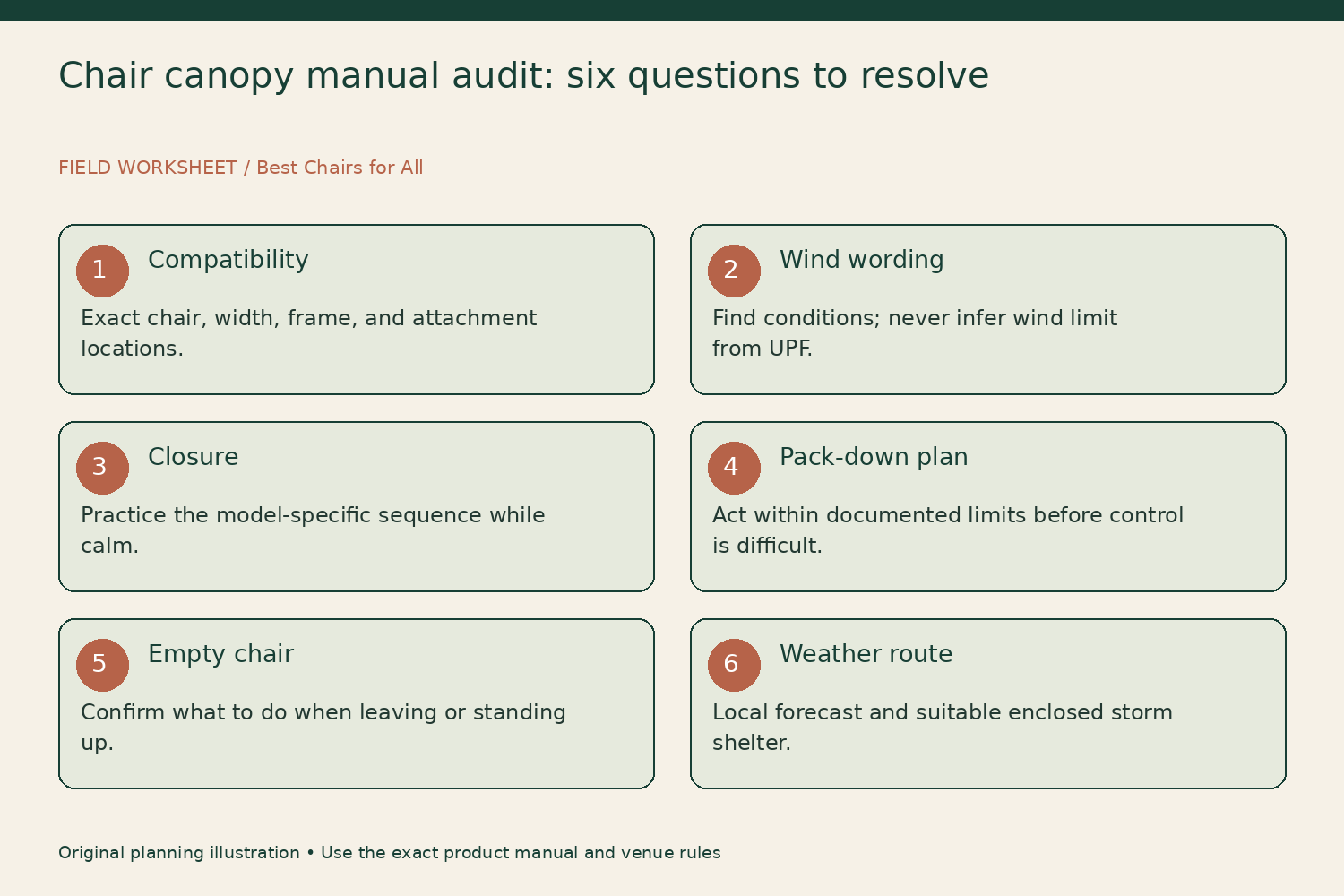
This guide provides a manual audit and an early pack-down plan. It does not prescribe a universal miles-per-hour threshold, ballast weight, anchoring depth, or chair orientation for every canopy. Integrated shades, clip-on canopies, and side-mounted umbrellas have different connections and operating arrangements. Treat each as the product it is, with the manufacturer’s conditions attached to the complete assembly.
Separate sun protection from wind performance
A UPF statement concerns the fabric’s ultraviolet protection under its specified conditions. It is not a wind rating or a promise that the shade stays attached in a gust. Likewise, a broad canopy can provide useful shade while creating a larger exposed surface. Read the wind and operating instructions separately instead of treating one favorable specification as evidence for every outdoor condition.
The GCI SunShade Accessory page describes UPF fabric and a compatible chair-width range. Those are useful sunshade and fit specifications; neither should be converted into a wind-speed allowance. Ask for the current manual for the exact accessory and chair combination, especially if a retailer advertises a wind figure not explained in the manufacturer documentation you have.
Identify the shade arrangement
An integrated canopy may pivot from the back of the chair. A clip-on shade uses clamps on specified frame locations. A side umbrella has a different pole and hinge arrangement. Photograph the attachment points and compare them with the product diagram. Note whether the manufacturer identifies compatible chairs, tube sizes, mounting locations, or other limits beyond a broad claim that the accessory is universal.
A matching width alone cannot establish every aspect of clamp fit. A rounded arm, fabric-covered tube, reclining linkage, or tapered frame can change the available attachment. Do not add tape, foam, a spacer, or a different clamp simply to make an accessory grip. Obtain an approved fit confirmation or choose a compatible assembly. The canopy’s weather instructions make sense only after its mounting arrangement is correct.
Audit the manual for missing information
Make five rows: compatible chair, mounting procedure, permitted weather conditions, closing procedure, and unattended-use instructions. Add a sixth row for inspection and replacement parts. In each row, copy the location of the relevant instruction in your notes, then summarize it accurately. Leave missing information marked ‘not supplied’ rather than filling it with a number from another model.
Ask the manufacturer a precise question about each gap. For example: ‘Does this shade have a specified operating wind limit for chair model X, does that include gusts, and what should I do before leaving the chair unoccupied?’ An answer that repeats the fabric’s UPF rating does not resolve the weather question. Keep the inquiry tied to the exact accessory version and mounting arrangement.
Read numeric wind claims critically
If the manufacturer gives a wind figure, look for the conditions attached to it: deployed or closed configuration, required mounting, occupancy, surface, gust versus sustained wind, and any test description. Do not assume a single advertised number applies to every chair that accepts the clamp. A claim about an independent pop-up shelter is not a claim about a chair canopy from the same brand.
Also distinguish a laboratory or documented test claim from a reviewer’s informal experience. A reviewer reporting that a shade survived a particular day has not established an operating limit for your combination. Forecast wind at a nearby station is another different measurement. Use the maker’s actual restrictions and local conditions; do not treat a collection of unrelated numbers as a safety margin you can calculate yourself.
Learn closure before arriving at the beach
Practice the documented closing sequence in a suitable calm setting, keeping hands clear of the identified pinch points. Find the releases, hinges, ties, and transport position before you need them outdoors. Some designs require several steps rather than simply pulling the fabric down. Keep the original instructions accessible so another user can follow the same sequence.
The Sport-Brella Recliner Chair instruction sheet, for example, shows a sequence involving straightening and closing the umbrella, securing its ties, and positioning it for folding. That is an example of why a shade’s transport arrangement is model specific. Use the current sheet for your actual version rather than applying those movements to a clip-on canopy or another umbrella hinge.
Plan an early pack-down trigger
Use the manufacturer’s restriction as the operating boundary, and plan to close the shade before the situation becomes difficult to control. Add local beach or venue instructions and the weather forecast to that decision. Do not wait for the frame to lift or the clamp to move before deciding that the conditions require attention. Visible instability is a reason to stop use, not a useful way to find a performance limit.
When the manual provides no numerical wind allowance, choose a plan that does not depend on an invented threshold. Ask the supplier and avoid using the deployed shade in conditions it has not documented as appropriate. The absence of a warning number is not evidence of unlimited wind capability. A canopy may be a convenient sun accessory while still being an unsuitable choice for the conditions expected that day.
Do not improvise ballast or anchors
A seated occupant’s weight capacity does not tell you how much wind the assembly can resist, and the chair may become unoccupied at any time. Do not assume a cooler, bag, sand weight, or another person’s foot creates an approved anchoring system. Such additions can change loading on the frame, interfere with folding, or create an obstacle near the chair.
Use anchoring or stabilizing accessories only when the manufacturer specifies them for the exact assembly and explains their installation. Instructions for a separate beach umbrella anchor do not transfer to a chair-mounted shade. Do not tie a canopy to a railing, another chair, or a nearby structure without explicit approval. A connection that prevents one part from moving can still load another part in an unintended way.
Inspect the connection before deployment
Check the components listed in the manual: clamps, hinges, releases, support arms, fabric attachments, and frame contact areas. Look for visible damage, missing pieces, or a part that does not seat as shown. Confirm that the chair itself is fully opened and placed on a permitted surface. A shade should not be used to conceal an already unstable chair setup.
If a clamp slips or a hinge fails to hold its specified position, stop use and ask for assessment or the correct replacement. Do not tighten beyond the maker’s instructions or bend a support arm back into shape. Record the location and take a photograph while the assembly is safely at rest. Recreating the movement in wind to obtain a dramatic video is unnecessary and can make the situation harder to manage.
Plan for an empty chair
Ask what the manufacturer requires when you stand up, walk away, or leave the setup unattended. The conditions change when a person leaves, and a canopy remains exposed. Make shade closure part of the departure sequence if the instructions require it. Do not leave someone unfamiliar with the mechanism responsible for an open canopy without explaining the actual procedure.
Keep small belongings from becoming a reason to leave the shade deployed. Organize books, cups, and towels so you can pack without reaching through moving linkages or loosening the wrong component. A clear area around the chair helps with ordinary closing and reduces interference with neighboring beach users. Follow venue rules about unattended equipment and permitted shade structures as well as the product manual.
Check weather through an appropriate source
The National Weather Service beach forecast portal links to local beach forecasts. Use the forecast for the actual destination and check updates during the day. A general sunny icon does not describe every gust or approaching storm. Combine official local guidance with the manufacturer’s operating restrictions, and keep the return route in mind when deciding how much equipment to deploy.
For thunderstorms, a chair canopy is not a shelter. The NWS outdoor lightning guidance directs beach users toward suitable enclosed shelter and explains that open picnic shelters are unsafe during lightning. Follow its current instructions, including the waiting period after thunder. Do not delay reaching safety to preserve a shade setup, and do not interpret a canopy’s rain resistance as protection from an electrical storm.
Document the limitation before buying
Compare candidates using the manual-audit rows. One product may have clearer closure instructions or a better documented compatibility list, while another leaves weather conditions unanswered. Treat missing information as a purchasing limitation. Do not award extra credit for a vent, reinforced fabric, or a heavier frame unless the manufacturer explains the consequence relevant to your intended use.
If you frequently visit a windy location, tell the supplier that before purchase and ask whether the model is appropriate. You may decide to use a different permitted shade arrangement or visit under different conditions. The decision should address the expected environment, not depend on holding the canopy down or adding unapproved weight whenever the breeze rises.
Keep a shade-specific operating card
Write the exact shade and chair models, mounting source, weather restriction, closing sequence reference, unattended-use rule, and forecast link on a small card. Put unresolved answers on the same card so they cannot disappear behind the word ‘approved.’ Keep the original manual accessible; the card is a reminder of verified information rather than a replacement for the instructions.
The useful precaution is knowing the assembly’s documented limits before it is open at the beach. Correct fit, a practiced closing sequence, and an early decision to stop deployment are more meaningful than a guessed universal wind speed. Choose the conditions and equipment that the manufacturer actually supports, and treat a sun canopy as a specific accessory whose shade, fit, and weather behavior require separate answers.
Something unclear or out of date? Send a correction with this article’s title and the detail to check.
Sources, research & corrections policy ↗