Water-resistant outdoor cushions can shed some water without being a sealed barrier against sustained exposure. Waterproof fabric can resist water passing through that fabric, but the complete cushion also has seams, openings, an underside and filling. Read the claim at the level where it applies. A fabric specification alone does not establish how the entire cushion behaves after rain.
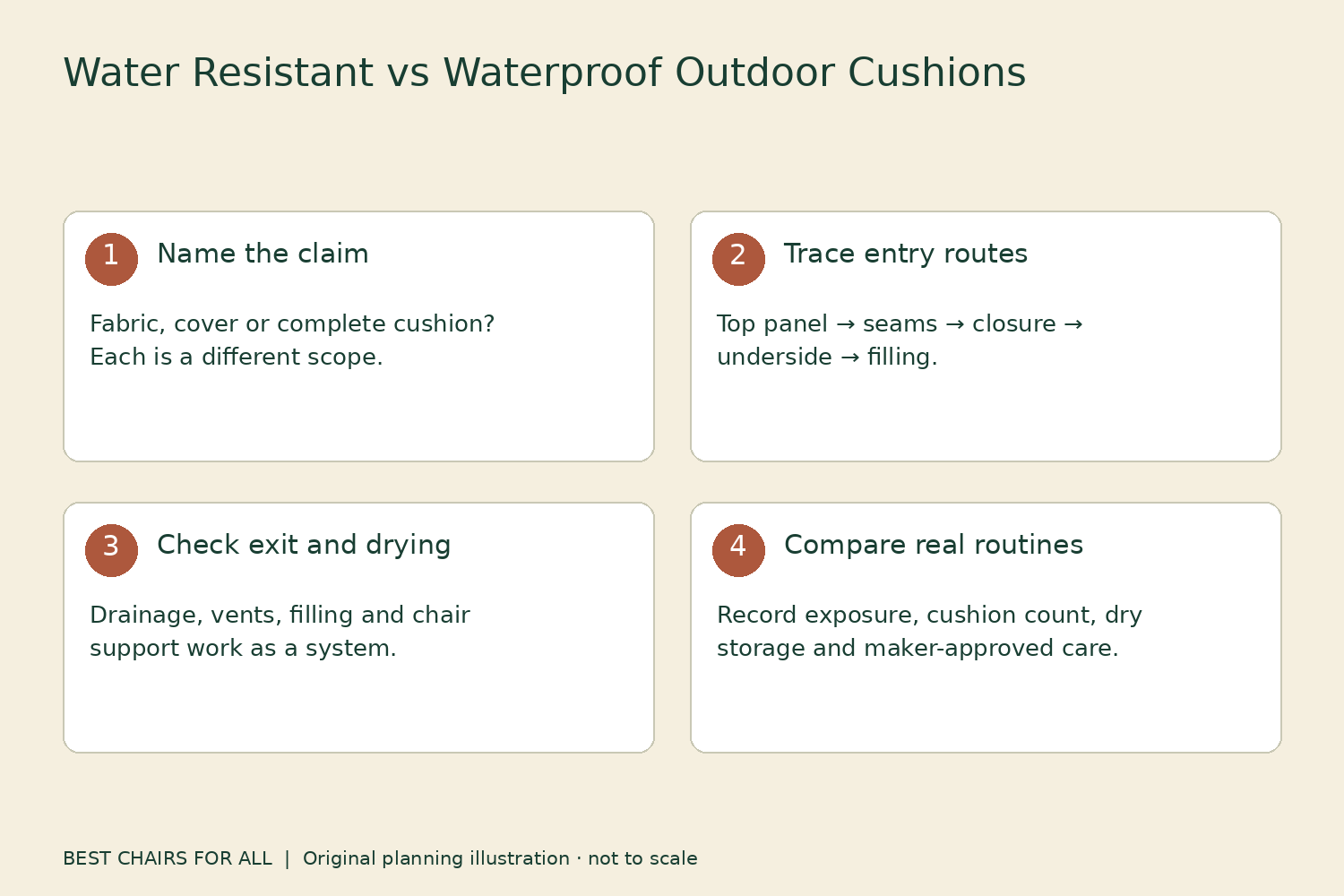
The practical purchase question is not simply which adjective sounds stronger. Ask where water can enter, where it can leave, how the filling dries and what care the manufacturer requires. A cushion designed to drain and dry can suit one patio routine, while a construction intended to keep water out may suit another. Both still need care consistent with their actual instructions.
Identify the exact fabric range
A familiar fabric brand can include several products with different water performance. Sunbrella’s own support page says its fabrics range from water-resistant to waterproof. Therefore “made with Sunbrella” is not by itself a complete answer to whether a cushion is waterproof.
Ask for the fabric name, style number and any coating or backing designation. Keep those details with the cushion model. The same color can appear in different constructions, and a retailer’s short title may omit the relevant distinction. If the seller cannot identify the actual range, leave the claim unresolved rather than assigning it the strongest performance available under the brand.
Also establish whether the claim applies to the top panel, the whole cover or the finished cushion. Those are separate products in manufacturing terms. A waterproof top panel sewn to a breathable base can be a deliberate system, but its correct orientation and drainage matter. Do not assume you can flip it over without changing how it handles water.
Follow water through the cushion
Imagine rain landing on the top, flowing toward the edge and reaching a seam. It may shed from the surface, pass through stitching, enter at a zipper or reach the filling from the underside. This is a reasoning exercise, not a prediction that every cushion leaks at every opening. Its purpose is to identify the construction questions a fabric-only claim leaves unanswered.
Inspect seams and closures without pulling them apart. Ask whether the maker uses a barrier, special seam construction or another documented method for water management. If a zipper is exposed on a side that commonly receives rain, ask how that area should be positioned. A closure intended for manufacturing access may not be a user-removable washing opening.
Check where the cushion touches the chair. Water can remain between fabric and a solid support or collect in a low area. A chair frame with an open support pattern creates a different drying environment from a solid platform. The cushion and chair should work as a combination. Replacing the fabric with a more resistant cover does not automatically improve drainage underneath.
Water resistance is not a drying-time promise
A cushion can resist brief wetting yet become damp during prolonged rain. How long it takes to dry depends on its filling, construction, exposure and airflow. Do not turn “quick drying” into a guaranteed number of minutes unless the maker provides conditions and a specific claim. Even then, your patio may not reproduce those conditions.
SunVilla describes its performance cushions, including those with Sunbrella and Outdura fabrics, as water-resistant and quick-drying, while still recommending complete drying between uses. That is a useful example of performance language paired with an ongoing care requirement. The care requirement is part of the product description, not an optional afterthought.
If a cushion remains wet inside after the cover feels dry, storage needs to wait. A dry-looking top is insufficient evidence that the whole assembly is ready for a sealed box or bag. Follow the maker’s inspection and drying instructions. Do not remove filling through a zipper unless the construction and care directions allow it.
Keeping water out and letting water leave are different strategies
Some cushions rely on a water-repellent surface, a filling designed for drainage and an underside that permits drying. Others use more substantial barriers to limit entry. The right questions concern the complete strategy: what happens during rain, after someone sits on a damp surface, and during the next drying period?
A barrier system must still manage its seams and any moisture that gets inside. A drainage-oriented system needs a suitable route for water and air, and may be uncomfortable to use before it has dried. Neither description is a universal ranking. Ask the manufacturer how the finished cushion is intended to be used, oriented, cleaned and stored.
Avoid adding a plastic wrapping around the filling as a home waterproofing upgrade. It can interfere with the intended construction and make moisture harder to detect or remove. Likewise, cutting new drainage holes into a cover can damage the material and seams. Select a cushion designed for the result you want rather than reconstructing a different water-management system yourself.
A documented waterproof construction example
Frontgate’s explanation of its Sunbrella Rain cushion describes more than a waterproof fabric. It discusses a covered foam core, thread intended to expand when wet and a venting system. The article is dated January 2020, so use it as a construction example rather than a promise about every cushion currently sold by Frontgate.
This example illustrates why a finished cushion claim deserves a construction description. The maker is addressing several possible paths for moisture, not relying only on the top fabric’s reputation. If you are shopping today, verify the current model’s materials and instructions directly. A historical article does not establish current availability, identical construction across collections or an unchanged product specification.
Do not transfer that description to a custom cushion simply because it uses a fabric with the same Rain name. Fabrication matters. Ask the custom maker what it does at seams, closures and the underside, and whether it supports a waterproof claim for the finished item. The answer should be specific enough to inform care and placement.
Use a claim-and-construction worksheet
| Question | What a useful answer identifies |
|---|---|
| What is water-resistant or waterproof? | Exact fabric, cover or finished cushion |
| Which fabric? | Brand, range, style and backing |
| How are seams handled? | Documented fabrication method or limitations |
| What is inside? | Filling construction and approved drying method |
| Which side faces down? | Orientation and any vent or drainage panel |
| What happens after soaking? | Maker’s drying and storage instructions |
| What maintenance is required? | Cleaning, repellency treatment if permitted and seasonal storage |
Use the worksheet to compare actual candidates. A seller that provides clear limitations may be more helpful than one that repeats “weatherproof” without defining the assembly. Keep uncertainty visible. If waterproof performance is essential because you cannot move cushions before rain, obtain confirmation about the entire current product rather than assuming a fabric label covers that requirement.
Test your patio routine before selecting a claim
Write down how often the seating is used and where the cushions go between uses. A covered porch with easy indoor storage is different from an exposed deck far from a storage area. If you regularly bring cushions inside, simple handling and manageable bulk may matter more than the strongest water claim.
Count and measure the cushions as a complete set. Four deep seat-and-back combinations can be much bulkier than four dining pads. A deck box must have useful internal space and a suitable moisture environment. Its advertised exterior volume does not prove that thick cushions fit without compression or that it will keep already damp filling dry.
Consider the return from a wet day. Can you place the cushions on a permitted drying surface with airflow, protected from another shower? If the answer is no, a supposedly quick-drying product may still be inconvenient. Improve the storage and drying arrangement or select a product with documented performance that suits the actual routine. Do not rely on a stronger adjective to solve a missing care space.
Cleaning can affect surface behavior
Surface repellency and the underlying fabric’s properties are different. Cleaning, wear and contamination can change how water beads. A loss of beading does not by itself diagnose every layer of the cushion. Check the fabric and furniture maker’s directions before applying a treatment, especially if the cover has a coating or special underside.
Use only a permitted protector or retreatment and apply it under its current instructions. A waterproofing spray intended for boots or tents is not automatically compatible with outdoor upholstery. It may change feel, appearance or breathability. Do not assume treating the top panel seals seams or makes the filling waterproof.
Keep dirt and food residue from building up even on performance fabrics. Claims about mildew resistance do not mean a cushion is self-cleaning or that damp contamination cannot cause problems. Brush or clean as directed, address spills promptly and allow the complete item to dry. Maintenance needs remain relevant whichever water-management strategy you choose.
Judge the whole assembly
For a replacement purchase, request the finished cushion’s care sheet before ordering. Confirm fit, retention and water performance together. A well-described waterproof assembly that does not fit the chair is still unsuitable; a comfortable water-resistant cushion can be perfectly practical when its drying and storage requirements fit your home.
Avoid conducting a home soaking test on a new cushion unless the maker specifically recommends it. Deliberately saturating the filling can create a drying problem without establishing a standardized waterproof rating.
Keep the product name, fabric identity, orientation and care instructions with your patio records. When performance changes, you can ask a precise question instead of guessing from a brand name. The meaningful distinction is how the complete cushion manages water in your setting, with the limitations and care routine understood before it reaches the chair.
Something unclear or out of date? Send a correction with this article’s title and the detail to check.
Sources, research & corrections policy ↗