A chair mat that moves on carpet may have the wrong backing, the wrong support rating, insufficient coverage, a damaged or curled shape, or an application that its grippers cannot engage properly. Check those conditions before adding tape or placing furniture on the mat. A hard-floor mat and a carpet mat are not interchangeable just because their top surfaces look similar.
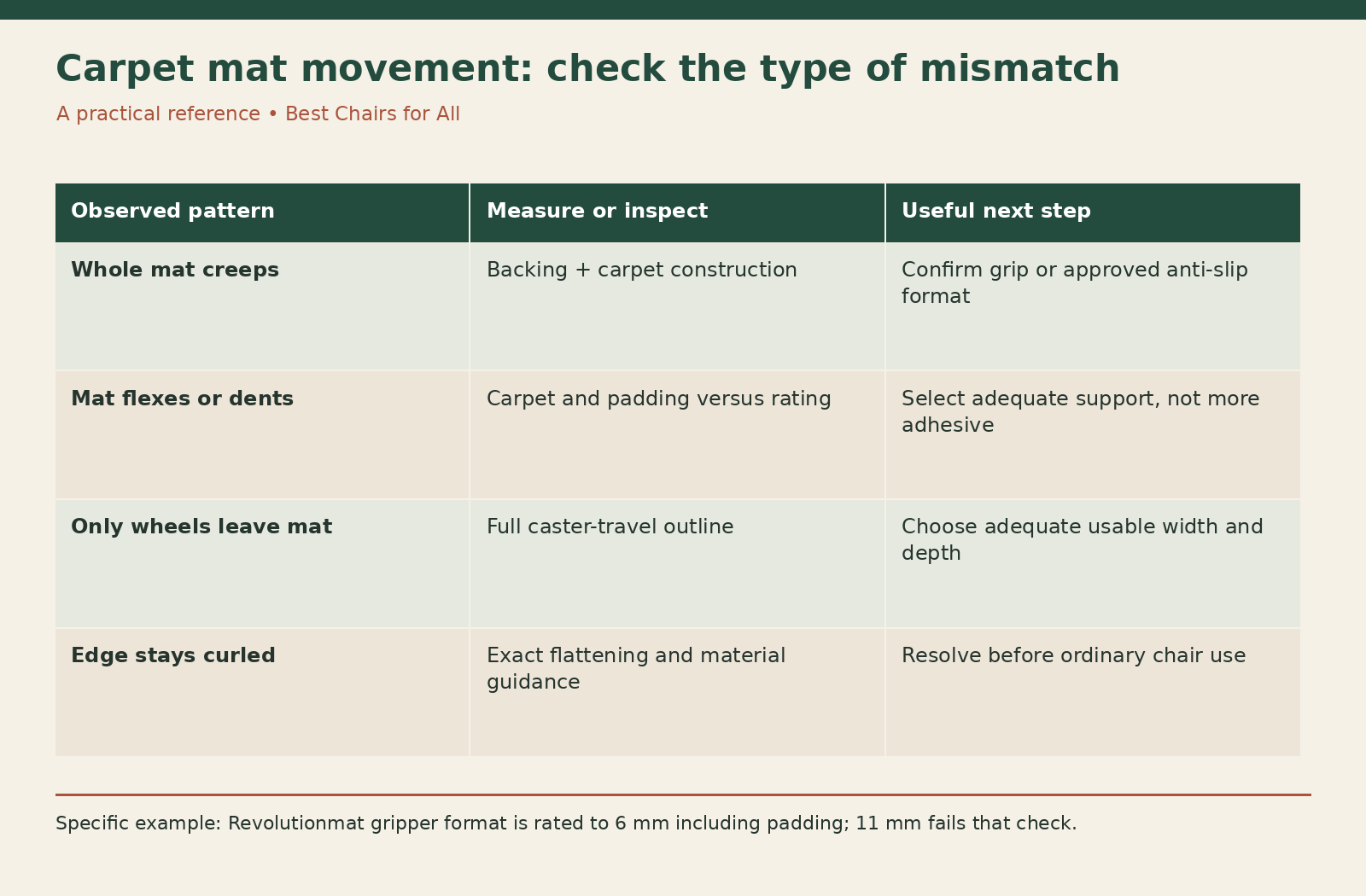
The goal is a flat, appropriately supported rolling surface whose location remains predictable during normal work. This guide provides a movement log and a carpet-depth comparison that distinguishes a selection problem from an installation problem. It also explains why very low-pile carpet can require a different approach from a thick plush carpet.
Confirm what is actually moving
Observe the mat relative to a fixed reference such as a desk leg or floor feature. Use a removable nearby marker only where it will not affect the carpet or mat. Record whether the entire mat creeps, an edge lifts, or the chair simply rolls off a stationary mat.
Those are different faults. A chair leaving a small stationary mat needs a rolling-area check. A mat that bends under the wheels needs a support-rating review. A whole mat shifting gradually across carpet points toward backing, carpet interaction, or the use pattern.
Do not recreate a trip or fall to demonstrate the problem. Remove the chair from the mat before inspecting underneath and handle the mat according to its instructions. A curled edge in a walkway is a reason to stop using the arrangement until it is corrected.
Identify the mat rather than guessing from its top
Find the manufacturer, product code, material, backing, and stated floor application. Check the packaging or purchase record if the underside has no clear label. A transparent rectangular mat is not enough information to establish carpet compatibility.
The ES ROBBINS FAQ distinguishes cleated carpet mats from smooth-backed hard-floor versions and requires selection for the actual carpet thickness. Within that manufacturer’s system, a smooth-backed hard-floor mat is not the intended ordinary carpet solution.
Keep exceptions specific. Some specially documented anti-slip products are designed for more than one application. That does not mean an unidentified smooth mat is suitable on carpet. The exact product instructions, rather than the general material name, establish the supported use.
Measure carpet and padding by the stated method
Read what the mat maker includes in its depth rating. Some specifications include padding, while others describe carpet pile differently. Measure using the manufacturer’s recommended method and record units. Do not select a low-pile product merely because the visible fibers look short over a thick cushion pad.
As an example of a defined limit, the Floortex Cleartex Revolutionmat care sheet identifies its gripper-back application for low-pile carpets up to 6 mm including padding. That limit belongs to that product and is not a universal rating for polypropylene mats.
For a hypothetical carpet-plus-pad measurement of 11 mm, a mat limited to 6 mm does not pass the application check. Adding more adhesive does not change that support condition. Look for a product rated for the measured floor assembly and intended use, or ask the manufacturer which option applies.
For comparison, ES ROBBINS describes separate flat-pile, low-pile, medium-pile, and high-pile categories. Its FAQ distinguishes a flat commercial-carpet category without padding from several categories whose stated depth includes padding. Read the actual product you intend to buy rather than transferring a category name across brands. One manufacturer’s low pile is not a unit of measurement. Put the measured depth and the written limit beside each other in the same units, then keep the full description with the order. If you cannot measure the hidden padding confidently, obtain the carpet specification or ask the mat supplier how to establish the correct category.
Distinguish deep-pile support from grip
A mat can have grippers and still be inadequately supported by the carpet beneath it. Under the chair’s rolling contacts it may flex or form depressions, making the user push harder and changing how forces pass through the mat. Grip and support are therefore separate questions.
Inspect whether the surface stays suitably flat in ordinary use or develops persistent dents, cupping, or cracks. Do not assume that more spikes solve a rigidity mismatch. If the mat is already damaged, take it out of service and ask about replacement rather than hiding the defect beneath another layer.
Compare the product’s rating with actual use conditions, including any stated user or usage limits. A recommendation from another owner with “similar carpet” is less useful than a documented rating and your own measured depth. Carpet construction and padding can differ substantially beneath a similar appearance.
Very low pile can need a different backing
Grippers need an appropriate surface to engage. Very low-pile or tightly constructed carpet and carpet tiles may not behave like a deeper carpet. Do not respond by pressing harder, sharpening cleats, or adding homemade spikes that could damage the floor assembly.
The Floortex Unomat information sheet describes a specific anti-slip approach with supplied slip-resistant pads for hard floors and very low- or no-pile carpets. It is a named product solution to a defined application, not permission to attach any adhesive pad to an unrelated mat.
Ask the maker whether your carpet type and depth are within that product’s scope and follow its placement instructions. Keep floor-finish or carpet-warranty requirements in the conversation. A backing modification that stabilizes one surface can be unsuitable for another.
Check orientation and initial flattening
Confirm the top and underside from the actual instructions. For a gripper-backed mat, the cleats belong against the compatible carpet and the rolling surface faces up. Do not flip a mat merely because the rougher side appears to hold the wheels better.
Read the flattening instructions for the material and delivery format. Rolled vinyl, rigid polycarbonate, and a fold-supplied polypropylene product can have different procedures. The Revolutionmat sheet, for example, contains specific guidance for its folds; do not transfer that method to a rigid or glass mat.
Wait until the mat meets the maker’s ready-for-use condition before putting a rolling chair on it. Avoid heat guns, boiling water, deliberate overbending, or forced trimming as universal flattening methods. If it will not lie correctly after the specified procedure, ask the supplier to assess the product.
Measure whether the mat is large enough
Sketch where the outer casters travel while working, turning toward equipment, and rolling back to stand. Include the area behind the typing position, where wheels often cross an edge. A mat sized only for the stationary base can be too small for normal use.
For a worked example, suppose side-to-side travel spans 39 inches and front-to-back travel spans 46 inches. A 36-by-48-inch rectangle fails the width check despite appearing nearly large enough. A lipped outline needs an additional check because the narrow extension may not cover the full base at the under-desk position.
Observe whether the repeated edge crossing is pushing or shifting the mat during use. A larger appropriate shape may solve the coverage problem, but confirm it fits the room and desk. Do not overlap two unsupported mats as a patch, because the step between them creates another rolling transition.
Keep the surface and underside clean
Remove loose debris from the mat top and accessible underside using its care instructions. Clear the carpet below before relaying it. Dirt and fibers can obscure whether cleats are contacting the intended surface and can complicate a movement diagnosis.
For the specific Revolutionmat product, the care sheet describes mild-soapy-water cloth or sponge cleaning and limits its environment and loading. Follow the applicable method for your mat, then ensure the surfaces are ready for reuse. Do not add polish or oil to make the chair roll more easily.
Inspect the carpet itself for buckling, loose sections, or an underlay problem. A mat cannot repair an unstable carpet installation. If the floor assembly shifts or forms ridges, ask the property owner, installer, or facilities team to assess it before choosing another accessory.
Avoid unsupported anchoring shortcuts
Do not screw, nail, or staple a mat into the carpet or subfloor as a routine anti-creep measure. Such fasteners change the mat and can create exposed hazards or damage a rented floor. Check the manufacturer’s position before any permanent alteration.
Tape and loose rug-gripper products also need compatibility checks. A backing approved for a small entrance rug is not automatically appropriate under a rolling-chair mat. It can change support, leave residue, or conflict with the mat’s care and warranty conditions.
Avoid placing a heavy cabinet or desk foot on a corner unless the specific mat permits that loading. An anchored corner can leave the remaining area flexing or create a new obstruction. Correct selection and supported installation are the first steps; anchoring should not disguise an unsuitable mat.
Keep a movement-and-fit log
Use fields for mat product, underside type, carpet-plus-pad measurement, stated application limit, initial position, observed movement, edge crossings, and surface condition. Record the period of ordinary use you observed without implying a standardized performance test.
A hypothetical entry might read “gripper mat rated to 6 mm; measured assembly 11 mm; flexes and creeps; application mismatch.” Another might read “very low carpet tile; grippers do not engage; ask about maker-approved anti-slip format.” A third could read “mat stays put; rear wheels leave edge; larger outline needed.”
Change one supported condition at a time and update the record. If the correct mat continues moving after its installation checks, send the log and photographs to the maker. The most useful outcome is a documented match between carpet, backing, support, and rolling area, followed by ordinary use that no longer creates unexpected edges or drift.
Something unclear or out of date? Send a correction with this article’s title and the detail to check.
Sources, research & corrections policy ↗