Inspect a used office chair in a fixed order: establish its identity, check recalls and major condition concerns, inspect it without loading, then test ordinary functions only if there is no reason to stop. Finish with a fit trial and a record of unresolved issues. A short inspection cannot certify hidden structural condition or predict remaining life, but it can reveal missing evidence and obvious reasons to reject an offer.
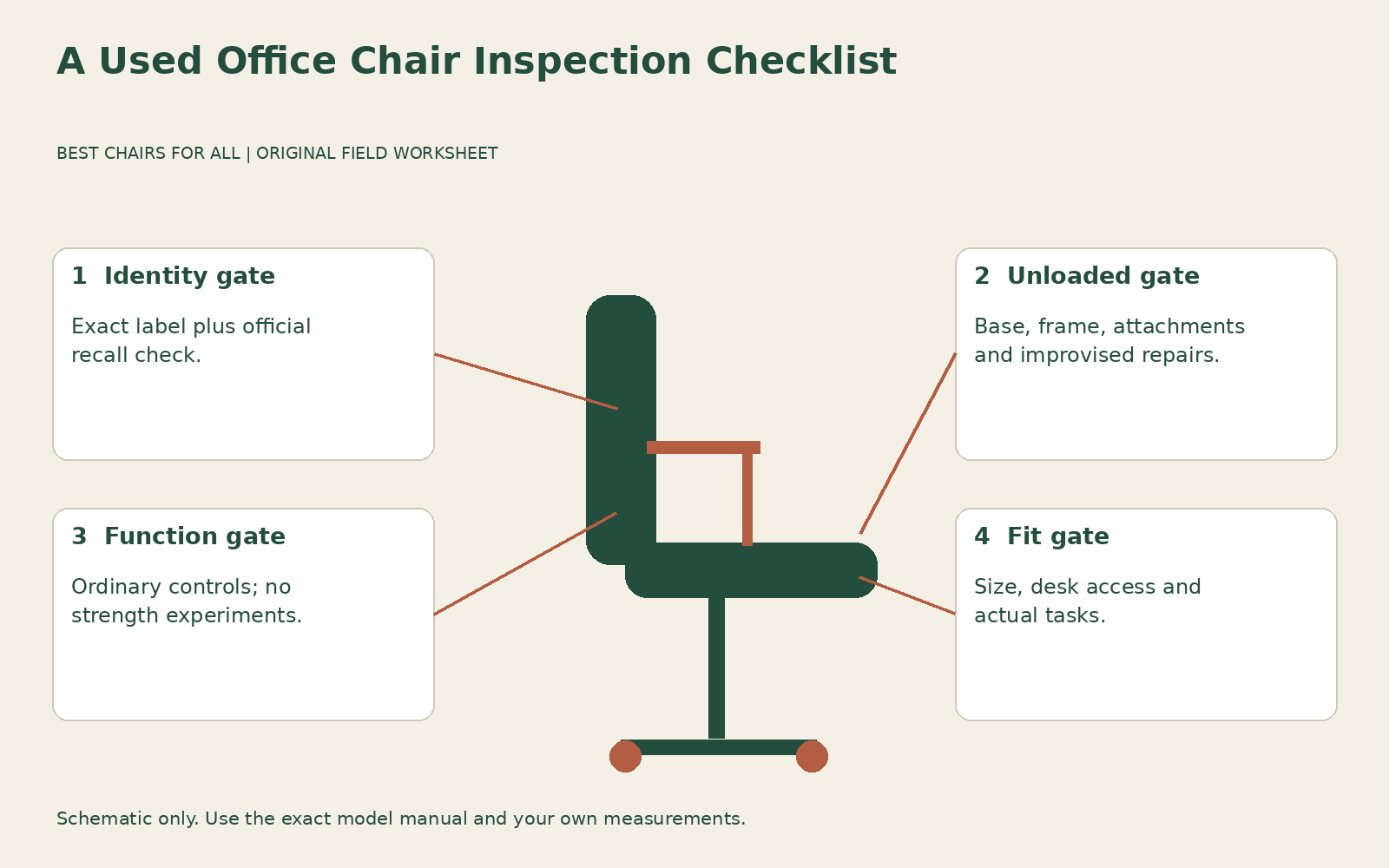
The checklist below is a purchase gate rather than a repair tutorial. It avoids opening mechanisms, removing pressurized components, or testing strength by bouncing. If you want to compare a seller’s restoration work, use our refurbished-versus-used ledger. Here the objective is to document the condition and operation of the actual unit you may take home.
Request the right information before traveling
Ask for clear photographs of the entire chair, underside label, base, casters, seat surface, backrest, and controls. Request the model, approximate history, known faults, and replaced components. A front photograph in flattering light cannot establish whether the chair has the option you need or whether its base has visible damage. Asking early can save a journey to inspect an unsuitable configuration.
Identify whether photographs show the exact chair or a representative unit from a batch. If it is a batch sale, ask how the delivered unit will be selected and whether you can reject one with different options or condition. Chairs from the same office can differ in size, arm type, lumbar support, and maintenance history even when their upholstery matches.
Bring your desk measurements and a short list of essential fit requirements. Also bring the exact model’s user guide on your phone or paper. You need to know which controls should be present and what ordinary operation looks like. Do not arrive intending to infer every feature from generic lever positions or an online review of another generation.
Gate one: establish identity and recall status
Photograph the identifying label and compare it with the seller’s description. Herman Miller manufacturer label, parts and service guidance shows why the model and manufacturing information matter for service and parts identification. A missing label is not proof of a counterfeit, but it limits verification. Ask the manufacturer or a knowledgeable authorized service channel if the identity cannot be established from reliable information.
Check the applicable official recall database and manufacturer notices using that identity before sitting. A current example is the CPSC March 2026 Tainoki swivel office-chair recall, involving specific Tainoki swivel office-chair models and a base-bending hazard. The notice illustrates why a normal-looking five-star base and a relatively recent purchase date do not establish that a chair is unaffected. Read the exact notice and its remedy instructions if a model appears to match.
If recall status is unresolved, postpone the occupied test. Do not accept a statement that the chair was inspected as evidence that a particular remedy was completed. Ask for the appropriate record and confirm it through the responsible recall channel when necessary. A seller’s cleaning or refurbishment label does not override an official stop-use instruction.
Gate two: inspect without loading
Place the chair in a clear area on suitable flooring. Inspect the base spokes, caster housings, visible seat supports, back frame, arms, and attachment areas for cracks, bending, missing components, or unusual separation. Use a flashlight if helpful and avoid putting your face or hands beneath an unstable assembly. Do not tip a heavy chair without suitable help and a safe method.
Distinguish cosmetic marks from possible structural concerns without pretending a lay inspection can prove strength. A scuff on a finish is different from a crack in a load-bearing part, but an uncertain line or distorted joint may need a service opinion. Photograph the area and stop the purchase test if you cannot establish whether ordinary use is appropriate.
Look for improvised repairs: wedges, clamps, straps, adhesive patches on structural areas, mismatched fasteners, or parts that do not appear to belong to the model. Ask what was done and by whom. Do not remove a makeshift restraint to see what happens under your weight. An inexpensive offer with an unresolved structural modification is not made acceptable by reducing the price.
Inspect the surface and cushion condition
Check the seat front, sitting area, seams, backrest corners, and arm pads. Look for tears, exposed support material, lifting surface layers, sticky areas, deep permanent depressions, and attachments separating from the frame. On mesh or suspended seats, distinguish a small cosmetic snag from a tear or loss of support that needs assessment. Do not pull at a damaged area to test how far it spreads.
Ask about cleaning history, storage, odors, and spills. These can affect whether you want the chair and what cleaning is feasible, but avoid making a diagnosis from a stain or smell. Obtain the actual material care instructions before deciding that a strong cleaner will solve it. A replacement cover may conceal an old cushion, so ask whether foam and support parts were retained.
Record each surface concern separately from mechanical operation. “Seat fabric stained, no structural conclusion” is clearer than marking the whole chair poor. If reupholstery is necessary, obtain a quote for the specific assembly before buying. A generic fabric price does not include labor, compatibility, or the possibility that a more complex seat cannot be recovered as expected.
Gate three: test only ordinary intended functions
Once identity, recall status, and visible condition permit a normal trial, sit carefully and test the functions described in the manual. Set height within the approved range, pause under ordinary seated use, and note whether the position remains consistent. Do not bounce to stress the lift or exceed the documented user limit. Unexpected sinking or release is a reason for service, not an invitation to dismantle the cylinder.
Check seat depth, arm adjustments, lumbar movement, and recline as applicable. A control may require weight to be removed or a particular movement before it operates. The Herman Miller Classic Aeron user adjustment guide distinguishes Classic Aeron tension, forward tilt, and tilt limiting, illustrating why a knob that turns is not proof that every tilt function works. Apply that guide only to the matching chair and installed options.
Test smooth swivel and ordinary positioning on appropriate flooring. Listen for unusual sounds and note where they occur without declaring every squeak a structural failure. Likewise, some play may be design-related, while newly excessive movement may require assessment. Ask the manufacturer or service provider if behavior is inconsistent with the guide. A seller’s assurance that all old chairs do that is not verification.
Do not mask a failed lock by tightening tension until the back barely moves. Those controls have different roles. If a promised function is absent, ask whether the chair lacks the option, has a broken control, or is being described incorrectly. Record the answer and supporting evidence before deciding whether the offer still meets your needs.
Gate four: check fit at the useful settings
A mechanically functioning used chair can still be the wrong size. Resolve height and foot support, then check usable depth and back contact. Test the arms at relaxed working positions and compare the desk underside measurements you brought. If the chair cannot meet an essential relationship within its normal range, reject it for fit rather than planning an unverified modification.
Repeat a few actual tasks or their realistic equivalents: typing, using a pointer, reading in a controlled recline, and standing. Note whether the seat or support changes unexpectedly during transitions. This fit check is shorter than a real workday trial, so keep sustained comfort unresolved unless the seller provides a suitable return opportunity. An excellent first sit is useful evidence, but it is not a lifespan forecast.
Confirm capacity from exact-model documentation separately. A wide seat, heavy base, or replacement cylinder label cannot establish the complete chair’s rating. Ask whether major replacement parts are approved for that assembly. If the information is unavailable, mark it unverified; do not perform a home load test to manufacture the missing evidence.
Use a four-gate inspection record
Make headings for identity and recalls, unloaded condition, ordinary function, and fit. Under each, list the observation, evidence, and decision. Use pass, unresolved, or stop. An unresolved identity or structural concern should not be averaged against attractive upholstery. A failed fit requirement can be enough to reject an otherwise intact chair without claiming that it is unsafe for someone else.
An illustrative record might read: “Label confirms model and version; no applicable notice identified in the documented search; visible base intact; seat slide does not hold its selected position; repair assessment needed before purchase.” Another might read: “Functions checked within ordinary use; arms too wide for useful support; unsuitable for this buyer.” The record clarifies the next step without pretending to certify the product.
For a repairable known issue, obtain the exact part and service quote before negotiating. Add transport and cleaning to the actual commitment, then compare another suitable offer. Leave unknown repairs unknown rather than inventing a low estimate. Do not negotiate away a stop-use issue when the responsible remedy or structural assessment remains unresolved.
Preserve the record when you buy
Save the listing, photographs, identifying label, agreed condition, and any return or service terms. Confirm that the chair you collect or receive is the inspected unit and configuration. At delivery, check for transport damage and repeat ordinary operation before routine use. Keep the relevant manual and maintenance information with the purchase record.
The inspection succeeds when it produces a clear decision: accept a documented suitable unit, resolve a specific question, or walk away. It does not need to prove every chair defective or eliminate every future uncertainty. A fixed sequence keeps the most consequential questions ahead of comfort and price, while the record gives you useful evidence if service or a return becomes necessary.
Something unclear or out of date? Send a correction with this article’s title and the detail to check.
Sources, research & corrections policy ↗