The electricity cost of a massage chair can be estimated from three numbers: its power use, your total operating time and your electricity rate. Ownership costs are broader. Delivery, upholstery care, repairs and eventual removal may matter more to your budget than a small difference in energy use.
This guide gives you a calculation worksheet and a practical care record. The numerical examples are illustrations, not measured consumption, average household usage or price quotations. Follow the exact chair’s manual for operation and maintenance.
Find the model’s power specification first
Look at the product label and the specification section in the manual. Record the model name, voltage, frequency and power figure. Do not substitute the wattage of a different chair just because it looks similar. If the seller’s listing and the manual disagree, ask for clarification before using either number.
For a documented example, the Infinity Aura manual lists power consumption as 150 watts. That is a specification for that model, not a claim that every chair uses 150 watts continuously. The actual energy used during a program can depend on which components are operating.
Keep electrical compatibility separate from energy budgeting. The correct outlet and supply requirements come from the manual. Do not choose an extension cord, adaptor or replacement power cable merely because the estimated running cost looks small.
The electricity calculation
Convert watts to kilowatts by dividing by 1,000. Multiply by operating hours to estimate kilowatt-hours, then multiply by your rate per kilowatt-hour. Virginia Cooperative Extension’s appliance-energy guidance describes this method and notes that actual consumption can vary with settings.
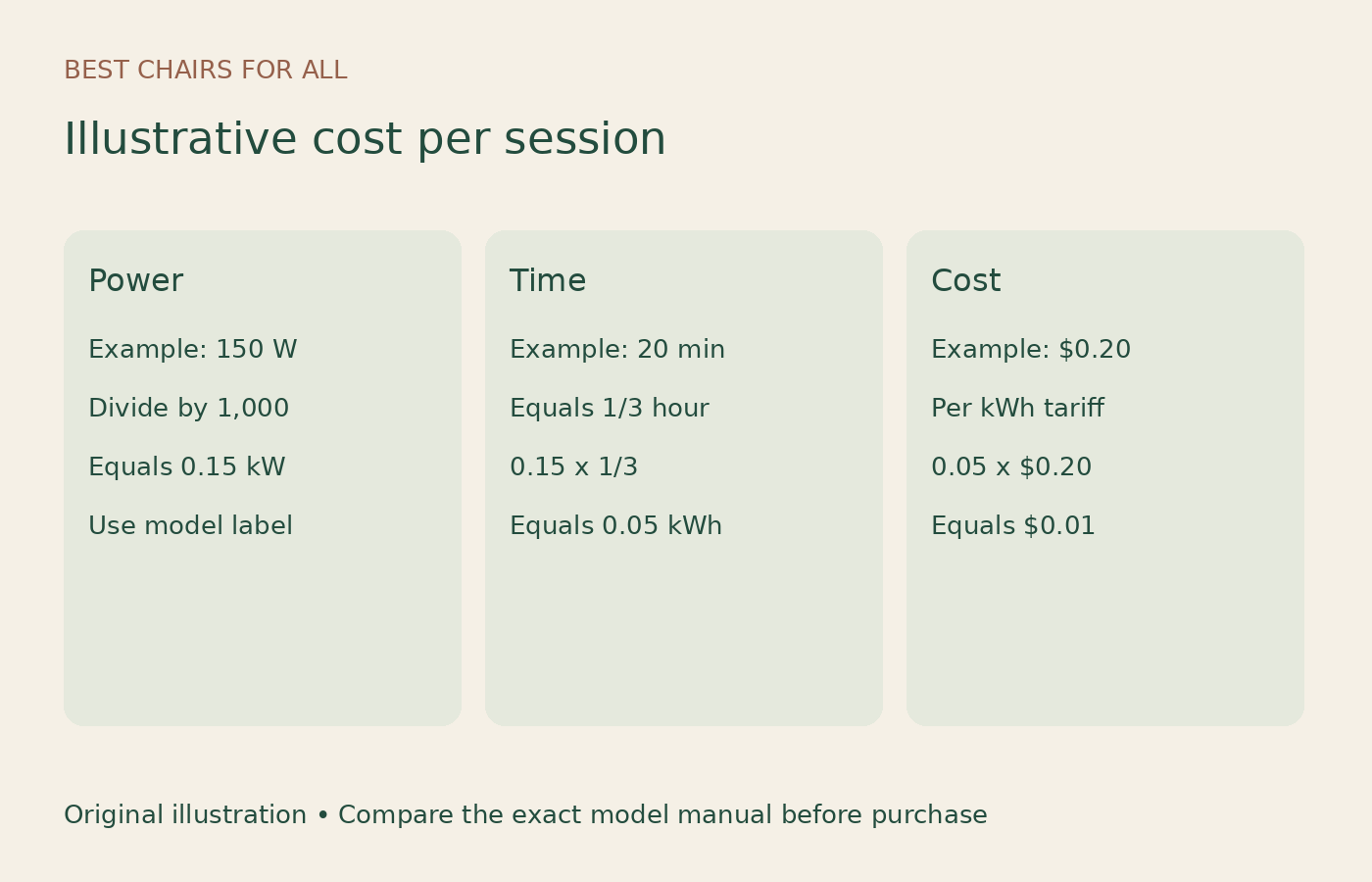
Estimated session cost = watts ÷ 1,000 × session hours × electricity rate. Convert minutes to hours before calculating. Twenty minutes is one-third of an hour, not 0.20 hours. Thirty minutes is 0.5 hours. Mixing minutes and decimal hours creates a substantial error.
For an illustrative 150-watt chair operating for 20 minutes at a hypothetical rate of $0.20 per kilowatt-hour: 150 ÷ 1,000 × one-third = 0.05 kilowatt-hours. Multiplying by $0.20 gives $0.01, or one cent. This assumes the listed power is drawn throughout that session and excludes standby consumption.
| Illustrative pattern | Energy at assumed 150 watts | Cost at assumed $0.20/kWh |
|---|---|---|
| One 20-minute session | 0.05 kWh | $0.01 |
| Thirty such sessions | 1.5 kWh | $0.30 |
| Sixty such sessions | 3 kWh | $0.60 |
| 365 such sessions | 18.25 kWh | $3.65 |
These rows are arithmetic scenarios, not recommended session schedules. Use only the duration and frequency permitted by your manual and appropriate for you. If several people share the chair, add their operating time together for the budget.
Use your tariff rather than a national average
Find the energy rate on your utility bill. If the rate changes by time of day, calculate separate groups for the times you expect to use the chair. If taxes or variable delivery charges apply per kilowatt-hour, decide whether to include them and label your calculation accordingly.
Fixed monthly charges should not automatically be allocated to the chair. You may pay those charges regardless of whether the chair is present. Your worksheet should distinguish extra usage charges from the whole electricity bill; otherwise, you can make a small appliance appear much more expensive than it is.
If your bill is confusing, ask the utility which marginal rate applies to additional household consumption. Keep the date beside the rate. An accurate calculation using an outdated tariff is still an outdated cost estimate.
Rated power and measured energy answer different questions
A label gives an electrical specification. A compatible plug-in energy monitor can record consumption over a period of actual use, provided the chair and monitor instructions permit that arrangement. Choose equipment rated for the supply and load, and do not open the chair or modify its wiring.
Record the total kilowatt-hours across several comparable sessions, along with program choices and whether heat was enabled. Divide by the number of sessions for your own observed average. Do not label one brief reading a typical annual consumption figure.
The U.S. Energy Information Administration’s explanation of electrical measurement distinguishes power from energy over time. That distinction is the reason a cumulative kilowatt-hour reading is more useful for a bill estimate than a momentary watt reading alone.
Include standby only if it exists on your setup
Some equipment consumes energy while waiting for use, but do not invent a standby figure for a chair without documentation or measurement. If you measure it, record the state of the chair: main switch on, screen asleep, wireless functions active, or some other condition.
A hypothetical one-watt standby load left on for 24 hours a day uses 8.76 kilowatt-hours over 365 days. At the same illustrative $0.20 rate, that would be about $1.75 a year. This example explains the calculation only; it is not a measured value for any chair.
Follow the manufacturer’s shutdown instructions. Switching off or unplugging may be required after use on some models. Do not bypass a necessary return-to-position routine or interrupt moving parts simply to chase a tiny theoretical energy saving.
Build a broader ownership budget
Use separate lines for purchase, delivery, assembly, electricity, approved cleaning supplies, expected paid service and removal. Enter confirmed quotations where available and “unknown” where they are not. A blank field is more honest than an invented annual repair allowance presented as an industry average.
Ask whether room-of-choice delivery includes stairs, unpacking, assembly and packaging removal. Confirm what happens if the delivery route fails. These are transaction costs, but they affect the practical cost of owning a very large chair.
For service, ask about callout charges after the labor warranty ends and whether parts shipping is covered. A long structural warranty does not necessarily cover an upholstery replacement or a technician’s visit. Read each coverage category rather than treating the largest year count as complete protection.
Use model-specific cleaning instructions
Massage chair upholstery can look like ordinary furniture upholstery while surrounding electrical controls, seams and moving mechanisms. Establish which material covers each section and which cleaning products the manufacturer permits. Do not assume that a product labeled for leather suits every synthetic cover.
Infinity’s cleaning guidance recommends disconnecting power before cleaning, using gentle methods, avoiding harsh solvents and keeping moisture away from electrical areas. Its instructions also distinguish cleaning the remote from cleaning upholstery. Treat those recommendations as brand guidance; the current instructions for your exact chair take priority.
Put cleaning solution on the approved cloth rather than indiscriminately spraying the chair. Work on a small area, avoid saturating seams, and let the material dry as directed. If the manual does not authorize a conditioner or disinfectant, ask support before applying it. A familiar household cleaner can still be unsuitable for a particular finish.
A realistic care routine
After use: return the chair to its prescribed resting position, remove loose belongings and follow the shutdown instructions. Keep drinks away from the mechanism. Look for anything that could become caught when the chair moves again.
When visibly dusty: clean permitted surfaces with the method in the manual. Clear accessible debris gently without inserting tools into moving sections. Remove washable inserts only if they are designed to be removed and the instructions explain how.
Periodically: check accessible upholstery for tears, observe whether cords are pinched or worn, and note any change in movement or sound. This is an external observation routine, not permission to remove covers or inspect internal wiring.
After a spill or damage: stop and consult the manufacturer’s instructions. Do not test a wet electrical control to see whether it still works. Take photographs and describe the event to support so they can identify the appropriate next step.
Keep a service record that saves repeated work
Create a folder containing the receipt, serial number, manual revision, delivery photographs and warranty terms. Add a simple log with dates, symptoms and support case numbers. If a problem is intermittent, record which program was running and what happened immediately before it.
Useful descriptions include “footrest stopped during return at the end of Program Two” or “new clicking sound occurs only while reclining.” Avoid guessing that a motor, sensor or circuit board has failed. Accurate observations help support decide what to check without anchoring the conversation to an unsupported diagnosis.
Do not lubricate, tighten hidden mechanisms or substitute electrical parts unless the manufacturer explicitly instructs you to do so. Routine care and mechanical repair are different tasks. An unauthorized attempt can add damage and complicate warranty coverage.
Compare two chairs without pretending to know their lifespan
Suppose Chair A costs more upfront but includes a longer labor period, while Chair B has a lower purchase price and an unknown callout charge. List those facts without calculating a guaranteed lifetime saving. You do not yet know whether either chair will need a repair.
You can create scenarios instead. One column can show no paid repairs; another can show a seller-quoted service visit. Clearly label both as possibilities. This makes uncertainty visible without converting it into a false forecast of average ownership cost.
Keep energy differences in proportion. A claimed saving of a few dollars a year does not automatically justify a large purchase-price premium. Verify the calculation, then compare it with the features, support and fit that matter to your household.
Your five-minute budget worksheet
- Copy the exact model and power figure from the manual.
- Add the household’s expected permitted operating time.
- Use the current tariff from your bill.
- Label the result as a rated-power estimate or a measurement.
- Add confirmed delivery, care and service costs separately.
Revisit the worksheet after a month of ownership if you want a more personal estimate. Replace assumptions with actual usage records and compatible meter readings where available. A small, clearly labeled calculation is more useful than a sweeping claim that every massage chair costs the same amount to run.
Separate cleaning supplies from repair spending
Give each purchase a category in your ownership log. A permitted cleaning cloth or manufacturer-approved conditioner belongs under routine care. A replacement remote, upholstery panel or technician visit belongs under repairs or replacement parts. Keeping them separate prevents a single unusual repair from becoming a misleading claim about normal monthly maintenance.
Also record whether a charge was reimbursed under warranty. Your out-of-pocket amount and the invoice amount may differ. If you later compare actual costs with your original worksheet, use the same basis in both columns. Note any remaining warranty claim as pending rather than subtracting an expected reimbursement before it arrives.
This record also helps when selling or relocating the chair: you can show the exact care products used and distinguish cosmetic upkeep from mechanical service.
Something unclear or out of date? Send a correction with this article’s title and the detail to check.
Sources, research & corrections policy ↗