A recliner that will not close needs a careful description before it needs a replacement part. First stop if there is visible damage, unusual twisting, electrical odor, or a trapped object or person. Then distinguish a manual closing problem from a powered function that has stopped. Only perform the simple external checks permitted by the exact owner’s manual; leave moving-linkage, spring, and electrical repairs to an authorized service provider.
Do not force the footrest down, reach underneath while someone presses a control, or assume that an online repair for another model applies. The most useful home task is to identify the failed stage, check the unobstructed environment and power supply where appropriate, and give the provider a clear incident record.
Establish the immediate situation
Is someone still seated? Is the footrest fully open or partly closed? Is the back upright, reclined, or uneven? If a person needs help leaving a chair, prioritize appropriate assistance rather than troubleshooting around them. Follow the manufacturer’s emergency instructions for that model and seek urgent help if a person is trapped or injured. A general article cannot supply a safe transfer method for an unknown chair and user.
Keep children, pets, and bystanders away from the operating area. Do not let anyone inspect underneath while the chair is connected or could move. Unplugging the wall supply does not remove spring forces, and a backup battery can leave a powered system able to operate. Treat the mechanism as a pinch area throughout the assessment.
Identify manual, power, or lift operation
Write down whether the chair uses a manual handle, push-back action, power buttons, or a lift-chair hand control. Record the full model and serial information if safely accessible. A powered headrest does not necessarily tell you how the footrest works, and a lift chair adds another motion stage. Use the actual operating instructions rather than deciding from the chair’s appearance.
La-Z-Boy’s manual index separates operating guides by product family and, for some models, shipment date. That demonstrates why model identification matters. If your chair’s manual cannot be found, contact the retailer before attempting a reset, release, or closing procedure learned from a similar-looking chair.
Locate the stage that fails
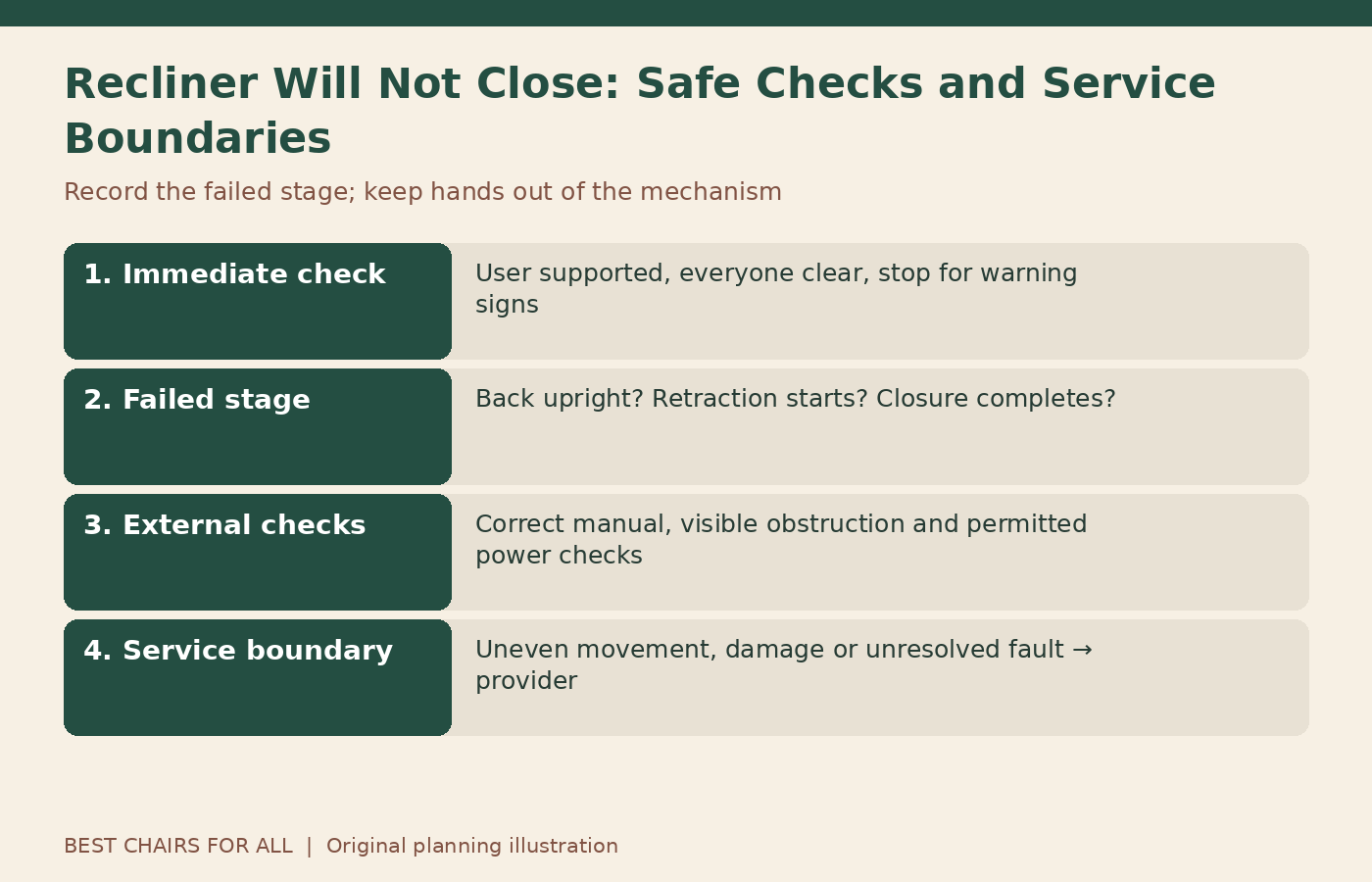
Divide normal use into four stages: back returns toward upright, footrest begins retracting, footrest completes closure, and the chair remains in its normal closed position. Note the first stage that does not happen. A chair that stops before any movement differs from one that reaches almost closed and springs open again. Record what you saw during ordinary operation without repeatedly reproducing the fault.
Add whether the movement is even on both sides and whether there was a new sound. An uneven or visibly distorted footrest is a reason to stop, not to push harder on the higher side. The stage record helps the provider decide what to inspect. It does not establish that a particular latch, spring, motor, or cable is defective.
Check for an external obstruction safely
Look around the chair from a normal standing position. A table, rug edge, toy, loose blanket, or misplaced cable may be in the movement path. Do not reach into the gap between the footrest and frame to retrieve an item. Stop operation and follow the manual’s isolation and access instructions; request service if the object cannot be removed without entering a moving area.
After any accessible external object is removed, inspect for damage before trying normal operation again, and only do so if the manual permits and no warning signs remain. A chair that encountered resistance may need assessment even after the obstacle is gone. Avoid repeated closing cycles that force the mechanism against an obstruction you cannot see.
For a manual chair, verify the normal sequence
Some manual mechanisms require a particular handle or body-position sequence. Confirm the exact instructions and have the retailer explain them if needed. Do not interpret resistance as permission to apply more weight to the footrest. The user should not stand on it, sit on its outer edge, or ask another person to push it closed from below.
Best Home Furnishings’ FAQ discusses model-dependent mechanism behavior and adjustment availability. That is a reason to ask the dealer, not a universal adjustment recipe. An instruction about one manufacturer’s tension arrangement should not be transferred to an unidentified manual recliner. Loaded springs and linkages require a service boundary even when no electricity is present.
Do not borrow a safety-release procedure
Some manufacturers document model-specific responses when a legrest contacts an obstruction or a safety device disconnects it. That does not mean every footrest that will not close has the same release system. Applying a reconnection procedure to the wrong mechanism can cause damage or injury. Establish the precise model, manual revision, and circumstances before following any such instruction.
For example, the La-Z-Boy Power Recline manual 93000536 includes instructions tied to the products it covers. It should be read as a complete operating manual, including its warnings, rather than as a standalone trick for closing any recliner. If your model is not explicitly covered, ask your provider for the correct procedure.
For a powered chair, separate all-function loss from one-function loss
If every powered function is unresponsive, an external power problem becomes one possibility. If the headrest still works but the footrest does not, the evidence points toward a more limited issue, but it still does not prove which part failed. Record which functions responded during normal use and stop cycling controls once the pattern is clear.
Check only accessible power connections as the manual allows, with its isolation instructions followed. Look for a loose wall plug, damaged cord, pinched cable, or disconnected external supply. Do not open the transformer, probe connectors, bridge wires, or substitute a similar-looking adapter. A matching plug shape is not confirmation of voltage, polarity, or system compatibility.
Note thermal or duty-cycle clues without inventing a reset
A chair that stopped after repeated operation may have a model-specific protection behavior. Consult its manual for the stated duty cycle and any cooling instruction. Do not apply a ten-minute, thirty-minute, or overnight reset as a universal procedure. A temporary return to operation also does not explain why the chair stopped or establish that continued repeated cycling is appropriate.
The Pride owner manual describes thermal protection for its covered equipment. Use that information only where the model matches. Frequent overheating, recurring stoppage, or unusual warmth should be reported to the authorized provider rather than managed through a routine of repeated cooling and restarting.
Inspect the control without opening it
Look for a button physically held down by an object or a control trapped between cushions. Do not pry the remote apart or spray cleaner into buttons. If a button sticks or the chair moves without the intended command, stop use and contact the provider. Record which button is affected and whether its indicator lights behave differently from normal.
A control that appears to illuminate is not proof that the motor supply is adequate, and a dark control is not proof that the remote itself failed. Keep these as observations. The provider can decide whether control, power, connection, or mechanical inspection is needed. Ordering an unverified replacement remote can be expensive, particularly where electrical parts are nonreturnable.
Make a closure-fault record
Use six fields: exact chair identity, failed stage, other functions available, last normal use, recent event, and warning signs. Add one front or side photograph of the chair stationary if it can be taken safely. A short video of an already documented fault is not worth recreating abnormal movement; ask the provider what evidence they need before operating again.
A useful hypothetical entry reads: footrest begins retracting then stops; back adjustment still responds; issue started after moving the chair; no visible external obstacle; left side appears higher. That final observation changes the next step to service rather than repeated power checks. Keep the record factual and avoid naming a failed part without diagnosis.
Set clear service boundaries
Stop home checks for a bent or uneven mechanism, broken upholstery exposing hardware, visible cable damage, burning odor, fluid entry, uncontrolled movement, or an object trapped inside. Also stop when the owner’s manual’s simple checks do not resolve the issue. Do not remove springs, motor pins, linkage bolts, or covers to reach a suspected component.
Ask the retailer whether an in-home visit is available and whether the chair should remain unused until assessed. Tell them if the chair’s open position blocks an essential route. Do not move it by dragging the footrest or back. The manufacturer or service provider can advise an approved handling arrangement based on the model and condition.
Prepare for the service conversation
Have the receipt, label information, manual revision, symptom record, and photographs ready. Ask whether the initial assessment is covered, which charges may apply, and whether any proposed part has been confirmed for the serial number. Request an itemized explanation if parts, labor, travel, and transport have different warranty treatment.
If the provider recommends a procedure, ask them to identify the matching manual section and clarify anything uncertain before acting. Record the outcome and date. A chair that closes again after a permitted external check should still be monitored for recurrence; report a repeated pattern rather than treating it as a solved one-time inconvenience.
Reduce repeat problems through the actual cause
After service, ask what caused the failure and what normal routine would help avoid it. If an external table or cable was involved, revise the layout. If a control or component was replaced, save the approved part record. If the issue concerned operation sequence, keep a short copy of the manufacturer’s instructions beside the chair for other household users.
Do not add lubricant, adjust springs, or alter the mechanism as general prevention. The right preventive action follows the documented cause and model instructions. A recliner-closing problem is handled well when the user is supported, the movement area is protected, observations are clear, and any internal repair is assigned to the appropriate service provider.
Something unclear or out of date? Send a correction with this article’s title and the detail to check.
Sources, research & corrections policy ↗