An office chair squeaks when moving surfaces, fasteners, upholstery, casters, or nearby objects rub or shift. The sound alone does not identify the failing part, and spraying lubricant underneath the seat can miss the source. Locate the triggering movement first, then compare that location with the chair’s assembly and maintenance instructions.
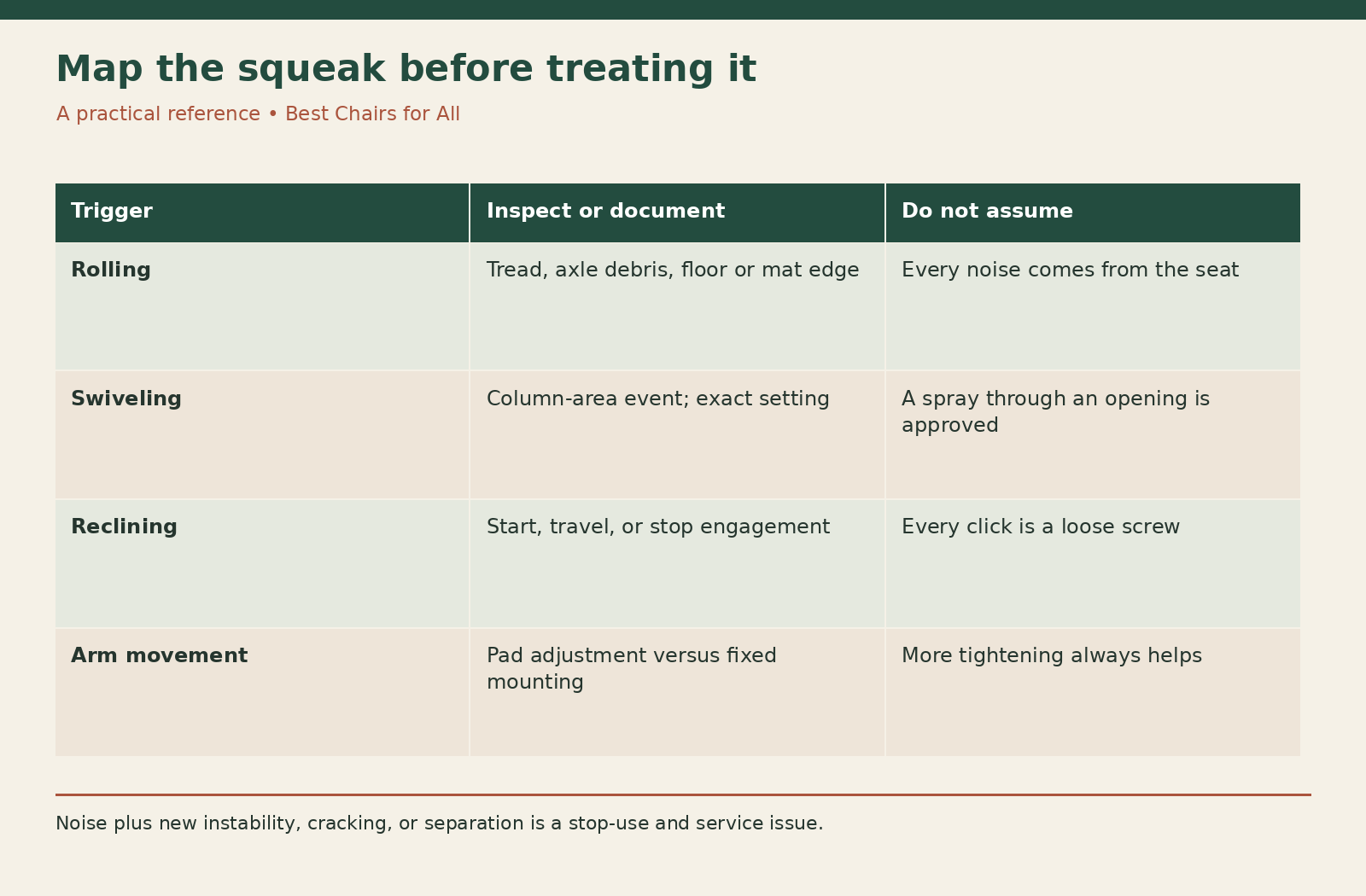
A light intermittent noise and a crack followed by looseness require different responses. Stop using a chair with visible damage, new instability, or separation at a seat or back attachment. For an otherwise intact chair, the sound map below helps you collect useful evidence without dismantling the mechanism or treating every joint.
Describe the event rather than naming a part
Record whether the noise happens while rolling, swiveling, reclining, changing seat depth, or moving an arm pad. Also note whether it occurs at the start of movement, throughout movement, or when reaching an end position. These details narrow the possibilities more effectively than describing every noise as a squeaky spring.
For example, “one short chirp when the chair crosses the mat edge” points toward a different investigation from “continuous creak during backrest recline on a stationary base.” Neither observation proves a particular component is faulty, but each tells support which movement to examine.
Do not repeatedly rock hard to reproduce a sound. Use ordinary controls and normal movements only when the chair remains sound. A sudden change after a fall, impact, or repair should be assessed before further use rather than subjected to a home stress test.
Rule out contact outside the chair
Check whether the arm pad touches the desk apron, the back touches a wall, or the base catches a cable. Clothing hardware, a belt, or shoes can also make sounds that seem to come from the seat. Move loose objects away and observe whether the same ordinary movement remains noisy.
Look at the floor and mat. A caster that squeaks at one location may be encountering grit, a curled edge, or a floor joint. If the noise is tied to that location, inspect the surface rather than immediately treating the chair’s internal mechanism.
Keep this check simple and reversible. You are trying to separate an external contact from a chair event, not create a new sitting posture that avoids all movement. If an arm constantly strikes the desk in normal work, adjust its documented position or address clearance; rubbing a lubricant onto the contact point does not create more space.
Build a movement-and-location sound map
Draw four columns: trigger, likely area to inspect, visible finding, and next supported action. Use broad areas such as wheel, arm mounting, seat interface, or back attachment. Leave the actual diagnosis blank until the evidence supports it.
A useful row might read “rolling only; front-right caster; visible hair and lint; clean external debris under caster instructions.” Another might read “recline start; beneath seat; no visible fault; send video to manufacturer.” A third could read “arm repositioning; pad pivot; indexed movement with no looseness; ask whether sound is expected.”
This map prevents a common mistake: treating a sound location as a confirmed cause. Hollow frames and panels can transmit noise, making the loudest point different from the rubbing point. Report what you can observe instead of confidently naming a bearing you cannot see.
Check assembly only where the manual directs
If the chair was recently assembled, compare the accessible joints with the exact instructions. Confirm the correct hardware was used in the correct positions and that the documented sequence was completed. A long and short bolt can appear similar while serving different joints.
Trust’s chair-noise support article emphasizes verifying mounting steps and the relevant screw connections. Its illustrated steps belong to the chairs addressed by that guidance; they are an example of assembly-first troubleshooting rather than a universal torque prescription.
Do not tighten every visible screw indiscriminately. Some fasteners secure adjustments, moving joints, or service-only components. Follow specified tools and torque where supplied. Stop if threads spin without securing, a head strips, or the joint will not align. Extra force can conceal an assembly error while damaging the part.
Separate intentional motion from looseness
Office chairs contain adjustment travel, flexible supports, and recline mechanisms. A click when a documented stop engages can differ from a persistent scraping sound or newly loose joint. Read the control guide and compare the behavior with the exact setting being used.
A locked recline position may also have a model-specific release sequence. Do not pull harder because a control resists under load. Follow the instructions for unloading or repositioning the backrest. A noise created by forcing a control is not useful evidence of how it behaves in normal operation.
Ask the manufacturer to confirm whether a particular sound and movement are expected. A video showing the complete chair and the control setting can help. Do not use a forum report about another model as proof that your noise is harmless or that a particular internal lubrication fix is appropriate.
Clean accessible rolling surfaces before adding chemicals
If the noise occurs during rolling, inspect the tread, wheel gap, and floor. Remove accessible hair and debris using the approved method, leaving sealed wheel assemblies intact. A trapped strand or hard particle can affect movement without requiring any work on the seat mechanism.
Check all wheels individually. A caster that rolls normally but binds while swiveling needs a different description from a wheel that will not rotate. Record cracks, peeling tread, or a loose stem as a replacement or service issue, not merely a noise problem.
Avoid oiling wheel treads or the floor to quiet movement. If the maker specifies lubrication at a service point, obtain the approved lubricant and application instructions for that point. Overspray can reach upholstery and flooring, while an unspecified product may be incompatible with plastic or existing grease.
Treat internal lubrication as a specific service question
A lubricant is not interchangeable with a cleaner, penetrating fluid, or corrosion treatment. The right material and quantity depend on the joint and surrounding components. Some mechanisms should not be lubricated by an owner at all, while others have documented maintenance points.
The Steelcase store FAQ provides a manufacturer route for maintenance and selected service parts. Use the relevant support process to ask about your model’s noise and approved action. General maintenance advice does not authorize opening a tensioned mechanism or introducing a spray through any convenient hole.
Keep the gas lift outside an improvised squeak repair. Do not drill, heat, open, or alter a pressure cylinder. If the suspected sound is near the column, report its location and triggering movement to service personnel. The observation is useful even when the internal repair is outside owner maintenance.
Apply a stop-use threshold when noise changes
A new loud crack accompanied by a lean, dropped support, or separation needs prompt assessment. Do not continue sitting just because the chair has been noisy for months. The important change may be the associated movement, not the volume by itself.
Check the CPSC recall database by manufacturer and model and follow any matching notice. A recall remedy can be specific and should take priority over generic tightening or lubrication advice. Include the identifying label when asking the manufacturer whether your chair is affected.
If no recall is listed, that does not establish that a damaged chair is usable. Keep it out of service while a structural fault is unresolved. Conversely, an isolated sound does not justify claiming that an entire model is unsafe without evidence. Keep observations, manufacturer findings, and your own assumptions separate.
Work through a three-noise example
Imagine a chair has a short squeal while rolling, a click when changing recline stops, and a creak when the left arm is pushed outward. Start three rows rather than buying one spray for everything. Inspect the rolling surfaces, read the stop-control instructions, and inspect the documented arm mounting separately.
Suppose external debris removal eliminates the rolling squeal. The recline click is confirmed by the manufacturer as expected engagement. The arm mounting has a loose accessible assembly fastener that the manual identifies for checking. These are hypothetical outcomes, but they show why one noise can disappear while another remains for a legitimate reason.
Now change the last finding: the arm bracket is cracked. The right action becomes taking the affected chair out of use and arranging a compatible repair, not tightening harder. The sound map’s value is that each next action follows a finding rather than a preset list of fixes.
Make a support recording that answers questions
Record a short clip in a quiet room that first shows the whole chair, then the relevant movement from a useful angle. State the model, approximate age, recent assembly or part changes, and control setting. Avoid placing your phone or hand in a moving mechanism to make the sound louder.
Include a photograph of the label and a written description of when the noise began. Tell support about any cleaner or lubricant already applied. That history matters because a changed surface or existing chemical can affect both diagnosis and the next recommended treatment.
Ask a defined question: “Is this movement and sound expected at this setting, and which owner checks are approved?” Request a part or service estimate only after the cause has been identified. A support conversation becomes more efficient when it begins with a repeatable event and an accurate configuration.
Verify the specific remedy
After an approved adjustment, cleaning step, or repair, repeat the same ordinary movement under the same conditions. Update the sound map with what changed. A quieter chair is useful, but also verify that the relevant control, caster, or attachment still works as intended.
Avoid adding a second intervention immediately if the first result is uncertain. Let a cleaned part dry and allow the prescribed service process to finish. Multiple simultaneous treatments make it difficult to explain a new problem or know which action resolved the original sound.
A well-handled squeak investigation ends with a located event and a supported response: cleaning, an identified assembly correction, confirmed normal operation, or service. That is a more durable result than temporarily masking the sound while leaving its source and the chair’s condition unexplained.
Something unclear or out of date? Send a correction with this article’s title and the detail to check.
Sources, research & corrections policy ↗