A high chair tray holds food and provides a surface for mealtimes. It does not replace the chair’s required restraint. Fasten and adjust the manufacturer-specified harness or belt every time it is required, even when the tray looks close to the child and an adult is sitting beside the chair.
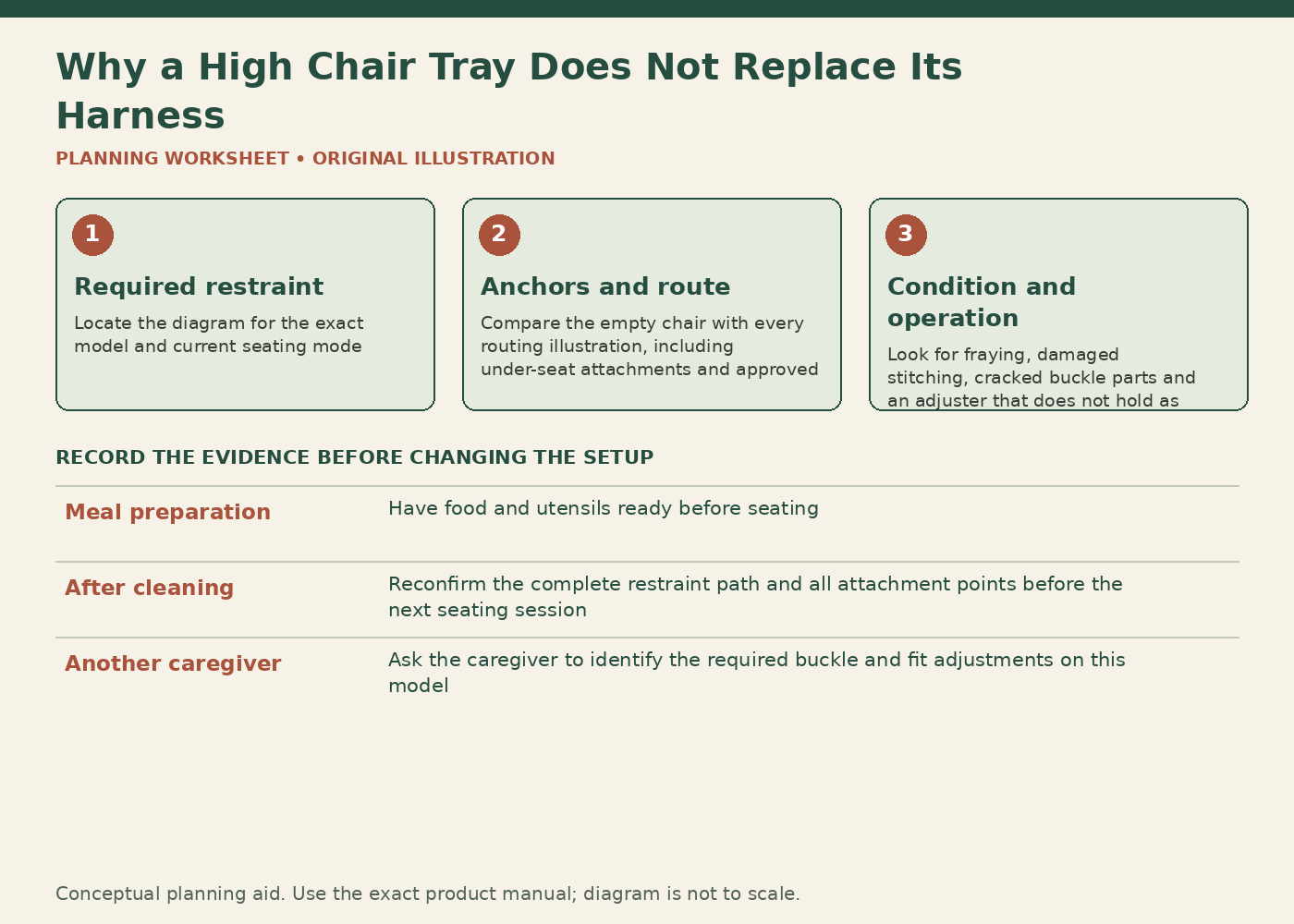
A tray and a harness control different things
The CPSC high chair safety guidance explicitly tells caregivers to use the safety straps snugly and not use the tray to hold a child in the chair. That distinction is easy to overlook because the tray occupies the front of the seat. Its position can give a visual impression of enclosure without providing the restraint system the product requires.
Consider what you can observe with the empty chair: the tray latches attach a food surface to the seat or arms, while the harness webbing and anchors form a separate system around the intended occupant. Do not infer a harness-routing arrangement from the tray geometry. A removable tray may have several positions for eating convenience, and it may be absent in a permitted table-use arrangement. Neither fact changes the restraint requirements written for that mode.
Identify every restraint component
Open the exact manual to the restraint diagram and identify each webbing section, anchor, buckle and adjuster on the empty chair. A five-point harness, a waist-and-crotch belt and a passive between-leg component are different arrangements; this article does not tell you to substitute one for another. Use the system supplied and specified for the exact product. If any part is missing, ask the manufacturer for the correct replacement rather than improvising.
Check the threading path rather than counting visible straps. A strap can be present but attached to the wrong slot, twisted beneath a cushion or routed around an accessory that interferes with adjustment. Compare both sides and the underside with the manual while no child is in the chair. Do not introduce knots, extra holes, clips or buckle covers to compensate for a restraint that does not fit or operate as specified.
Compare two official examples without mixing them
The IKEA LANGUR seat-shell instructions direct caregivers to use the safety belt when the child is in the highchair. The Stokke Tripp Trapp Baby Set² US/Canada guide illustrates its own harness installation, adjustment and buckle operation. Those sources support the same broad need to follow the product’s restraint instructions, but their hardware and attachment diagrams are not interchangeable.
A secondhand chair may include an insert or harness from a different generation. Confirm that the parts belong together before trying to recreate a familiar-looking arrangement. A newer buckle is not automatically a compatible upgrade for an older seat. Ask the manufacturer which exact part number and instruction revision apply. When the chair converts to another mode, read that mode’s requirements afresh rather than assuming a strap can be removed because a tray has been removed.
Set up the meal so fastening is not rushed
Prepare the food, utensils and cleaning materials before seating the child. Keep hot drinks, cords and other reachable hazards away. Place the chair as the manufacturer requires, with the folding or adjustment mechanisms locked. Then place and restrain the child using the manual’s sequence, adjust the fit as instructed and remain nearby watching throughout use. A tray should not become a temporary substitute while you look for a buckle or fetch a missing part.
If the child resists fastening, pause the meal arrangement and check for twisted webbing, an obstructed buckle, clothing caught in a strap or a fit issue. Do not resolve resistance by leaving the harness loose or unfastened. Questions about the child’s support or ability to sit safely should go to their clinician. Questions about damaged hardware, adjustment range or incompatible accessories belong with the manufacturer.
Keep supervision and restraint as separate safeguards
An adult’s presence is necessary, but it does not turn a tray into a harness. A caregiver can look away briefly to attend to another child or handle food, and a child can move while an adult is close. Follow the restraint requirement and stay near; do not trade one responsibility against the other. Prevent climbing or standing and do not allow siblings to hang on the chair.
A restrained child must still be watched and should not be left seated while the caregiver goes into another room. If the caregiver needs to leave, end the seating session using the normal safe routine and place the child appropriately elsewhere. Avoid describing the harness as a way to keep a child occupied independently. Its purpose in the product’s seating system does not make the chair suitable for unattended use, sleep or an extended holding arrangement.
Cleaning is a common point for restraint errors
Webbing can become soiled and need the manufacturer’s specified care, but taking it apart creates a reassembly task. Before permitted removal, photograph the correct routing and obtain the cleaning and reattachment directions for that exact component. Do not soak, bleach or machine-wash a harness based on instructions for a cushion or a different model. Let the approved cleaning process finish before the chair returns to use.
Afterward, inspect all straps and anchors, compare the route with the manual, and verify the buckle operates as instructed. A cleaner-looking harness is not ready if an anchor is only partly engaged or a strap has been rethreaded incorrectly. If the restraint cannot be restored with confidence, keep the chair unavailable and request manufacturer help. Do not use the tray for the next meal while waiting for replacement straps to arrive.
Make the caregiver handoff specific to this chair
For another caregiver, show the actual buckle, adjusters and anchors, using the empty chair for the hardware demonstration. Point out the mode being used and which accessories are required. Keep the manual accessible at the dining location or in a shared record. A reminder to “strap them in” can be too vague when someone has only used a different model.
Explain what prompts a stop: missing or frayed webbing, a buckle that does not latch normally, an anchor that cannot be verified, a lock that is not fully engaged or a child who cannot be supported as the product requires. Do not hand over a chair with an unresolved issue and expect the next adult to compensate by holding the tray. The useful instruction is to stop the seating session and obtain the proper correction before use resumes.
Restraint check before the tray goes on
| Check | Evidence and decision |
|---|---|
| Required restraint | Locate the diagram for the exact model and current seating mode. Name the components the child must use and distinguish them from tray latches. If the instruction cannot be located, ask the manufacturer before seating the child. |
| Anchors and route | Compare the empty chair with every routing illustration, including under-seat attachments and approved insert positions. A strap that emerges through a convenient opening is not necessarily attached to its designated anchor. Keep fingers clear of folding joints while inspecting. |
| Condition and operation | Look for fraying, damaged stitching, cracked buckle parts and an adjuster that does not hold as described. Do not repair load-bearing webbing by sewing or tying it. Obtain the exact manufacturer-approved replacement and its installation directions. |
| Meal preparation | Have food and utensils ready before seating. Identify reachable hot objects and pushing surfaces. Plan to remain near and watching rather than relying on the restraint to make a departure from the room acceptable. |
| After cleaning | Reconfirm the complete restraint path and all attachment points before the next seating session. Check the care instructions for each component separately. An intact tray does not permit use while a washed harness remains detached or wet. |
| Another caregiver | Ask the caregiver to identify the required buckle and fit adjustments on this model. Share the manual and unresolved questions. A demonstration with the empty chair can reveal uncertainty before a child is seated and fastening becomes rushed. |
Worked example
A caregiver removes a hypothetical chair’s harness for approved cleaning and then finds that the straps have not dried by dinner. The tray still locks into place, and another adult proposes staying beside the child while using the tray alone. That changes neither the restraint requirement nor the product’s intended arrangement. The appropriate choice is another suitable seating arrangement until the complete required harness is dry, correctly installed and checked.
In a second scenario, the straps are dry but a shoulder section appears on the wrong side of the insert. Rather than fastening what is visible and tightening the tray, the caregiver compares the empty chair with the exact routing diagram. If the route cannot be established, they contact the manufacturer. These examples show why the pre-meal check asks two independent questions: whether the tray is attached as intended and whether the required restraint is complete, correctly routed and adjusted. Passing the first does not answer the second.
For a chair used directly at the dining table, the same logic remains visible even without a tray. Confirm that table-use mode is permitted, then follow its restraint and placement instructions. Do not add an aftermarket tray merely to make a child seem more enclosed. A table edge, accessory rail or padded insert has the role assigned in the manual; it cannot acquire a restraint function because it sits in front of the child.
Sources checked November 6, 2026
Use the current document for the exact model, market and production revision. These sources establish the cited instructions and distinctions; they do not certify an individual chair or replace a personal assessment where one is needed.
- CPSC: High chair standard and caregiver safety guidance
- IKEA USA: LANGUR highchair seat shell assembly and safety instructions
- Stokke: Tripp Trapp Baby Set² US/Canada user guide
- CPSC recalls and product safety warnings
Something unclear or out of date? Send a correction with this article’s title and the detail to check.
Sources, research & corrections policy ↗