A useful salon chair maintenance checklist names the chair, the task, the approved method, and the person responsible. It does not begin with a universal instruction to oil every moving part or tighten every visible bolt. Hydraulic bases, upholstery coverings, finishes, and powered mechanisms can require different care, even within the same salon.
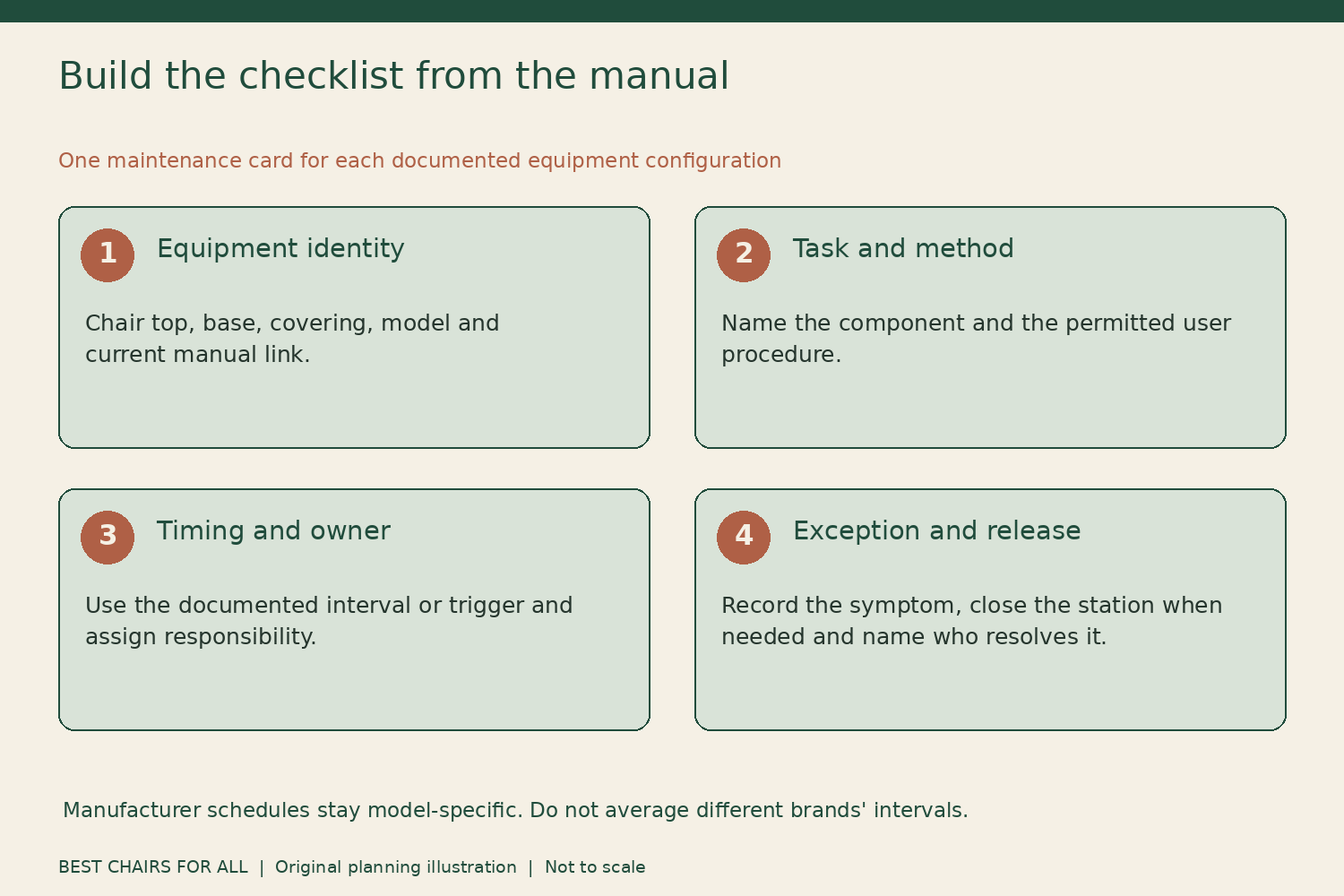
Build the checklist from the current manual for each actual chair and base, then add a reporting process for damage and abnormal operation. Keep routine cleaning, user maintenance, and technician work in separate fields. That distinction makes the checklist usable during a busy day without turning staff into hydraulic or electrical repairers.
Begin with a chair register
Assign a simple station or asset number and record the chair-top model, base model, serial or order identifier, upholstery code, purchase date, and service contact. Store the relevant manual with that record. If the chair top and base have different documents, keep both. The chair's appearance is not enough to identify replacement parts or maintenance instructions.
Photograph accessible labels without tipping or dismantling the chair. Record replacements when they occur, including the part identity and who fitted it. A maintenance sheet should describe the equipment currently in the room, not just the original invoice. If the base has been changed, ask the supplier whether any care instructions or compatibility confirmation need updating.
Group chairs only when their actual instructions match. Two black styling chairs can have different hydraulic units or coverings. Conversely, chairs in different colors may share the same approved base procedure. Build groups from documents rather than from how easy it would be to print one checklist for the whole shop.
Why schedules differ
Minerva's Minerva model-family maintenance guidance advises fully raising and lowering its styling-chair hydraulic at least daily. Keller's Keller styling-chair normal-cycle guidance describes full-range cycling three or four times as part of its styling-chair guidance and refers to a weekly routine. These are examples of manufacturer instructions with different frequencies; they should not be averaged into a new universal interval.
Collins' Collins seating care and hydraulic-base guidance includes its own hydraulic-base cycling and care guidance, including an initial-use procedure and a periodic interval. Before applying it, confirm that it covers your model. A support article can discuss more than one seating type, so the heading alone may not establish that every paragraph applies to your exact mechanism.
If a general manufacturer blog conflicts with the supplied model manual, ask the manufacturer to resolve the difference. Record the answer, date, and equipment identity. Do not choose whichever schedule appears less demanding, and do not assume that extra cycling is a repair for a fault. Abnormal behavior needs assessment before routine use continues.
Translate a manual into an actionable row
Each checklist row needs six fields: component, observable task, approved method, timing or trigger, responsible role, and action if a problem is found. For example, an upholstery row can refer to the documented cleaning process and identify tears or surface deterioration as a reason to report the chair. It should not simply say “clean thoroughly.”
For a normal hydraulic cycling task, copy the applicable frequency into the schedule but keep the complete method in the linked instruction. Staff need access to the manufacturer's control sequence and precautions, not a compressed reminder that changes its meaning. Do the task only on equipment that is operating normally and under the conditions the manufacturer specifies.
For technician work, the row can say “arrange authorized inspection when indicated by manual or fault report.” Do not fill that field with an invented annual pump teardown. If no interval is stated, ask support whether a scheduled inspection is required for the use pattern. A blank technical requirement should prompt a question, not a fabricated maintenance rule.
The opening check
Before the first appointment, visually confirm that the station is ready: floor and controls clear, required protective covers correctly fitted, upholstery intact enough for the site's approved process, and no newly visible damage or unexplained leakage. This is a practical availability check, not a structural test or a guarantee of safety.
Ask staff to report changes noticed during ordinary use: unexpected descent, difficulty holding position, unusual noise, a new wobble, or a control that behaves differently. Do not instruct them to reproduce the problem with a client seated. A clear symptom report can be made from what already happened, with accessible photographs if useful.
When a problem affects operation, mark the chair unavailable and route the report to the assigned manager or supplier. The checklist should say who has authority to return the station to use after assessment. Without that step, one shift may remove a chair from use while the next assumes the note is only a reminder to clean it.
Cleaning belongs to identified materials
Record the approved cleaner and process separately for upholstery, metal trim, coated base, and other surfaces. Include the exact upholstery code where known. A product suitable for chrome may damage a coated finish; a material-safe cleaner may not fulfill the workplace's disinfection requirements. Do not combine those purposes into one vague “sanitize chair” instruction.
Where disinfection is required, reconcile the product label, material compatibility, and site procedure before placing it on the checklist. Include required contact time and any permitted aftercare through the approved process. A shorter exposure invented to protect the vinyl does not establish the product's label claim.
Make chemical substitutions a review trigger. If purchasing changes wipes or cleaner because of stock, the compatibility record needs checking before use. Staff should not have to infer equivalence from similar packaging. A checklist that names the exact approved product is more reliable than one that says “any disinfectant.”
Hardware inspection has limits
Some chair manuals authorize checking and securing particular fasteners. Follow the identified hardware, tool, method, and any torque requirement. Do not tighten unidentified adjustment screws, sealed hydraulic parts, or electrical connections. “Check bolts” is too broad if it encourages staff to alter components the manual reserves for service.
If a bolt repeatedly loosens, a bracket moves, threads appear damaged, or a component does not align, report it rather than repeatedly forcing it tight. Do not add threadlocker unless the specific manufacturer procedure permits it. A product mentioned in one brand's general care article is not automatically appropriate for another chair or a joint that needs later adjustment.
Keep tool use separate from occupancy. No client should be sitting in the chair while staff work beneath it or attempt hardware maintenance. Do not support a raised chair top with improvised props. If the task cannot be performed through the manual's authorized user method, arrange the appropriate technician.
A weekly review that checks the record
Use a short manager review to confirm that required tasks were completed and that open faults have an owner. This review frequency is an organizational example, not a manufacturer maintenance interval. The mechanical and material-care tasks themselves keep their documented schedules. The review simply prevents unresolved items from disappearing between shifts.
Look for recurring observations rather than counting checkmarks alone. Three notes about the same pedal interference may indicate that the mat or trolley arrangement needs correction. Repeated upholstery deterioration after a supply change deserves a compatibility review. Neither pattern proves a technical cause, but it tells the manager where to ask a better question.
Check that the manual link still opens and that stored documents match the chair's current configuration. Confirm the service contact and warranty information before a breakdown makes them urgent. Keep completed service reports with the register, including the date and any conditions for returning the chair to use.
Worked maintenance-card example
Consider a hypothetical salon with two identical documented styling chairs and a different reclining barber chair. The owner initially prints one sheet listing daily lubrication, weekly tightening, and monthly hydraulic repair checks. Those tasks are not supported as a universal schedule, so the sheet needs rebuilding before staff use it.
The revised card for the styling chairs links their actual base instructions, records the approved normal-operation task and frequency, names the upholstery process, and defines the fault-report route. The barber chair gets a separate card for its headrest, recline controls, footrest, and model-specific care. Shared housekeeping can remain on the station-opening sheet without pretending the mechanisms are identical.
Each completed row records date and initials; each exception records an observation and next action. “Seat lowered during appointment; station closed; supplier contacted” is more useful than a checked “hydraulics okay” box after an uncertain test. The revised system produces a traceable decision about availability, not just evidence that someone held a pen.
Closing and longer shutdowns
Check the manufacturer's specified parked position. The Takara Belmont hydraulic-base parked-position instructions directs users of the covered bases to lower the seat when not in use, including the end of the day and long holidays. Apply that requirement to the equipment it covers, and obtain the corresponding instruction for other chairs rather than assuming every powered or hydraulic product is stored identically.
Before a longer closure, review cleaning, permitted protective covering, environmental conditions, and any power-isolation instructions in the relevant manual. Do not wrap damp upholstery tightly or apply unapproved polish as a storage treatment. If equipment must move, use the manufacturer's handling method and suitable assistance instead of dragging it by the chair top.
On reopening, verify that no unresolved service restriction remains and complete the applicable normal readiness procedure. A chair left unused is not automatically ready for appointments. If an issue appears, record it and arrange assessment rather than attempting internal repairs to make opening day work.
The finished checklist should be short enough to use but supported by complete instructions. Its value comes from matching tasks to the actual chair, noticing changes early, and giving every fault a clear route to resolution. It is a management tool built around the manual, not a replacement for one.
Sources and specifications checked November 6, 2026. Examples are planning exercises, not product testing.
Something unclear or out of date? Send a correction with this article’s title and the detail to check.
Sources, research & corrections policy ↗