Before cleaning a fabric office chair, find the upholstery’s care code and the chair manufacturer’s instructions. The code tells you which broad cleaning route is appropriate; the full instructions tell you how to use it on that material and assembly. Start with dry debris removal and keep wet treatment controlled so the hidden filling is not saturated.
A fabric chair is not necessarily washable just because the textile feels synthetic or the seat has a zipper. Water, solvents, brushing, extraction, and heat can each affect different coverings differently. The plan below turns the care code into a small decision record and explains when a stain belongs with a professional rather than another household cleaner.
Find the actual upholstery identity
Look for a fabric identifier in the purchase record, manufacturer label, finish specification, or dealer invoice. The chair model alone may not identify the fabric because many office-chair families are offered with several textiles. A used chair may also have replacement upholstery that no longer matches its original order.
Ask the manufacturer or dealer to connect the fabric code with the relevant care instructions. If the label is missing, send photographs and any surviving identifiers, but do not assume that visual similarity proves fiber or finish. A finish applied to a textile can affect its cleaning requirements even when the underlying weave looks familiar.
Keep the seat and back separate in your notes. They can use different fabrics, and one may have additional backing. Record the arm pads as another material. Cleaning a fabric seat should not become an excuse to apply the same product to plastic, leather, or a mesh back without checking those surfaces.
Read W, S, W-S, and X as routes
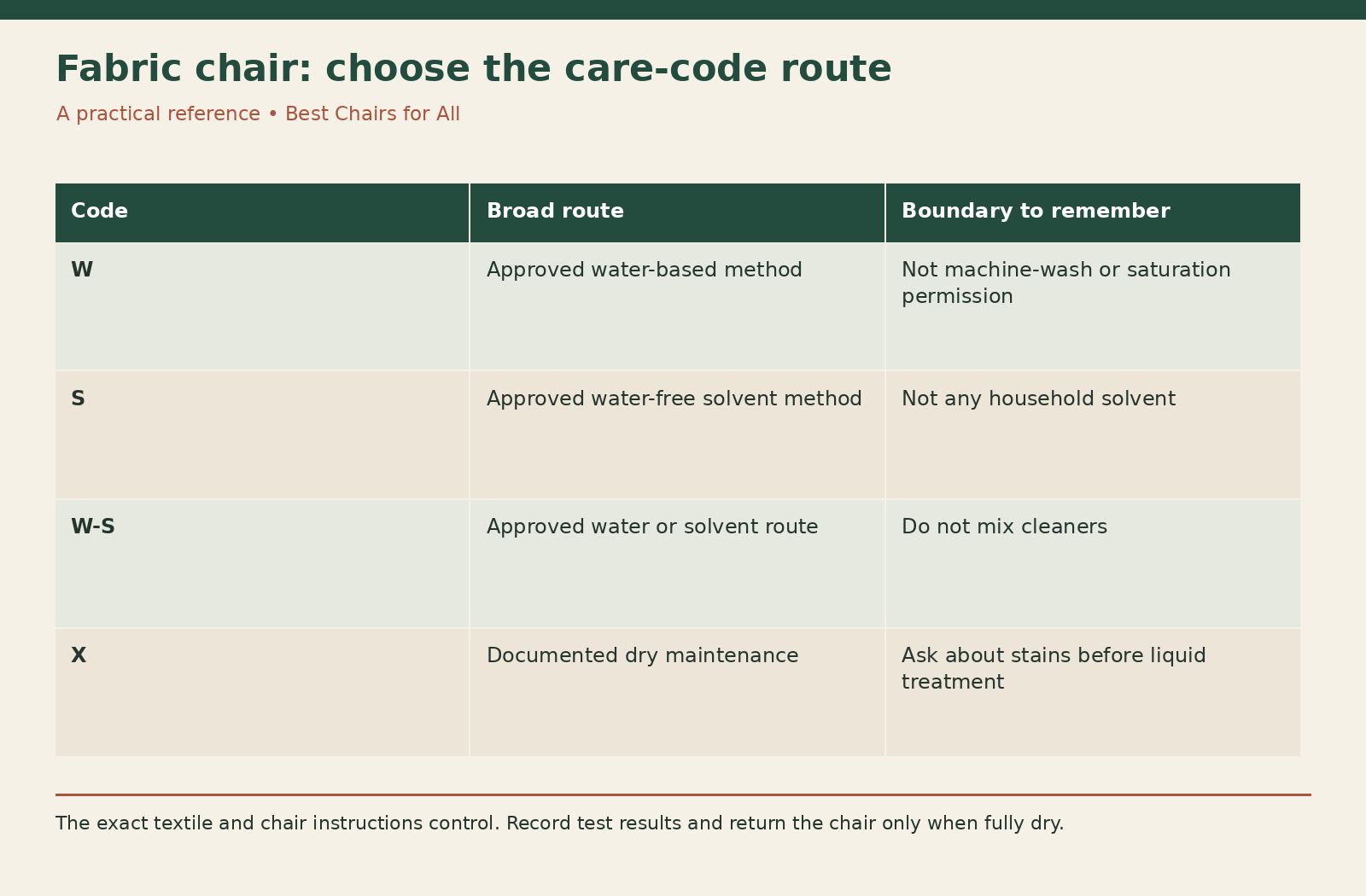
The SitOnIt Seating Designtex care guide distinguishes W, S, and WS routes and maps named textiles to care sections. For example, Connor and Measure use its blended-content S guidance, while Adler is mapped to the polyester section, identified there as WS. The Steelcase reference below also defines X as dry maintenance rather than liquid cleaning. Consult the specific textile entry and instructions rather than relying on the letter alone.
W does not mean unrestricted water or machine washing. S does not mean any household solvent is acceptable. W-S is not permission to mix cleaners. X does not mean that a strong stain remover should be tried as a last resort. Each code defines a boundary, and products still need to match the material and their own labels.
Additional wording matters. A fabric specifically documented as bleach-cleanable has instructions that a normal W fabric does not automatically share. Do not infer bleach compatibility from color, fiber content, or commercial branding. If your workplace requires a particular disinfectant, confirm compatibility before purchasing or treating the chair.
Understand the hidden cushion
Fabric is only the outer layer. Beneath it may be foam, backing, adhesives, seams, and a shaped seat support. A cleaning code for the covering does not establish that the whole seat can be saturated. Water or solvent that penetrates deeply may be difficult to remove or dry.
The Steelcase surface-material care reference explicitly warns against over-wetting upholstery and notes that finishes or laminations can change cleaning codes. This is why a generic recipe based only on a fabric’s broad fiber family is inadequate.
Do not remove a cover for laundering simply because it can be unzipped. A zipper may be part of manufacturing or service access. Confirm a removal and washing procedure for the exact chair and covering first. A shrunken or distorted cover may be difficult to refit even if the stain has gone.
Make a stain record before choosing a product
Write down what spilled, when it happened, and what has already been applied. Distinguish a known water-based beverage from an unidentified oily patch. The history is often more informative than the color of the stain, particularly after somebody has treated it with a spray.
Photograph the affected area in ordinary light. Include a wider image showing the stain’s position relative to seams and edges. That record helps a professional assess whether a ring developed during cleaning or existed beforehand. It also prevents you from repeatedly expanding the treated area because the damp patch temporarily looks darker.
If the material is unidentified, stop at dry maintenance and seek guidance. The inconvenience of waiting is usually smaller than the difficulty of reversing a bleached or distorted patch. For contamination that needs specialist treatment, ask whether the entire seat assembly can be cleaned appropriately before investing in surface products.
Dry-cleaning preparation is not solvent treatment
First remove loose crumbs, dust, and hair with the approved upholstery vacuum attachment. Use gentle contact and avoid tools that catch loops or abrade the surface. If the textile has a pile or directional texture, follow the maker’s brushing guidance rather than scrubbing against it.
Work from clean areas toward soiled edges and empty the tool of debris before moving to another surface. Keep the vacuum attachment away from gritty caster treads. A tool used on the floor can carry dirt into a pale cushion, defeating the purpose of starting with dry removal.
Pause and reassess once the dust is gone. A broad dull appearance can improve enough that no liquid treatment is needed. Avoid applying stain remover to an entire seat by habit. Routine soil removal and targeted stain treatment are separate jobs with different exposure and drying implications.
For a documented water-based route
Use only a product and method approved for the identified W or W-S textile. Follow its dilution and application instructions. Test on a small inconspicuous area, allow it to dry, and inspect for changes in color, stiffness, or texture before treating the visible stain.
Apply controlled amounts using the specified cloth or foam method. Absorb liquid rather than driving it into the filling. Use clean white cloths so transferred color and removed soil are visible. A colored towel can make it harder to distinguish the chair’s dye from the towel’s own color transfer.
Follow the material’s residue-removal directions. Do not improvise a whole-seat rinse or assume a household extractor is appropriate. Extraction may be suitable for some documented materials and unsuitable for others. Confirm that both the textile and the completed cushion can tolerate the method, including the available drying conditions.
For S or X upholstery
For S upholstery, obtain a suitable solvent-cleaning recommendation from the manufacturer or a professional cleaner. Water-free does not mean risk-free: solvents have their own handling, ventilation, and compatibility requirements. Follow product labels and avoid experimenting with automotive cleaners, paint removers, or mixed household products.
For X upholstery, keep routine care within the documented dry-maintenance route and ask for professional advice about stains. A liquid cleaner labeled safe for “most fabrics” does not override an X designation. If a stain cannot be removed within the supported method, discuss replacement upholstery or acceptance of the mark rather than escalating chemicals.
Tell the professional about previous treatment. A water spray, deodorizer, or grease remover may affect the next step. Complete information helps prevent a second incompatible application and avoids treating the resulting discoloration as if it were only the original spill.
Allow complete drying and inspect again
Keep the chair out of service until the treated fabric and hidden cushion are dry. Normal indoor airflow can help, but avoid unapproved heat sources. Do not sit on a damp cushion to compress water out, and do not cover it with plastic or another cushion while waiting.
Drying time is a condition to verify, not a universal number of hours. Cushion thickness, liquid quantity, and room conditions differ. Check the underside and seams and follow the cleaning provider’s return-to-use instructions if extraction or professional work was performed.
Inspect the dry result from the same angle as your first photograph. If a ring, texture change, or residue remains, stop and consult the instructions before repeating the process. A second treatment should have a specific purpose, such as removing documented residue, rather than simply using more of the same product.
Use this care-code worksheet
Create one row per upholstered component. Record fabric identifier, care code, source document, approved cleaner, test-area result, stain history, and drying result. Include the date. For a shared workplace, use the asset number so the instructions stay with the correct chair even after desks are rearranged.
A worked example might read: “Seat: fabric F23; W; dealer-supplied textile sheet; approved upholstery foam; test unchanged after drying; fresh coffee; cushion fully dry.” A second row might read: “Back: unknown replacement textile; no verified code; dry vacuum only while awaiting identification.” Different answers for the same chair are perfectly reasonable.
The Steelcase product-cleaning page provides another useful boundary: disinfectants need specific fabric approval. Record any such approval separately from a general stain-cleaning code. A cleaner’s ability to act on microorganisms does not establish that your chair’s textile will tolerate it.
Prevent repeat problems without overtreating
Respond promptly to spills using the applicable instructions and keep loose soil from accumulating. In a shared office, make the approved cleaner and care sheet easy to find. A written method is more reliable than relying on whichever multipurpose spray happens to be near the printer. Keep the original fabric identifier with that method so a future replacement cushion does not silently inherit inappropriate instructions.
Avoid fragrance treatments as substitutes for cleaning. They may mask a smell without removing its source and can complicate later assessment. If odor persists after appropriate cleaning and full drying, ask about the hidden filling and professional options. Do not repeatedly wet the seat in pursuit of an uncertain cause.
When choosing your next chair, request upholstery-care information before ordering. Consider whether the supported method fits your environment, cleaning staff, and available downtime. A fabric that looks appealing but needs a care process you cannot provide may be a poor practical choice, regardless of its color or texture.
Something unclear or out of date? Send a correction with this article’s title and the detail to check.
Sources, research & corrections policy ↗