A used high chair should be identified before it is bought, cleaned or used. The essential checks are the exact model and manufacture information, current recall status, the complete manufacturer parts list and the condition of the assembled chair. A low price and a clean tray do not answer those questions.
Get label photographs before arranging pickup
Ask the seller for clear photographs of the model label, manufacture date, batch or lot information and the entire chair from several sides. Product names can cover multiple generations, and a marketplace listing may be based on memory. CPSC’s high chair guidance advises choosing a chair manufactured on or after June 19, 2019, when the federal high chair standard took effect. A later date is a useful selection filter, not a declaration that an individual chair is undamaged, unrecalled or correctly assembled.
If the label is missing or unreadable, do not guess from color or upholstery. Contact the manufacturer with the photographs and ask whether identification is possible. A seller’s statement that the chair was purchased recently is not the manufacture date, particularly when an item was stored, handed down or bought secondhand before.
Search recalls using identifiers, then read the notice
Use the current CPSC recall database and manufacturer safety notices. Search brand, model and alternate spellings, but compare the actual affected-product description. A recall may cover a specific production batch rather than every chair bearing the family name. Record the search date and the notice reviewed; avoid writing “recall free” as if the search certifies the product.
For example, the Harppa BHC001 recall identifies Model Number BHC001 together with Production Batch Number 202408. Its stop-use and replacement directions apply to the affected units described in the notice. That example shows why a model-only photograph may be insufficient. It is not a complete list of recalled high chairs, and an item outside that batch still needs all other checks.
Treat a claimed recall repair as evidence to verify
If the seller says a recall remedy was completed, ask what the remedy was and request documentation. Compare the product with the official remedy instructions and contact the manufacturer when anything is uncertain. Do not assume a bag of replacement screws or an unfamiliar added strap proves the official work was completed. A remedy for one hazard also does not repair unrelated damage accumulated later.
Do not purchase an affected chair on the assumption that a remedy will be easy to obtain afterward. Check eligibility and availability directly. Follow the official notice if a recalled chair is already in the home, including any stop-use instructions. Do not resell or donate it to transfer the problem to another family. The notice, rather than a seller’s proposed repair, determines the required response.
Build a parts inventory from the matching manual
Obtain the actual manual from the manufacturer, including any supplemental instructions for inserts or conversion modes. The IKEA LANGUR seat-shell instructions are one example of why an accessory has its own assembly and restraint directions. A general high-chair assembly video cannot show what every model requires.
List the frame, seat, restraints, buckles, locks, fasteners, glides or feet, and every component required for the intended mode. Compare each part with the diagrams. A missing tray may be a convenience question on one design and a required component in another configuration; do not generalize. A missing harness is not solved with an aftermarket universal strap or by pushing the tray closer to the child.
Inspect after identity and completeness are established
With the chair empty and correctly assembled according to its instructions, inspect the seat, frame, joints, restraint webbing, stitching, buckles and locks. Look for cracking, distortion, corrosion, fraying, improvised holes and mismatched hardware. Ask the manufacturer about any questionable component. Do not perform a home overload or tip test, place a child in it to see whether it holds or climb onto it yourself.
Folding and height-adjustable models need their specified locking checks. A mechanism may appear closed without being fully engaged. Keep children away during inspection and folding. Check feet or glides for missing pieces and compare them with the manual. A replacement made from a different material or a different height can alter the intended support arrangement even if the chair looks level.
Prepare a seller conversation that can end early
Send a short list of evidence requests before committing to collect the chair. Ask whether anything has been replaced, whether the product was used in more than one conversion mode and whether the seller still has all components. Request photographs of the underside as well as the tray and fabric, taken with the chair empty and safely positioned. A missing label or unexplained hardware substitution may make a long inspection trip unnecessary.
If the seller cannot provide the requested information, distinguish inability from dishonesty: they may simply not know the chair’s history. The purchasing decision still depends on evidence rather than intentions. Do not let a friendly handoff or a nearly new appearance replace the missing record. Set aside time to compare the manual after collection if appropriate, with the chair unavailable to the child during that process.
A successful inspection does not create a warranty or testing history. Write what you actually verified: identifiable model, document located, recall notice reviewed, listed parts present and no observed issue in the specified empty-chair checks. Avoid broader claims such as fully safety certified. Keeping the wording limited to the evidence makes it easier to update the record if the manufacturer later identifies an affected batch or a part needs replacement.
Price the complete usable arrangement
Before paying, obtain manufacturer confirmation for required replacement parts, their availability and any service needed. Add those costs and the uncertainty of the chair’s condition to the comparison with a complete alternative. Cleaning is a separate task: it cannot restore worn webbing, correct an unidentified recall or validate unknown hardware.
A sensible purchasing boundary is that the chair can be positively identified, its intended configuration documented, the recall question resolved through current official information and its required parts obtained and inspected before use. If any of those remain unresolved, walk away or keep it unavailable while asking the manufacturer. The purpose of the checklist is to find reasons to stop early, before a bargain becomes furniture that cannot responsibly be used.
If the chair will be used by grandparents or another caregiver, give them the actual approved configuration rather than an assortment of loose accessories. Label stored conversion parts and retain their instructions. Demonstrate the specified locks and restraints with the chair empty, and make sure the caregiver can locate the model label and recall information. A chair that is correctly assembled once can still be put into an incomplete mode after cleaning or travel. The handoff should preserve what the inspection established rather than asking another person to reconstruct it from memory.
Used high chair: evidence before purchase
| Check | Evidence and decision |
|---|---|
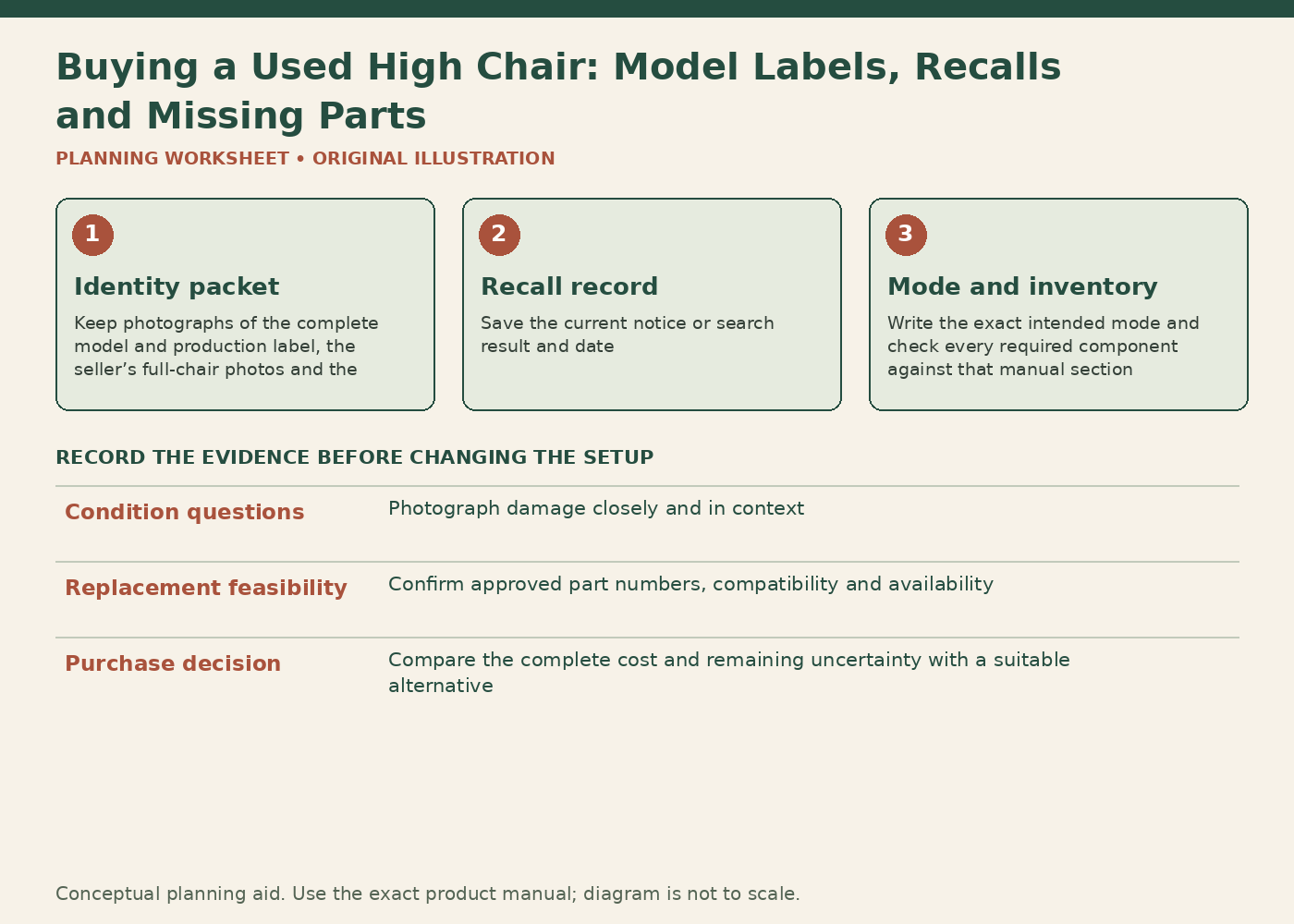
| Identity packet | Keep photographs of the complete model and production label, the seller’s full-chair photos and the matching manual. Mark a missing identifier explicitly. Color, approximate age and a tray logo are clues, not a substitute for the product’s actual identity. |
| Recall record | Save the current notice or search result and date. Compare every identifier in an affected-unit description. If a repair is claimed, obtain manufacturer-verifiable details rather than relying on the seller’s assurance or a photograph of loose parts. |
| Mode and inventory | Write the exact intended mode and check every required component against that manual section. Include restraints and hidden fasteners. Do not count optional accessories as essential, or assume a visible accessory replaces a required safety component. |
| Condition questions | Photograph damage closely and in context. Describe fraying, cracks, missing glides, loose locks or substituted hardware without trying to diagnose a structural repair. Obtain the manufacturer’s assessment before the chair is occupied. |
| Replacement feasibility | Confirm approved part numbers, compatibility and availability. Ask whether installation is an owner task or needs service. A visually similar buckle from another chair is not evidence of an acceptable replacement. |
| Purchase decision | Compare the complete cost and remaining uncertainty with a suitable alternative. Set a boundary before meeting the seller. Convenience, a matching kitchen color or a seller’s deadline should not override unresolved identification or safety questions. |
Worked example
A seller offers a hypothetical used high chair with a recent-looking cover and says it has “never been recalled.” The label photograph shows a model number, but the batch line is obscured. The buyer finds a recall that distinguishes batches. The useful next step is to request a readable complete label and contact the manufacturer if identification remains unclear, not to compare the cover color with a recall photograph and declare a match or clearance.
Suppose the batch question is resolved but the restraint buckle is missing. The chair is still not ready for use. The buyer checks the exact replacement with the manufacturer, including compatibility and installation requirements. If the correct part is unavailable, the low purchase price does not solve the problem. This example separates identification, recall remedy and physical completeness: each is a different gate, and passing one does not erase a failure in another.
Sources checked November 6, 2026
Use the current document for the exact model, market and production revision. These sources establish the cited instructions and distinctions; they do not certify an individual chair or replace a personal assessment where one is needed.
- CPSC: High chair standard and caregiver safety guidance
- CPSC recalls and product safety warnings
- CPSC: Harppa BHC001 high chair recall, affected batch 202408
- IKEA USA: LANGUR highchair seat shell assembly and safety instructions
- CPSC: Resellers Guide to Selling Safer Products, 2025
Something unclear or out of date? Send a correction with this article’s title and the detail to check.
Sources, research & corrections policy ↗