Clean a fabric gaming chair by removing dry debris first, blotting fresh spills, and using only the cleaning method approved for the exact upholstery. Keep liquid out of the foam and mechanisms. A fabric-looking cover is not permission to soak the seat, steam it, or use a carpet extractor. If the manufacturer gives no suitable stain-removal method, ask before escalating beyond dry maintenance.
The most useful preparation is a material map. A gaming chair may combine woven fabric, synthetic leather, embroidered panels, plastic trim, removable pillows, and a separate slipcover. Those parts may need different care. Treat the map as a set of boundaries: permission to clean one textile area with a named product does not extend to every neighboring surface.
Identify the cover before choosing a cleaner
Find the exact model, upholstery name, and care page. Keep a copy with the purchase record. Secretlab’s aftercare guide separates woven fabric, microsuede-type materials, leatherette, and removable SKINS. This separation matters more than whether a chair feels soft to the hand. Two visually similar textiles can have different approved cleaning methods, and decorative printing may need additional care.
The Corsair T3 RUSH 2023 product page identifies a soft cloth exterior and a separate memory-foam lumbar support. That description establishes the construction category, not authorization for a particular chemical or wet-cleaning machine. Locate the instructions for that exact generation rather than applying a competitor’s fabric-cleaner recommendation. A removable pillow is also not automatically a washable pillow; its cover and foam may have different requirements.
Do not infer a cleaning code from a retailer’s generic “fabric” description. If there is a sewn care label, read it in addition to the model manual. When the two seem inconsistent, ask the manufacturer which instruction applies to your upholstery. Record the answer. A support message identifying the exact surface and cleaner is more useful than an online comment saying that a household product worked once on an unspecified chair.
Build a dry-cleaning station
Move food and drinks away and protect nearby electronics from accidental contact. Arrange good lighting so you can see seams, crumbs, and the boundary between materials. Use a clean, dry, soft vacuum attachment only where the care instructions permit vacuuming. Check the attachment itself for grit or sharp damaged edges before bringing it to upholstery. Do not drag a dirty floor head across the seat.
Work from the upper back downward so loosened debris does not fall onto a section you have already finished. Use gentle passes over broad textile areas and appropriate low-force attention near seams. Do not pull at a loose thread or force a nozzle under a stitched panel. Remove visible crumbs from accessible creases without prying apart the upholstery or exposing internal foam.
Dry maintenance is valuable even when there is no stain. Debris trapped where your clothing rubs can become harder to remove later, and vacuuming makes it easier to see a fresh spill. Keep this step separate from stain treatment. A cleaner cannot compensate for rubbing loose grit into the weave, and adding moisture before removing crumbs can spread material across a larger area.
Respond to a fresh spill without spreading it
Lift away a cup or container and blot with a clean, dry, absorbent cloth. Use an unprinted white cloth where practical so you can observe transfer without adding dye. Work gently and replace the contact area of the cloth as it becomes wet. Do not scrub back and forth or press repeatedly with a saturated cloth. The immediate goal is to remove free liquid, not to erase every trace in one pass.
Secretlab’s current fabric instructions advise absorbing spills promptly, avoiding rubbing and hot water, and using its named fabric products under the stated conditions. Follow the actual page rather than an older blog summary. Cleaning advice can change as upholstery ranges and products change. A recommendation for original SoftWeave, SoftWeave Plus, or a separately fitted cover should be matched to the surface you own.
If liquid reaches a mechanism or electrical accessory, stop ordinary use and follow the manufacturer for that component. A powered speaker, haptic accessory, or charging feature changes the situation; upholstery cleaning guidance does not establish that it is safe to power on after a spill. Do not tilt the chair in an improvised attempt to drain it through mechanisms. Ask support for model-specific handling if liquid penetration is substantial or uncertain.
Use approved spot care with clear boundaries
For Secretlab’s specified SoftWeave fabric care, the aftercare page describes applying its approved foam cleaner to a clean microfiber cloth rather than indiscriminately saturating the chair. It also warns against using that treatment on nonmatching areas. Keep the product label and upholstery instructions together when working. A stronger concentration or longer soaking time is not automatically more effective and can make residue or drying problems harder to resolve.
Test any manufacturer-approved product in an inconspicuous area if its instructions call for a compatibility check, and allow that area to dry before judging the result. Look for color transfer, texture change, a ring, or residue. Testing is a check within an approved method, not a way to make an unapproved solvent safe. If the test changes the finish or fibers, stop and ask for guidance rather than treating the whole seat to make it look uniform.
Treat the stain’s identity as useful information. Write down whether it was water, coffee, an oily food, ink, or an unknown substance, along with any product already applied. Do not stack household remedies. Vinegar, alcohol, detergent, disinfectant, and solvent suggestions found online may conflict with the actual fabric instructions. Once several substances are mixed into the surface, even the manufacturer may have difficulty identifying the source of a new discoloration.
A spill decision worksheet
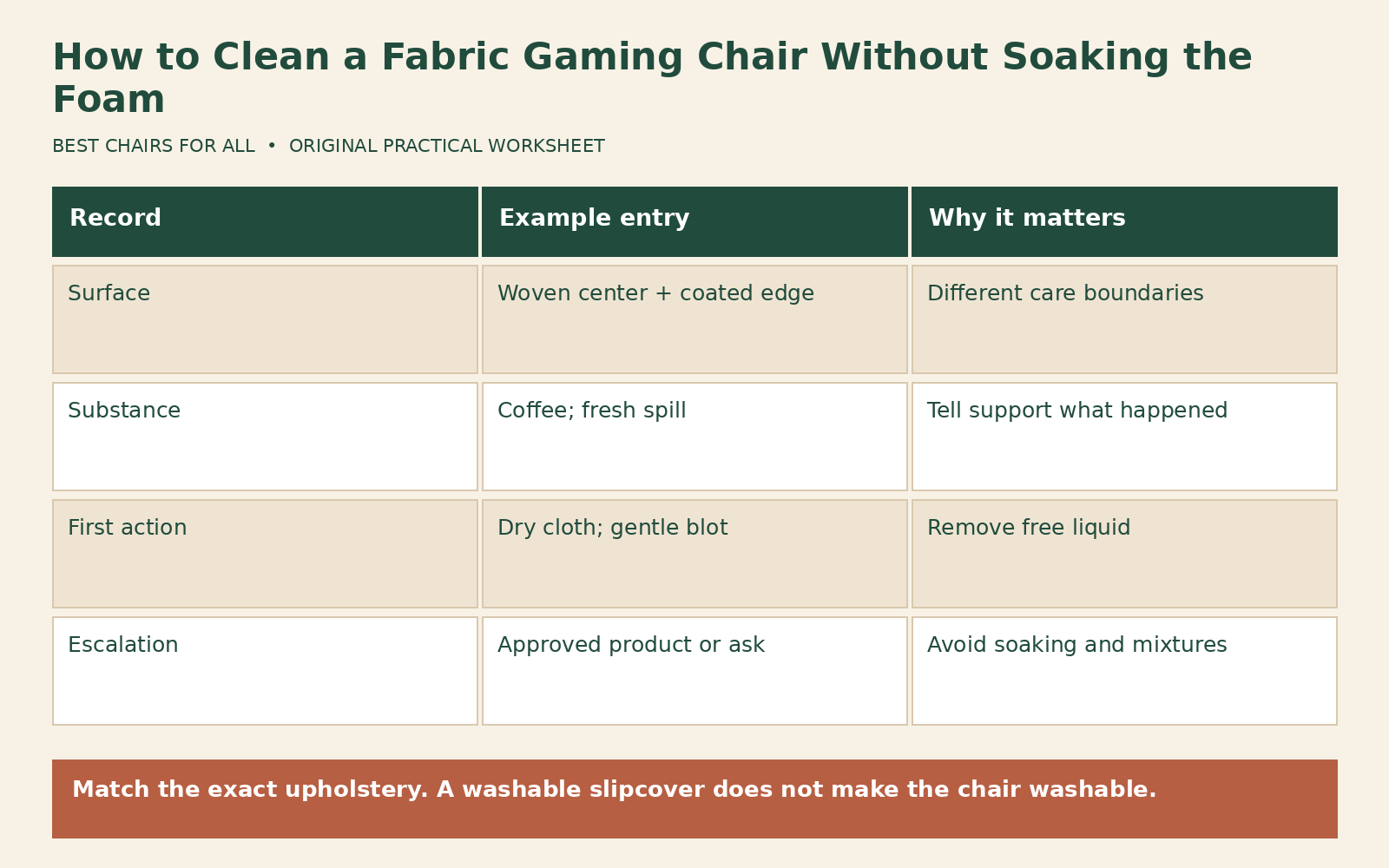
Use four boxes: surface, substance, first action, and escalation. In surface, write the precise material and whether it is an original sewn panel or removable accessory. In substance, record what spilled and when. In first action, record dry debris removal or blotting already done. In escalation, write the approved cleaner and method, or “awaiting manufacturer advice.” This prevents a rushed decision from spreading a stain across incompatible panels.
Here is an illustrative example. A small coffee spill lands on a woven seat center and reaches a nearby synthetic-leather edge. The owner blots the liquid, then checks the material map. The textile gets only its approved fabric care; the adjacent coating gets its own permitted wiping method. The owner does not spray both at once. After drying, a remaining mark is photographed and sent to support with the spill description before another product is attempted.
A second example involves an unknown mark on an embroidered backrest panel. The owner cannot confirm whether the cleaner approved for the main weave is suitable for the decoration. Dry debris is removed, the mark is documented, and treatment pauses at that boundary. Waiting for an answer is an active care decision: it avoids converting a small uncertain mark into a larger area of color loss. No promise is made that every stain can be removed.
Dry the surface fully before sitting
Let treated upholstery air dry under the manufacturer’s conditions, with ordinary room ventilation and no direct intense heat. Do not use a hairdryer, heated blanket, radiator, or iron to accelerate drying unless the specific care label explicitly authorizes that use. Surface dryness and deep foam dryness are different questions. If the seat has been heavily wetted, contact support rather than assuming a dry-looking cover proves the interior is ready.
Avoid covering a damp chair with plastic or a tight slipcover, and do not sit on it merely because the visible cleaner has disappeared. Check the entire treated zone, especially seams and low points. A clean, dry cloth pressed gently against an accessible surface can help reveal remaining moisture, but it does not inspect internal foam. If moisture or odor persists after an accidental soaking, request professional or manufacturer guidance suited to the construction.
Write the treatment and drying date in the worksheet. If a ring or texture change appears only after drying, that record helps separate the original stain from the cleaning result. Do not repeatedly rewet the outline to chase it outward. Photograph it in consistent light and ask whether a broader approved cleaning method exists. Sometimes a cosmetic mark is the less damaging outcome compared with repeated unapproved treatment.
Remove and wash only what is designed for it
A zipper may provide manufacturing access rather than an invitation to remove upholstery. Do not unzip sewn seat covers, pull foam through an opening, or detach straps without instructions. A removable aftermarket sleeve, original pillow cover, and integrated seat cover are three different items. Confirm which layer is washable, whether foam must be removed, and what drying method applies before starting laundry.
Secretlab’s aftercare page with SKINS washing instructions explicitly distinguishes those removable covers from the original chair and supplies a separate washing procedure. Its permission does not apply to another brand’s slipcover or to the chair beneath it. Check the label on your own accessory, close or protect fasteners as instructed, and reinstall only after the item meets its drying requirements. Keep detached components organized so no strap or attachment is lost.
Finish with prevention that addresses your actual spill route. Move drinks away from the desk edge, keep a dry absorbent cloth nearby, and remove crumbs before they accumulate in seams. For a recurring stain source, change the habit or environment rather than applying protective chemicals without approval. Save the material map and successful care method. The next cleaning session should begin with a known surface and a documented method, not a new round of guessing based on the word “fabric.”
Something unclear or out of date? Send a correction with this article’s title and the detail to check.
Sources, research & corrections policy ↗