As an Amazon Associate, we earn from qualifying purchases. Read our affiliate disclosure.
A camping chair with a side table is most useful when it gives ordinary items a dependable place within reach. The best model is not necessarily the one with the largest tray. It is the one whose table works with your body, preferred seating position, cup, book, and campsite layout without obstructing your way out.
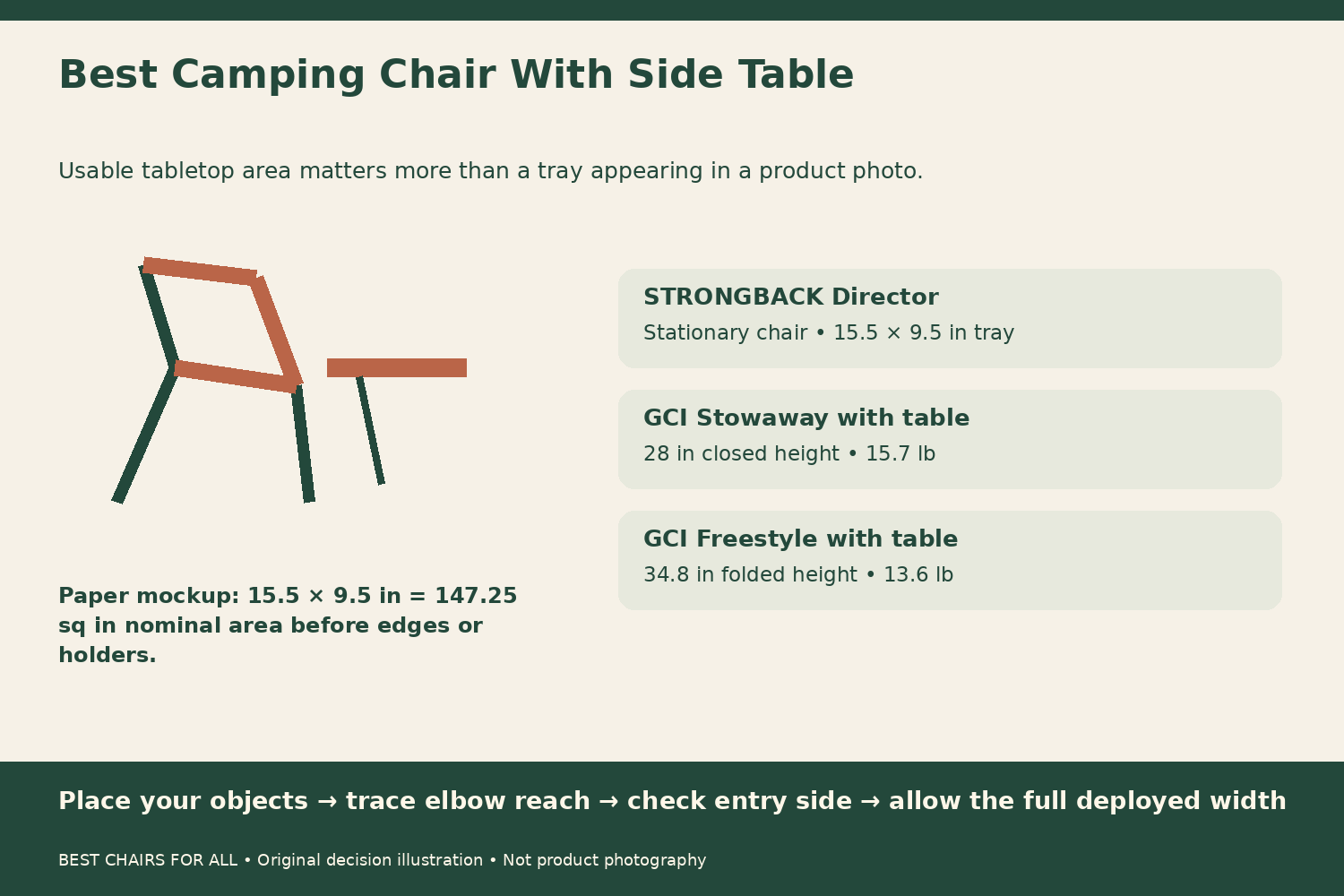
This guide compares the STRONGBACK Director Chair with Side Table, GCI Outdoor Stowaway Rocker with Side Table, and GCI Freestyle Rocker with Side Table. The STRONGBACK is the stationary director-style candidate. The Stowaway emphasizes a compact folded shape and storage caddy. The Freestyle combines a folding table with GCI's established spring-rocker format.
Our recommendations are based on manufacturer information reviewed November 6, 2026, rather than our own load or spill tests. We do not assign a tabletop load limit when the researched documentation does not establish one. Prices and inventory vary, and the links below search matching Amazon listings rather than confirm specific offers.
Decide what the tabletop must hold
Write down the actual objects you expect to place beside you. A closed water bottle and paperback need a different shape from a dinner plate, handled mug, and phone. Include the parts of those objects that overhang: a mug handle, a wide bottle lid, or a book opened across two pages.
Separate flat surface from dedicated holders. A cup cutout may secure the right bottle while being unsuitable for a mug with a large handle. A phone slot may be useful for one device and awkward with a thick case. The presence of a holder does not mean your particular item fits it.
Think about movement. A table fixed to a rocking chair moves with the chair. A stationary director's chair creates a different environment for items on its tray. This does not make either arrangement universally better, but it matters if your main use is a plate of food, a delicate craft, or a drink you prefer to keep motionless.
Three chairs and the reason to compare each
STRONGBACK Director Chair with Side Table: for a stationary setup
The STRONGBACK Director page specifies a 15.5-by-9.5-inch side table with a raised outer ridge, a 20.5-inch seat width, and a 300-pound frame capacity. The chair has integrated lumbar-shaped support and an aluminum-alloy frame. These details make it useful to compare when the table is the main reason you are changing chairs.
Its stationary format is the distinguishing practical feature here. If you want a tray beside a seat for reading, snacks, or organizing small items, first decide whether you prefer that still arrangement over a rocker. Try the back contour as well; a table cannot compensate for a chair that pushes you into an unwanted position.
The tradeoff is that an attached table commits you to its position and reach. Confirm the side and adjustment arrangement from the exact model before ordering. At research time the manufacturer showed out-of-stock or preorder messaging, so verify a real delivery commitment rather than relying on a search result's generic availability label.
Check matching STRONGBACK Director side-table listings on Amazon (paid link). The rocking director is a separate chair.
GCI Stowaway Rocker with Side Table: for a shorter folded package
The Stowaway with Side Table page lists a 300-pound capacity, 15.7-pound item weight, folding side table, mesh back, oversized storage caddy, and shoulder strap. Its published closed height is 28 inches. The compact fold is the specific reason to compare it with a larger flat-folding rocker.
A caddy can reduce how much you expect the tabletop to do. Put a phone, keys, or other small items in appropriate pockets and reserve the tray for the objects that need a horizontal surface. That separation can be more useful than choosing a chair by tray size alone.
The compromise is a heavier chair and a moving table. If you walk a long way from parking, carry the actual weight before deciding the folded shape solves your transport problem. GCI's selected page showed sold-out messaging during research; other sellers and colors need their own availability check.
Check matching GCI Stowaway with Side Table listings on Amazon (paid link). The ordinary Stowaway does not imply a table is included.
GCI Freestyle Rocker with Side Table: for a familiar flat-fold rocker
GCI's Freestyle with Side Table specification identifies a 250-pound capacity, 13.6-pound weight, mesh back, folding table, and beverage and phone holders. The listed folded height is 34.8 inches. It gives shoppers a second table-equipped rocker with different carrying and storage tradeoffs from the Stowaway.
Choose it for consideration if you like the Freestyle seating format and want a table that travels with it. The published weight is lower than the Stowaway with Side Table's figure, while the folded package is taller. That is a concrete comparison for a trunk, closet, or RV compartment rather than a vague claim that one is more portable.
The 250-pound capacity is a separate requirement from the table function. Also verify whether the maker's displayed width includes the table's entire deployed reach; do not assume a bare footprint drawing gives you the full clearance needed beside a neighboring chair.
Check matching GCI Freestyle with Side Table listings on Amazon (paid link). Standard Freestyle and XL variants have different specifications.
A paper tabletop test before purchase
Use the STRONGBACK's published 15.5-by-9.5-inch table dimensions as a worked planning example. Cut a piece of paper to that rectangle and place your intended objects on it. The rectangle has a nominal area of 147.25 square inches, but that is not all guaranteed usable space: a raised edge, holder, or shape detail can reduce how objects sit.
Now test a dinner plate, closed bottle, and phone one at a time and in the combination you expect to use. Do not put a hot or spillable drink on an unsupported paper mockup. You are checking the layout of objects, not demonstrating the table's strength or stability.
Mark where your forearm would pass when reaching across the surface. A bottle can fit geometrically yet stand directly in the path of your elbow. If the table will mainly support a book, try the book open. If it is for a device, include the case and cable connector you normally use.
Repeat with the actual shape when the manufacturer supplies a drawing or you can inspect the chair. Do not transfer the STRONGBACK's table dimensions to either GCI chair. Each product needs its own template and holder checks. A generic rectangle is a starting exercise, not a substitute for model-specific measurements.
Finally, write the minimum useful result in plain language. Examples are enough space for one plate and a closed bottle, or a stable place for a paperback while the phone goes in a pocket. That requirement helps resist buying a more complicated chair merely because its product page shows more accessories.
Reach and handedness can decide the purchase
Sit in the chair and let your shoulders relax before reaching for the table. If your arm has to stretch behind you or across your torso, the tray may not be convenient during an ordinary evening. A feature can be physically present without being well placed for your proportions.
Consider which hand you use for a drink, book, or device. Do not assume the table swaps sides unless the manufacturer says so. A fixed-side table can be a good fit for one person and a frequent irritation for another. Check its position in relation to your usual seating neighbor as well.
Try approaching from the side you normally use. An RV door, cooler, or picnic table may constrain that path. If the attached tray blocks your preferred entrance, see whether it folds out of the way using the intended procedure. Do not climb around it or use it as a handhold.
For a pair of chairs, draw both deployed tables on the campsite plan. Two trays pointing toward each other may need more room than a shared freestanding table. Two trays pointing outward may make the setup unusually wide. The answer depends on the exact chair orientation, so plan the pair rather than buying identical chairs automatically.
A table on a rocker deserves a movement check
Start with the chair on stable, level ground and all parts deployed correctly. With the table empty, observe its path as you use the rocker normally within the manufacturer's instructions. Check nearby chair arms, tent fabric, and table edges that could interfere with that motion.
Use closed containers where appropriate and avoid assuming that a cup holder makes every drink immune to spilling. A tall tumbler and a short can create different shapes above the holder. Test fit with a closed, cool container and follow the product's intended use.
Do not treat the tray as a workbench, stove stand, extra seat, or support for standing. The chair's user capacity is not the table's load rating. If a tabletop load specification is absent, ask the manufacturer about your intended object rather than importing a rating from another model.
A separate camp table may be the better choice if you want a shared food surface that stays still while chairs move. An attached tray is strongest as a personal convenience. It should not be expected to replace every function of a campsite kitchen table.
Folding and storage: inspect the entire sequence
Empty the holders and remove loose items before folding. A phone left in a slot or keys tucked against a hinge can complicate the process or damage equipment. Follow the model's table-folding order instead of forcing the chair closed while the tray remains deployed.
Check the folded shape against your real storage opening. The Stowaway's shorter listed height and the Freestyle's lower published weight are different benefits. A shallow compartment may favor one outline, while a long walk may favor another characteristic. Measure the access hatch as well as the compartment behind it.
For dusty or sandy trips, clean holders, hinges, and fabric according to the manufacturer. Dry the chair before long storage. Examine the table's attachment and locking arrangement if it begins to feel loose; seek the correct replacement or repair rather than adding an improvised brace that may affect folding.
Choose for the objects and activities you actually have
Select the STRONGBACK Director for a stationary table-and-seat comparison, the Stowaway with Side Table when a shorter folded package and caddy matter, or the Freestyle with Side Table when its weight and rocker format better fit your routine. Each still needs a personal seat trial.
Confirm the full model name, table inclusion, package quantity, and return terms before ordering. This guide makes no hard budget promise because delivered prices and seller configurations were not uniformly validated. A photo showing a tray is not enough if the selected variant removes it.
The paper tabletop test, reach trial, and deployed campsite drawing should identify the useful choice. A good side-table chair keeps your ordinary items where you want them while letting you sit, move, and stand without negotiating around the feature you bought for convenience.
Something unclear or out of date? Send a correction with this article’s title and the detail to check.
Sources, research & corrections policy ↗