As an Amazon Associate, we earn from qualifying purchases. Read our affiliate disclosure.
The best camping chair with a footrest depends on what you mean by putting your feet up. A suspended fabric footrest, a flip-out leg support, and the linked lower section of a zero gravity recliner create different positions. They also change how you enter the chair, where the support meets your legs, and how much campsite space the setup needs.
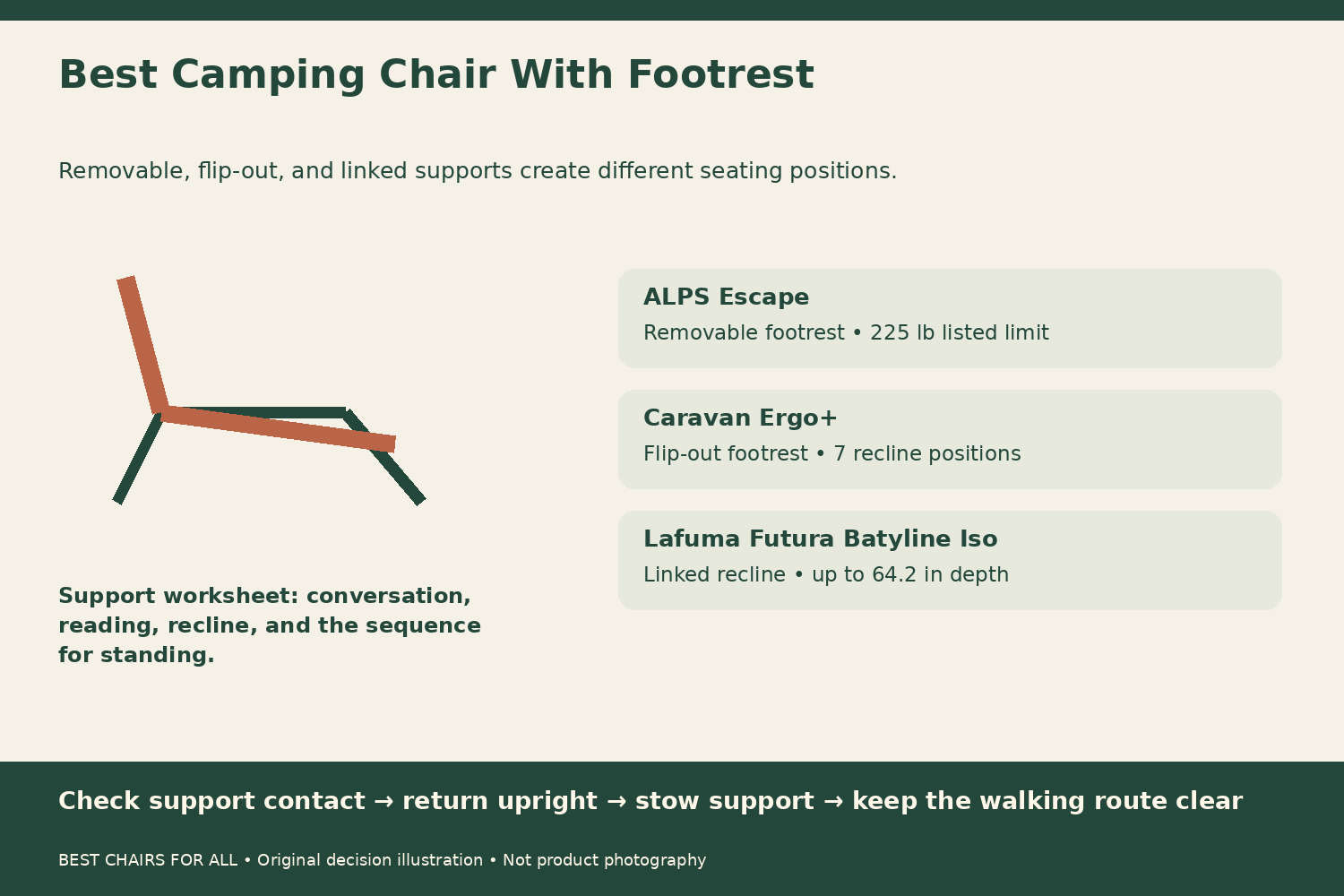
This guide compares the ALPS Mountaineering Escape Chair, Caravan Canopy Ergo+ Patio Folding Chair, and Lafuma Futura Batyline Iso. The Escape is the candidate for a removable footrest on a familiar camp-chair format. The Ergo+ provides a flip-out support and multiple recline positions. The Futura is for someone who wants the backrest and lower support to move as a recliner system.
Recommendations are based on online manufacturer and retailer documentation reviewed November 6, 2026. We have not conducted hands-on comfort testing. None is presented as a medical solution, and no fixed price or retailer availability is promised. The Amazon links search exact model names and require a careful match before purchase.
Choose the support arrangement before choosing the chair
Begin by describing the position you want. Do you prefer your knees bent with your heels supported, your lower legs resting more continuously, or a linked reclining posture? An image of someone with feet raised can conceal substantial differences in the contact area underneath them.
Next decide whether you need the support out of the way for conversation, meals, and frequent standing. A detachable footrest gives you a separate part to manage. A flip-out support stays with the frame but needs its own deployment space. A linked recliner may be comfortable for a long pause while being less convenient for repeatedly leaning toward a dining table.
Finally, consider your fellow campers. Extended supports occupy the same low space people may use as a walking route. A compact chair can become a long obstacle once the footrest is deployed. Evaluate the resting arrangement at full extension, not the upright chair alone.
Three chairs that solve the problem differently
ALPS Mountaineering Escape Chair: for a removable footrest
ALPS describes the Escape with a removable footrest in its 2020 manufacturer camping catalog. That is an archival design reference; confirm that the current version supplied has the same removable arrangement. The researched Frank's Great Outdoors specification lists a 10-pound chair weight, 225-pound capacity, adjustable armrests, and an included shoulder carry bag. The retailer also explicitly states that the footrest is not intended for sitting.
Its appeal is flexibility within a familiar folding-chair arrangement. You can evaluate the chair with the footrest in use and follow the supplied procedure to remove it when you want a different setup. That is useful for a camper whose evening shifts between relaxed sitting and more active conversation or tasks.
The limitations are the lower capacity and the loose-part logistics. A detachable component needs a consistent storage place. We do not assume that its footrest height, tension, or support point will suit every leg length. Try the exact chair, and use the current manual to confirm adjustment and attachment rather than treating a retailer photograph as instructions.
Check matching ALPS Escape Chair listings on Amazon (paid link). Confirm that the complete footrest and carry bag are included.
Caravan Canopy Ergo+: for a flip-out support
The Caravan Ergo+ manufacturer listing identifies a flip-out footrest, seven reclining positions, and a 300-pound capacity. This arrangement is worth comparing when you want the support to remain part of the chair rather than becoming a separate item to carry and keep track of.
Its practical question is whether the available combinations include the posture you actually want. Seven positions are not automatically seven useful positions for one person. Try the one you would use for reading and the one you would use to relax, checking headrest contact and the lower support at both settings.
The word patio in the product name is relevant: a folding lounge design can work for car camping while remaining much bulkier than a backpacking chair. Check the folded package against the vehicle compartment you intend to use. Also examine the transition back to the upright position before buying; convenient foot support should not turn ordinary standing into an awkward sequence.
Check matching Caravan Ergo+ listings on Amazon (paid link). Do not confuse it with Caravan's Infinity zero gravity models.
Lafuma Futura Batyline Iso: for linked reclining support
The Futura Batyline Iso product page describes a clip-suspended fabric seat, an adjustable removable headrest, fixed armrests with stabilizers, and a protected footrest ring. It lists a 16.72-pound weight and an open depth range extending to 64.2 inches. This is a different scale of campsite object from a small quad chair.
Choose it for consideration if a sustained reclining position is your main objective and the chair will travel by car or RV. The replaceable sling also gives you a defined service path when the exact matching fabric eventually needs replacement. Confirm the Batyline Iso version; padded Futura configurations are different purchases.
Its limitations are carrying weight, broad folded shape, and the location of the footbar relative to your legs. A user may like the backrest but dislike where the lower bar contacts the calf or heel. Do not extend the frame, remove a support, or add an improvised rigid platform to fix an unsuitable fit.
Check matching Lafuma Futura Batyline Iso listings on Amazon (paid link). Standard and XL variants need separate fit checks.
The three-position support worksheet
Create three columns titled upright conversation, reading, and relaxed recline. In each column, record the location of support under your legs, your knee position, head contact, and whether the arms remain comfortable. The goal is to describe the whole posture rather than deciding that any elevated footrest must be comfortable.
Start with the chair assembled fully on suitable level ground. Sit normally and use only the adjustments the manufacturer provides. Keep the feet and lower supports in their intended roles. The footrest is not an extra seat, a climbing step, or a place for a second person's weight.
For conversation, ask whether you can rest comfortably with the support stowed or removed as designed. For reading, hold a book at a normal height and notice whether you keep lifting your shoulders or looking sharply downward. For reclining, check whether your head and lower legs settle naturally without pressure from an edge or bar.
Then add a fourth row for getting up. Record the intended sequence for returning upright, retracting or removing support where required, and standing. If you repeatedly need help with a procedure that will be inconvenient on your trips, that matters as much as the most relaxed position.
Do not turn the worksheet into a medical experiment. Stop if a position causes discomfort, and choose equipment with appropriate individual advice if you have particular health or mobility requirements. This is a buying exercise to identify fit, not a claim that raised feet treat swelling, pain, or circulation problems.
A campsite-layout exercise with real dimensions
Measure the clear ground where the chair will sit. Mark the chair's maximum deployed depth, the side table, and the path from the tent or RV door. Use the exact model's dimensions and required clearances. An extended footrest should not occupy the only route to the cooler or the vehicle.
The Futura provides a useful arithmetic example. If your clear strip is 96 inches deep and the chair uses its published 64.2-inch maximum open depth, 31.8 inches remain in total. That is not an approved clearance or an automatic walkway allowance; it is the space available before adding required operating clearance and access.
For the Escape, think about where the detached footrest goes during meals. Setting it beside the chair can create another trip obstacle if it is left in the walking route. Put it in the carry bag or a consistent out-of-the-way location according to its storage instructions. Make the storage routine part of the decision.
For the Ergo+, inspect the arc of the support as it flips out. An object that fits beside the chair while upright may interfere with deployment. Move tables and loose gear before changing position rather than forcing the mechanism against them.
Why changing one feature can change the whole seat
A detachable support can leave the basic chair useful when the footrest is not wanted, but only if the removal procedure and remaining attachments suit ordinary use. A flip-out support reduces loose parts while making deployment space more important. A linked recliner connects your preferred back angle with the lower support position. Put these three tradeoffs beside the worksheet rather than ranking them by how many parts they include. The better design is the one that lets you change activities without repeatedly rearranging your entire camp.
Footwear, blankets, and practical support contact
Try the chair with the footwear you expect to wear at camp. A stiff hiking boot and a soft camp shoe contact a narrow support differently. If you normally remove boots before resting, evaluate the support in that state too. The aim is to avoid buying from a photograph showing a position you never actually use.
Keep blankets and straps clear of hinges and moving supports. A blanket can make a cool evening pleasant, but fabric bunched around a mechanism can interfere with its intended movement. Fold and move it before adjusting the chair if the instructions require a clear mechanism.
Consider how you will reach ordinary items. A footrest may make it harder to lean forward for a bottle on the ground, so a reachable table or pocket can be useful. Do not reach across the extended support toward a hot stove or cooking pot. Arrange a separate cooking position if that is part of your camping routine.
Decide whether an included footrest is really the better purchase
If you already own a comfortable chair, first investigate whether its manufacturer offers a compatible support accessory. Compatibility should be explicit; a universal attachment that clamps to an unrelated frame can change loads and interfere with folding. We do not recommend improvising an attachment based only on matching tube diameter.
A separate approved ottoman can offer placement flexibility, but it is another object to pack and may move independently on the ground. An integrated support stays attached but limits you to the geometry of that chair. A removable sling falls between those arrangements. Choose the compromise that fits your setup habits.
At checkout, compare the complete configuration, including any removable part, headrest, case, and delivery costs. A replacement-footrest listing is not a complete chair. Keep the model name and instructions with the receipt so future parts can be matched accurately.
Start with the Escape for removable support, the Ergo+ for a flip-out design, and the Futura for a linked recliner. The right model should pass all three positions on the worksheet and still leave a usable campsite when fully extended.
Something unclear or out of date? Send a correction with this article’s title and the detail to check.
Sources, research & corrections policy ↗