As an Amazon Associate, we earn from qualifying purchases. Read our affiliate disclosure. Amazon buttons search for matching listings; they do not confirm the exact model, seller, price, or stock.
The best dining chair for a heavier person needs two separate qualifications: a documented load figure suitable for the user and enough usable sitting space. A high number cannot compensate for a narrow seat, and a wide-looking upholstered chair cannot substitute for verified loading information. National Public Seating’s 8500 and 8700 series are worth investigating for their current 500-pound static-load statements. Article Nosh is a residential alternative only for people whose required load stays within its published 300-pound test figure.
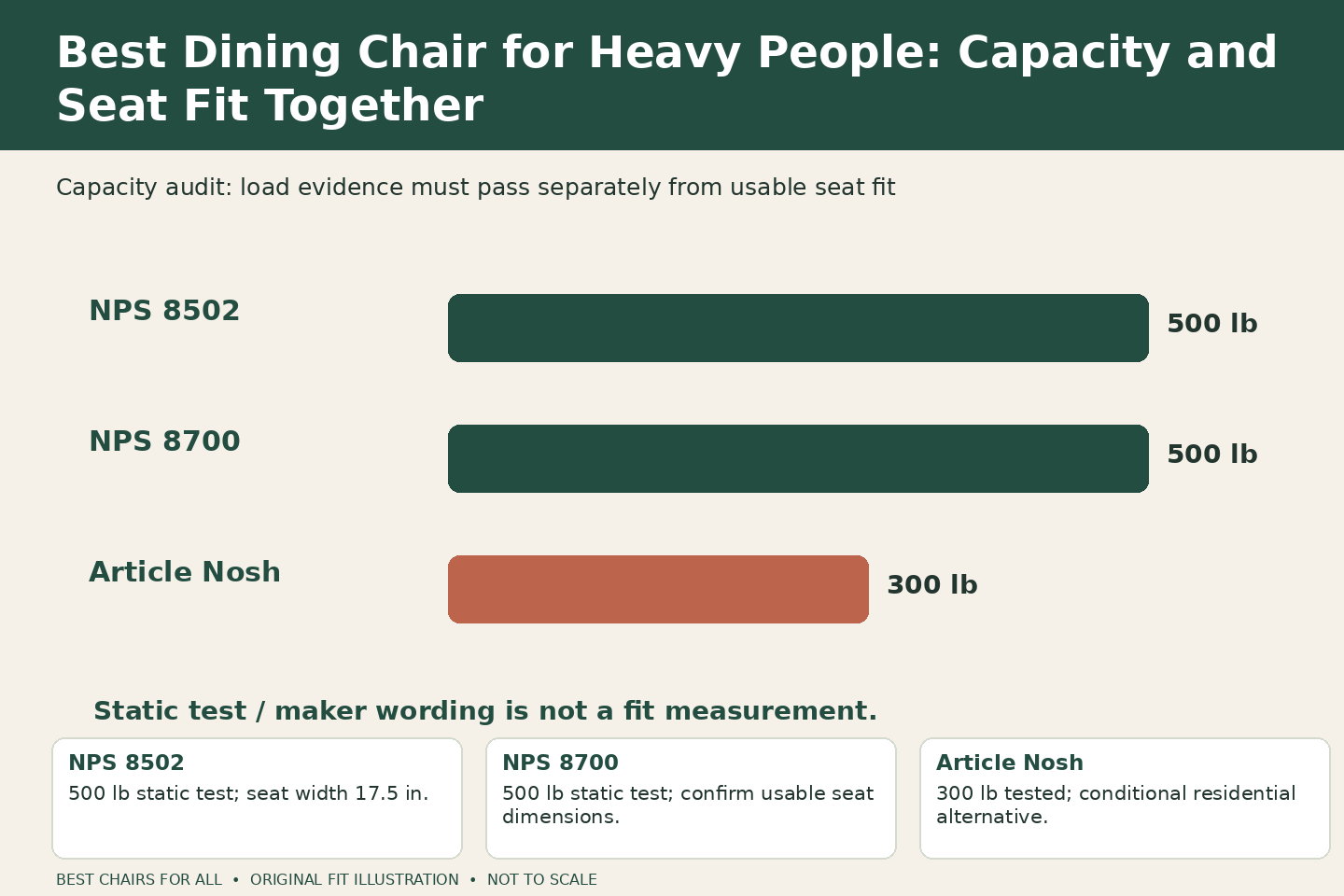
We checked primary manufacturer information online on November 6, 2026. These are researched candidates, not chairs we physically load-tested. The NPS information explicitly describes static testing, which is different from every force a chair can experience in real use. If a person’s needs exceed the published figure, or involve leaning or transfer support outside the stated intended use, request a suitable specification rather than extrapolating.
The two-gate buying method
Gate one is evidence. Locate the exact model number, the manufacturer’s load wording, and the current source date. Gate two is fit. Confirm usable seat width and depth, height, any arm spacing, table position, and normal entry and exit. Only a chair that passes both gates belongs on the shortlist. You do not have to disclose body weight to a roomful of sales staff to ask precise questions about a product’s documented capacity.
Read dining chair weight ratings before comparing capacities, keeping published limits separate from comfort, seat width, and product testing claims.
This approach also avoids an unhelpful assumption that heavier diners all need the same shape. People differ in hip width, leg length, preferred posture, and sensitivity to a hard front edge. An armless chair can remove a side constraint, but an armless frame can still be narrow at the seat or obstructive near the legs. Measure the sitting surface rather than judging generosity from the top of the backrest.
Verify the exact variants in the manufacturer references: National Public Seating 8502 Ultra-Compact Stack Chair, Gunmetal; National Public Seating 8710-11-10 Cafetorium Stack Chair, Black/Chrome; Article Nosh dining chair, Oak and Ratine Ivory. Specifications were checked November 6, 2026.
1. National Public Seating 8502 Ultra-Compact Stack Chair, Gunmetal
Best for: Documented 500-pound static test.
The 8502 is a useful evidence-first candidate because the current maker page states a 500-pound static-load test and separately lists seat dimensions. It should immediately be ruled out if its seat is too narrow for the diner.
The published seat is 17.5 inches wide, 17.25 inches deep, and 17 inches high. The overall frame is wider than that seat; the two widths must not be confused.
Product Details
| Brand | National Public Seating |
|---|---|
| Overall dimensions | 19 3/4 W × 22 D × 31 H in |
| Seat height | 17 in |
| Manufacturer load wording | 500 lb static load test |
| Materials | Polypropylene seat/back; chrome-plated steel rod frame |
Pros
- Current maker states the test qualifier explicitly
- Usable seat measurements are provided
Cons
- 17.5-inch seat width will not fit every heavier diner
- Hard shell requires a comfort trial
Resolve any lower retailer load claim for the exact item before purchase.
2. National Public Seating 8710-11-10 Cafetorium Stack Chair, Black/Chrome
Best for: Padded institutional candidate.
The armless 8710-11-10 in black/chrome belongs on a supplier-question shortlist if you want vinyl seat padding with current 500-pound static-test series information. It is not a verified wide-seat recommendation.
The maker sheet lists a dining seat height of 18 inches and overall size of 20 inches wide by 19 1/4 inches deep by 30 3/4 inches high. Obtain usable seat dimensions for the exact configuration.
Product Details
| Brand | National Public Seating |
|---|---|
| Overall dimensions | 20 W × 19 1/4 D × 30 3/4 H in |
| Seat height | 18 in |
| Manufacturer load wording | 500 lb static load test |
| Materials | Vinyl-padded seat; polypropylene back; steel frame |
Pros
- Vinyl seat avoids a fixed textile cleaning format
- Current series description states a 500-pound static test
Cons
- Retailer specifications conflict and need resolution
- Overall width is not verified inside sitting width
Require a dimensioned answer before choosing it for a person needing a broad surface.
3. Article Nosh dining chair, Oak and Ratine Ivory
Best for: Residential option within 300 pounds.
Nosh is included for heavier diners whose load requirement remains within its published 300-pound test figure and who prefer padded fabric furniture. It does not serve readers needing a 500-pound figure.
Article lists a 19-inch seat height and 16-inch seat depth. Its armless shape avoids an arm-spacing constraint, but the actual sitting area still needs an individual trial.
Product Details
| Brand | Article |
|---|---|
| Overall dimensions | 20 W × 21 D × 31 H in |
| Seat height | 19 in |
| Manufacturer load wording | 300 lb tested |
| Materials | Polyester upholstery; rubberwood legs and plywood |
Pros
- Padded seat and back in an armless design
- Manufacturer publishes a clear tested-weight field
Cons
- 300-pound figure is a firm shortlist limitation
- Fabric maintenance differs from the institutional chairs
Keep the load limit and personal fit as separate pass-or-fail decisions.
Our load-evidence audit
Use a five-line record for each chair: model, manufacturer, stated load, test qualifier, and unresolved questions. Copy the qualifier exactly in your private worksheet. For the NPS 8500, the current manufacturer page says it was tested to support a 500-pound static load. For Nosh, Article uses the field Weight Tested To and gives 300 pounds. Those are not identical claims, even though both contain a number in pounds.
Keep the product source with the order confirmation. In this research we found older NPS-related documents and retailer pages showing different figures for these chair families. A retailer can carry an earlier version, reuse an old specification, or have a catalog mistake. Resolve a conflict with the seller and maker for the exact item being supplied. Do not automatically select whichever number is largest because it makes the purchase easier.
The current NPS 8500 manufacturer page provides the 500-pound static-test wording and dimensions for the 8502 model. The 8700 manufacturer page and the maker’s 8700/8800 series sheet provide the corresponding series context. Ask for written confirmation if a retailer’s listing differs, especially if the loading information is central to your decision.
Never perform a homemade proof-load test. Dropping onto a chair, loading it with stacked objects, or having another person sit on an occupant’s lap does not recreate a manufacturer test and can damage the item. Inspect ordinary assembly and condition, and rely on appropriate documentation. A damaged chair should be taken out of use even if its original rating sounded generous.
A seat-width worksheet that protects dignity and usefulness
Start with a chair the diner already finds spacious enough. Measure its usable width where the person sits, its front-to-back depth to the useful back-contact point, and its sitting height. Record whether the frame narrows toward the back or has rails projecting beside the seat. This personal reference is more useful than applying a universal wide-seat label.
For a candidate, ask whether the published width is overall furniture width or usable seat width. The NPS 8502 overall width is 19 3/4 inches, while its seat width is listed at 17.5 inches. The difference is 2.25 inches. Buying from the larger number would create a materially inaccurate expectation of sitting room. The steel outline and the actual surface are different measurements.
If the familiar chair gives 20 inches of useful sitting width, a 17.5-inch seat is 2.5 inches narrower. That is a reason to reject or closely trial the 8502, regardless of the 500-pound static-test figure. The load documentation has passed gate one; the seat can still fail gate two. Do not convince a diner to accept a tight surface merely because it is one of the few products with a large advertised number.
NPS’s 8700 materials identify overall dimensions and an 18-inch dining seat height, but usable measurements can be inconsistently labeled in retailer listings. Ask the maker for a dimensioned drawing of the exact armless configuration. We do not promote the overall 20-inch width into a verified 20-inch usable seat width. An unresolved critical measurement should remain unresolved until the seller supplies evidence.
Hard shell, padded vinyl, or fabric
The 8500 uses a molded polypropylene seat and back over a steel-rod frame. Its maintenance format is attractive when easy inspection and surface cleaning are priorities. The tradeoff is that a hard molded seat needs a personal comfort trial. A high load figure does not tell you whether the front edge and back contour feel right during a meal.
The 8700 combines a vinyl-padded seat with a polypropylene back. That can be a useful middle route for someone who wants seat padding without a full fabric-covered chair. Treat vinyl as its own material and follow the supplied care guidance. It is not genuine leather, and a leather conditioner should not be assumed appropriate. Keep the exact model’s cleaning instructions with the product record.
Nosh has a padded fabric seat and back and a more residential appearance. It becomes a candidate only within its stated 300-pound test figure, not as an alternative for a person who needs a higher one. A household can reasonably select it for some places and a differently specified chair for another diner. A coordinated room does not require every chair to have identical construction.
Table geometry still matters
A larger body may need more comfortable clearance to the apron and neighboring diners. Measure the lowest rail under the table at the intended seat. Compare it with the chair’s seat height, then verify with the diner seated in their ordinary position. A table top can be high while a low apron leaves little usable space. Check for central braces and trestles that can interfere with feet.
Avoid allocating chairs by overall width alone. Two frames may fit between table legs while two diners do not have enough elbow room. Try the setting with place mats, cutlery, and adjacent seats occupied. If the room allows, using fewer chairs can improve the experience more than squeezing in the advertised maximum capacity of a dining table.
Consider the path away from the table as well. A chair that requires a long pull-out can meet a wall or cabinet before the person can stand comfortably. Moving the table, changing the seating position, or choosing a different chair can solve that problem. Buying a stronger chair does not alter the geometry of the room.
Questions to send a supplier
Ask: Is the stated load for the exact model and current construction you will deliver? Is it a static test, a stated user capacity, or another measure? What are usable seat width and depth, measured inside any frame or arms? Is the chair intended for the required home or commercial use? What assembly and periodic inspection does the maker require? Clear answers are more valuable than broad promises that the chair is heavy duty.
If a chair includes arms, ask for inside arm spacing and intended arm loading separately. A seating figure does not establish that armrests can support a person’s full weight in a transfer. If the user depends on that support, involve a qualified seating professional. This is an ordinary furniture shortlist, not an assessment of mobility equipment.
Ask about returns before ordering a case of chairs. Institutional models may ship in multi-chair cartons or carry freight conditions different from a residential chair. You may need one sample from a dealer rather than an entire four-pack. Confirm how an unsuitable seat can be returned and what transport costs apply to your address.
The conditional recommendation
Investigate NPS 8502 first if you need the current 500-pound static-load documentation and its 17.5-inch seat width fits. Investigate the armless NPS 8700 if a padded vinyl seat appeals, obtaining any missing usable dimensions and resolving retailer conflicts before buying. Consider Nosh only when 300 pounds is sufficient and its fabric-care routine works for your household.
If none meets the load evidence and usable-seat requirements together, keep searching for a properly specified wider or higher-capacity model. The most useful result may be a written rejection of a chair that looked promising online. A confident purchase starts with documented limits, comfortable space for the person, and a supplier who can establish both.
Something unclear or out of date? Send a correction with this article’s title and the detail to check.
Sources, research & corrections policy ↗