A dining chair weight rating is useful only when it applies to the exact chair and clearly describes the permitted user load or intended use. “Heavy duty,” a large test load, and a long warranty are different statements. Read the manufacturer’s specification, ask what the number means, and keep fit, condition, assembly, and maintenance in the decision. Do not estimate capacity from the chair’s appearance or test it by adding people or weights.
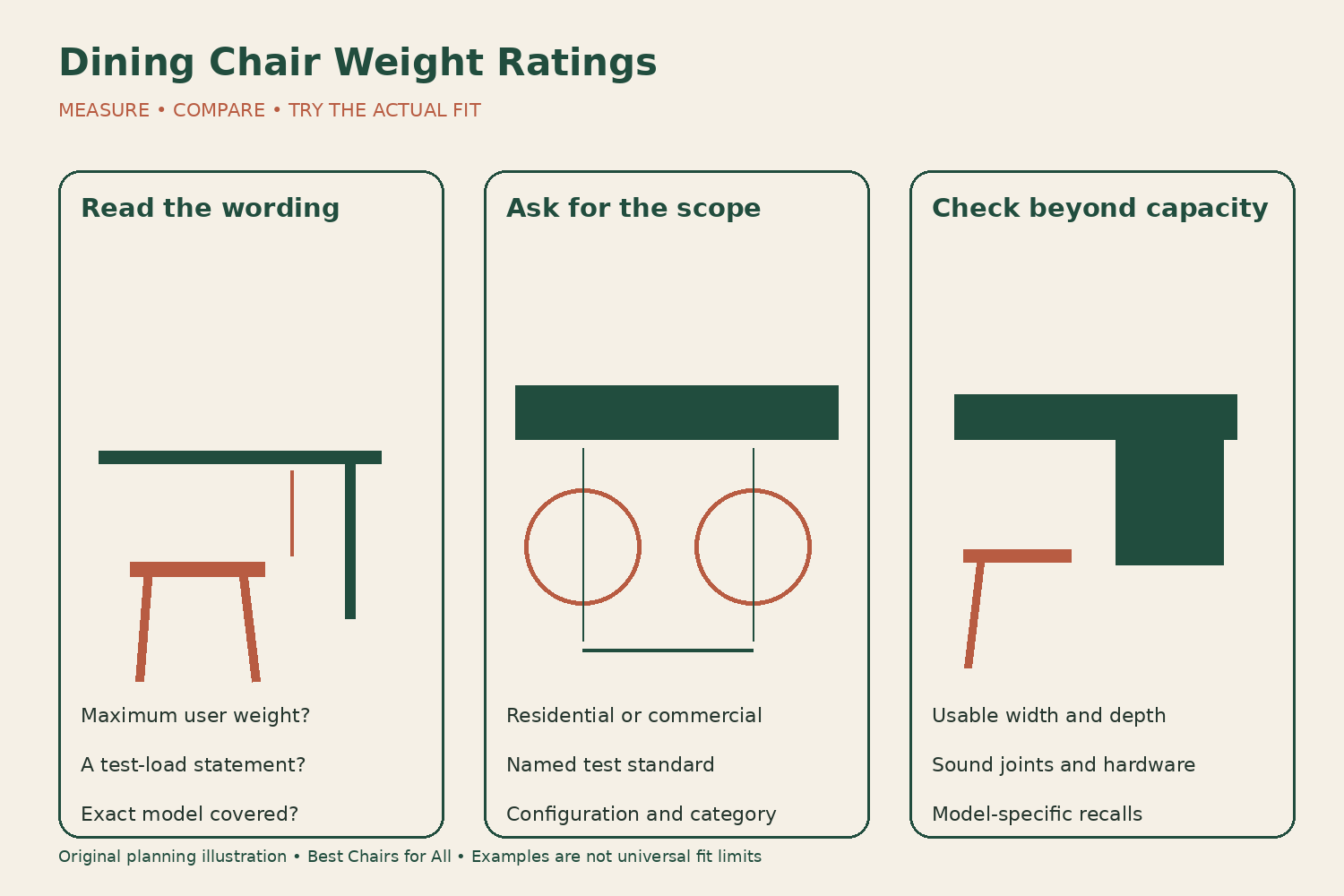
Find the manufacturer’s actual statement
Look for a published maximum user weight or capacity in the product specification and instructions. Record the model, size, base, arms, and any other configuration identifiers. A retailer may combine several versions on one page, while a specification applies to only one. Check that the number belongs to the exact item you intend to order.
If the listing says “tested to,” ask whether that is a stated maximum user weight or a description of a particular test. A test may apply force to one component under defined conditions. Without the test method and the manufacturer’s interpretation, a large test number is not permission for a person of that weight to use the chair.
Do not assume an unlisted capacity is unlimited or that every product from a brand has the same rating. Ask the manufacturer directly if the number matters to your purchase. “The frame looks thick” and “other customers use it” are not substitutes for a documented specification. Keep unanswered questions visible until you have enough information to choose.
Distinguish capacity, test scope, and certification
Capacity concerns the manufacturer’s permitted use of the product. A test standard describes procedures and criteria within a stated scope. A compliance program may provide a way to document conformity with specified standards. These pieces of information can support a decision, but they do not all mean the same thing and should not be blended into one impressive-sounding claim.
The BIFMA Compliant program identifies different seating standards and separately lists large-occupant public and lounge seating categories for 400-pound and 600-pound users. This is why a broad “BIFMA” label deserves follow-up: ask which standard, which category, and which exact product were assessed. Do not infer that every product carrying the brand name has a large-occupant rating.
BIFMA’s reaffirmation notice for X5.4-2020(R2025) describes public and lounge seating, including restaurant, dining, and cafeteria settings among the covered applications. That scope information is useful, but it does not establish a particular household chair’s user limit. The product’s own documentation still needs to answer that question.
Ask whether the rating is per seat
A single chair should have a statement that clearly applies to that chair. Benches and multiple-seat units need additional clarity: is a listed figure per seating position, for the entire unit, or based on an evenly distributed load? Do not divide a total figure into imagined seats unless the manufacturer says that is how the product is intended to be used.
For a chair with arms, ask whether there are restrictions on how the arms may be used. A maximum user weight does not automatically state the permitted force on one arm, the back, or a footrest. Follow the instructions for normal sitting and standing. A chair is not a step stool unless specifically designed and labeled for that purpose.
Avoid calculating your own “safety factor.” If a manufacturer says a chair is suitable up to a stated user weight, do not increase that figure because a test used a larger load or because you expect only occasional use. Likewise, do not invent a universal percentage margin as if it were an industry rule. Choose within clear published guidance and ask about any uncertainty.
Confirm the intended setting
Residential and commercial use can have different requirements, test scopes, and warranty conditions. A dining chair sold for a home is not automatically documented for a restaurant. A commercial chair’s description may address an application but still require checking its exact capacity, configuration, and maintenance instructions. State your intended setting when asking the manufacturer for guidance.
If the chair will be moved frequently, stacked, or used in an institution, mention those tasks too. A weight rating does not grant permission to stack a nonstacking design or expose an indoor chair to weather. Each use condition deserves its own answer. Buying for a café, shared facility, or other managed setting may also involve procurement requirements beyond ordinary household shopping.
Read the warranty separately. It may cover certain defects for an original purchaser while excluding particular uses, alterations, or wear. A lifetime headline is not an independently measured capacity, and a short warranty is not a direct measure of weakness. Keep the warranty as ownership information rather than converting it into a load rating.
Fit is independent of the load number
A chair can be rated for a user and still be too narrow, too shallow, or too difficult to enter. Check usable width between arms, usable seat depth, seat height, and the back shape. The widest outside dimension does not tell you how much room the person has inside the chair. Ask for the relevant measurements and try the exact configuration if possible.
Compare the chair with the table. Arms can prevent it from approaching the place setting, and an apron can reduce thigh room. A wider chair may fit the person but collide with the table legs or neighboring seats. A higher stated capacity does not remove these dimensional conflicts. Evaluate the complete place at the table rather than treating the rating as the whole selection process.
Include normal entry and exit in the trial, without deliberate rocking, bouncing, or loading one side to see what happens. Such actions are not a valid home strength test and could damage the chair. A useful trial concerns comfort and normal movement; structural capability should come from the manufacturer’s documentation and the chair’s sound condition.
A capacity does not cancel damage
Do not use a chair with cracked components, visibly loose joints, damaged welds, missing hardware, or unexplained instability merely because it once carried an adequate rating. The specification describes a product under its intended conditions, not a guarantee that a damaged or incorrectly assembled example remains fit for use. Remove a suspect chair from use while obtaining appropriate guidance.
Check the exact assembly instructions and use the supplied or approved replacement hardware. A substituted bolt, missing washer, or altered seat attachment may change how the chair functions. Do not assume a larger or longer screw is an upgrade. The manufacturer can identify the correct component and explain whether owner maintenance is appropriate.
For secondhand chairs, ask about repairs, modifications, and product identification. A seller’s estimate of capacity is not documentation. If the chair’s maker or model cannot be established, you may be unable to verify a needed rating or obtain the correct parts. That uncertainty can be decisive even when the chair looks appealing.
Check recalls by model and production details
Look up the chair with the maker and the appropriate official recall source. As checked on November 6, 2026, the CPSC notice for certain Crate & Barrel Ana dining chairs describes a leg-breakage hazard and instructs affected owners to stop using the chairs and contact the company for the remedy. The notice includes identifying details and a sales-period exclusion; a product name alone is insufficient for matching.
This example is not a statement that every Ana chair or every chair from that retailer is recalled. Read the complete current notice, compare the underside identifiers and applicable dates, and follow its instructions if there is a match. Do not attempt a home repair in place of a recall remedy because the chair still appears able to carry someone.
Retain a photograph of labels and the receipt. If a notice appears later, those details make matching easier. A recalled or damaged chair should not be passed to another household as ordinary usable furniture. Follow the manufacturer’s and recall authority’s instructions for the affected item.
Use a documentation comparison sheet
Create one row per exact model. Include the published capacity wording, source URL, access date, intended setting, test standard if stated, and configuration covered. Add a column for questions and the manufacturer’s written answers. Preserve the wording rather than reducing “tested for” and “maximum user weight” to identical entries.
Add separate rows for usable seat width, depth, height, arm opening, table clearance, and maintenance requirements. This keeps a strong capacity specification from hiding a poor fit. Use “not supplied” where necessary. An incomplete specification may still be clarified, but it should not silently become an assumed favorable result.
A useful manufacturer question is: “For model X with base Y and arms Z, what maximum user weight do you specify for normal residential dining use, and where is that documented?” If you need commercial use or a particular configuration, name it. A precise question is easier to answer than a request asking whether the chair is simply “strong.”
Make the purchase traceable
Confirm the exact product code on the order and keep the relevant specification with it. Check the delivered label and assembly components before use. If the seller substitutes a related model, repeat the capacity and fit checks. Visual similarity is not evidence that the same rating applies.
The useful rating is a clear manufacturer statement that you can trace to the chair you own, used within its instructions and kept in sound condition. It narrows the choice without replacing comfort, dimensions, proper assembly, or the need to respond to damage and recalls.
If buying chairs for guests whose needs you do not know, provide clear product information without making assumptions about any person. Keep the decision focused on documented capacity and usable dimensions, and avoid asking someone to perform a trial on a chair whose suitability remains uncertain.
Something unclear or out of date? Send a correction with this article’s title and the detail to check.
Sources, research & corrections policy ↗