Choose an adjustable bar stool when its real seat-height range and footrest arrangement solve a specific fit need. Choose a fixed-height stool when the measured height works for the intended users and surface without adjustment. “Adjustable” is not a guarantee of comfort, and “fixed” is not a guarantee of simplicity in every other feature. Compare the mechanism, occupied fit, access, and ownership requirements of the exact models.
Start with the counter, not the mechanism
Measure the floor-to-top height and the height of the lowest underside obstruction where the stool will stand. Record the overhang depth and any brackets or cabinet returns. Those measurements describe the opening you have to work with. A seat-height adjustment cannot create missing horizontal knee room or remove a low support rail under the counter.
For each candidate seat position, calculate the distance from seat to eating surface and from seat to underside obstruction. Keep them separate. A thick counter or apron makes the two numbers different. Then try the position with the intended user, because arithmetic identifies plausible candidates rather than proving comfort.
If the household uses two surfaces, make two records. A lower island and raised bar may need different seat positions or different stools. Do not assume that one adjustable product spans both just because the listing uses the words counter and bar. Compare the actual limits before choosing a mechanism for flexibility you may not receive.
Read the real adjustment range
Find the minimum and maximum seat heights, not the overall height including a backrest. Check whether the dimensions describe an unloaded padded seat. A mechanism can have an attractive advertised travel range while the resulting seat positions do not suit your particular surfaces. Record the exact model and version beside the range so a similar-looking alternative is not substituted later.
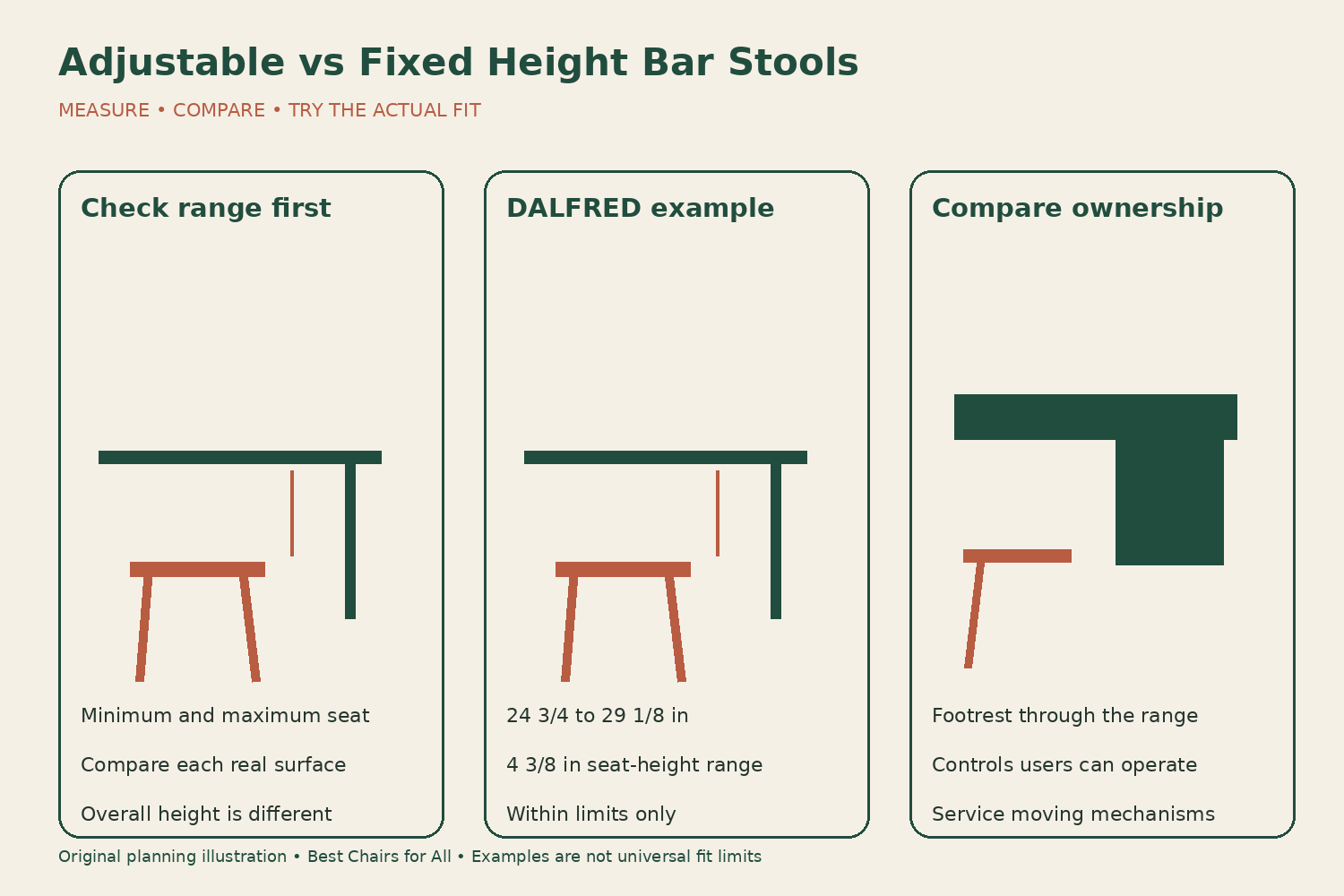
The IKEA DALFRED listing gives a minimum seat height of 24¾ inches and a maximum of 29⅛ inches. The difference is 4⅜ inches. That documented range is more useful than assuming an adjustable stool can reach any desired height. It is a product example, not a recommendation that those limits fit every counter or user.
A fixed stool may come in several manufactured heights. Amisco’s Clock height-selection information distinguishes counter and bar seat-height options. Selecting a suitable fixed version can resolve a fit need without an owner adjustment. Verify the ordered version’s exact dimensions rather than relying only on a dropdown label.
A worked range comparison
Suppose one measured setup works best during a normal trial with a seat near 25 inches and another with a seat near 31 inches. An adjustable stool covering 24¾–29⅛ inches includes the first target but not the second. The fact that it adjusts does not eliminate the need for another height or model at the higher surface.
Now suppose two regular users prefer plausible occupied positions near 25 and 27 inches at the same counter. A range containing both deserves a trial, but it still needs checks for cushion behavior, foot support, and entry. The range comparison establishes an opportunity to fit; it does not establish that the seat shape and mechanism suit either person.
For a fixed candidate, write the one manufactured seat height and perform the same counter relationship checks. If it works comfortably for the regular users, the absence of adjustment is not a problem. If one user cannot find foot support or the seat is too deep, adjustable height alone may not address the actual mismatch.
Understand how the stool adjusts
Some adjustable stools use a threaded seat, others use a lever-operated lift or another mechanism. Follow the exact product instructions for adjustment, locking, and permitted use. Do not assume the user should adjust while seated or while standing unless the maker specifies the method. Controls can operate differently even when the stools look similar.
A gas-lift mechanism is not an owner repair project. Do not puncture, heat, open, or dismantle a pressurized component, and do not modify it to extend the range. If it sinks, moves unexpectedly, or fails to hold a position, stop use as appropriate and contact the manufacturer or qualified service provider with the model information.
A threaded system also has limits and maintenance requirements. Respect stops and engagement instructions. Do not remove a retaining part, overextend the column, or use household lubricant or thread treatment without approval. A visible thread does not mean every aspect of the mechanism is intended for user modification.
Follow the footrest through the range
Look at whether the footrest moves with the seat, stays with the base, or adjusts independently. The seat-to-footrest drop can change as the seat rises. A taller position that improves reach to the counter may leave a person’s feet without useful support. Test the actual settings each regular user expects to use.
For a fixed stool, the relationship stays consistent, but it still needs to suit the sitter. Measure seat height and footrest top height from the same floor, then subtract to compare the vertical drop. Also check horizontal reach and the contact surface. A rail behind the heels is different from a forward support, even if the heights match.
OSHA’s chair guidance emphasizes supported feet and trying seating before purchasing, within a workstation context. That general fit concern is useful here, but its office-specific recommendations should not be treated as a dining-stool certification. A stool needs its own complete trial at the counter.
Try the controls and ordinary movement
Ask the intended users to operate the adjustment according to the instructions. Check reach to a lever or handle, clarity of the direction, and whether the chosen position is easy to reproduce. A feature is less useful if the person cannot comfortably use it or if the household leaves the stool at a setting that suits nobody well.
Then try entry, normal sitting, and exit. A swivel can be present on either an adjustable or fixed-height stool, so assess it separately. Rotation may change arm and back clearance at the counter. A fixed-height stool with a swivel may provide the turning behavior you want without offering height adjustment, while an adjustable stool may still require space to move the base.
Do not equate a moving seat with accessibility. Some users prefer a stationary feel, while others welcome turning. A person with particular transfer or mobility needs should receive appropriate individual assessment. Product features alone cannot establish a safe or suitable assistance routine.
Compare the complete base footprint
A pedestal base, multiple legs, and a sled frame occupy different floor areas, but none belongs exclusively to one height category. Measure the exact base and the widest moving upper section. Check the path beneath the counter and room behind the occupied stool. A mechanism selected to solve height can introduce an unexpected storage or circulation issue.
At an island with several stools, include neighbor clearance. A broad circular base can overlap the walking area even when narrow seat cushions appear well spaced. An armed upper section can sweep into another diner during rotation. Mock up the actual envelopes rather than counting seats from cushion width alone.
Inspect the floor-contact components and obtain the correct protector for the floor. Adjustable does not mean the base never moves, and fixed does not mean the feet require no upkeep. Keep contact surfaces clean and replace worn approved parts. A chair-floor interaction is a separate ownership decision from the choice of adjustment system.
Plan maintenance and service support
Read the care and assembly instructions before buying. DALFRED’s product page, for example, specifies a post-assembly screw recheck about two weeks later and when necessary. That is product-specific guidance, not a schedule for every adjustable stool. Record the requirement if you choose that model and ask about any other maintenance the instructions identify.
For another mechanism, ask which parts the owner may inspect and which require service. Check availability of approved glides, accessible fasteners, and complete replacement assemblies where relevant. Do not promise that a stool will be easy to repair without a documented parts route. A seller’s assurance should identify the product and the proposed support.
For fixed stools, review joints, seat attachments, and footrest connections according to their own manual. Fewer adjustment functions can reduce the number of features to evaluate, but the furniture still needs sound construction and care. Compare written requirements rather than assuming either category is maintenance-free.
Use a setting-by-user worksheet
Create a row for each regular user and each eating surface. Record the measured surface and underside heights, candidate seat position, supported-foot observation, back and seat-depth fit, and entry method. For an adjustable candidate, add whether the position lies inside the published range and whether the user can operate the control correctly.
Add another column for the setting after use. If several people share one stool, consider whether it is practical to reset it each time and how they will remember a successful position. Do not mark or alter a moving component in a way the manufacturer prohibits; a written reference or photograph may be sufficient.
Choose the adjustable option when the documented range and mechanism create useful, repeatable positions that pass the full fit trial. Choose the fixed version when its single height already works and its other features suit the room. The decision is about a real fitting task, not a general ranking of flexibility over simplicity.
For a stool moved between two counters, note the route as well as the two settings. Check that the base passes through the available opening and that moving it does not require lifting by a control, back cushion, or other unsuitable part. Follow the maker’s handling guidance. A product can cover both heights mathematically and still be impractical to relocate in daily use.
Something unclear or out of date? Send a correction with this article’s title and the detail to check.
Sources, research & corrections policy ↗