Before applying a disinfectant to a salon chair, check two independent requirements: the chair and upholstery must tolerate the exact product and process, and the disinfectant label must permit the intended surface and use. A product that removes hairspray is not automatically a disinfectant. A disinfectant with a useful label claim is not automatically compatible with the chair's covering, stitching, foam, or metal trim.
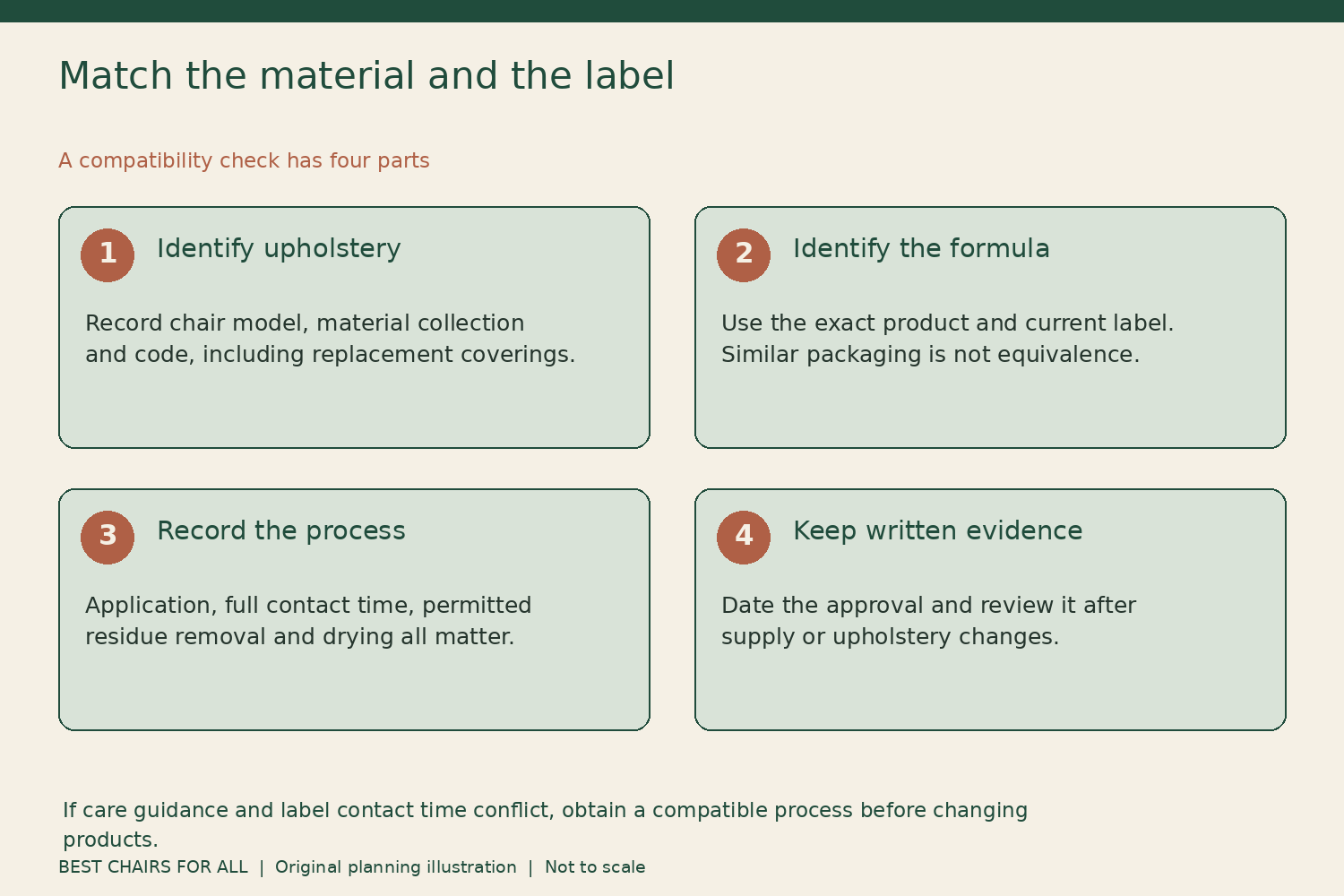
The practical solution is a written compatibility record for each chair material. Identify the covering, collect its current care instructions, match them with the product label and salon policy, and resolve conflicts before introducing the chemical. Do not improvise a weaker dilution or shorter contact time simply to reduce visible damage.
Identify the upholstery accurately
“Leather look,” “premium vinyl,” and “easy clean” describe appearance or marketing, not a complete material specification. Ask for the upholstery manufacturer, collection, product code, finish, and chair model. A seat recovered by a local upholsterer may no longer have the covering listed on the original chair's sales page.
Record separate surfaces where necessary: seat, back, arm pads, piping, decorative inserts, and replacement headrest. Different materials on one chair may have different care requirements. Keep invoices and upholstery sample labels, because a color name alone may not identify the construction or protective coating.
If the covering cannot be identified, ask the chair supplier what can be confirmed and what remains unknown. An inconspicuous spot test can reveal some immediate cosmetic reactions when the manufacturer permits it, but it cannot establish long-term compatibility or disinfectant effectiveness. Do not use a successful single wipe as proof that repeated daily exposure is acceptable.
Cleaning and disinfection answer different questions
The EPA explanation of cleaning, sanitizing and disinfecting explains the distinction between removing dirt and using registered products to sanitize or disinfect surfaces. For a chair, this means a manufacturer's gentle cleaner can be useful for routine soil removal without establishing the disinfectant process required by your workplace. Keep the cleaning step and the required disinfection step clear in staff instructions.
Visible residue can also make the material difficult to inspect. Hair products, color splashes, and accumulated cleaner can hide changes in sheen, surface cracking, or seam condition. A consistent routine makes it easier to notice what is new. Do not use aggressive scrubbing to make an old stain disappear if the care instructions do not permit that treatment.
A chair can look clean without a documented disinfection process, and it can look worn after exposure to an incompatible chemical. Neither appearance alone establishes what happened microbiologically. Avoid claims that a glossy surface, a familiar smell, or a wipe's color proves that the chair is appropriately disinfected.
Read both sets of instructions
The upholstery instructions address material care. The disinfectant label addresses matters such as approved surfaces, dilution, application, and contact time. The EPA registered-disinfectant label and contact-time guidance says users must read the label and keep the surface visibly wet for the full specified contact time. Choose a process that can satisfy the label while remaining compatible with the chair assembly.
If one document says to remove a chemical almost immediately while the label requires a longer wet period, there is a conflict to resolve. Contact the chair manufacturer and the disinfectant manufacturer, and involve the person responsible for the salon's hygiene policy. Do not assume that following only the shorter instruction accomplishes the label's disinfectant claim.
Ask about rinsing and drying too. Some material-care documents call for removing residual solution after the required process. That can be a separate step rather than a substitute for contact time. Write the complete sequence only after the relevant instructions agree, including how surfaces are returned to use. Avoid mixing chemicals or applying one product over another without a supported procedure.
What manufacturer care documents can tell you
Spradling's Spradling upholstery care and cleaning guide describes periodic care, prompt removal of spills, and the risk of damage from particular aggressive solvents and cleaners. Its guidance is valuable for the named upholstery system; it is not proof that every salon vinyl has the same resistance or that every concentration of a familiar chemical is acceptable.
Minerva's Minerva salon chair care guidance cautions that harsh products can damage vinyl and stitching and recommends gentle material-appropriate cleaning. That general chair-care advice still needs to be matched with the exact chair covering and the workplace's disinfection requirements. A broadly worded sales-page statement such as “easy to disinfect” is not a substitute for a product compatibility table.
Use manufacturer documents to ask precise questions. Instead of “Can I use disinfecting wipes?” ask whether the exact wipe, formula, concentration, contact time, frequency, residue-removal step, and application method are compatible with your upholstery code and assembled chair. Product families can include different active ingredients and formulations under similar branding.
Build a compatibility matrix
Make one row for each chair surface or upholstery code. Use columns for chair model, material identification, approved cleaning product, proposed disinfectant, exact label identifier, application process, required contact time, aftercare, and evidence. Add a date and the person who confirmed the process. This becomes the working reference when someone buys supplies.
Mark each row approved, pending, or unsuitable for the proposed process. “Pending” should have a named next action, such as requesting written compatibility confirmation from the chair supplier. Do not quietly treat missing information as approval. If a necessary process cannot be reconciled with the material, consider a different supported covering or chair rather than repeatedly damaging the existing one.
Keep the matrix accessible where staff prepare supplies, but store the full labels and technical documents as well. A short wall card can describe the agreed routine, while the underlying record preserves the details needed when a formula changes. Ensure the bottle actually in use matches the matrix; an old label on a refilled container creates uncertainty.
Worked example: a change of wipes
Imagine a salon that has used a documented cleaner and disinfectant process on a particular vinyl. The distributor substitutes a different wipe because the usual one is unavailable. The container looks similar, but its formula and contact-time instructions differ. The old compatibility entry does not automatically transfer to the replacement.
The manager records the new product's exact name and label information, requests compatibility confirmation for the identified upholstery, and checks the site's required process. Until the conflict is resolved, the manager uses an already approved alternative or keeps affected equipment out of service as the site policy requires. They do not shorten the new contact time to match the old routine.
The purchasing record then names the approved formula rather than just “disinfectant wipes.” This small administrative change reduces accidental substitutions. It also makes later investigation easier if the covering becomes tacky, discolored, stiff, or visibly cracked. The record can show when the process changed without proving that the change caused the damage.
Inspect seams and high-wear areas
A material test usually does not describe every part of a complete chair. Seams, thread, backing, exposed foam at a tear, and adhesives may respond differently from the face of a swatch. Inspect arm corners, seat edges, piping, and headrest contact areas during ordinary care. Record deterioration early and ask the supplier what repair or replacement is appropriate.
Do not pour or saturate the chair in an attempt to make a seam easier to disinfect. The permitted amount and application method belong to the product instructions and material guidance. Avoid spraying into controls, electrical parts, or openings. If the required procedure cannot be performed on damaged upholstery, follow the workplace's process for removing or repairing that equipment.
Photographs can be useful when taken consistently. Photograph the same location with ordinary lighting and include the date, chair identification, and cleaning history. Keep client information out of the record. This is a maintenance observation, not a laboratory test, and it should not be described as evidence of chemical resistance or infection control performance.
Covers do not remove the compatibility question
A fitted protective cover can help manage hair-color splashes or product buildup when approved for the chair, but it introduces another material to maintain. Ask for its laundering or cleaning instructions and whether it changes access to controls. Do not let a cover conceal a damaged seat or interfere with the chair's movement.
Disposable barriers, where required by the workplace's procedure, also need a defined application and removal process. They are not permission to ignore underlying upholstery condition. The appropriate hygiene requirements depend on the service and site policy; this article does not establish a clinical decontamination method or an exposure-response protocol.
When ordering replacement upholstery, include cleanability in the specification before choosing color. A covering that cannot tolerate the site's documented required process is a poor fit even if its texture and appearance are ideal. Get confirmation for the proposed material code rather than relying on a neighboring salon's experience with a different covering.
Train around the actual process
Demonstrate the approved routine using the exact products and equipment staff will use. Include label reading, appropriate protective equipment, dilution only when specified, contact time, any permitted residue-removal step, drying, and safe storage. Follow the workplace's training and chemical-safety requirements. Do not add homemade mixtures or fragrance products to the routine.
Check the process after a product reorder, upholstery replacement, or supplier update. A matrix that is never reviewed can become detached from what is on the shelf. Give one person responsibility for keeping the current instructions accessible and for routing unanswered questions to the supplier or site lead.
The useful standard is agreement between material care, product labeling, and the site's procedure. When those do not align, pause the proposed chemical change and resolve the mismatch. That protects the chair's serviceability while keeping disinfectant claims tied to the process actually permitted by the label.
Sources and specifications checked November 6, 2026. Examples are planning exercises, not product testing.
Something unclear or out of date? Send a correction with this article’s title and the detail to check.
Sources, research & corrections policy ↗