As an Amazon Associate, we earn from qualifying purchases. Read our affiliate disclosure.
There is no camping chair that is best for every bad back. People use that phrase for different symptoms, preferred postures, and difficulties getting into a seat. A useful purchase starts with the problem you experience: a hammock-like sag, an intrusive support ridge, an awkward seat edge, or a chair so low that standing is the hardest part.
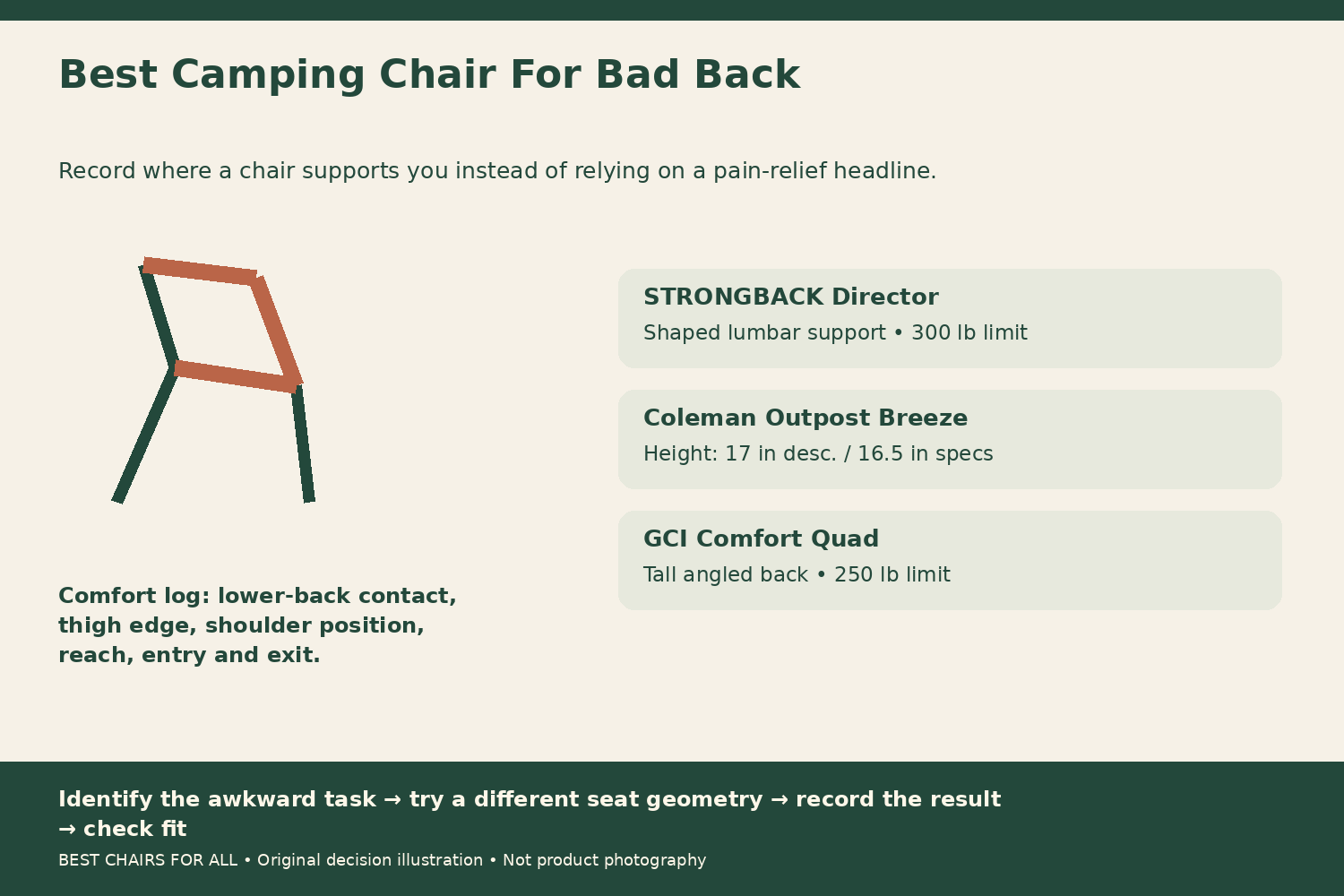
Our shortlist compares the STRONGBACK Director Chair with Side Table, Coleman Outpost Breeze Deck Chair, and GCI Outdoor Comfort Quad Chair. They offer three different arrangements: shaped lumbar support integrated into the frame, solid padded arms with an angled seat, and a taller angled fabric back. These are candidates for a fit trial, not treatments or medically ranked products.
This guide draws on current manufacturer information reviewed November 6, 2026. We have not tested these chairs clinically or measured pain outcomes. MedlinePlus explains that back pain has different causes and treatments; seek individual medical advice for severe, persistent, or injury-related pain rather than relying on a chair recommendation to diagnose it.
Separate the seat problem from the back problem
Describe the uncomfortable situation in ordinary words. Does your lower back lose contact with the backrest? Does a lumbar bulge feel too high? Do you slide forward until the seat edge presses behind your thighs? Does reaching a cup on the ground repeatedly pull you into a position you dislike? Each observation points toward a feature you can examine.
Do not assume more support is always better. A pronounced contour can suit one person and press in the wrong place for another. Likewise, a soft seat can feel pleasant initially yet leave you in a posture you do not prefer. The word ergonomic does not tell you where the support meets your body.
Think about the campsite too. A low dining surface, a sloping pitch, or frequently leaning toward a fire can influence how you sit. Changing the chair may not resolve a layout that continually requires awkward reaching. Evaluate the seat as part of the actual camping arrangement.
Three useful candidates, with different limitations
STRONGBACK Director Chair with Side Table: for testing shaped lumbar contact
The STRONGBACK Director product page describes support built into the frame, a 20.5-inch seat width, an aluminum-alloy frame, a side table, and a 300-pound capacity. Those features make it a relevant candidate when your main objection to a conventional camping chair is the absence of a defined lower-back support shape.
Its reason for inclusion is the physical arrangement, not the manufacturer's pain-relief language. Try where the contour contacts your back and whether you can remain against it without being pushed forward. The side table may help keep a bottle or book within a comfortable reach, but it should not be used as a support for standing.
Pass if the fixed contour does not match you, if the seat width is insufficient, or if you need adjustments the chair does not provide. At the time of research, the manufacturer's page showed out-of-stock or preorder messaging, so verify the seller's actual delivery status before planning a trip around it.
Check matching STRONGBACK Director listings on Amazon (paid link). Confirm the director model rather than a lower beach chair.
Coleman Outpost Breeze Deck Chair: for a solid-arm alternative
The Coleman Outpost Breeze page, SKU 2000019421, lists a 20.5-inch seat width, a 300-pound capacity, padded solid arms, and a cooling mesh back. Its Description calls the sitting height 17 inches, while the same page's Specifications field gives Furniture Seat Height as 16.5 inches. We preserve that source-field conflict rather than select one as a universal measured height; confirm the current chair's height with Coleman if the difference matters for your fit. Its angled sitting arrangement provides a useful comparison for someone who dislikes deep, loose quad-chair seats.
This chair is worth trying when the entry and exit experience matters as much as backrest shape. Solid arms feel different from suspended fabric armrests. That is a reason to evaluate them, not proof that the chair is suitable as a transfer aid for every user. Check what the manual permits and whether the actual chair remains appropriate for your needs.
The Breeze does not offer the STRONGBACK's specific lumbar contour or an adjustable office-chair mechanism. If you need precisely placed lumbar contact, an upright back angle, or a seat higher than this model provides, it may be the wrong comparison. The related Outpost Elite is also a different configuration, so check the full name.
Check matching Coleman Outpost Breeze listings on Amazon (paid link). Verify Breeze and the listed seat dimensions.
GCI Outdoor Comfort Quad Chair: for a taller angled fabric back
GCI's Comfort Quad page specifies a tall angled backrest, a breathable mesh panel, a steel frame, a carry bag, and beverage and phone storage. The published chair weight is 7.7 pounds and capacity is 250 pounds. It provides another seating shape to try without assuming every back-sensitive user wants the same rigid contour.
Its appeal is a familiar folding format with a longer back and a relaxed angle. Someone who finds a low-backed chair incomplete may prefer that arrangement. Someone who wants a very upright position or firm integrated lumbar shape may not. The useful comparison is how the back supports you during your actual camping activity.
The 250-pound limit is a separate pass-or-fail requirement. Do not interpret a tall back or the word comfort as evidence of a higher load rating. Also distinguish Comfort Quad from Comfort Pro Rocker and other GCI models whose names appear beside it in search results.
Check matching GCI Comfort Quad listings on Amazon (paid link). Verify the exact non-rocking chair.
A comfort log for comparing seats without guessing
Use a one-page log with five rows: lower-back contact, thigh-edge contact, shoulder position, reach to ordinary items, and getting in and out. For each candidate, write what you notice rather than assigning a medical score. Examples include contour feels too high, feet rest comfortably, or bottle requires leaning to the floor.
Start with a familiar chair you already use comfortably. Measure its seat height, usable width, and depth, and describe its back shape. This gives you a personal reference. It does not mean every camping chair must reproduce that geometry exactly; suspended fabric and outdoor posture can feel different.
During a trial, sit long enough to settle. Try a normal activity such as reading or talking, then note whether you keep changing position for a specific reason. Stop the trial if it provokes symptoms rather than trying to push through to produce a better comparison. The purpose is useful information, not endurance.
Repeat the task in each chair using the same clothing and similar conditions where possible. A thick jacket, a cushion, and a different table height can change the experience. Record those variables so you do not attribute every difference to the frame itself.
Finish by describing the entry and exit movement. Can you approach the seat without stepping around a table? Do you need a higher seat? Is a soft armrest inconvenient? If your needs include assistance or a particular transfer technique, evaluate the arrangement with appropriate individual guidance. A camping-chair label is not a mobility-equipment specification.
Work through a common mismatch
Imagine a camper who sits on the front edge because the chair feels too deep. Adding a lumbar cushion might move the back contact forward, but it can also reduce usable depth, alter shoulder support, and change how the arms align. Buying a deeper chair with a thicker pillow is therefore not an automatic improvement.
A better shopping sequence is to compare actual seat depth and back contact first. Try the chair without accessories, then with the specific cushion you would use if the manufacturer allows it. Keep the cushion clear of mechanisms and make sure it stays in position. Reject the arrangement if it solves one pressure point by creating another.
Another camper may prefer the backrest but struggle to stand from a low position. That is a seat-height and transfer question, not necessarily a lumbar-support question. A higher or different-format chair may deserve priority even if its marketing says less about backs. Let the observed problem direct the purchase.
Arrange camp to reduce repeated awkward reaching
Keep frequently used items at a convenient reach instead of putting everything on the ground. A closed water bottle, glasses, book, or phone can live on a suitable side surface. Ensure the table does not obstruct standing or require you to twist over an armrest to reach it.
Face the activity you intend to watch. If a conversation circle or view requires constant turning, reposition the chair while unoccupied. Do not twist the frame or balance it on uneven supports to improve the view. Use stable level ground and follow the manufacturer's setup instructions.
Consider the height of the meal surface. A low lounging chair at a tall table can invite forward perching, while a high chair at a very low table may lead to repeated bending. Your preferred camping routine may be better served by changing the chair-and-table combination than by choosing the chair with the most padding.
Allow room to change position and follow any movement guidance given by your clinician. This guide does not prescribe a sitting duration or exercise routine. The practical aim is a campsite arrangement that supports your own needs without making every ordinary task a reach or a negotiation with furniture.
Claims to treat carefully
A patent concerns an invention, not proof that a chair will treat your condition. A customer testimonial reflects one person's experience, not a clinical comparison. A high capacity describes a load limit, not back support quality. Keep those categories separate when reading product pages.
Similarly, heating, reclining, and extra cushions are features rather than medical endorsements. Choose them only when their actual function suits you. Avoid selecting a heated chair to manage a symptom without considering its instructions and your individual health circumstances.
If buying online, prioritize a return policy that permits a careful fit assessment. Confirm the model, delivery date, and return freight before purchase. This is particularly important when a specialized support shape is the reason you are buying. A product can be well made and still fit you poorly.
Keep the completed log for future trips. A useful note identifies a specific mismatch, such as an edge pressing behind the knees, rather than simply labeling an entire brand uncomfortable. That makes your next comparison more focused.
A practical final choice
Try the STRONGBACK Director when the specific question is whether a defined lumbar contour suits you. Compare the Outpost Breeze when solid arms and its published seat geometry address your concern. Try the Comfort Quad when you prefer a taller angled fabric back and meet its capacity requirement.
Do not choose solely by the phrase bad back in a retailer title. Your comfort log should show what improved, what remained awkward, and whether you could use the chair for the tasks you actually do at camp. That evidence is more useful for a personal purchase than an unsupported promise of pain relief.
Something unclear or out of date? Send a correction with this article’s title and the detail to check.
Sources, research & corrections policy ↗