As an Amazon Associate, we earn from qualifying purchases. Read our affiliate disclosure.
The best backpacking chair is the one that fits both your pack and your evening routine. A long-distance walker arriving at dusk may value a different seat from someone spending two nights beside a lake. Rather than declare one universal winner, this guide compares three distinct ways to bring back support into the backcountry.
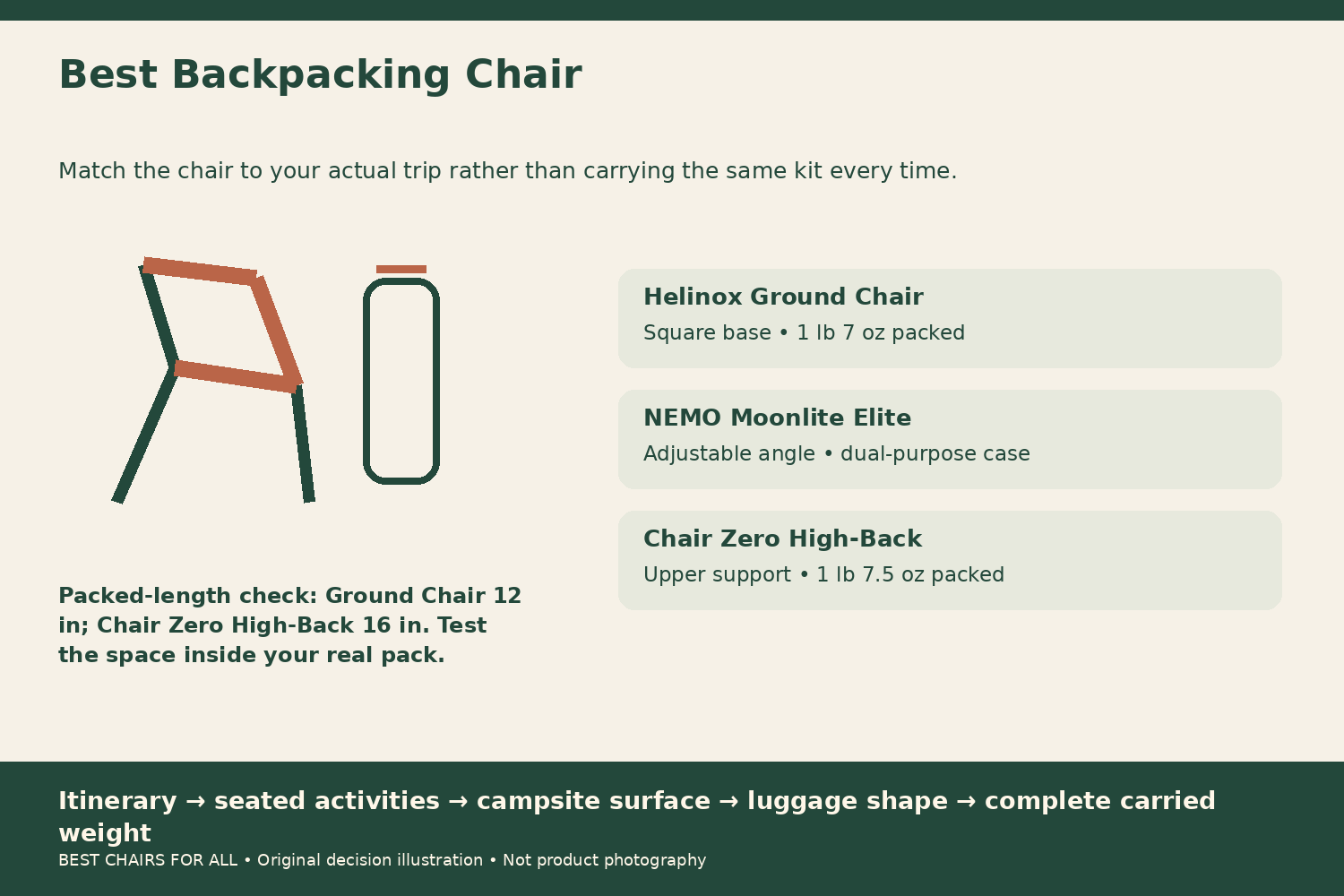
The Helinox Ground Chair is worth investigating for its broad square base and short packed length. The NEMO Moonlite Elite offers adjustable reclining in a backpacking-focused design. The Helinox Chair Zero High-Back adds upper-back support for someone willing to carry the larger packed package. Each solves a different problem, and each can be the wrong choice for a particular person.
This is manufacturer research reviewed November 6, 2026, not a report of our own trail testing. We do not claim measured comfort scores or long-term durability results. Prices and stock vary; Amazon model searches below are provided for comparison and are not confirmation of a matching available offer.
Begin with the itinerary rather than the chair catalog
Write down when you expect to sit. Include breakfast, lunch stops, camp chores, reading, and the evening after dinner. A chair that will be used for several relaxed hours has a different role from one unpacked for ten minutes before sleep. Neither schedule automatically makes the purchase sensible or foolish; it identifies the benefit you are trying to buy.
Next describe your usual campsite surface. A broad support base may matter on soft ground. A short packed length may matter when a chair must fit inside a small pack or pannier. An adjustable sitting angle may matter if your preferred rest position changes after walking. Rank these needs rather than assuming minimum weight should always come first.
Finally, decide whether an elevated seat is essential. A very low chair can be comfortable to lounge in yet awkward to enter or leave. If that is your main concern, try the seating position early in the shopping process. Do not purchase a low design simply because its packed dimensions fit a gear list.
Three chairs for three backpacking priorities
Helinox Ground Chair: for broad contact and short packed length
The Ground Chair manufacturer page specifies a square base, a 265-pound capacity, and a 1-pound-7-ounce packed weight. Its bag is listed as 12 by 4.5 by 4.5 inches. Helinox publishes a 3.5-inch seat height, emphasizing how close to the ground this design sits.
The broad base is the reason to compare it when ground contact matters as much as carrying weight. It avoids the same point-foot layout used by many compact chairs. That can be useful in a packing plan focused on a low seat and soft-ground considerations, although a broader base never makes unsuitable terrain acceptable.
The decisive compromise is entry and exit. You are buying a ground-adjacent lounging position, not the height of a campground director's chair. Try getting up after sitting for a while. Also check your intended camp table: a low chair may work with meals in your lap but feel mismatched beside a taller table.
Check matching Helinox Ground Chair listings on Amazon (paid link). Ground Chair is a specific model, not a generic term for any low seat.
NEMO Moonlite Elite: for changing the sitting angle
NEMO's Moonlite Elite page describes an adjustable cord-based reclining system and a tool-roll Platform Pack that can double as a ground platform on sand. The brand markets the chair at 1.2 pounds; check the exact current packed specification before comparing a complete system by grams.
This is the candidate for a backpacker who expects to eat upright and then lean back to read or watch the sky. The adjustment is a functional reason to carry the chair rather than merely an added feature on a checklist. Its included case having another purpose can also simplify a considered equipment plan.
The limitation is that a sophisticated lightweight design still needs the correct setup and a compatible body fit. Learn the attachments and adjustment at home, and inspect the suspension before a trip. Pass if a fixed seat feels just as good to you or if the actual chair shape does not justify its place in the pack.
Check matching NEMO Moonlite Elite listings on Amazon (paid link). Verify Elite rather than standard Moonlite.
Helinox Chair Zero High-Back: for upper-back support
The Chair Zero High-Back page lists a 1-pound-7.5-ounce packed weight, a 265-pound capacity, and a 16-by-5.5-by-5.5-inch bag. The manufacturer says the back is 7.5 inches taller than the standard Chair Zero. That makes its purpose clear: added support above the compact low-back seat category.
It is worth trying if you regularly wish a small backpacking chair supported more of your upper body. Compare where the top actually contacts you, not just the word high-back. Torso length, shoulder position, and preferred recline can change whether that extra fabric feels useful.
The packed length is its main purchasing question alongside fit. A 16-inch bundle is different from the Ground Chair's 12-inch package when you are arranging a compact pack. The High-Back's low seat also remains a low seat; more backrest does not turn it into a full-height camp chair.
Check matching Chair Zero High-Back listings on Amazon (paid link). Do not apply these figures to Chair Zero L or Chair Zero LT.
An itinerary-to-chair worksheet
Divide a page into three trip scenarios you actually take. For example, one might be a single-night walk with a late arrival, another a relaxed two-night basecamp, and the third a mixed walking-and-paddling trip. These are planning examples, not claims about how any product performs on a particular route.
For each scenario, record expected seated activities, likely surface, carrying arrangement, and acceptable complete chair weight. Add a line for your reason to carry it. If the reason is vague, make it specific: reading comfortably for an hour is a clearer objective than making camp better.
Now compare the chairs against those requirements. The Ground Chair's short package may suit an internal compartment, but its very low seat might fail your activity requirement. The High-Back might provide useful support but require an awkward packing orientation. The Moonlite Elite's adjustment might be valuable at basecamp and less relevant on a quick overnight.
Keep unknowns visible. If a product page gives only one weight value without defining included items, mark it as unconfirmed for your complete system. Add the bag, ground accessories, and anything else you will carry. A worksheet is most useful when it admits uncertainty rather than filling every box with a guessed number.
Choose a chair for your most frequent realistic trip, then decide whether to leave it behind for other outings. There is no requirement to carry every owned comfort item on every walk. A sensible kit can change with season, itinerary, and personal priorities.
A pack-fit exercise before ordering
Use the published packed length to make a cardboard or paper outline. Place it where the chair will go among your actual equipment. Check whether you can retrieve rain clothing, food, and first-aid supplies without removing the chair. A package that fits only when everything is perfectly arranged may be frustrating during a wet lunch stop.
If you plan to carry it outside the pack, use secure attachments intended for that luggage arrangement. Keep loose straps from snagging and avoid exposing fabric to sharp objects. Check balance rather than assuming an accessory is harmless because it is light. A swinging bundle can be more irritating than its weight suggests.
For a shared trip, agree whose pack holds the chair and whether it is truly shared. Two people cannot use one seat at the same time, and a couple's evening routine may not suit taking turns. The apparent weight saving should be evaluated against how you intend to rest.
A basecamp decision that changes on a moving trip
Imagine that the same chair fits two itineraries. On a two-night lake stay, you may unpack it once and use it through several meals and reading sessions. On a route with a different camp each night, you will assemble, disassemble, and repack it repeatedly. Neither scenario changes its published weight, but the value of simple setup and compact luggage access changes. Put the number of likely setup cycles beside your expected seated time before selecting a model for a specific departure.
Fit, setup, and realistic use around camp
Assemble the exact model completely on suitable level ground. Make sure each pole and attachment is seated as instructed. Do not rush the final corners or assume shock cord means every joint has connected itself. A visual inspection takes less effort than dealing with a preventable assembly problem far from the car.
Sit in your expected camp layers and try the ordinary tasks on your itinerary worksheet. Check whether your knees, hips, and back settle naturally. Reach for a closed bottle or book without leaning outside the chair's support area. The fit test should resemble a quiet evening, not an exaggerated lounge pose for a photograph.
Follow the maker's instructions for ground and movement. Do not rock a fixed chair onto two legs or support it over unstable obstacles. Leave enough room around the legs to avoid tripping during evening chores. Keep it away from stoves, flame, sparks, and paths used by other campers.
When packing up, check for loose parts and remove grit according to the care guidance. Dry damp fabric when practical and fully dry it before long storage. If a pole or hub is damaged, seek the appropriate replacement or repair from the manufacturer rather than improvising a structural fix.
Questions worth answering before purchase
Does the chair's capacity cover the intended user? Does its seat fit, and can that person rise comfortably? Will the complete packed system fit in the chosen luggage? Can it be returned after a careful indoor assembly and fit check? These are useful pass-or-fail questions before comparing minor features.
Review delivered cost and return shipping for the exact variant. We have not validated a current all-in price for every seller, so none of these recommendations is a promise of a particular budget. A model-name Amazon search may include accessories, earlier versions, or products with similar titles. Confirm the label against the manufacturer page.
Save the model number, receipt, and instructions after purchase. Replacement seats and frames are often specific to a generation or size. This matters especially when a favorite chair eventually needs one component rather than complete replacement.
For low, broad-based seating, start with the Ground Chair. For adjustable angle, investigate the Moonlite Elite. For more upper-back support in a backpacking package, try the Chair Zero High-Back. Your itinerary worksheet should explain the final choice in one concrete sentence: what you carry, where it fits, and which evening task makes it worthwhile.
Something unclear or out of date? Send a correction with this article’s title and the detail to check.
Sources, research & corrections policy ↗