If a salon chair will not lift, stop using that station until you understand the problem. The useful owner checks are identification, correct control technique, visible obstructions, and a clear record for the manufacturer. They do not include opening the hydraulic pump, adding unidentified fluid, removing the seat under load, or experimenting with internal adjustments.
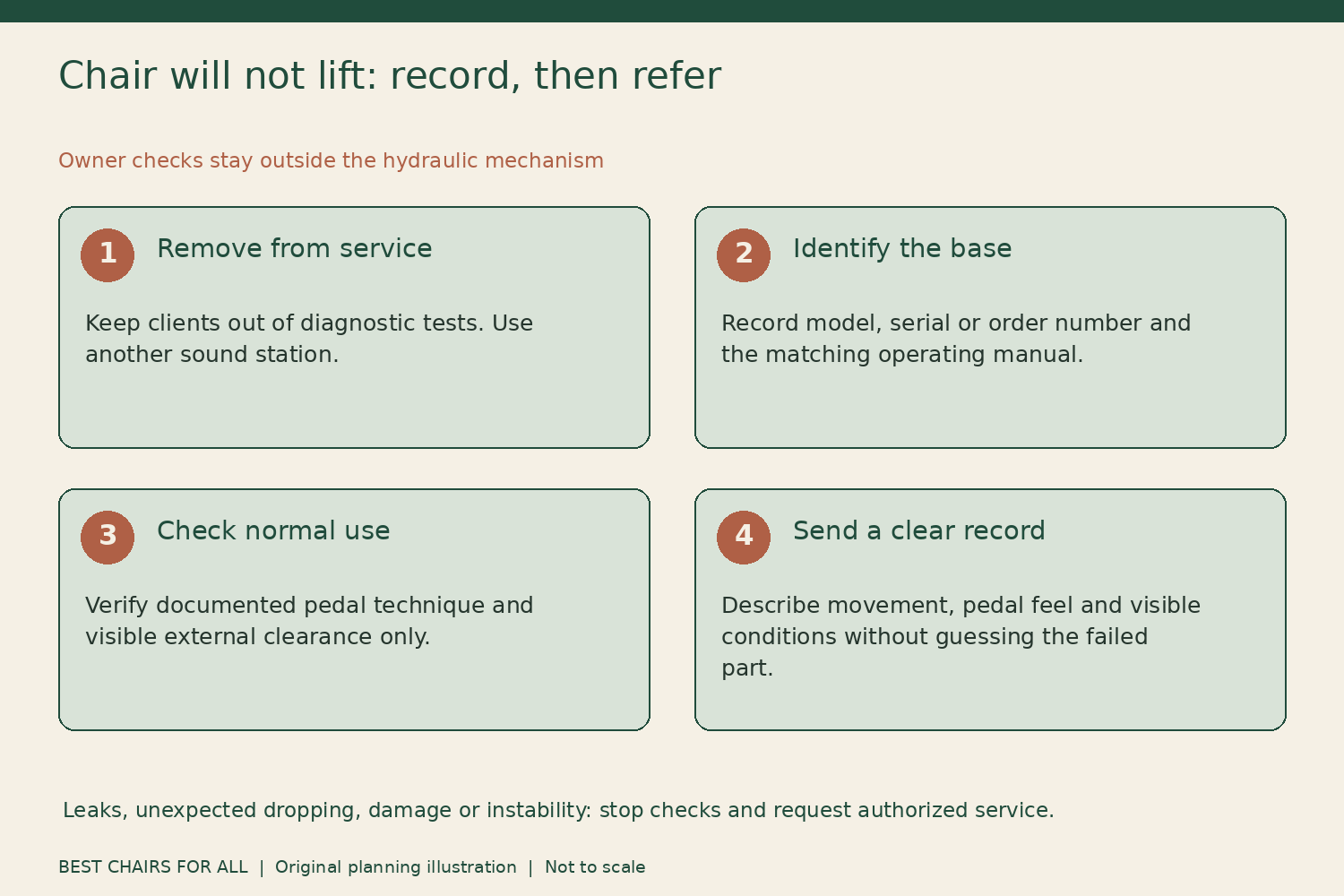
A chair that does not rise is not necessarily suffering from one specific pump failure. The control may be operated incorrectly, the chair may already be at its upper limit, an obstruction may affect the pedal, or a component may need professional service. The symptom alone cannot distinguish those possibilities. Keep clients out of the diagnostic process and use a sound alternative station.
First make the situation manageable
If someone is seated when the problem appears, stop the service and avoid further adjustment attempts. Explain what is happening without blaming the client. Help them leave only through the chair's normal, stable access position and according to their wishes. If the chair is stuck in a position from which they cannot exit safely, obtain appropriate on-site help rather than forcing movement or lifting the person with improvised equipment.
Once unoccupied, mark the station unavailable and tell everyone who might use it. A small “do not use” note on the mirror may be missed by a colleague who approaches from behind, so place the notice where the operator will see it. If necessary, remove the station from appointment allocation until it has been assessed and released for service.
Do not keep pumping harder to prove that the chair is broken. Stronger force is not a diagnosis, and normal controls are not intended as test levers. If there is sudden dropping, significant leakage, structural damage, uncontrolled rotation, a damaged pedal, or unusual instability, end owner checks and contact the supplier or authorized technician.
Identify the mechanism before following advice
Find the manufacturer, chair-top model, base model, approximate purchase date, and serial or order information. Use accessible labels and existing purchase records. Do not tip a heavy chair or lift it by the seat to expose a hidden label. A clear photograph from a safe position is sufficient if the writing is hard to read.
Some professional stools use pneumatic cylinders, some styling chairs use manual hydraulic bases, and some salon equipment uses powered lift systems. Instructions for one are not interchangeable with another. A troubleshooting video that happens to show a similar upholstered seat may be addressing a completely different mechanism.
Takara Belmont publishes a dedicated Takara Belmont USA hydraulic chair-base instructions with separate operations for raising, lowering, rotation, and locking. Minerva's Minerva replacement-pump compatibility list lists different pumps for different base families and specifically directs owners of pre-2012 chairs to contact customer service about fit. Both resources show why the base's identity matters independently of the chair's appearance.
Check the manual's normal control technique
Read the operating section for the exact base. On the Takara Belmont hydraulic base described in the cited USA instructions, repeated light pedal strokes raise the seat; deeply depressing the pedal lowers it. The document warns that pressing too deeply during raising can produce only a small rise because lowering also occurs. That is a model-specific operational check, not a universal pedal sequence.
If your own manual describes a different control, use that instruction. The important question is whether the operator is using the documented normal motion. Ask the supplier to demonstrate if there is uncertainty. Do not translate another chair's “lock,” “release,” or “pump” action into an assumed procedure for your equipment.
Check whether the chair is already at its documented maximum height. Compare its position with the manual or a reliable previous record; do not force it beyond its normal stop. A chair that is already fully raised has no additional upward travel to provide. If it cannot lower normally, report that as a separate symptom rather than treating it as ordinary end-of-travel behavior.
Look for external interference
With the chair unoccupied, visually inspect the area around the pedal and base. A floor mat edge, trolley wheel, cable, cleaning tool, or accumulated debris may be occupying the control's travel path. Keep hands out of moving gaps. Remove loose surrounding items only when doing so does not require moving or supporting the chair mechanism.
A mat that has shifted against the pedal is different from a bent pedal or broken linkage. The former is a layout issue to document and correct; the latter needs service. Do not bend a control back into shape, insert a longer handle, or push a tool into an opening. Photographs taken without operating the mechanism can help support distinguish what is visible.
Check the immediate floor area for a recent spill and prevent anyone from slipping. Do not assume every oily-looking mark proves hydraulic failure, but do not dismiss a new puddle either. Record location, approximate size, and whether it appeared with the symptom. The technician can interpret that information alongside the actual model and service history.
Distinguish observation from repair
“Pedal moves but seat does not rise” is an observation. “The internal seal has failed” is a diagnosis that requires evidence you may not have. Likewise, “chair slowly descends during a normal appointment” describes behavior; it does not establish which valve or component needs replacing. Use plain descriptions to avoid sending service down the wrong path.
The Takara Belmont instructions prohibit user disassembly, repair, and modification. They also warn against lifting the unlocked chair top, because the top and ram can come away and the base may then require dealer attention. This is why pulling up on the seat while someone pumps is not an appropriate general remedy.
Routine maintenance advice should not be used to override an active fault. Keller's Keller styling-chair assembly and normal-cycle guidance describes cycling its styling-chair hydraulic through its normal range as part of manufacturer guidance. That does not authorize repeated operation of a leaking, unstable, or malfunctioning chair, or establish a repair procedure for another brand. Ask support whether any manual-defined user check is appropriate for your symptom.
A technician-ready fault worksheet
Prepare one short record with the chair and base identities, purchase date, supplier, station number, date the problem appeared, and the last time it worked normally. Include whether the chair was moved, reassembled, cleaned with a new product, or fitted with a replacement component recently. Record facts without assuming the recent event caused the failure.
Describe the symptom using separate fields: upward movement, downward movement, rotation lock, pedal feel, visible leakage, and stability. For example: “No upward movement during ordinary light pedal strokes; seat already low; normal rotation was observed before removal from service; no further tests performed.” Do not recreate an unsafe event to complete a field.
Attach photographs of accessible labels, the full chair, the pedal area, and any visible damage. If support requests a video, agree on a safe unoccupied demonstration and stop if the chair behaves unpredictably. Never place a colleague in the seat solely to reproduce a load-related failure. The manufacturer can advise a professional inspection instead.
Worked triage example
Imagine a chair that seems to rise only slightly after a new floor mat is installed. The owner removes the station from service and identifies the exact hydraulic base. The manual distinguishes light raising strokes from a deeper lowering action. A visual check also shows the mat edge pressed against the pedal. These are two useful observations, not proof that the pump is healthy.
The owner records both, restores the approved clear floor arrangement, and follows the normal unoccupied operation specified by the manufacturer only if there are no other warning signs. If the symptom persists, the next step is support with the worksheet. The owner does not add oil, loosen a valve, or pull the seat upward to “help” it.
In another case, the chair drops unexpectedly and fluid is visible near the base. That case goes directly to service; the mat and pedal-technique branch is no longer a useful experiment. The diagnostic flow should become shorter as the warning signs become clearer. The goal is a dependable decision about the station, not completing every possible check.
Replacement and warranty questions
Before ordering a pump, ask support to identify the approved part for the chair, base, and manufacturing period. Request confirmation of the installation method, who should perform it, and whether other components need inspection. A pump advertised as universal may not establish compatibility with your complete assembly.
Ask what evidence is needed for a warranty claim and retain correspondence, photographs, and the original order. Do not discard the old part until the supplier explains any return or inspection requirements. Do not ship hydraulic equipment using an improvised packing method; request the manufacturer's handling and transport instructions.
If replacement is recommended, compare the repair plan with a complete approved base or chair option, including installation and downtime. Avoid treating a new pump's advertised rating as an automatic upgrade to the whole chair's client capacity. The frame, connection, base, and documented rating remain part of the system.
Returning the station to use
Record the technician's findings, approved parts, completed work, and any revised maintenance instructions. Have the normal height and lock functions demonstrated and confirm that the station is released for its intended service. Keep the service record with the manual so the next owner check starts with accurate history.
Review whether the original symptom revealed a training or layout problem as well as an equipment fault. Clear pedal space, accessible instructions, and a consistent method for reporting problems can prevent confusion during busy appointments. They cannot replace repairs, but they make it easier to notice and act on a chair that needs attention.
The safest useful response to a salon chair that will not lift is therefore structured: stop the station, identify the base, verify only documented normal operation and visible clearance, then provide good evidence to the right service contact. Internal hydraulic work belongs with the authorized repair process.
Sources and specifications checked November 6, 2026. Examples are planning exercises, not product testing.
Something unclear or out of date? Send a correction with this article’s title and the detail to check.
Sources, research & corrections policy ↗