As an Amazon Associate, we earn from qualifying purchases. Read our affiliate disclosure.
An ultralight camping chair earns its place by delivering enough rest to justify the weight you carry all day. That is a personal tradeoff, but the comparison can still be disciplined. Start with a firm system-weight allowance, decide whether you need an elevated seat, and eliminate anything that fails your fit or ground requirements before comparing the remaining grams.
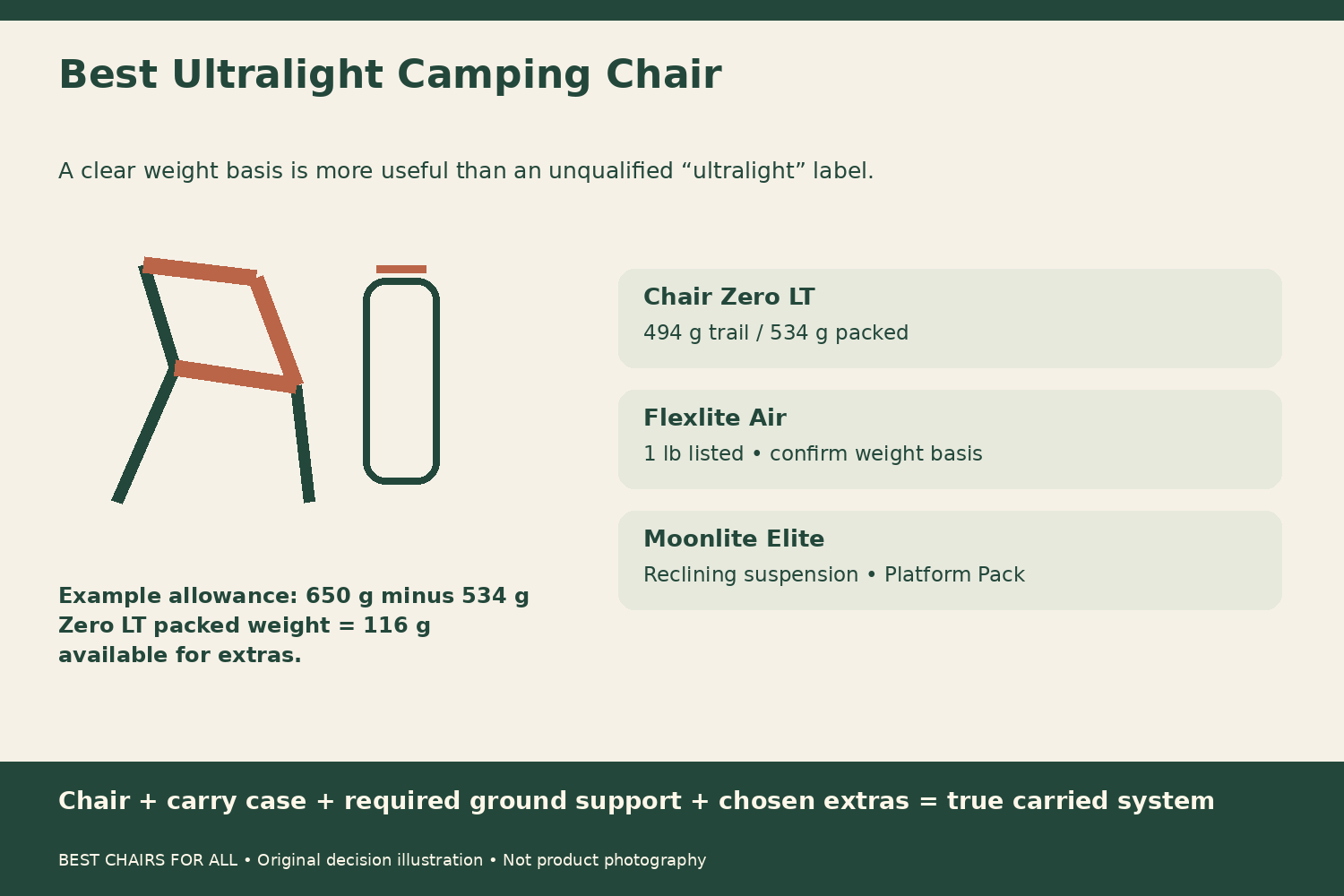
The three candidates here are the Helinox Chair Zero LT, REI Co-op Flexlite Air, and NEMO Moonlite Elite Reclining Backpacking Chair. They represent an integrated stabilizer design, a minimalist one-pound listed chair, and an adjustable reclining design. Our recommendations come from manufacturer research reviewed November 6, 2026, not from our own field tests or laboratory weighing.
If minimizing weight is the sole objective, leaving the chair behind remains an option. This guide is for people who already want a compact supported seat and need to choose intelligently among the compromises. Prices and availability are not fixed; the Amazon links are model searches rather than validated offers.
The shortlist, with weight definitions kept visible
Helinox Chair Zero LT: for a documented packed-weight comparison
The Chair Zero LT manufacturer page publishes a 494-gram trail weight and a 534-gram packed weight. Its stated capacity is 265 pounds, and the carry case measures 14 by 4.5 by 4.5 inches. The included X-strap stabilizer and translucent grid fabric distinguish it from the older Chair Zero.
This is the first model to examine if you want the weight basis clearly stated and an included feature intended to spread ground contact. You can put the 534-gram packed figure directly into a trip spreadsheet, then add only the accessories you actually plan to carry. The distinction avoids comparing its bare-chair figure against another model's total package.
The limitation is its low seat. Helinox lists a seven-inch seat height, so try getting in and out rather than assuming a light chair is easy to use. Also distinguish the LT from Chair Zero, Chair Zero L, and special collaborations. Shared branding does not guarantee identical weight or fabric.
Check matching Helinox Chair Zero LT listings on Amazon (paid link). Confirm the exact model and included case.
REI Co-op Flexlite Air: for a minimalist elevated seat
The REI Flexlite Air specification lists one pound, a 250-pound capacity, and a 4.5-by-15-inch packed size. Its ripstop nylon seat and aluminum frame keep the feature set focused. It belongs on an ultralight shortlist because the published weight is low without converting the purchase into a ground-only seat.
Its value for a particular hiker depends on the sit, not the number alone. If the seat cradles you well and you can rise comfortably, an uncomplicated design may be all you need for evening meals or reading. If the shape leaves you perched or the low posture is inconvenient, ounces saved on paper do not make it useful.
REI's displayed specification does not separate trail and packed weight in the same way as Helinox's table. Treat the one-pound listing as the maker's stated value and confirm the complete system you will receive. We do not claim a precisely measured advantage based on unlike reporting methods.
Search matching REI Flexlite Air listings on Amazon (paid link). Primary model information comes from REI, and an Amazon match is not guaranteed.
NEMO Moonlite Elite: for reclining within a low-weight design
NEMO describes the Moonlite Elite as a 1.2-pound reclining backpacking chair. The product uses cord-based suspension adjustment and includes a tool-roll-style Platform Pack that can also serve as a platform on sandy surfaces. Those design choices make it a meaningful alternative to a chair with one fixed sitting angle.
Choose it for consideration when your evenings involve switching between a more upright meal posture and a relaxed lean. The platform's dual purpose is particularly relevant to a packing list: one included item can do two jobs. Verify the current exact packed specification before ranking it by grams against the other candidates.
The cost of that flexibility is another mechanism to understand and inspect. Keep cordage, connectors, and fabric clear of grit and follow the correct setup directions. It is still a compact suspended chair, not a substitute for a full-height campsite recliner. Pass if its actual fit does not justify carrying a chair at all.
Check matching NEMO Moonlite Elite listings on Amazon (paid link). Standard Moonlite and Elite are different products.
A gram-budget worksheet for an actual packing decision
Write your maximum complete chair-system allowance at the top of a page. Choose a number that fits the rest of your trip plan rather than an internet definition of ultralight. Below it, list the chair, bag, ground support, anchor if used, repair items dedicated to the chair, and optional accessories.
Use the Chair Zero LT's published packed weight for a worked example. With a hypothetical 650-gram chair-system allowance, 534 grams leaves 116 grams for additional items. That remainder is arithmetic, not a recommendation that everyone should choose a 650-gram allowance or that an unspecified accessory will fit within it.
If an accessory you need weighs more than the remaining allowance, revise the choice honestly. You can increase the allowance, choose a different chair, use a different approved accessory, or leave the chair behind. Removing the carry bag from a spreadsheet while still packing it is not a real weight reduction.
Add a second column for confidence. Mark each value as manufacturer packed weight, manufacturer unspecified weight, or your own complete-system measurement. This prevents a tidy table from hiding uncertain inputs. If you own a scale, weigh the equipment as it will leave the house, with the bag closed and every intended accessory inside.
A third column should record what the weight buys you. Examples are a different sitting angle, more ground contact, a headrest, or easier packing. That column turns a gram comparison into a decision. An extra item is easier to justify when it solves a problem you have repeatedly experienced rather than a hypothetical inconvenience.
The campsite changes what counts as the lightest system
A chair intended for firm ground may need additional support on loose sand. A product with integrated or included ground-contact features may therefore compare differently once both systems are prepared for the same site. Do not credit one chair with a bare weight while assigning another all the equipment needed for real use.
Ground contact is also about placement. Use stable, level ground and follow the manufacturer's conditions of use. A strap or platform is not permission to sit over unstable rocks, fragile vegetation, or a steep slope. Move the chair when the location is unsuitable instead of improvising a leveling structure.
Think about where you will sit on most trips. Established campsites, exposed gravel bars, forest duff, and sandy beaches create different demands. If your itinerary includes several surfaces, choose a plan that works for the difficult common case without carrying redundant accessories for every imaginable campsite.
Keep the chair out of the cooking zone and away from sparks. Lightweight materials deserve ordinary equipment care, not special confidence because the frame uses premium alloy. A damaged seat or connector can end the usefulness of the entire chair. Protect it during packing rather than forcing hard gear against the folded fabric.
Decide whether the support is useful enough
Try the chair wearing the clothing you expect to use at camp. A narrow sling can feel different through a thin hiking layer than through a bulky insulated jacket. Check whether the upper seat edge contacts a comfortable part of your back and whether your legs rest without unwanted edge pressure.
Then sit for a realistic task. Eat a snack from your lap, read, or speak to someone sitting nearby. Notice whether you keep shifting forward or supporting yourself with your arms. A chair that needs constant repositioning may not earn its place even if its listed weight is excellent.
Try standing without treating the frame as a grab rail. Low seats can be a poor match for someone who needs a higher transfer surface. No amount of packed-weight precision can compensate for a chair you cannot comfortably use. Consider a different seating category when that is the real requirement.
For adjustable models, learn the intended adjustment before departure. Practice on suitable ground at home so you are not sorting unfamiliar connectors after a long hike. Read the instructions for the exact model; a standard Moonlite setup video is not automatically an Elite instruction manual.
When a sit pad or ground seat makes more sense
A chair is not the only way to make a campsite pause more comfortable. If your actual need is a dry surface during short stops, an appropriate pad may meet it with less setup. If you need back support, however, a simple pad does a different job and should not be presented as an equivalent product.
Be equally honest about your route. A fast trip with late arrivals and early starts gives a chair fewer hours of use. A basecamp evening with time for reading gives it more. The same person can reasonably choose differently for two trips without changing their commitment to carrying an efficient kit.
Avoid counting on available logs, benches, or rocks as guaranteed furniture. Campsite conditions vary, and fragile or occupied locations should not be altered to create a seat. Plan the comfort item you need, then accept its real weight.
Keep the comparison reproducible
Save a copy of the specification page or record its review date alongside your worksheet. Manufacturers sometimes revise fabrics, cases, or included accessories while keeping a familiar family name. A later replacement purchase should begin with the label on the equipment you own. This is especially useful for a gram-focused kit, where a small difference in included items can change whether the complete package meets your chosen allowance.
Purchase and arrival checks
Before paying, verify the exact model, included bag or platform, return conditions, and delivered cost. This guide deliberately avoids a hard budget promise because we have not validated a current all-in retailer price for every variant. A promotional color or older generation can change the apparent comparison.
On arrival, inspect the frame and fabric before the first trip. Assemble it according to the manual, check that all connections seat fully, and store the instructions in an accessible place. Weigh the complete system if a tight allowance was central to your choice. Resolve a missing part or specification discrepancy while you still have time to return or exchange it.
Choose the Zero LT when a clearly defined packed weight and integrated stabilizer suit your plan. Try the Flexlite Air for a minimalist seat, and the Moonlite Elite when adjustable recline is worth its complete carried weight. The best ultralight chair is the smallest burden that delivers the particular rest you will actually use.
Something unclear or out of date? Send a correction with this article’s title and the detail to check.
Sources, research & corrections policy ↗