Patio swivel chair maintenance starts with identifying the mechanism and reading its care guide. A squeak might come from a swivel joint, a rocking assembly, a loose frame connection, or something rubbing against the chair. Spraying the entire underside with a familiar lubricant can miss the source and expose fabric or finishes to a product they were never meant to receive. First inspect, then carry out only the procedure specified for that chair.
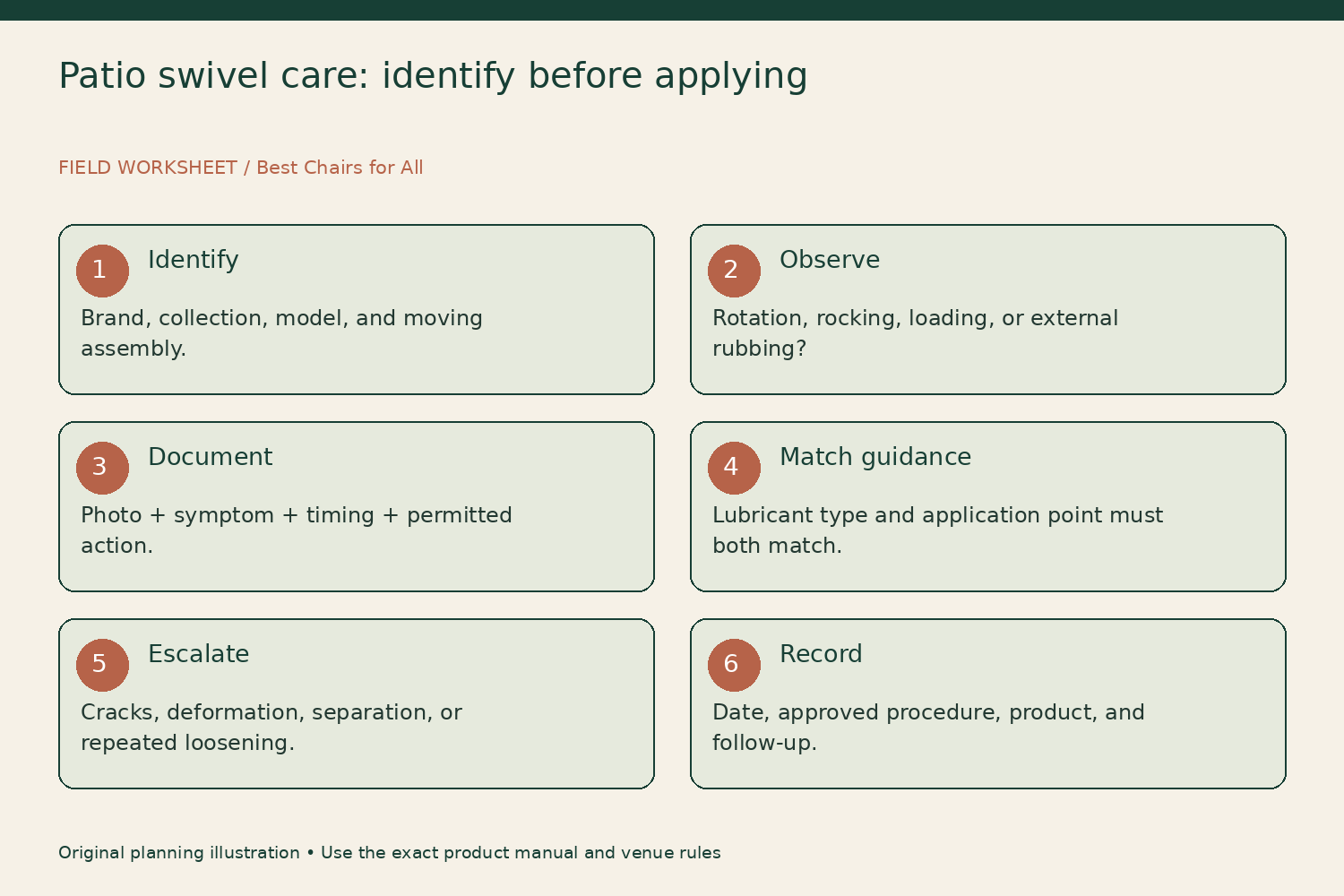
This guide gives you a symptom worksheet, a way to compare manufacturer instructions, and a practical record for recurring problems. It does not provide a universal lubrication recipe or instructions for dismantling spring plates and bearings. Keep an uncertain or damaged chair out of use until the manufacturer or a suitable furniture service provider has assessed it. Quiet operation is useful, but it is not proof of structural condition.
Identify the furniture and its moving parts
Find the brand, collection, model number, and purchase date. Photograph the complete chair and its underside without placing yourself under an unsupported object. Compare the mechanism with the manual’s diagram. Some chairs rotate around a central post; others use a plate assembly beneath the seat. A swivel rocker adds a separate movement, so a sound during rocking may have little to do with rotation.
Write down which parts are intended to move and which should remain fixed. Include the base, frame connections, seat supports, and any rocking elements. If your paperwork describes a different base, obtain the correct instructions before proceeding. A manufacturer’s general frame-cleaning page may be useful for the finish while leaving the mechanism procedure unanswered. Keep those two jobs separate in your maintenance notes.
Compare named manufacturer guidance
On its product-care page, Tropitone recommends periodic lubrication of moving parts with a silicon lubricant spray, following the lubricant manufacturer’s instructions. That is Tropitone’s guidance; it is not permission to apply the same spray everywhere on another brand’s furniture. Read the surrounding instructions and any model-specific guidance before selecting an application point or deciding that lubrication is needed.
Hanamint offers a different, more specific example in its difficult-swivel FAQ: it discusses lubrication between the nylon bushings and metal post of its chair arrangement. The value of this comparison is the difference in component identification. A procedure referring to a post and bushings cannot be assumed to describe an enclosed plate mechanism, and a named product in one brand’s FAQ does not become a general patio-chair recommendation.
Gather symptoms before cleaning them away
Record when the problem happens: while rotating left, rotating right, rocking, sitting down, or shifting weight. Note whether it began after rain, storage, moving the chair, or a nearby landscaping job. A short unloaded video can help support staff hear a sound and see which assembly moves, provided the movement can be observed without forcing anything or creating a pinch hazard.
Avoid diagnostic tricks that require balancing the chair, adding weight, or sitting in a suspect assembly. If the base visibly separates, a frame member cracks, a connection distorts, or the chair tilts unexpectedly, stop the investigation and arrange assessment. The purpose of recording the symptom is to improve a service inquiry, not to reproduce a failure. An intermittent fault deserves documentation even when it disappears on a second attempt.
Use a four-path diagnostic worksheet
Make four rows headed ‘rubbing,’ ‘loose connection,’ ‘resistance,’ and ‘structural concern.’ In the rubbing row, record visible contact with a cushion tie, cover, nearby table, or accumulated debris. In the loose-connection row, list hardware that does not match the manual’s assembled condition. In the resistance row, describe stiffness without guessing that a bearing has failed. In the final row, list cracks, deformation, separation, or pronounced instability.
Add columns for evidence, permitted action, and unresolved question. For example: ‘rotation catches once per turn; video saved; check for visible external obstruction; ask whether enclosed mechanism requires service.’ This format keeps an observation from turning into an unsupported repair diagnosis. A lubrication step belongs in the permitted-action column only when you have matched the manufacturer’s procedure to the actual component.
Clean the accessible areas correctly
Remove loose dirt using the method approved for the identified frame and fabric. Keep cleaning liquid away from any area the manual says to protect. Do not flood an enclosed mechanism or pressure-wash the underside simply because the furniture is used outdoors. Outdoor exposure resistance does not mean every bearing, bushing, finish, or cushion can tolerate concentrated water or aggressive cleaner.
Use separate cloths for greasy mechanical areas and seating surfaces. Work where drips can be managed without staining a patio or creating a slippery patch. If the approved cleaner requires rinsing and drying, include both in the job rather than putting the chair away while hidden areas remain wet. Photograph corrosion before cleaning it so a service representative can judge the original condition and location.
Tighten only as the manual directs
Check accessible frame hardware against the assembly instructions. Use the specified tools, sequence, and torque if provided. Do not borrow a torque figure from a similar-looking chair. A joint may include a washer, spacer, locking nut, or sleeve that controls movement; changing the stack of parts can create a new problem even if the connection feels tighter afterward.
Repeated loosening is a service question. Record which fastener moves, how often it recurs, and whether the connection holes or surrounding material look changed. Do not add thread locker or substitute larger bolts without approval. Also distinguish user-assembled frame bolts from factory mechanism hardware. The presence of a visible screw does not establish that the owner is meant to adjust it or open the assembly.
Apply lubricant only to an approved point
Once the exact care instructions call for lubrication, verify the product type, application area, surrounding-material compatibility, and any required preparation. Read the lubricant label as well as the furniture instructions. Protect nearby fabric and finishes as directed. Use the documented amount or method; an excess can run onto surfaces or collect dirt without improving the condition you are trying to address.
If the care guide names a lubricant category but does not identify where it goes on your mechanism, ask the manufacturer for a marked diagram. Do not spray through every gap to find the right place by trial and error. Save the product name and date in your maintenance log. That record helps explain later staining, persistent resistance, or a warranty question without relying on memory.
Recognize the limits of noise reduction
A squeak that disappears after an approved maintenance step gives you one useful observation: the symptom changed. It does not establish that a cracked plate, worn connection, or corroded frame has recovered. Recheck the original visual findings separately. If a structural concern remains, continue the service process even when the chair sounds better and turns more freely.
Conversely, persistent noise after routine care does not prove a particular component is defective. Send the symptom worksheet to support and ask what inspection or service they recommend. Avoid replacing a central mechanism based solely on a sound description in an online forum. Model-specific parts, mounting patterns, movement range, and load instructions matter more than a photograph suggesting that two assemblies look alike.
Plan storage around the frame design
Use the storage orientation specified for your furniture. Tropitone’s care guidance, for example, warns against storing its frames upside down and discusses protecting clean, dry furniture from freezing conditions. Apply that instruction to the relevant Tropitone product rather than inventing a universal rule for all patio chairs. Check drain openings and storage instructions in the correct manual before covering or relocating your own chair.
Keep covers from becoming a substitute for drying. Note whether the manufacturer specifies a particular cover style or ventilation arrangement, and inspect after prolonged wet weather. Store cushions according to their separate care instructions. A swivel chair’s metal base, woven shell, fabric sling, and removable cushion may require different treatment, so one ‘outdoor furniture’ checklist can overlook the component most likely to stay wet.
Prepare a useful service request
Send the model identity, receipt if available, overall photographs, close-ups, symptom description, and your record of approved care already performed. Ask whether the mechanism is owner-serviceable, which replacement part is specified, and whether installation requires a professional. If a seller cannot identify a secondhand chair’s mechanism, a replacement that happens to share the same bolt spacing is not sufficient evidence of compatibility.
The Brown Jordan support FAQ illustrates the practical value of manufacturer identification and service channels: it invites furniture photographs for collection identification and directs owners to appropriate replacement-part resources. Use the support route for your own brand. Be explicit about whether you need a cosmetic part, a frame fastener, or the moving mechanism so the inquiry reaches the right person.
Keep a small maintenance record
Your record needs only a few fields: date, chair identity, symptom, inspection result, procedure source, product used, and follow-up. Add a photograph after any approved replacement so future checks can compare the same viewpoint. Keep unresolved findings visible. A note such as ‘left chair still catches during rotation; support case pending’ is more useful than marking all patio maintenance finished.
Choose inspection intervals from the manual and actual exposure rather than a universal calendar. Heavy use, salt air, storage, or a sudden change in operation may justify earlier attention, while a specific manufacturer schedule remains the starting point. The practical result is a chair maintained through identified instructions, with recurring faults escalated promptly and no hidden assumptions about what a spray, wrench, or replacement plate can fix. Keep the manual with the record so another household member can repeat the same approved checks without guessing which online advice you followed.
Something unclear or out of date? Send a correction with this article’s title and the detail to check.
Sources, research & corrections policy ↗