As an Amazon Associate I earn from qualifying purchases. If you buy through our links, we may earn a commission at no additional cost to you. How our links work.
The best camping chair for a heavier adult needs to pass three separate checks: the exact model’s stated load limit, usable space between its arms, and the height you can comfortably stand from. A chair can pass the first check and still be an awkward purchase. This guide starts with those decisions, then compares a high-capacity quad chair, a mesh chair, and a lumbar-support alternative for people whose weight fits its lower limit.
Our starting shortlist: investigate the ALPS Mountaineering King Kong when load rating and seat room lead your search; consider the YETI Trailhead Camp Chair when you want a mesh seat within a 500-pound rating; consider the STRONGBACK Elite only below its 300-pound maximum when its support shape fits you. These are research-based choices from published specifications, not results from hands-on load or durability testing.
Quick decisions before you shop
| Your priority | Starting candidate | What could rule it out |
|---|---|---|
| Published 800-pound capacity | ALPS King Kong | Its packed bulk or the exact version’s seat fit |
| Mesh seating, up to 500 pounds | YETI Trailhead Camp Chair | Its carrying weight or clearance between the arms |
| Structured lumbar shape, below 300 pounds | STRONGBACK Elite | Its lower capacity or a support shape that does not suit you |
A rating is a maximum stated by the supplier. We do not treat it as permission to bounce, rock onto two legs, or put a second person on a single chair. Nor do we infer that an 800-pound chair will last twice as long as a 400-pound model. Those are different claims that require different evidence.
How we selected these chairs
We looked for recognizable model names, traceable specification pages, and materially different reasons to buy. We avoided making this a long list of nearly identical generic chairs with different brand names. The King Kong’s specification needed extra checking because older and newer listings disagree on some dimensions. The recommendations below identify those limits rather than quietly blending the numbers.
Our selection also separates capacity from comfort. The first two options have higher stated limits than the third, but the third remains useful for a reader below its limit who specifically wants a shaped backrest. Readers above 300 pounds can remove it immediately. That narrower shortlist is more helpful than giving every product a universal “best overall” badge.
Three chairs with different strengths
1. ALPS Mountaineering King Kong
Best for: a high-capacity quad-chair shortlist.
An 800-pound published capacity is the King Kong’s clearest distinction here. SCHEELS lists a 24-inch seat width, 20-inch seat depth, and 19-inch seat height. Those measurements make it worth investigating when a conventional folding chair feels too narrow, but they do not establish your personal fit.
Version checks matter. The older ALPS catalog lists an 18-inch seat height and 24.5-inch fabric width; the current retailer page gives different measurements. We would confirm the item number rather than combine those specifications into a fictitious model. Both sources give a 13-pound chair weight.
Product Details
| Brand | ALPS Mountaineering |
|---|---|
| Weight capacity | 800 lb |
| Weight | 13 lb |
Pros
- Highest published capacity in this shortlist
- A quad-fold format for vehicle-based trips
Cons
- Published seat measurements differ between versions and sources
Start here if capacity leads your search and carrying a substantial folded chair is acceptable. Ask for the exact model’s dimensional information before ordering.
2. YETI Trailhead Camp Chair
Best for: a mesh-seat alternative within 500 pounds.
YETI lists a 500-pound capacity and a 13.3-pound product weight for the Trailhead Camp Chair. Its FlexGrid mesh and tensioning system distinguish it from the fabric quad-chair option. This is the Camp Chair, which should not be confused with other Trailhead models.
The current product page gives overall dimensions of 24 inches wide, 29.9 inches deep, and 36.3 inches high. Overall width is not a published clear-seat measurement. Check clearance before buying. The carry bag offers two straps, useful when you want your hands available for other gear.
Product Details
| Brand | YETI |
|---|---|
| Weight capacity | 500 lb |
| Weight | 13.3 lb |
Pros
- A mesh seating surface instead of a padded fabric panel
- Two-strap carry bag included
Cons
- Overall width alone does not confirm usable space between the arms
Choose it for the mesh-seat arrangement if your intended load fits the rating. Confirm the seat clearance and try its tensioned sitting position before committing.
3. STRONGBACK Elite
Best for: shaped back support below a 300-pound limit.
A 300-pound maximum immediately narrows the Elite’s audience. It belongs in this guide for readers below that limit who prioritize a shaped lumbar area over maximum capacity. Anyone above the limit should remove it from consideration, even if the seat dimensions otherwise sound appealing.
STRONGBACK lists a 23-inch seat width, 18-inch seat height, 11.9-pound weight, and a powder-coated steel frame. The brand promotes its support system, but those marketing claims do not establish pain relief for an individual reader. A personal sit test remains necessary.
Product Details
| Brand | STRONGBACK |
|---|---|
| Weight capacity | 300 lb |
| Weight | 11.9 lb |
| Seat width | 23 in |
Pros
- Published seat width and height make an initial fit comparison possible
- Structured lumbar area provides a different seating shape
Cons
- Its 300-pound capacity excludes many readers shopping this category
Consider it only after checking the lower capacity and whether the backrest shape feels comfortable. Do not substitute a support claim for an actual fit check.
Specification sources: the SCHEELS King Kong listing, ALPS manufacturer catalog, YETI Trailhead product page, and STRONGBACK Elite specifications support the model facts above. Check the label and listing for the exact item you order.
A five-minute fit check is more useful than another star rating
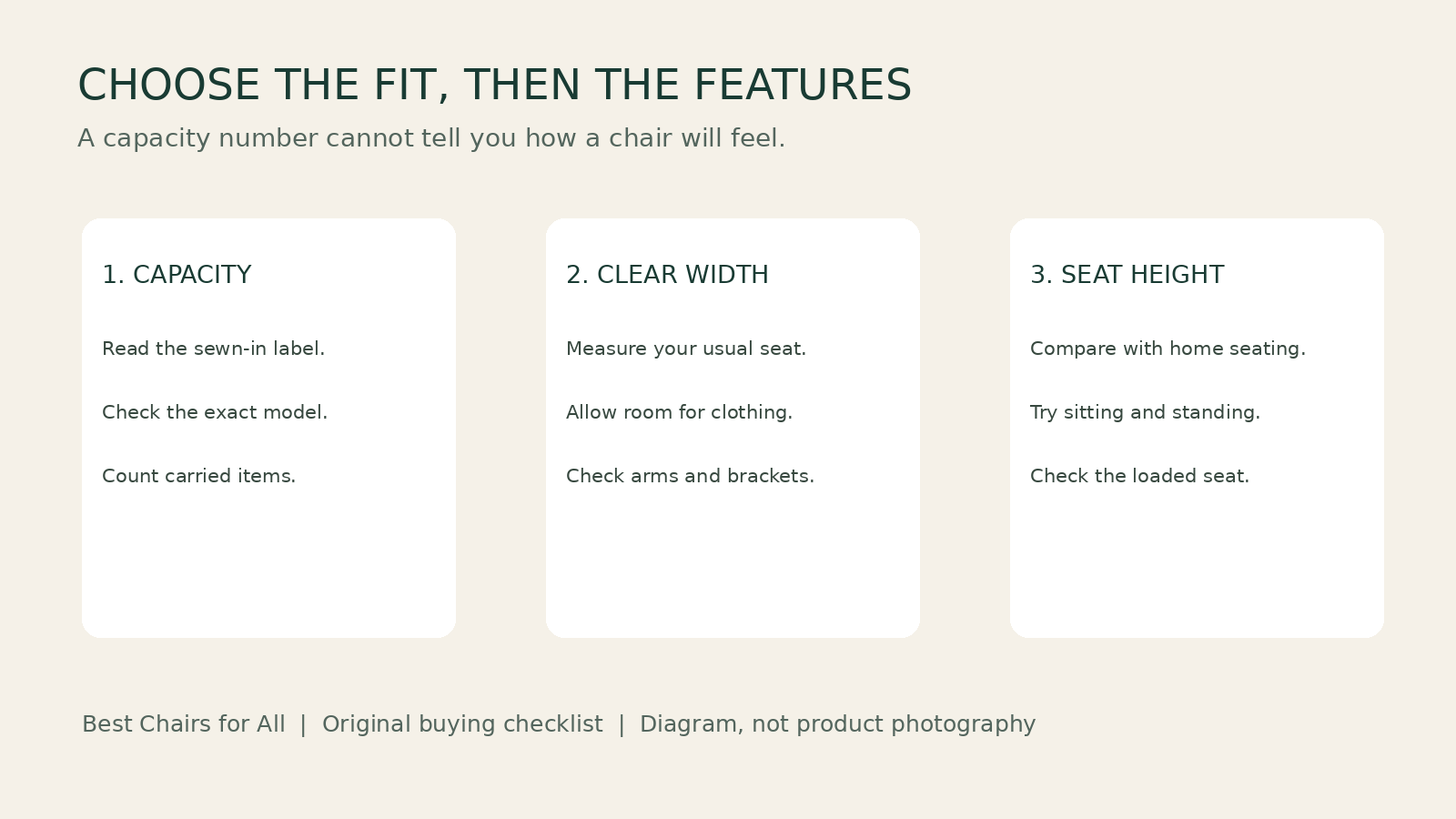
Measure the seat you already like
Choose a chair at home that gives you enough room in ordinary clothing. Measure the clear distance between its arms at the place your hips sit. Write down the seat depth and the floor-to-seat height as well. This gives you a personal comparison point instead of relying on “oversized” in a product title. If your preferred home chair has no arms, measure the area you actually occupy rather than the full cushion width.
For example, if you need 23 inches of clear hip room, a listing that says 24 inches wide does not automatically pass. That number might describe the outside of the frame. Ask whether it is fabric width, clearance between hard parts, or overall width. A bracket protruding inward can matter even when the seat fabric sounds wide enough. Measure in the jacket or layers you actually take camping.
Check height with your feet on the ground
Use your existing chair as a starting point, then think about the surface at camp. Your feet should feel planted when sitting, and you should be able to stand without an awkward pull on flexible armrests. A very low lounge position may be pleasant for one person and difficult for another. Height preference is personal; the fact that a model is marketed to “big and tall” buyers does not establish a suitable height for every heavier adult.
Fabric sag complicates this measurement. An unloaded height in a specification table is not a guarantee of the height under your body. If possible, try the chair with both feet positioned naturally and stand up several times. If ordering online, ask whether an indoor fit check is allowed under the return policy before using it outdoors. Save packaging until you know the chair fits.
Plan how you will carry it
Consider your actual route from the vehicle. A chair carried ten steps to an RV awning is a different purchase from one carried across a festival parking area. Add the weight of your drink, bag, and other gear when you picture the walk. Backpack straps may make the load easier to manage, but they do not make a bulky package smaller. Measure the space in your vehicle where the folded chair will live.
If two chairs travel with you, calculate their combined carrying weight before adding them to the cart. Two chairs of roughly 13 pounds each make a load of about 26 pounds before any accessories. That arithmetic is a planning example, not an independent measured weight. You might prefer two trips, a suitable gear cart, or a lighter chair that still meets every fit and capacity requirement.
Do not confuse overall width, seat width, and shared capacity
Product listings use “width” inconsistently. One brand may quote the outermost frame while another quotes the fabric panel. Treat comparisons of those numbers as unfinished until you know what each measures. Draw a simple rectangle on paper with your required clear width and depth. Then mark the frame, arms, and protruding hardware separately. This is especially useful when a manufacturer supplies a dimensional drawing.
A two-person chair introduces another problem: the capacity may apply to the entire seat. Kelty’s current Low Loveseat page lists a 600-pound capacity, while some older retailer listings show 400 pounds. We do not assume those listings describe identical versions or that half a shared rating is a separately certified single-position limit. Confirm the actual model label and permitted loading with the manufacturer before treating a loveseat as a substitute for an individual heavy-duty chair.
Why we do not recommend choosing by the largest number alone
Start with your real requirements. Write four lines: minimum usable width, acceptable sitting height, maximum carrying weight, and an exact model whose rated load covers your intended use. Any product failing one line comes off the list, regardless of its other strengths. Once the remaining chairs meet those constraints, compare back shape, fabric, pockets, folding method, and storage.
There is no universal percentage buffer we can add to every manufacturer’s rating. We also cannot use a positive customer review as evidence that exceeding a stated limit is acceptable. If your intended use is close to a limit or involves unusual loading, ask the supplier directly and retain its response. If it will not clarify the intended use, keep looking rather than treating a marketing adjective as engineering guidance.
Inspect the exact chair when it arrives
Before the first trip, open the chair fully on a level surface following its instructions. Check that any locks or tensioning parts are in their correct positions. Read the label on the chair rather than relying solely on the shipping box. If the number or model differs from the listing, pause and resolve that mismatch before use. Photograph the label so it is easy to reference later.
Look at the fabric attachment points, feet, arms, and hinges. A loose fastener, bent part, missing cap, or torn seam is a reason to contact the seller before sitting. Do not modify the frame to get extra width or defeat a locking feature. After wet trips, follow the maker’s drying and care directions before storage. Maintenance cannot turn an unsuitable model into a suitable one, but inspection can reveal a problem before your next outing.
Questions worth asking before checkout
Which model would we start with for a 400-pound camper?
Begin with the King Kong and Trailhead Camp Chair, because their published limits are above that example weight. Remove the Elite because its stated limit is 300 pounds. Then compare usable width, standing comfort, and carrying burden. We cannot choose between the remaining two on body weight alone; hip clearance and sitting position still need checking.
Is a loveseat automatically the roomiest solution?
It offers a different seating arrangement, but width does not answer the loading question. Determine whether you are buying a single-person or shared seat, read the exact combined capacity, and ask about acceptable weight distribution. Also consider whether the seat is so low that it becomes difficult to rise. A large footprint can solve one problem while creating another.
Can we verify the current Amazon price here?
No fixed price is quoted because listings, sellers, versions, and shipping change. The Amazon links search for the named model so you can compare the matching item yourself. Confirm the manufacturer, model, return terms, and capacity on the actual listing. A similar photograph or a shorter product title is not enough to establish that two offers are the same chair.
Choose your first chair to try
Use the King Kong as the starting point for a high-capacity quad-chair search, the Trailhead Camp Chair for a mesh alternative within its stated limit, and the Elite for a shaped-back option only when its lower capacity fits. Make the final decision with your measurements and an indoor sit-and-stand check. A chair that meets your numbers and fits your body earns its place at camp; extra pockets come after that.
Something unclear or out of date? Send a correction with this article’s title and the detail to check.
Sources, research & corrections policy ↗