As an Amazon Associate, we earn from qualifying purchases. Read our affiliate disclosure. Amazon buttons search for matching listings; they do not confirm the exact model, seller, price, or stock.
The best bedroom lounge chair should make the room more useful while preserving the activities that already happen there. A chair beside a window can become a pleasant place to read or pause before bed. The same chair can make a wardrobe difficult to open, block the bedside route, or turn into a permanent pile of clothes. Plan around the bedroom’s daily movements before deciding which silhouette belongs in the corner.
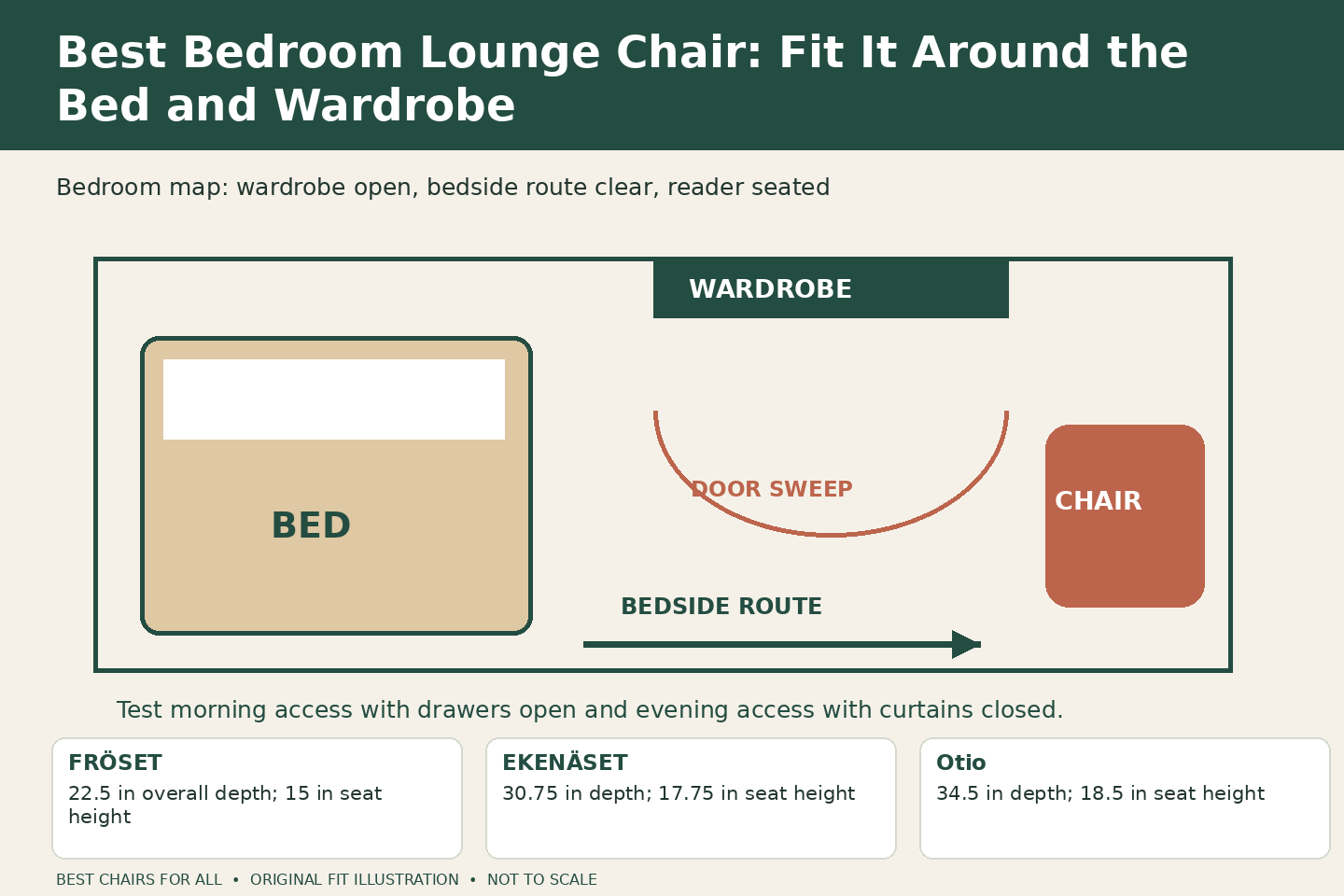
Our shortlist compares IKEA FRÖSET in white-stained oak veneer for a very shallow occasional seat, IKEA EKENÄSET in Kilanda light beige for a narrow upholstered wooden-arm chair, and Article Otio in Walnut and Welsh Taupe for a deeper dedicated lounge position. We researched current US manufacturer pages and have not physically tested these chairs. FRÖSET is a compact bare-wood alternative, so it should not be mistaken for a padded reading chair merely because it occupies little floor space.
Name the bedroom task honestly
Decide whether the chair is mainly for reading, dressing, talking, or taking a short break. A bare easy chair can suit occasional use and be simple to wipe down. A deeper upholstered lounge seat may be a better candidate for a deliberate reading destination. Neither can be declared universally comfortable from its catalog category.
If the real need is a surface for tomorrow’s clothes, a lounge chair may be an expensive way to create a storage problem. Identify where clothes, a blanket, and a book will go when the chair is occupied. The seat needs to remain available for the purpose that justified buying it. A nearby hamper, hook, or shelf can be more useful than choosing an oversized chair to hold more belongings.
If you want to put on shoes, test that task in the selected chair. A low angled lounge seat can feel different from an upright dressing seat, and a high arm can affect how you bend or reach. None of these chairs is presented as mobility equipment. If rising or transferring is difficult, an ordinary bedroom lounge recommendation cannot establish suitability for that need.
The three options and their roles
Verify the exact variants in the manufacturer references: IKEA FRÖSET chair, white stained oak veneer; IKEA EKENÄSET armchair, Kilanda light beige; Article Otio 26 lounge chair, Walnut and Welsh Taupe. Specifications were checked November 6, 2026.
1. IKEA FRÖSET chair, white stained oak veneer
Best for: Shallow occasional bedroom seat.
FRÖSET occupies just 22.5 inches of overall depth and 23.25 inches of width. Its exposed shaped wood makes it the option when a bedroom needs a modest occasional seat rather than another upholstered volume.
The 15-inch seat height is notably low, with an 18.125-inch seat depth. There are no conventional arms or upholstery padding in this selected form. IKEA lists a mild-cleaner damp-cloth routine followed by drying; the selected finish was marked Last Chance.
Product Details
| Brand | IKEA |
|---|---|
| Overall dimensions | 23 1/4 W × 22 1/2 D × 29 1/8 H in |
| Seat height | 15 in |
| Manufacturer load wording | Tests based on use by people up to 242 lb |
| Materials | Layer-glued wood veneer; oak veneer; tinted lacquer |
Pros
- Shallowest nominal footprint here
- Simple lacquered-wood care
Cons
- Low bare seat requires a personal trial
- Not a padded lounge armchair
Choose it for occasional use when the actual low wood seat suits you.
2. IKEA EKENÄSET armchair, Kilanda light beige
Best for: Compact upholstered wooden-arm chair.
EKENÄSET gives a bedroom a defined upholstered seat and visible wooden arms within a 25.25-inch overall width. It suits a nook that can spare more depth than FRÖSET requires.
Its 30.75-inch depth should be checked against open drawers and the bedside route. A 22-inch seat width and 19.625-inch seat depth provide useful inner measurements. The Kilanda cover is stationary, so do not assume it can be washed with the bedding.
Product Details
| Brand | IKEA |
|---|---|
| Overall dimensions | 25 1/4 W × 30 3/4 D × 29 7/8 H in |
| Seat height | 17 3/4 in |
| Manufacturer load wording | Tests based on use by people up to 242 lb |
| Materials | Solid wood frame; lacquered beech arms; polyester upholstery |
Pros
- Published clear seat width
- Arms and upholstery for a different sitting task
Cons
- Limited depth margin in a shallow recess
- Selected cover is not removable
Choose it after the wardrobe and reading trials both work.
3. Article Otio 26 lounge chair, Walnut and Welsh Taupe
Best for: Deeper dedicated lounge position.
Otio’s exposed walnut frame can suit a bedroom where reading is a deliberate activity and enough depth exists beside the bed. Its narrow appearance should not conceal the 34.5-inch overall depth.
The current Welsh Taupe version stands 33 inches high, with an 18.5-inch seat height and 20.5-inch seat depth. Its low wooden arms differ from the EKENÄSET relationship. Check the rear view and selected fabric beside your actual bedding.
Product Details
| Brand | Article |
|---|---|
| Overall dimensions | 26.5 W × 34.5 D × 33 H in |
| Seat height | 18.5 in |
| Manufacturer load wording | 300 lb tested |
| Materials | Solid black walnut; foam; polyester/viscose/linen/cotton blend |
Pros
- Distinct walnut frame for a dedicated nook
- Useful fixed lounge proportions
Cons
- Deepest overall chair here
- Blended upholstery needs its own spill-care routine
Choose it only when its occupied position preserves the bedroom’s normal access.
Draw two bedroom maps rather than one
The first map should show the room in the morning: wardrobe doors open, drawers extended, bed covers moved as usual, and the laundry basket where you use it. The second should show the evening arrangement: bedside table in use, curtains closed, reading light on, and the route from the bed to the doorway. A chair needs to work in both ordinary states.
Mark the new chair’s whole footprint on each drawing. Do not reduce it to the seat panel or draw only the legs. Add the person sitting with feet in the preferred position, then standing. Check whether the bed can still be made without lifting or shifting the chair every day. A furniture arrangement that relies on repeated rearrangement needs a realistic reason to exist.
Open the wardrobe and drawers fully during the tape-outline test. Hinged doors sweep across an area rather than merely projecting straight outward, and a handle can contact the chair before the door reaches its nominal open position. Keep any required access to electrical outlets and heating controls in the plan. Follow the relevant appliance or heater clearances where they apply.
Write down the conflict that would make you reject the chair. “Blocks one drawer unless moved” is more informative than “looks a little large.” Use that limit while browsing. A different upholstery color will not fix a piece that occupies the route you need at night.
A worked depth comparison beside a bed
Imagine a bedroom furniture zone that is 29 inches wide and 32 inches deep after necessary access has already been reserved. FRÖSET’s 23.25-by-22.5-inch footprint leaves 5.75 inches across and 9.5 along the depth. EKENÄSET’s 25.25-by-30.75-inch footprint leaves 3.75 and 1.25 inches. Otio’s 26.5-by-34.5-inch footprint leaves 2.5 across but exceeds the depth by 2.5.
Those figures illustrate a first screen rather than a universal bedroom clearance rule. FRÖSET leaves the most nominal margin in this example, but it offers a bare low seat. EKENÄSET is much closer to the depth boundary and may need a revised position. Otio requires more depth than the allocated zone, even though its width fits. Choose according to the actual room and task instead of declaring the smallest rectangle the automatic winner.
Remember the side table or lamp. A table shared with the bed may look economical, but its reachable edge can be farther away from the chair than it appears in an overhead plan. Sit in a temporary chair at the intended position and place the book or glasses on the surface. If you have to reach around the bed or twist backward, create a different arrangement.
Low seats need their own trial
FRÖSET lists a 15-inch seat height and 18.125-inch seat depth. Its bent seat and rounded back are part of a fixed bare-wood easy-chair form. A person who enjoys a low occasional seat may appreciate it, while someone expecting a padded armchair can find the experience entirely different. Do not add improvised leg risers to convert it into another type of chair.
EKENÄSET lists a 17.75-inch seat height and 19.625-inch seat depth, with wooden arms at 24.75 inches. Otio lists an 18.5-inch seat height, 20.5-inch seat depth, and 22-inch arms. Those nominal relationships help compare the models, but compression, back angle, and the user’s proportions affect the actual fit. A meaningful trial includes sitting, reading or dressing, and standing again.
If you add a cushion to FRÖSET, recognize that the change affects height, depth, and how securely the cushion stays on the shaped surface. Use only an appropriate accessory and do not assume the chair’s documented fit now matches a different product. A cushion can alter the experience, but we have no test evidence that any particular addition creates a universally suitable lounge seat.
Upholstery and bedding should work together
A bedroom often has more fabric nearby than a living-room corner: a duvet, curtains, pillows, and perhaps a rug. Put the chair swatch beside the bedding you actually use rather than a temporary neutral showroom palette. Kilanda light beige and Welsh Taupe are different materials and colors; neither name establishes a match to cream bedding under your lamp.
An exposed frame can give the room a less enclosed appearance, but visual openness should not be confused with spare walking space. FRÖSET’s shaped wood, EKENÄSET’s visible arms, and Otio’s walnut rails all occupy their measured outlines. In a room with a low window, also check overall height: FRÖSET is 29.125 inches, EKENÄSET 29.875, and the current Otio listing 33.
View the back as well as the front. A chair may face the window and present its rear to the bed or doorway most of the day. Natural wood variations and visible upholstery construction become part of that view. Ask for an accurate rear photograph when the product page does not show the part of the chair your room will reveal most often.
Light, curtains, and the evening routine
A bedroom reading light should illuminate the page in the selected chair without becoming an unwanted bright source for another person in bed. Test the lamp at the time you expect to use it. A light that works beside the bed may fail when you sit lower or farther to the side in a lounge chair.
Keep the cord out of the normal route and make sure the curtain can move without rubbing or trapping against the chair. If the chair sits near a heater, follow the heater’s clearance instructions; a small catalog footprint is not permission to place wood or upholstery close to heat. These checks can change the best location before they change the best chair.
Avoid planning a bedroom lounge chair as an alternative sleeping surface. These are ordinary chairs, without a verified sleeper function or sleep-safety claim. If the goal is overnight guest accommodation, use furniture designed and documented for that task rather than expecting a deep seat and an ottoman to serve as a bed.
Choose the maintenance burden you want nearby
FRÖSET has lacquered veneered wood and a damp-cloth, mild-cleaner routine followed by drying. EKENÄSET’s Kilanda cover is fixed, with vacuuming and a damp cloth specified. Otio’s blended fabric emphasizes blotting with a dry cloth and air drying, with chemical cleaners discouraged. These differences matter in a bedroom where cosmetics, body products, and clothes may come into contact with the seat.
A bare chair is simpler to inspect for a spill, but it does not offer upholstery padding. A fabric chair may better suit a long reading session, but its selected cover might not be removable or washable. Decide which compromise matches the task instead of treating maintenance as an afterthought once the color has been chosen.
Check local supply for the selected FRÖSET and clearance-listed EKENÄSET versions before committing to a room plan around them. Choose FRÖSET for a shallow occasional bare-wood seat, EKENÄSET for a compact upholstered chair with wooden arms, or Otio for a dedicated lounge position with genuine depth available. The bedroom map should still work with doors open, lights in use, and the chair occupied; that is the standard a useful bedroom addition has to meet.
Something unclear or out of date? Send a correction with this article’s title and the detail to check.
Sources, research & corrections policy ↗