As an Amazon Associate, we earn from qualifying purchases. Read our affiliate disclosure. Amazon buttons search for matching listings; they do not confirm the exact model, seller, price, or stock.
The best reading chair is the one in which you can hold your usual book, see the page clearly, and change position without the room fighting you. A high back may be appealing, but it does not tell you where your elbows land. A deep seat may look comfortable, but it can leave a shorter-legged reader sitting forward away from the back. The task involves the book, the reader, the chair, and the light together.
Our researched options are IKEA STRANDMON in Tibbleby yellow for a traditional winged outline, Article Otio in Walnut and Welsh Taupe for an open frame with low wooden arms, and Article Archie in Bijou Cream Bouclé for a taller upholstered form. We have not conducted hands-on sitting trials. The recommendations use manufacturer dimensions and care information, with a practical trial method you can use before making a comfort-dependent purchase.
Choose the reading format before the chair
A small paperback can be held close with one hand. A large hardback may ask both hands to support its weight and keep it open. A tablet changes the task again, especially if you use a stand or an attached case. Bring the item you actually read to a showroom trial rather than demonstrating comfort with empty hands.
Notice where the book settles when you stop thinking about posture. Are your elbows on the arms, near your body, or supported by a cushion? Can you turn a page without losing your position? Do you keep shifting because the arm edges contact an uncomfortable place? These observations are more specific than deciding that a chair feels “supportive” during a brief sit.
This guide does not prescribe a posture or claim a chair prevents pain. If sitting brings persistent symptoms or you need clinical seating advice, ordinary furniture specifications cannot resolve that need. For everyday selection, use your current comfortable seat as a reference and compare the new chair with the same reading material and position.
Three different reading-chair approaches
Verify the exact variants in the manufacturer references: IKEA STRANDMON wing chair, Tibbleby yellow; Article Otio 26 lounge chair, Walnut and Welsh Taupe; Article Archie 31.5 lounge chair, Bijou Cream Bouclé. Specifications were checked November 6, 2026.
1. IKEA STRANDMON wing chair, Tibbleby yellow
Best for: Traditional winged reading corner.
STRANDMON pairs a 39.75-inch overall height with a winged back and padded sides. The selected Tibbleby yellow version suits someone seeking a clearly defined reading destination in a room with enough depth.
The seat is 19.25 inches wide, 21.25 deep, and 17.75 high. Those inside dimensions are more useful for reading fit than the 32.25-inch overall width. Its fixed cover cannot be treated as a removable washable slipcover.
Product Details
| Brand | IKEA |
|---|---|
| Overall dimensions | 32 1/4 W × 37 3/4 D × 39 3/4 H in |
| Seat height | 17 3/4 in |
| Manufacturer load wording | No load figure established from reviewed selected page |
| Materials | Wood/plywood/particleboard; foam; polyester; beech legs |
Pros
- Published clear seat width
- High winged silhouette for an enclosed corner
Cons
- 37.75-inch overall depth requires space
- Selected upholstery has restrictive washing instructions
Try it with your normal book before choosing the traditional outline.
2. Article Otio 26 lounge chair, Walnut and Welsh Taupe
Best for: Open frame with lower arms.
Otio gives the reading nook an exposed walnut structure rather than a fully upholstered block. Its 20.5-inch seat depth and low 22-inch arms provide a distinctive relationship for holding a book.
The current page lists 33 inches overall height and 18.5 inches seat height. We do not claim the low arms support every reader equally. Try the selected chair with your book or tablet, including any cushion you intend to use.
Product Details
| Brand | Article |
|---|---|
| Overall dimensions | 26.5 W × 34.5 D × 33 H in |
| Seat height | 18.5 in |
| Manufacturer load wording | 300 lb tested |
| Materials | Solid black walnut; foam; polyester/viscose/linen/cotton blend |
Pros
- Open structure leaves more visual space
- Precise seat-depth and arm-height information
Cons
- No verified clear seat-width figure quoted
- Fixed lounge angle is not adjustable
Choose it when the reading task works with its lower arm position.
3. Article Archie 31.5 lounge chair, Bijou Cream Bouclé
Best for: Taller upholstered enclosure.
Archie in Bijou Cream Bouclé offers a 36-inch overall height and 25-inch arm height. It is the option for someone who wants a more enclosing upholstered form without choosing a classic wing-chair outline.
Its 23-inch seat depth is the longest on this shortlist, and its 35-inch overall depth still needs a floor outline. Article specifies dry clean only. That commitment should be decided before treating the cream textured fabric as a casual snack-time surface.
Product Details
| Brand | Article |
|---|---|
| Overall dimensions | 31.5 W × 35 D × 36 H in |
| Seat height | 17.5 in |
| Manufacturer load wording | 300 lb tested |
| Materials | Wood/plywood/MDF frame; foam; 95% polyester/5% acrylic |
Pros
- Published arm height for a useful comparison
- Taller rounded back and substantial upholstered sides
Cons
- Deep seat may need a different position for some readers
- Dry-clean-only fabric
Choose the enclosure when your actual reading trial confirms the fit.
A book-holding trial you can repeat
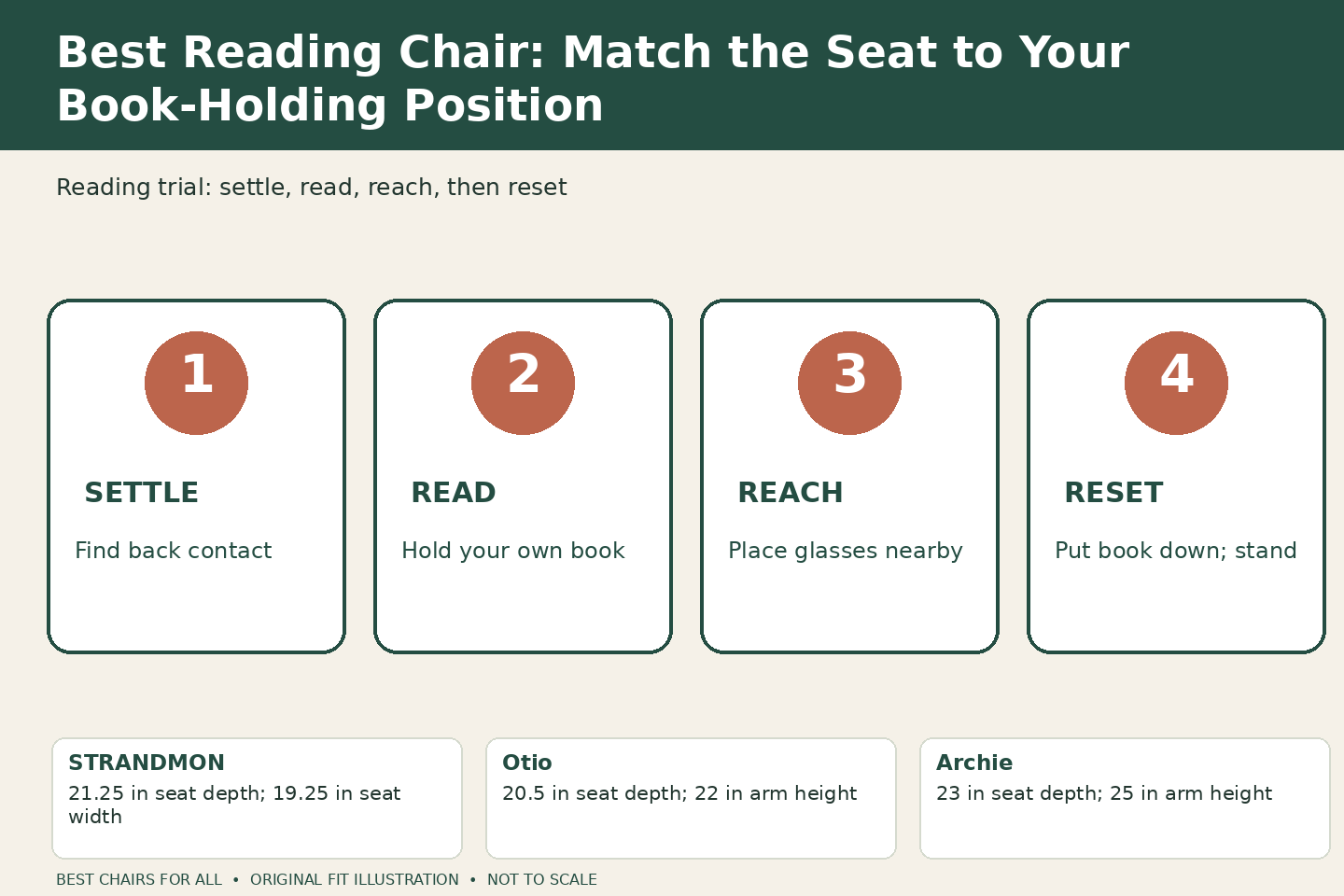
Use four prompts in sequence: settle, read, reach, and reset. Settle into the back without trying to imitate the product photograph. Read several pages or the equivalent on your device, noticing whether your forearms can rest as you prefer. Reach for a hypothetical bookmark or table without moving the entire chair. Finally, put the book down and stand in the way you normally would.
Write one observation for each prompt. For example, “book rests on my lap but I have to lift it to see the bottom lines” is useful evidence. “Chair is cozy” does not explain what worked. If a pillow is required during the trial, include its dimensions and placement in your notes so the final arrangement can be reproduced.
Compare the same task across the shortlisted chairs. Trying a paperback in one chair and a heavy atlas in another changes the task more than many product differences. Likewise, a display chair covered in decorative cushions can feel different from the delivered chair. Ask which cushions are included and which are separate accessories.
Use the final note to identify the main compromise you accept. That might be a larger room footprint for a winged back, a lower arm position for an open frame, or a dry-clean-only fabric for the enclosing shape you prefer. A conscious compromise is more realistic than expecting one chair to maximize every aspect of reading comfort.
Seat depth determines where you meet the back
STRANDMON lists a 21.25-inch seat depth, Otio 20.5, and Archie 23. The differences do not identify a winner by themselves. If you prefer both feet on the floor, check whether you can reach the back without pressure at the front of the seat. If you like sitting at an angle, investigate the usable width and the space around the arms too.
Check reading chair seat depth against the way you sit with a book, rather than assuming a deeper seat offers better support.
STRANDMON publishes a 19.25-inch seat width within a 32.25-inch overall width. The substantial wing-chair structure is part of its footprint. Equivalent clear-width figures were not established for Otio and Archie, so request those measurements when seated breadth or a curled-up position is central to the decision. Overall width cannot safely substitute for the space between arms.
The seat heights are 17.75 inches for STRANDMON, 18.5 for Otio, and 17.5 for Archie. Compare them with a known comfortable chair, recognizing that cushion compression changes the lived experience. Avoid adding a thick seat cushion merely to chase a catalog number; it also changes arm height relative to your body and where the back contacts you.
Arm height is a relationship rather than a ranking
Otio lists arms at 22 inches from the floor and Archie at 25. Subtracting their seat heights gives nominal differences of 3.5 and 7.5 inches respectively. That highlights two different relationships, but the arm shape, recline, and your proportions matter as much as the arithmetic. A lower wooden arm may be welcome for one reading position and unhelpful for another.
STRANDMON’s selected page does not establish a comparable arm-height number, so evaluate it directly or ask IKEA. Do not estimate the height from a lifestyle image. A traditional padded arm can slope or curve, and the point where your elbow rests may differ from the highest point visible in a photograph.
If you plan to use a reading cushion or book support, try it in the selected chair. It may reduce the need to hold a heavy volume continuously, while taking up seat width and changing how close the book sits. Keep accessories secure and appropriate for the task; do not bridge an unstable stack of objects across the arms to create an improvised desk.
Plan light around the page and the reader
Place the intended lamp where it illuminates the page without putting its bright source directly into your normal line of sight. Test this with the book held in the position you found comfortable. A lamp that looks balanced beside the chair may still cast your hand’s shadow across the paragraph. Move the light and observe the page before buying another accessory.
Include the lamp base in the floor plan. STRANDMON is 37.75 inches deep, Archie 35, and Otio 34.5. A floor lamp behind a deep chair can add to the total distance from the wall or conflict with a nearby route. Its power cord should reach an appropriate outlet without crossing the normal approach to the chair.
For a tablet, check reflected light as well as page illumination. Turn the device in the actual sitting position and see whether the window or lamp is reflected on the screen. A chair angled slightly toward or away from the source may change the result, but make sure that angled placement still fits the room and keeps the table reachable.
A side table is part of a useful reading nook
Choose a place for the closed book, glasses, bookmark, and drink that does not require a long backward reach. Determine the position while sitting, then measure it. A table selected only to match the arm height can still be too far away or blocked by the chair’s side. Test reaching with the book in hand rather than imagining an empty-chair arrangement.
A high winged back also changes the visual boundary around the chair. STRANDMON stands 39.75 inches high, Archie 36, and Otio 33. If the nook is beside a window, decide whether the chair’s back should partially screen the view or leave more of it open. Overall height describes silhouette; it does not guarantee head contact for a particular reader.
Do not add an ottoman automatically. It can be welcome for a preferred legs-up position but occupies another area in front and may make table access harder. Try the chair with and without it, and leave a route for entering and standing without stepping over furniture. The ability to move between reading and ordinary room use is part of the layout.
Choose a fabric for actual reading habits
The Tibbleby STRANDMON is not a washable-cover chair; IKEA permits vacuuming and a damp cloth for its frame and fixed cover while prohibiting washing and dry cleaning for the cushion cover. Otio’s selected blended fabric has dry-cloth blotting and air-drying guidance. Archie explicitly says dry clean only. Those are material differences, not reasons to apply one generalized upholstery routine to all three.
If you read with tea or snacks, be honest about whether the specified care fits your routine. No guide can guarantee that an accidental spill will leave no mark. A texture you enjoy against a sleeve may feel different on a bare forearm, so request the actual sample rather than choosing from a color thumbnail alone.
Choose STRANDMON for the winged high-back shape when its larger depth and narrower clear seat work. Choose Otio for the open walnut form and its lower arm relationship. Choose Archie for the taller upholstered enclosure when the deeper seat and dry-clean-only care are acceptable. A comfortable reading chair is a complete match to your reading task, demonstrated by your own repeatable trial.
Something unclear or out of date? Send a correction with this article’s title and the detail to check.
Sources, research & corrections policy ↗