As an Amazon Associate, we earn from qualifying purchases. Read our affiliate disclosure. Amazon buttons search for matching listings; they do not confirm the exact model, seller, price, or stock.
The best reading chair for a small space has to fit more than its own outline. A book needs light, a reader needs a way in and out, and the corner may need somewhere for glasses or a drink. A chair that leaves no room for those tasks has not solved the nook, even when the manufacturer calls it compact.
Our researched shortlist is IKEA LINNEBÄCK in Orrsta light gray for the narrowest overall form, IKEA EKENÄSET in Kilanda light beige for open wooden arms, and Article Otio in Walnut and Welsh Taupe for a narrow but deeper lounge seat. These are current US manufacturer comparisons, without firsthand comfort or physical-fit tests. The practical method below makes the complete reading area visible before you order.
Measure the corner in two directions
Record the available width across the wall and the depth toward the room’s regular route. Treat each as its own constraint. A chair can save four inches of width while extending six inches farther into the path. In a small apartment, that difference may matter more than its apparent bulk in a product photograph.
Include baseboards, radiator projections, curtain movement, and the place a door reaches when open. If the corner contains a heater or another item with required clearance, follow that item’s instructions instead of assuming a furniture rectangle can occupy the full area. Keep any normal access to controls or outlets available as part of the layout.
Next, draw the reader’s working area in front of the seat. Use your existing chair to observe where your feet go when reading and standing. This is a personal measurement, not a universal clearance number. Add the lamp base and side table you intend to keep. A wall-mounted light can save floor space only when it can be installed appropriately and illuminate the actual reading position.
Three compact candidates with different compromises
Verify the exact variants in the manufacturer references: IKEA LINNEBÄCK chair, Orrsta light gray; IKEA EKENÄSET armchair, Kilanda light beige; Article Otio 26 lounge chair, Walnut and Welsh Taupe. Specifications were checked November 6, 2026.
1. IKEA LINNEBÄCK chair, Orrsta light gray
Best for: Smallest overall footprint.
LINNEBÄCK is the narrowest and shallowest nominal chair here, at 21.625 inches wide and 27.375 deep. It is the first option to examine when the chair itself must leave room for reading accessories.
Its 16.75-inch seat height and 19.625-inch seat depth need a personal reading trial. The selected Orrsta upholstery is fixed rather than a washable slipcover. Ask IKEA about any critical usable-width question instead of inferring it from the outside figure.
Product Details
| Brand | IKEA |
|---|---|
| Overall dimensions | 21 5/8 W × 27 3/8 D × 28 1/2 H in |
| Seat height | 16 3/4 in |
| Manufacturer load wording | Tests based on use by people up to 242 lb |
| Materials | Coated steel; foam; 65% polyester/35% cotton cover |
Pros
- Most compact overall rectangle on this shortlist
- Light open construction limits visual bulk
Cons
- Nonremovable upholstery
- No conventional projecting wooden arms
Choose it if its actual sitting form works as well as its footprint.
2. IKEA EKENÄSET armchair, Kilanda light beige
Best for: Compact wooden-arm option.
EKENÄSET adds wooden arms and a 22-inch published seat width inside a 25.25-inch overall width. The exposed frame can help the nook look less enclosed without pretending the physical footprint disappears.
At 30.75 inches deep it takes more room toward the walkway than LINNEBÄCK. The selected seat is 17.75 inches high and 19.625 deep. The Kilanda cover is stationary, and local availability should be checked for this clearance-listed variant.
Product Details
| Brand | IKEA |
|---|---|
| Overall dimensions | 25 1/4 W × 30 3/4 D × 29 7/8 H in |
| Seat height | 17 3/4 in |
| Manufacturer load wording | Tests based on use by people up to 242 lb |
| Materials | Solid wood frame; lacquered beech arms; polyester upholstery |
Pros
- Useful clear seat-width specification
- Wooden arms for a different reading relationship
Cons
- Depth leaves less positioning margin in a tight nook
- Stationary cover cannot be removed for washing
Prefer it when the arms improve your task enough to justify the larger outline.
3. Article Otio 26 lounge chair, Walnut and Welsh Taupe
Best for: Narrow but deeper lounge seat.
Otio is only 26.5 inches wide but requires 34.5 inches of depth. That makes it a candidate for a narrow room with a deep corner, rather than an automatic choice for every small space.
The Welsh Taupe version lists 33 inches overall height, an 18.5-inch seat height, and 20.5-inch seat depth. Try the low 22-inch arms with your normal book. Its deeper outline must be accommodated before considering the walnut frame or fabric color.
Product Details
| Brand | Article |
|---|---|
| Overall dimensions | 26.5 W × 34.5 D × 33 H in |
| Seat height | 18.5 in |
| Manufacturer load wording | 300 lb tested |
| Materials | Solid black walnut; foam; polyester/viscose/linen/cotton blend |
Pros
- Narrow exposed walnut structure
- Defined fixed lounge position
Cons
- Deepest overall footprint here
- Clear seat width was not established
Choose it when depth is available even though width is restricted.
A worked 30-by-33-inch furniture-zone check
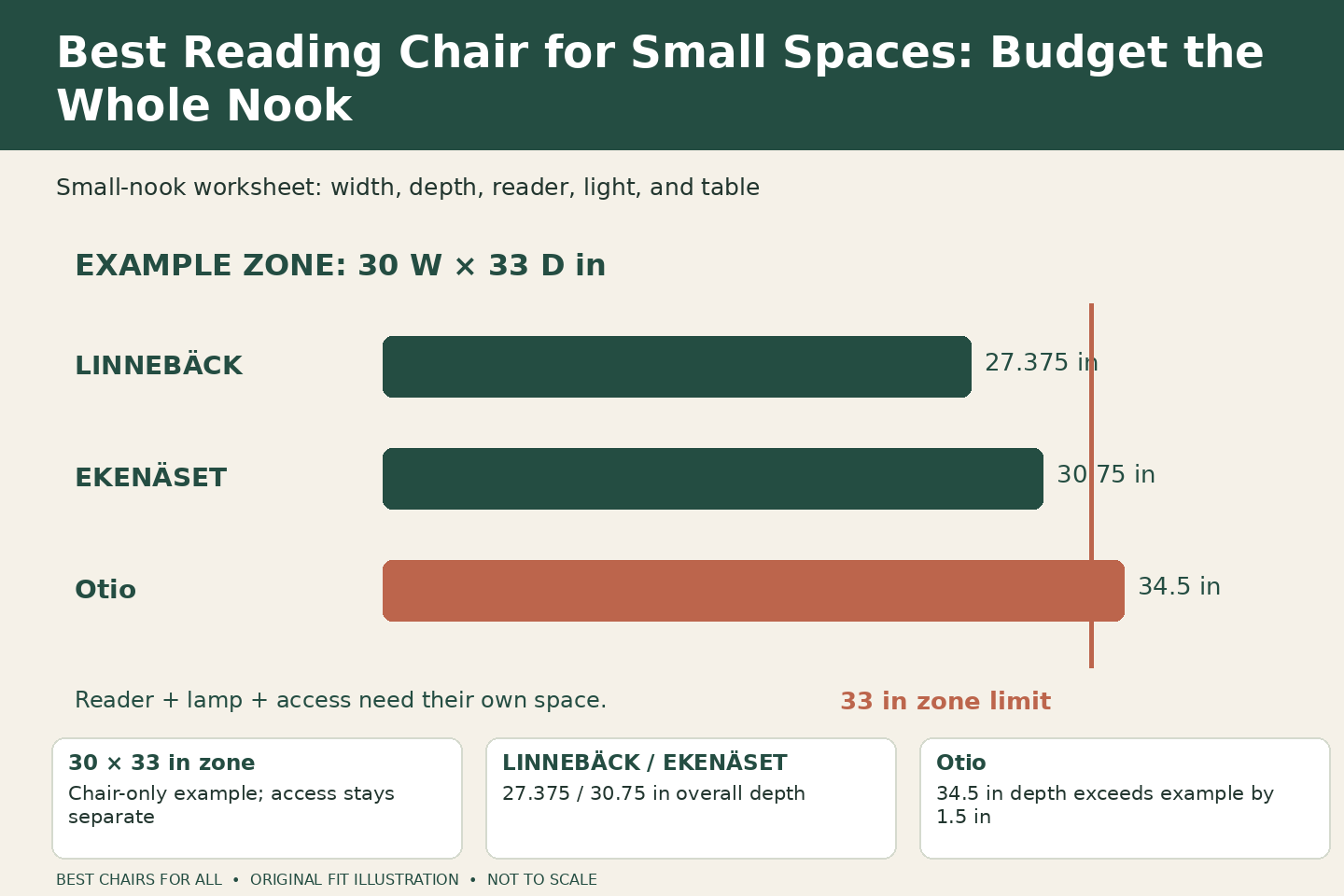
Imagine a corner that provides a 30-inch width and a 33-inch depth for the chair itself, with a separate verified route in front. LINNEBÄCK’s 21.625-by-27.375-inch nominal footprint leaves 8.375 inches across the width and 5.625 along the depth. EKENÄSET’s 25.25-by-30.75-inch footprint leaves 4.75 across and 2.25 along. Otio’s 26.5-by-34.5-inch footprint leaves 3.5 across but exceeds the depth by 1.5.
Those differences are screening margins, not spare space automatically available for a lamp. A margin may need to accommodate a baseboard, a placement gap, or a slight angle. A table may require its own independent rectangle. Write the proposed use beside every margin so a few remaining inches do not get counted twice.
In this example, LINNEBÄCK survives the first footprint screen most easily. EKENÄSET remains possible but needs careful placement. Otio should be removed unless the depth allocation can expand. That conclusion says nothing about which chair is more comfortable; it simply prevents a good seat from being ordered for an unsuitable floor plan.
Repeat the calculation with your actual measured zone. Keep the work on one sheet and add a full-size tape outline. Set a temporary object at approximately the chair’s rear height so you can see the effect from the doorway. A taped floor alone can make a chair seem less present than the three-dimensional piece will be.
Turning a chair diagonally changes its projection
A diagonal arrangement can look inviting but does not necessarily save depth. For a simple rectangle rotated by an angle, the projected depth combines part of the original depth with part of the width. At 45 degrees, a 25.25-by-30.75-inch rectangle projects about 39.6 inches in both directions. That is a mathematical box illustration for EKENÄSET’s nominal dimensions, not a manufacturer clearance requirement.
The actual chair is not a solid rectangle, so its outline may occupy less of the corners of that box. Still, the calculation explains why rotating furniture is not a reliable way to make a deep chair fit a shallow recess. Trace the actual arrangement or ask for a dimensional drawing when the corner is tight. Avoid relying on a stylized room rendering with no scale.
If angling the chair improves the view but extends one arm into the route, test the route during normal use. Carry the book or laundry basket you normally carry there. A layout that only works when everyone turns sideways may be a poor everyday compromise even if a chair technically misses the door.
Narrow outside does not settle the seated fit
LINNEBÄCK lists a 19.625-inch seat depth and 16.75-inch seat height. EKENÄSET lists the same seat depth with a 17.75-inch seat height. Otio lists a 20.5-inch depth and 18.5-inch height. Similar depths can feel different because of cushion compression, the back angle, and the arm construction. Try the selected model when reading comfort matters more than occasional use.
IKEA’s LINNEBÄCK page lists a seat-width figure that is slightly greater than the overall-width figure. We preserve the verified outside footprint for layout and do not silently “correct” the manufacturer by inventing an inner width. If usable breadth is decisive, request clarification or measure the actual chair. The discrepancy is a reason to verify, not a reason to assume more space than the frame can provide.
EKENÄSET supplies a 22-inch seat width within its 25.25-inch overall width. Otio’s reviewed page did not establish a comparable clear seat width. Do not count space occupied by arms as part of the reading surface. Someone wanting to sit cross-legged may need a different usable-width relationship from someone holding a paperback with both feet down.
Arms can save a table or create a mismatch
EKENÄSET has wooden arms listed at 24.75 inches above the floor. Otio’s arms are 22 inches. LINNEBÄCK has a different light upholstered-seat construction without conventional projecting wooden arm rails. Those differences change where a reader’s forearms can rest and how close a small table can be placed.
A wider chair with useful arms may suit your book-holding task better than a very narrow seat that needs an additional cushion or support. Conversely, a chair without prominent arms may make it easier to change position in a tight nook. Test the book you use most, because a large hardback asks more of the arrangement than an empty-hand showroom sit.
Do not select a side table solely by matching it to arm height. Check the reach from your actual seated position and whether the chair’s side blocks the approach. A compact table behind your elbow can be less useful than a slightly larger one placed beside your hand. Include the closed book, glasses, and any drink in that small-scale test.
Light without cluttering the floor
Position the reading light so the page is visible in your preferred seat position without the source glaring into your normal view. Place a temporary lamp before committing to the chair if the corner has awkward outlets. A long cord across the approach route is a layout problem that a smaller chair does not solve.
Consider the window treatment too. A low open chair may fit beneath a sightline while still touching a moving curtain. EKENÄSET’s open wood frame and Otio’s walnut structure offer visual space below the arms, but they still have their full measured footprints. LINNEBÄCK’s light frame can look modest, yet it requires room around the seat for the person as well as the chair.
If a floor lamp or table cannot fit without compromising entry, simplify the nook deliberately. A suitable installed wall light and a secure shelf may be possible in some rooms; a portable reading light may fit others. Choose accessories for the actual page and reach rather than building a miniature furniture display that leaves no space to use the seat.
Choose the care commitment consciously
LINNEBÄCK’s Orrsta cover is nonremovable, and the selected directions do not authorize machine washing. EKENÄSET’s Kilanda cover is stationary too, with vacuuming and a damp-cloth routine. Otio’s selected blended upholstery emphasizes blotting and air drying. A small chair can still be a difficult ownership choice if you need washable fabric and none of these configurations provides it.
LINNEBÄCK and the selected light-beige EKENÄSET were shown in clearance-related listings during research, so verify local supply before designing the room around one. A matching Amazon search does not establish that the exact current IKEA configuration is sold by an authorized seller or available at the maker’s price. Use the primary product page to resolve the model and order details.
Choose LINNEBÄCK when minimal overall width and depth are the leading constraints and its sitting form works for you. Choose EKENÄSET when useful wooden arms and a defined seat fit the remaining space. Choose Otio only when the corner can genuinely spare its greater depth. A successful small reading nook leaves enough room to read, reach, and stand, with the chair still in its intended place.
Something unclear or out of date? Send a correction with this article’s title and the detail to check.
Sources, research & corrections policy ↗