As an Amazon Associate, we earn from qualifying purchases. Read our affiliate disclosure. Amazon buttons search for matching listings; they do not confirm the exact model, seller, price, or stock.
The best lounge chair should suit the way you spend an unhurried hour. Some people keep both feet on the floor and talk. Others lean back with music or turn between the television and a window. A chair optimized for one of those habits can be disappointing for another, even if its upholstery looks inviting. Start by describing the position rather than looking for the softest-sounding product name.
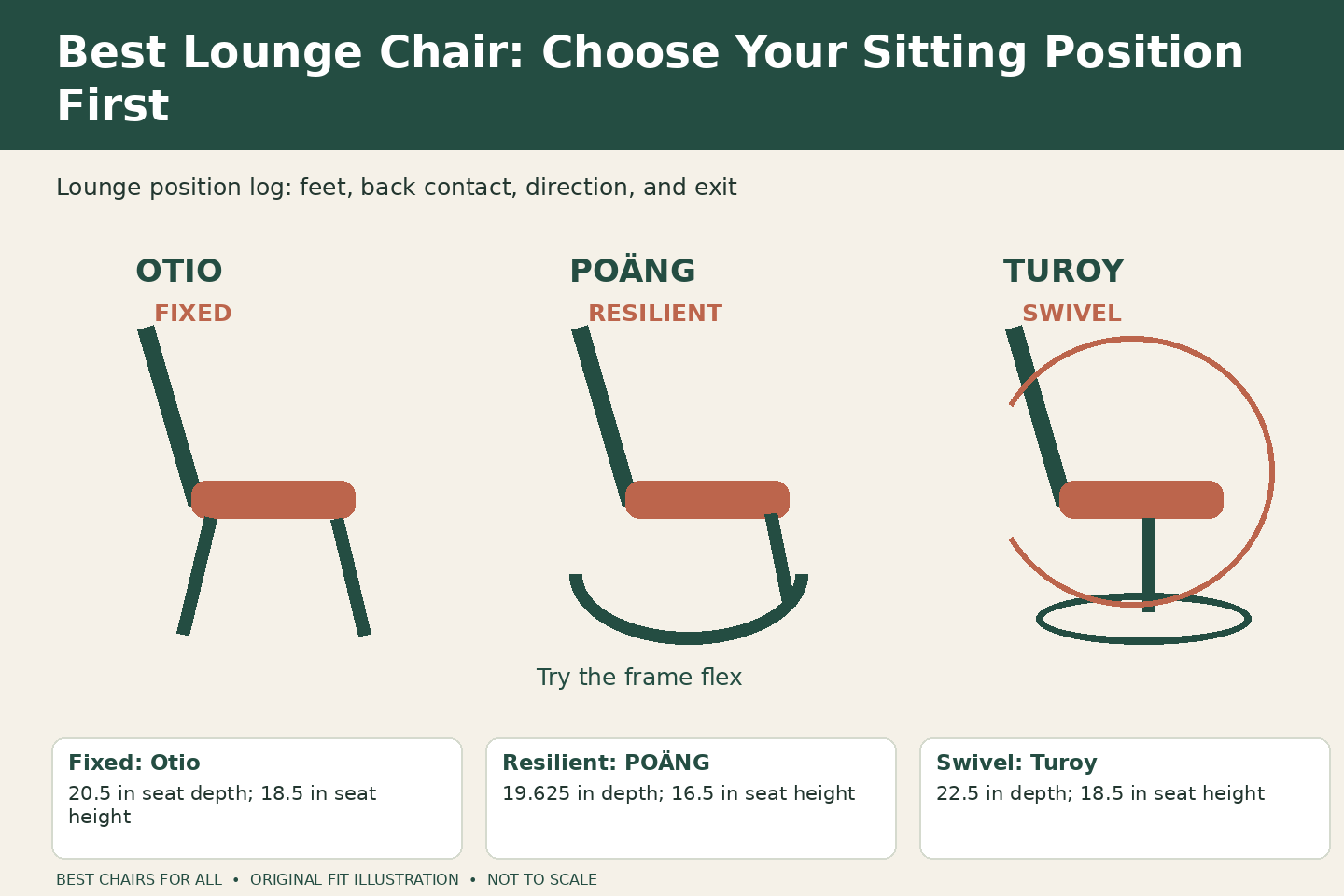
This shortlist compares Article Otio in Walnut and Welsh Taupe, IKEA POÄNG in birch veneer and Gunnared dark gray, and Article Turoy in Wicklow Gray. They offer three different structural experiences: a fixed wooden lounge frame, a resilient bentwood frame, and a full swivel. We use current US manufacturer specifications and instructions, not firsthand sitting tests. These are indoor furniture recommendations rather than outdoor loungers, recliners, or medical seating.
Observe your current relaxing position
Use the seat you already choose when you are free to sit anywhere in the home. Notice where your feet go, whether you change position, and whether you regularly turn toward someone or something. Record those observations in three lines: feet, back contact, and direction. Do this during ordinary use rather than forcing yourself into a posture that seems appropriate for a shopping guide.
If both feet stay down and you often talk to someone opposite, prioritize a seat depth that lets you reach the back without sliding forward. If you usually stretch your legs onto another surface, plan a suitable matching footrest and its floor space. If you keep twisting toward a second view, consider a swivel after checking its moving envelope. These observations identify a task; they do not diagnose posture or prescribe a treatment.
A soft-looking chair may have a fixed angle that you dislike. An exposed wooden frame may feel more padded than expected. A very deep seat can be generous for one position and awkward for another. Manufacturer measurements help narrow the search, but they cannot establish cushion compression, edge firmness, or individual comfort without a trial.
The three researched lounge options
Verify the exact variants in the manufacturer references: Article Otio 26 lounge chair, Walnut and Welsh Taupe; IKEA POÄNG armchair, birch veneer/Gunnared dark gray; Article Turoy 32.5 swivel lounge chair, Wicklow Gray. Specifications were checked November 6, 2026.
1. Article Otio 26 lounge chair, Walnut and Welsh Taupe
Best for: Fixed open-frame lounging.
Otio offers a defined fixed sitting angle inside a solid-black-walnut frame. Its 26.5-inch width is appealing when a lounge destination should remain visually open beside a larger sofa.
The current selected page lists 33 inches overall height, 34.5 inches depth, and an 18.5-inch seat height. Its arm height is 22 inches. These details help assess the intended position, but do not establish subjective firmness or long-session comfort.
Product Details
| Brand | Article |
|---|---|
| Overall dimensions | 26.5 W × 34.5 D × 33 H in |
| Seat height | 18.5 in |
| Manufacturer load wording | 300 lb tested |
| Materials | Solid black walnut; foam; polyester/viscose/linen/cotton blend |
Pros
- Clear fixed frame for a single main view
- Published seat depth and arm height
Cons
- Deep footprint for a narrow-looking chair
- No swivel or adjustable recline
Choose it after testing the actual back angle with your normal activity.
2. IKEA POÄNG armchair, birch veneer/Gunnared dark gray
Best for: Resilient high-back frame.
This standard POÄNG armchair combines bentwood resilience with a higher outline and an independently specified Gunnared dark-gray cushion. It suits someone who prefers that particular flexible sitting experience.
The complete selected chair lists a 16.5-inch seat height and 19.625-inch seat depth. Do not confuse it with the rocking version or apply another cushion’s washing instructions. The selected Gunnared cushion cannot be washed or dry cleaned.
Product Details
| Brand | IKEA |
|---|---|
| Overall dimensions | 26 3/4 W × 32 1/4 D × 39 3/8 H in |
| Seat height | 16 1/2 in |
| Manufacturer load wording | Tests based on use by people up to 242 lb |
| Materials | Layer-glued wood/birch veneer; foam; polyester Gunnared cushion |
Pros
- High-back outline within a relatively narrow width
- Replaceable named cushion component
Cons
- Frame resilience requires a personal trial
- Selected cushion is not washable
Choose the complete configuration for its sitting behavior, not familiarity alone.
3. Article Turoy 32.5 swivel lounge chair, Wicklow Gray
Best for: Swivel for two views.
Turoy turns through 360 degrees on a discreet steel base. Its rounded upholstered form works best when the chair needs to face more than one part of a living room regularly.
At 32.5 inches wide it occupies more width than the wooden-frame options. The 22.5-inch seat depth is also greater. Article lists a 300-pound tested figure, which does not establish the clear seat width or how the chair feels to an individual.
Product Details
| Brand | Article |
|---|---|
| Overall dimensions | 32.5 W × 32 D × 28.5 H in |
| Seat height | 18.5 in |
| Manufacturer load wording | 300 lb tested |
| Materials | Pine frame; foam/polyester; 83% polyester/15% acrylic/2% wool; steel swivel |
Pros
- Explicit swivel specification
- Loose seat cushion and no required assembly
Cons
- Low back may not suit upper-back contact preferences
- Occupied turning area needs checking
Shortlist it when movement has a clear everyday purpose.
Make a three-position comparison sheet
Draw three rows labeled everyday lounge, conversation, and getting up. For everyday lounge, write where your feet rest and what contacts the back. For conversation, write which person or screen you need to face. For getting up, note whether you can move your feet into the position you naturally use without an ottoman or table blocking the route. Keep the observations descriptive rather than scoring every chair with invented numbers.
Try the selected model in the position you will actually use, with the kind of clothing and footwear typical at home. A quick showroom perch on the front edge does not establish whether you like the reclined angle. Conversely, a comfortable relaxed position does not tell you whether you can hold a conversation facing another chair without constantly moving.
Use a book or headphones if that is your normal activity. A chair can seem comfortable with empty hands but reveal an awkward arm position when holding something. Bring any cushion you intend to use if the retailer permits it, because it changes effective depth and contact with the back. Do not assess a heavily accessorized showroom display and assume the unaccessorized chair will feel identical.
On the final line, name the chair’s decisive limitation for you. Examples might be “needs more depth than this corner has,” “turning function unnecessary,” or “resilient frame feels wrong when I stand.” A clear limitation is more useful than a generic ranking that pretends comfort is the same for every person.
Fixed lounge form: what Otio offers
Otio’s Welsh Taupe version measures 26.5 inches wide, 34.5 deep, and 33 high. Its 18.5-inch seat height and 20.5-inch seat depth create a different relationship from a tall dining chair or a low floor-level seat. The exposed walnut arms are listed at 22 inches above the floor. Try those arms with your actual activity rather than assuming they will support every book-holding position.
A fixed frame can be useful when the chair should stay aimed at one view and the room does not need movement. It also means that a change of direction requires repositioning the entire chair. If the main attraction is looking out of the window and talking to someone behind you, a fixed chair’s visual lightness may not offset that functional compromise.
The narrow width can disguise the depth in product photographs. In a room with a 33-inch furniture zone from wall to walkway, the nominal 34.5-inch depth already exceeds the zone by 1.5 inches before any placement gap. A relatively slim wooden chair is not automatically a shallow chair. Tape the entire footprint rather than measuring only the width between another piece and the wall.
Resilient bentwood: what POÄNG offers
The selected complete Gunnared POÄNG is 26.75 inches wide, 32.25 deep, and 39.375 high. IKEA lists a 16.5-inch seat height and 19.625-inch seat depth. Its high-back silhouette and flexible bentwood structure distinguish it from Otio’s fixed frame. This is the standard armchair, not the separate rocking-chair model in the same family.
The frame’s resilience is something to try, not a universal comfort advantage. If you prefer a seat that feels still during entry and exit, evaluate that experience directly. If you like the flex, confirm that the chair stands level on the intended floor. Do not change rails, add improvised restraints, or substitute components to make its movement behave like a different chair.
The Gunnared cushion can be replaced as a component, but that does not make its cover washable. IKEA’s selected cushion directions prohibit washing and dry cleaning, while permitting vacuuming and wiping with a damp cloth. Keep the frame care separate: its wood can be wiped with a mild cleaner and then dried. A familiar product family may contain several textiles with different instructions.
Swivel lounge: what Turoy offers
Turoy measures 32.5 inches wide by 32 deep and 28.5 high. Its 18.5-inch seat height matches Otio’s published figure, but the 22.5-inch seat depth and rounded upholstered form create a different sitting space. Article confirms a 360-degree steel swivel base. That makes it a candidate when changing direction is a regular part of relaxing.
Plan the turn with the person’s legs and arms included. The footprint when parked is not the whole moving envelope, particularly near a table corner or floor lamp. Avoid putting a cord or a curtain where the chair or occupant can contact it during rotation. The movement should connect two useful views without requiring someone to rearrange the room each time.
Article lists a loose seat cushion and no assembly required. Those are practical ownership details, not evidence that it rotates silently or with a particular resistance. We have not measured either. Ask the retailer about an actual trial if turning feel or noise is central to how the chair will be used.
Think about a footrest before adding one
A separate ottoman can change a lounge arrangement substantially. It adds another surface in front of the chair, moves the access route, and may change the way your thighs contact the seat. An available matching footrest is useful, but “matching” does not guarantee comfort for every leg length or position. Try both pieces together when possible.
Keep a route for moving into and out of the chair without stepping over the footrest. Do not treat an upholstered ottoman as a stable drink table without the maker permitting that use and a suitable arrangement. If you prefer to keep your feet down most of the time, a footrest may occupy valuable space without improving the actual activity.
None of these shortlisted chairs has a verified powered or manual reclining mechanism. A reclined fixed back is different from an adjustable recliner. If changing back angle or elevating a built-in leg support is essential, shop that category directly instead of expecting a lounge chair to acquire the function through cushions or an unrelated stool.
Let the daily routine determine the winner
Otio’s blend includes viscose, linen, and cotton alongside polyester, and its instructions emphasize dry-cloth blotting and air drying. Turoy’s Wicklow Gray blend and spot-care instructions differ. POÄNG’s named cushion has its own prohibitions. Select a material whose permitted routine fits the snacks, drinks, pets, and clothing that will share your relaxing time; no model here is claimed to resist every household accident.
Choose Otio for a fixed walnut-framed lounge position when its depth fits. Choose POÄNG when you enjoy the resilient high-back sitting experience and accept its selected cushion care. Choose Turoy when turning between views is genuinely useful and the low rounded back suits you. The right chair is the one that supports your preferred activity and fits the room throughout that activity, rather than merely looking relaxed in a photograph.
Something unclear or out of date? Send a correction with this article’s title and the detail to check.
Sources, research & corrections policy ↗