As an Amazon Associate, we earn from qualifying purchases. Read our affiliate disclosure. Retailer links below search for matching listings; verify the exact model and seller before ordering.
The best portable spectator chair begins with a simple distinction: will you sit on the ground, or on a bench supplied by the venue? The TravelChair Original Joey 7789 is our compact ground-chair candidate, subject to finding an available matching listing. The regular Cascade Mountain Tech Ultralight Stadium Seat is the bench-specific choice. The standard Kijaro Dual Lock is the conventional ground option when a short approach makes its greater weight acceptable.
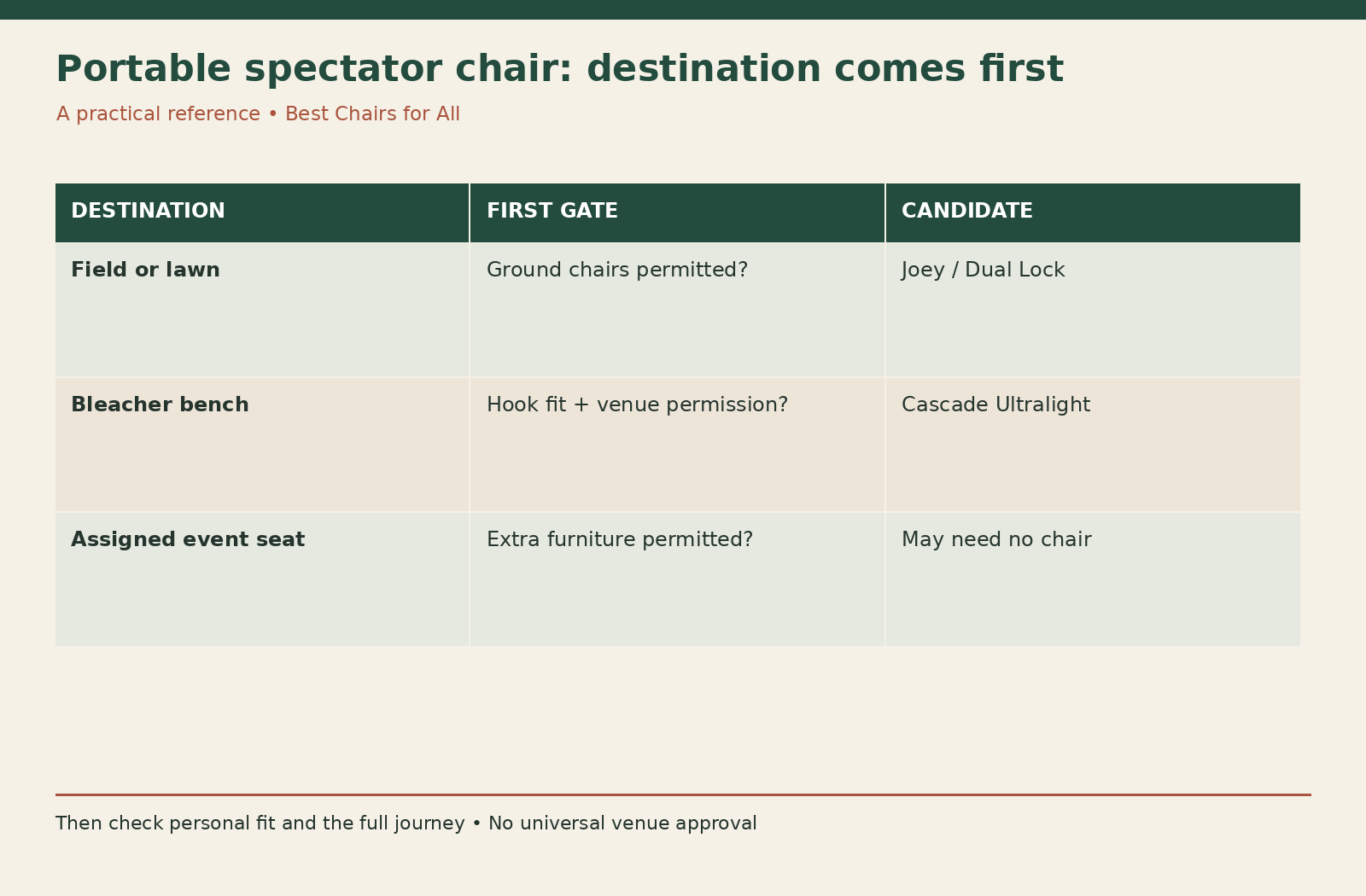
A portable chair that cannot be used at your destination is wasted luggage. This guide therefore ranks seating type and event rules before carrying weight. The recommendations use current manufacturer information checked on November 6, 2026, rather than hands-on comfort or durability tests. We have not assessed these chairs at a particular venue or obtained event approval for them.
Make a season itinerary instead of choosing by one photograph
Write down the next three or four events you actually expect to attend. Include the ticketed seating area, the supplied surface, the route from transportation, and any published chair restrictions. A school track meet, a community concert, and a stadium game can ask for three different forms of seating even if every retailer describes its product as portable.
Separate confirmed information from assumptions. “There were bleachers last year” does not establish what your ticket permits this year. “Lawn admission” does not establish that personal chairs are admitted, or that a normal-height chair meets the rules. An event may provide rentals, specify an allowed design, or prohibit outside furniture entirely.
For concert trips, Ticketmaster’s official guidance directs guests to the venue-specific policy and explains that rules and rental options vary. Use that as a research route, not as approval for one of these products. Save the applicable venue page and recheck before the trip if the rule is central to your purchase.
Three options with different destinations
Our sources are the Original Joey 7789 manufacturer page, the regular Cascade Ultralight bleacher seat listing, and Kijaro’s standard Dual Lock page. Their weights are empty-product figures. A drink, carry bag arrangement, or extra accessory can change the load you actually transport.
| Product | Supplies ground legs? | Needs a suitable bench? | Main transport distinction |
|---|---|---|---|
| Original Joey 7789 | Yes | No | 2.35 lb; 14-in packed length |
| Cascade regular Ultralight | No | Yes | 5.3 lb; hook and bench compatibility |
| Kijaro standard Dual Lock | Yes | No | 9.5 lb; conventional folding design |
1. TravelChair Original Joey Chair 7789
Best for: Best compact ground-chair candidate.
The Original Joey is the candidate for spectators who have confirmed that a freestanding ground chair is permitted and who want a genuinely short packed item. Its listed 14-inch packed length can make a substantial difference in a train, shuttle, or backpack arrangement compared with a long conventional folding-chair bundle.
The exact manufacturer designation is Original Joey 7789. This is not the Low Joey or the C-Series Joey. It uses an aluminum frame with a mesh and ripstop-polyester seat and requires assembly. The direct maker page showed out of stock when checked, so treat it as a shortlist option requiring a matching retailer listing rather than an assured immediate purchase.
Product Details
| Brand | TravelChair |
|---|---|
| Capacity | 300 lb |
| Listed weight | 2.35 lb |
| Packed size | 4 × 4 × 14 in |
| Open size | 21 × 21 × 28 in, maker order |
| Seat height | 16 in |
Pros
- The manufacturer supplies a clear compact package measurement.
- Its 300-pound listed capacity can be checked against the intended user before purchase.
Cons
- A 16-inch seat may be unsuitable when low seating makes getting up difficult.
- It supplies its own legs and cannot replace an anchored bleacher seat in a restricted row.
Choose it for permitted lawn or field seating when small packed dimensions dominate the trip. Check the actual ground and occupied fit; rubber-disc feet do not establish universal suitability for sand, mud, or sloping ground.
2. Cascade Mountain Tech Ultralight Stadium Seat for Bleachers
Best for: Best when the destination supplies a compatible bench.
This regular-width Cascade model makes sense when your ticket leads to an allowed, compatible bleacher bench. The seat uses the venue’s bench instead of providing freestanding ground legs. Its underside hook is an essential part of evaluating that specific use; it is not an accessory to disregard because the cushion appears to rest on the bench.
Cascade lists a 17-inch seat width, 14-inch depth, 15-inch backrest, and 5.3-pound weight for this configuration. The padded seat has bungee reinforcement, with a shoulder strap and carry handle for transport. A wider 20-inch relative has different specifications, so verify the selected variant rather than relying on the shared product family name.
Product Details
| Brand | Cascade Mountain Tech |
|---|---|
| Capacity | 250 lb |
| Listed weight | 5.3 lb |
| Seat dimensions | 17 W × 14 D in |
| Backrest height | 15 in |
| Construction | Aluminum frame; underside bleacher hook |
Pros
- A defined seat width can be compared with an actual bench allocation.
- Backrest and carrying features form one purpose-built bleacher package.
Cons
- It is not a freestanding chair for a lawn or a parking lot.
- The hook must fit the permitted bench without interference; venue approval is separate.
Buy it for known bench seating after measuring and checking policy. If the event sometimes assigns you to a lawn, bring a different approved seating plan rather than assuming one seat type can be improvised into the other.
3. Kijaro Dual Lock Chair
Best for: Best conventional ground chair for short approaches.
The standard Dual Lock is the conventional folding choice for a spectator who can tolerate a larger carry in return for a defined 20-inch seat height and an equipped sitting station. Its two mesh cup holders and attached organizer can keep small belongings beside the user during a long session.
The mechanism locks open and closed. That makes it a different setup proposition from the pole-style Joey, though we have not timed either. Kijaro publishes a 22-inch seat width within a 35.5-inch overall chair width. A spectator planning a narrow row must work from the larger dimension and the venue’s actual seating allocation.
Product Details
| Brand | Kijaro |
|---|---|
| Capacity | 300 lb |
| Listed weight | 9.5 lb |
| Open size | 26 L × 35.5 W × 37 H in |
| Seat | 22 W × 16 D in; 20 in high |
Pros
- Direct published seat depth and width help a buyer compare familiar furniture.
- Mesh back and integrated organization are useful for a settled outdoor viewing spot.
Cons
- At 9.5 pounds it is less appealing for a long transit-based approach.
- The manufacturer page used here does not establish a packed measurement for a gate-size decision.
Choose it when the approach is short, ground seating is allowed, and the occupied footprint fits. Ask for the current packed dimensions if storage size is a purchase condition; do not borrow a similar chair’s measurements to complete the listing.
A destination matrix that makes the purchase decision visible
Draw one row for every event and use the same four gates in order: permission, seating surface, individual fit, and transport. A failure at an earlier gate removes the option for that event. Do not let a low carrying weight compensate for a missing bench or a published restriction.
| Example itinerary | Permission question | Surface question | Candidate if both pass |
|---|---|---|---|
| Community field event | Are personal ground chairs allowed? | Is there a suitable place for all chair feet? | Joey or Dual Lock |
| Ticketed bleacher event | Are framed seats and hooks permitted? | Does the actual bench accept the hook? | Cascade regular Ultralight |
| Concert lawn | What chair design or height rule applies? | Is your permitted area suitable? | Only a model meeting that exact rule |
| Assigned stadium seat | Is extra furniture prohibited? | Does an approved alternative exist? | Possibly none of these |
Consider a spectator who attends six open-field events and two bleacher games each season. If the open-field sites allow both ground chairs, the choice between Joey and Dual Lock concerns transport and fit for six events. The Cascade solves a separate two-event bench problem. Buying only the bench seat because it has a carrying strap leaves the majority of trips unsolved.
Now change the scenario: a grandparent attends only those two bleacher games, with a short walk from a drop-off point. Ground-chair weight savings become irrelevant. Bench dimensions, hook access, the spectator’s fit, and the arena policy determine the shortlist. This is why multiplying event frequency by the right seating category provides better direction than a universal best-chair ranking.
Understand the bench measurement before carrying a framed seat
For the Cascade, obtain the available seat width, bench depth, underside edge shape, and any obstructions near the attachment location. Its nominal 17-inch seat width should fit within the space you are actually permitted to use. A seat fitting physically across a continuous bench does not entitle its owner to occupy part of another ticket holder’s space.
The hook must engage according to the manufacturer’s instructions. A bench rail, bracket, closed fascia, or an unsuitable edge can prevent the intended connection. We did not establish a universal compatible bench-thickness range from the source, so this guide gives none. If you cannot confirm the exact interface, ask the manufacturer or venue before treating the purchase as settled.
Keep two decisions separate: the product may fit the bench, while the event still disallows attachments. Conversely, a venue may generally allow stadium seats while your particular bench geometry prevents proper use. Passing only one condition is insufficient. A photo of a seat resting on a plank cannot resolve either question fully.
Give the ground-chair user an occupied trial
For freestanding models, assess the intended user sitting with ordinary event footwear and clothing. A 16-inch nominal seat and a 20-inch nominal seat create different positions, but neither number predicts comfort for everyone. Seat shape and how far the fabric yields under the person can change what those measurements feel like.
Notice whether feet have useful contact with the ground, whether the front edge presses behind the knees, and whether the spectator can rise in their usual way. Consider a coat or winter clothing if those are part of the season. A narrow-feeling seat in warm weather is unlikely to improve with several bulky layers.
The rated capacity is another gate, not a comfort score. Stay within the exact model’s instructions and rating; do not interpret a high load number as a guarantee against sinking, tipping, or failure on an unsuitable surface. If the available site does not allow proper placement, use another permitted seating arrangement rather than adapting the legs with makeshift objects.
Test the journey with the packed chair shape
A bus aisle, train rack, security queue, and narrow gate each impose different handling problems. The Joey’s verified packed dimensions are useful for this assessment. For the Kijaro, ask the maker or retailer for the current packed measurements when those are essential; the open dimensions cannot answer whether the bundle fits your bag or storage space.
Measure your backpack opening rather than merely its advertised volume. A fourteen-inch object may fit a cavity but fail to pass through an opening with other gear already inside. If you plan to lash the chair externally, use the bag and chair carrying provisions as instructed and check the resulting width. A protruding bundle may repeatedly strike other people in a queue.
For a bench seat with a strap, consider the orientation of the folded frame on the shoulder and the other items carried. Do an ordinary walking rehearsal, turn through a doorway, and put the arrangement down as you would at the entrance. This tests the luggage combination; it is not evidence of the chair’s long-term durability or a promise that the event will admit it.
Decide whether one chair is enough
A mixed calendar may justify two specialized seats, one compact ground chair and one permitted bench seat. It may also justify buying no extra furniture if your main event supplies a seat or offers a suitable rental. The matrix exposes that choice before you spend money trying to make a single product serve incompatible destinations.
If most trips involve suitable lawns and lengthy transport, investigate the available Original Joey 7789 and verify its lower seat fit. If the destination is a known compatible bleacher, evaluate the regular Cascade with its exact hook and width. For short approaches and a conventional sitting arrangement, try the standard Dual Lock. Keep the itinerary with your purchase notes so the next attractive feature does not distract from where the chair must actually work.
Something unclear or out of date? Send a correction with this article’s title and the detail to check.
Sources, research & corrections policy ↗