As an Amazon Associate, we earn from qualifying purchases; see our affiliate disclosure.
The best pool lounge chair depends first on whether you want a full-length chaise or a reclining chair with an integrated footrest. POLYWOOD’s Nautical Chaise is the strongest starting point here for a substantial slatted chaise with a 300-pound tested rating. IKEA’s NÄMMARÖ chaise suits buyers who want acacia wood and accept its regular finish maintenance. LAFUMA’s Futura Batyline Iso is the compact folding alternative when adjustable raised-leg lounging matters more than a long flat chaise surface.
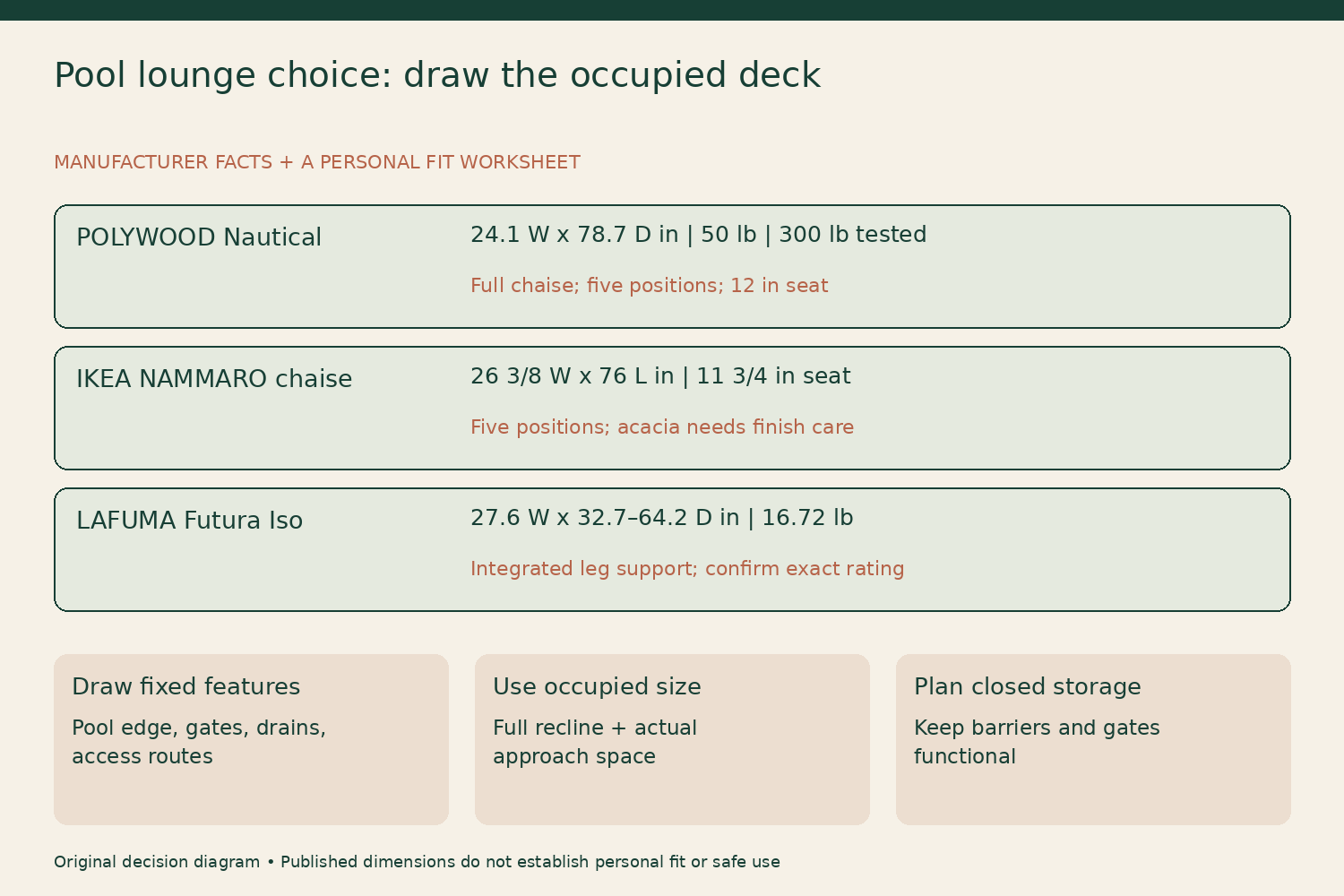
This comparison concerns use on a suitable poolside deck. It does not recommend floating products or supply an in-water installation plan. Manufacturer claims about outdoor materials do not establish immersion permission, pool-finish compatibility, ballast requirements, or suitable water depth. Those are separate product-specific questions. We reviewed official specifications in November 2026; these are research-based selections without hands-on comfort, corrosion, or durability testing, and without a current price ranking.
Start with the shape of the lounging experience
A chaise provides an extended seat-and-leg surface, while the Futura changes the relationship between its back and integrated leg support as it reclines. Someone who wants a long surface for stretching out may prefer a chaise. Someone who wants to move between seated and raised-leg positions may prefer a recliner. The words zero gravity describe LAFUMA’s seating arrangement here; they are not a claim of a medical outcome or a reason to ignore personal comfort.
Also decide whether the furniture moves daily. POLYWOOD’s listed fifty-pound chair is a different handling proposition from the 16.72-pound Futura, even though both can be stored more compactly than in their lounging position. IKEA’s chaise has wheels, but those do not establish how easily a particular user can move it over thresholds, deck joints, or stairs. Check the actual route and the manufacturer’s moving instructions rather than assuming wheels solve every storage task.
Verified options and exact model limits
The POLYWOOD Nautical Chaise NAC2280 has five positions, a 300-pound tested rating, and overall dimensions of 24.1 inches wide, 78.7 inches deep, and 39 inches high. It weighs fifty pounds. Seat dimensions are 21.1 inches wide, 46.1 inches deep, and twelve inches high. It folds flat and stacks. This is the armless NAC2280; dimensions from the wider chaise with arms or the wheeled version should not be substituted.
The IKEA NÄMMARÖ chaise 305.033.54 has five back positions and a solid-acacia frame with acrylic stain. Overall size is 76 inches long by 26⅜ inches wide, with a maximum height of 30¾ inches. Seat width is 22½ inches, seat height 11¾ inches, and backrest length 29⅞ inches. Its page gives 243 pounds in the measurements and 242 pounds in the safety-test explanation; resolve that discrepancy with IKEA if the rating is material to your purchase.
The US Futura Batyline Iso Graphite LFM3118_8717 page lists 27.6 inches of width, 15.75 inches of seat height, and 16.72 pounds of chair weight. Open depth varies from 32.7 to 64.2 inches. Folded size is 27.6 inches wide by 37.8 inches high by 7.1 inches deep. LAFUMA’s current manufacturer comparison lists Futura at a tested maximum of 140 kilograms; confirm the exact supplied US model’s instructions rather than borrowing a rating from an older XL listing.
1. POLYWOOD Nautical Chaise NAC2280
Best for: Substantial slatted chaise.
A good starting point for a fixed poolside furnishing when a long reclining surface matters.
The armless model has five positions and a twelve-inch seat. Its fifty-pound weight needs a deliberate moving and storage plan.
Product Details
| Brand | POLYWOOD |
|---|---|
| Overall | 24.1 W x 78.7 D x 39 H in |
| Weight | 50 lb |
Pros
- HDPE lumber avoids a wood re-staining schedule.
Cons
- Heavy for frequent carrying.
Match NAC2280 exactly; armed and wheeled models have different specifications.
2. IKEA NÄMMARÖ Chaise 305.033.54
Best for: Acacia wood option.
For buyers who specifically want stained wood and can maintain it as IKEA directs.
The product page has a one-pound discrepancy between its tested-for measurement and safety explanation. Request clarification when that limit affects selection.
Product Details
| Brand | IKEA |
|---|---|
| Overall length | 76 in |
| Seat height | 11.75 in |
| Back positions | 5 |
Pros
- Published 22.5-inch seat width.
Cons
- Regular finish care and protected storage are part of ownership.
Check IKEA directly for the exact article; retailer search matches may vary.
3. LAFUMA Futura Batyline Iso Graphite LFM3118_8717
Best for: Folding raised-leg alternative.
A reclining chair with integrated leg support for someone who does not need a full-length chaise surface.
The current maker comparison lists Futura at a tested maximum of 140 kilograms; match the supplied version and manual.
Product Details
| Brand | LAFUMA |
|---|---|
| Open depth | 32.7–64.2 in |
| Seat height | 15.75 in |
| Weight | 16.72 lb |
Pros
- Open-weave Batyline Iso and compact folded depth.
Cons
- Reclining movement still needs substantial clear space.
Use the complete movement envelope when drawing the deck layout.
A deck footprint worksheet with a worked example
Draw your actual usable deck area and mark the pool edge, gates, doors, drains, fixed shade bases, and routes that must remain clear. Use the longest occupied furniture configuration rather than a product’s upright photograph. Then add your chosen space for approach, adjustment, and moving around it. These allowances are personal planning inputs, not building-code or accessibility specifications. Required routes and clearances must be determined for the actual property and applicable requirements.
For a hypothetical clear area 144 inches wide by 132 inches deep, place two NAC2280 outlines side by side. Their combined width is 48.2 inches. If the owner chooses an eighteen-inch gap and twelve inches at each outer side for this initial paper exercise, the total becomes 90.2 inches, leaving 53.8 inches of the hypothetical width unassigned. This does not prove the layout is suitable; it shows exactly which assumed spaces still need review against real access and use.
For depth, the same owner might temporarily sketch twelve inches behind the 78.7-inch chair and thirty inches in front. That totals 120.7 inches, leaving 11.3 inches in the hypothetical 132-inch area. The apparently generous empty deck now looks much less generous. Replace every assumed allowance with the space the actual site and activities require. Never place the remainder automatically at the pool edge or claim that a few leftover inches establish an acceptable route.
Reclining movement changes the space you need
Futura’s published depth range grows by 31.5 inches from its shortest to longest open configuration. That is useful planning information, not a complete motion diagram. Check where the extra length appears relative to the feet and the chair’s center, and keep nearby tables and walls out of the actual movement envelope. A compact upright recliner can occupy a substantial length when opened, even though it still uses less total length than the chaises in this shortlist.
For the chaises, confirm the footprint and backrest clearance in each position you intend to use. The top of a reclining back can approach a wall or planter differently from the base. Include cushion thickness and permitted accessories in your actual check. A lounger that fits neatly in a paper rectangle may still leave the adjustment control inaccessible when a second chair and side table are added. Test ordinary access without crowding the mechanism or pool route.
Height and surface feel deserve their own trial
POLYWOOD’s twelve-inch seat and IKEA’s 11¾-inch seat are both low. Futura’s listed 15.75-inch seat creates another entry arrangement, but its sling and reclining geometry are not identical to a firm chair of that height. Anyone who dislikes lowering into a low chaise should evaluate that before selecting by finish or matching a patio set. Use the chair normally on a suitable surface during a permitted trial; do not add risers or improvised leg blocks.
Slatted wood, slatted HDPE lumber, and open-weave fabric feel different against a wet swimsuit or towel. This guide has not tested those sensations. Ask about the intended cushion and its care if you want padding. A matching cushion changes drying and storage tasks; it does not inherit the frame’s care instructions automatically. Make sure any pad is the correct product and attached only as the manufacturer allows, without interfering with the back adjustment or folding movement.
Match maintenance to the actual material
POLYWOOD’s product page describes HDPE lumber and recommends soap, water, and a soft-bristle brush for routine cleaning. That is a useful low-maintenance option for someone who does not want to maintain a wood stain. It does not mean the entire chair is immune to damage, that hardware never needs inspection, or that every chemical used around a pool is suitable for the material. Follow the current product care guidance for particular stains and finishes.
IKEA’s care requirements are different and explicit. For this acacia chaise it specifies a mild soapy solution, drying with a clean cloth, regular re-staining such as once or twice a year, and protected storage with ventilation if covered outside. It also recommends re-tightening screws at least once per season. Accept those tasks before choosing the wood appearance. Do not apply a plastic-lumber cleaning recipe or an unverified pool chemical to the stained wood.
LAFUMA identifies the Futura’s open-weave Batyline Iso as appropriate around pools and says soapy water is sufficient for routine fabric care. Its frame is coated steel, rather than the HDPE or acacia used in the other options. Keep model-specific fabric and frame instructions together, and obtain the current storage advice for the exact product. A removable sling is a service feature; replace it only with the compatible part through the manufacturer’s documented procedure.
Furniture placement belongs in the pool plan
The CDC’s drowning-prevention guidance calls for close, constant supervision and barriers that separate pools from the house and yard. Choosing a comfortable lounger does not reduce that responsibility. If someone is supervising swimmers, their task requires attention rather than reading, sleeping, or becoming absorbed in a device. Arrange furniture around that responsibility; a reclining position is not a substitute for an active designated supervisor.
The American Academy of Pediatrics’ pool guidance also says to avoid furniture alongside a barrier that children could use to climb it. A tidy stored chaise can still become a climbable object if placed carelessly. Keep gates and access routes functional when chairs are used and when folded or stacked. The convenience of stacking should be assessed within the actual pool-area layout, not only as a count of chairs that fit in a corner.
Choose the ownership pattern you prefer
For a substantial long-term deck chaise with a documented 300-pound tested rating, start with the armless POLYWOOD Nautical and plan for its fifty-pound handling weight. Choose IKEA NÄMMARÖ when the acacia finish is a priority and the regular care schedule is realistic, with the page’s rating discrepancy resolved when relevant. Choose Futura when folding storage and adjustable integrated leg support better match the desired lounging style, after verifying the exact supplied model and full reclining envelope.
Keep the footprint worksheet with the selected product dimensions and the actual maintenance instructions. Confirm current stock and delivery arrangements separately; a matching Amazon search can return related products rather than the exact model. A useful pool lounge purchase works both while someone is resting and while the deck is being used, cleaned, supervised, and closed for the day. Those practical ownership tasks should determine the choice as much as the first impression of the chair.
Something unclear or out of date? Send a correction with this article’s title and the detail to check.
Sources, research & corrections policy ↗