As an Amazon Associate, we earn from qualifying purchases. Read our affiliate disclosure. Amazon links below are model-name searches; verify the seller, exact variant, and specifications before ordering.
Choose Pottery Barn’s standard Irving Roll Arm Leather Chair when you want a comparatively narrow traditional club-chair arrangement. Consider Article’s Sven 42-inch chair for a broader stationary lounge seat. Investigate Article’s Cigar 44-inch swivel chair when a very low, deep seat and a fully upholstered surround are deliberate priorities. The best choice depends on seat height, depth, arm position, and whether the room needs a stationary or rotating chair.
This guide uses current manufacturer information checked on November 6, 2026. We have not sat in, tested, or rated the durability of these products. Club chair is used here for upholstered armchairs with substantial arms and a low or medium back; the category includes different silhouettes rather than one standardized dimension. Obtain a dated delivered quote for your chosen leather and configuration. No lowest-price or fixed-budget promise is made.
Compare three different club-chair geometries
A broad outside width can conceal a much narrower inside seat once thick arms are included. A low overall height can also accompany a very low seat, which changes how the chair is used. Start with the inside dimensions and your comfortable reference chair, then plan the outside envelope. Do not use the word oversized as a substitute for actual measurements.
| Candidate | Overall W × D × H | Seat height / depth | Primary reason to consider |
|---|---|---|---|
| Pottery Barn Irving standard armchair | 32 × 36 × 33 in | 17 / 23 in | Traditional rolled arms in a narrower outside width |
| Article Sven 42, Charme Green | 42 × 38 × 34 in | 19 / 24 in | Broad stationary chair with tufted seat and loose back |
| Article Cigar 44 swivel, Rawhide Tan | 44 × 38 × 26 in | 15 / 27 in | Low, deep lounge shape with 360-degree swivel |
Article lists both selected chairs as weight-tested to 300 pounds. That is the manufacturer’s published test description, not our independent verification or a reason to assume the same rating for Irving. We did not find an equivalent user-load figure in the Irving dimensions reviewed. Ask the manufacturer for a required limit rather than inferring it from a thick arm, a wide seat, or a commercial-use label.
Pottery Barn Irving: a traditional narrower candidate
The Irving specification page lists the standard armchair at 32 inches wide by 36 deep by 33 high, with a 22-inch inside width, 23-inch seat depth, and 17-inch seat height. It describes a tight back, loose seat cushion, rolled arms, and aniline-dyed top-grain leather. Consider the standard version when a traditional club profile is wanted without the 42- or 44-inch outside width of the Article alternatives.
Its limitation is that narrower outside dimensions do not necessarily mean a shallow sitting position. The 23-inch depth deserves a trial if your comfortable reference chair is shorter. Also specify standard, tall, or extra tall on the order. The page lists several versions, and their names should not be silently merged into one set of dimensions. A taller back does not automatically mean a higher seat.
Irving’s leather and cushion configuration should be recorded precisely. The manufacturer’s own wording about a firmer feel is not a cross-brand comfort test. Try the chair in your ordinary position, including arm contact and looking toward the room’s main conversation point. Do not assume a traditional shape provides a particular health benefit or that it suits every user simply because the arms look substantial.
Check matching Pottery Barn Irving Roll Arm Leather Chair listings on Amazon (paid link)
Article Sven 42: broad stationary lounging
The Sven Charme Green page gives a 42-inch outside width, 38-inch depth, 19-inch seat height, and 24-inch seat depth. It includes two bolster pillows and uses a tufted seat with a loose fabric-backed back cushion. It is the candidate for someone who wants a broad stationary upholstered chair and can allocate the extra width in the seating group.
The higher seat and deep cushion work together; neither should be judged alone. Someone who likes a 19-inch seat height may still find the back too far away, while another user may prefer that lounging space. Compare the supported position rather than sitting at the front edge for a quick impression. Do not treat removable bolsters as proof that the manufacturer intended every possible sitting posture or multi-person use.
The selected Charme leather is described as full-aniline and naturally variable. It can develop a different appearance with use, and the page cautions about clothing dye transfer and chemical cleaners. If you want a uniform finish with minimal visible change, investigate another approved upholstery rather than assuming every leather variant behaves the same. Record the exact finish on the order and follow its own care guidance.
Check matching Article Sven 42 Charme Green leather chair listings on Amazon (paid link)
Article Cigar 44 swivel: a deliberately low and deep arrangement
The Cigar Rawhide Tan swivel page lists a 44-inch width, 38-inch depth, 26-inch overall height, 15-inch seat height, and 27-inch seat depth. It describes a concealed 360-degree swivel, foam-and-feather filling, and buffed full-aniline leather with a suede-like surface. This is the relevant candidate when low lounge seating and rotation are wanted together, rather than a conventional upright armchair.
The low seat is the biggest reason to reject it if that position does not suit you. Do not describe it as easy to enter or leave, and do not assume a 44-inch outer width establishes enough usable room for every person. The listed arms are ten inches wide, showing how much visual volume can belong to the upholstered surround. A chair can be large in the room while providing a more specific internal sitting area.
Its swivel needs a room plan that includes rotation. A chair that clears a side table when pointed forward may contact it when turned. Ask for the manufacturer’s intended clearance or full rotating envelope, and keep tables, cords, walls, and curtains outside it. Do not use repeated contact with an obstacle to discover the turning range. The mechanism is a feature to plan around, not an excuse to ignore the surrounding space.
Check matching Article Cigar 44 Rawhide Tan swivel chair listings on Amazon (paid link)
Build a conversation-group worksheet
Draw the room’s sofa, television or fireplace, doors, and main walking routes. Add the club chair’s outside rectangle, then mark whether it is stationary or swivels. Put the side table on the drawing before deciding the layout is complete. A club chair is often used for conversation, so the view toward another person matters as much as its appearance from the room entrance.
Use three questions for the seated trial: can you sit back in your normal position, do the arms meet your forearms where useful, and can you face the intended activity without repeatedly twisting? A swivel may make changing view convenient, but a stationary chair can work well if positioned correctly. Do not buy rotation to rescue a layout that still blocks access or leaves the chair too close to surrounding furniture.
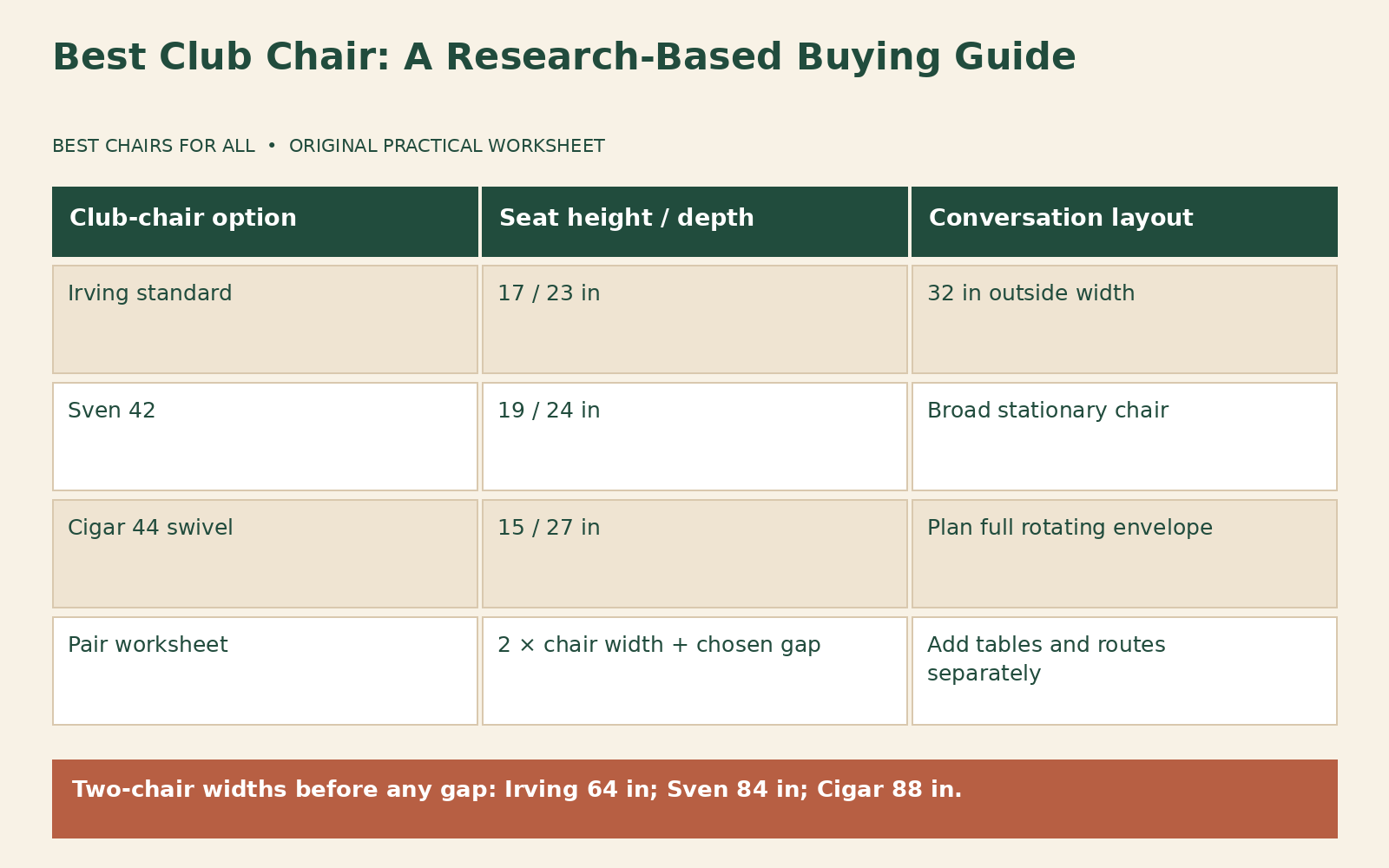
For a pair of chairs, draw each separately rather than mirroring a photograph by eye. A hypothetical plan with two Irving chairs uses 64 inches of combined chair width before a central table or gap. Two Sven chairs use 84 inches, and two Cigar chairs use 88. If your proposed central separation is 18 inches for planning purposes, the totals become 82, 102, and 106 inches respectively. That separation is an example, not a required or universally sufficient clearance.
The calculation illustrates why two single chairs can consume very different amounts of room. It also shows why a small difference per chair becomes more consequential in a pair. Add the actual side tables, swivel envelope where applicable, and walking route independently. Do not claim a route is accessible or code-compliant from this general furniture worksheet; obtain appropriate local guidance when a required route is involved.
Compare seat height and depth as a pair
Write your reference chair’s height and depth together. Suppose you are comfortable at 18 inches high and 22 inches deep. Irving is one inch lower and one inch deeper; Sven is one inch higher and two inches deeper; Cigar is three inches lower and five inches deeper. The differences identify what to try, not a comfort score. Cushion compression, back angle, and measurement location can change the experience.
Check what happens when holding a book, using a controller, or talking to someone across the table. A deep seat that suits relaxed viewing may be inconvenient for reading at the front of the cushion. Do not call that a defect automatically; it may be a task mismatch. If you want one chair for several activities, document each rather than assuming the most relaxed position serves everything.
If a separate ottoman is part of the plan, include it in both fit and floor calculations. Confirm its intended height and use, and do not assume it comes with the chair. An ottoman can improve one arrangement while making access around a pair of club chairs awkward. Use a stable product as intended and avoid turning the chair arms or ottoman into a step for reaching shelves.
Choose the surface for real contact routes
All three selected configurations involve leather, but their finishes and care are different. Read the exact page before applying a cleaner. Article’s Rawhide description is not equivalent to a heavily coated leatherette, and Pottery Barn’s care instructions caution against several common leather treatments. A general leather label does not authorize saddle soap, alcohol wipes, oils, or a conditioner from another brand.
Consider nearby table edges, pets, sunlight, dark denim, and clothing hardware. These are concrete exposure routes to manage, not evidence for an invented durability ranking. Request swatches and examine them in the room’s light. A sample can show texture and color while still failing to reproduce a complete cushion’s feel, so keep material selection and seated fit as separate decisions.
Ask whether back cushions are loose, attached, reversible, or fabric-backed, and what routine maintenance the manufacturer expects. A low, clean silhouette can require periodic cushion care. Do not infer that a chair will hold its photographed shape indefinitely without maintenance. Compare the care commitment with the household’s actual habits, especially for a heavily used conversation area.
Confirm the configuration and delivered commitment
The order should identify standard or taller Irving, the exact Sven finish, or the Cigar swivel model rather than a similarly named stationary version. Preserve the dimensions, upholstery code, and quote. Confirm assembly, room delivery, packaging removal, and returns for the selected finish. A made-to-order configuration may have different terms from a stocked chair, even when the product photograph is identical.
Irving is the narrower traditional starting point, Sven the broad stationary alternative, and Cigar the low swivel option. Choose among them using the conversation-group worksheet and supported-position trial. A club chair earns its place when its internal geometry and outside envelope work together with the room, with care and purchase conditions understood before delivery.
Something unclear or out of date? Send a correction with this article’s title and the detail to check.
Sources, research & corrections policy ↗