As an Amazon Associate, we earn from qualifying purchases. Read our affiliate disclosure. Amazon buttons search for matching listings; they do not confirm the exact model, seller, price, or stock.
The best swivel accent chair should connect the views you actually use. It might turn from the sofa toward a window or from a television toward a conversation. That benefit disappears if the back hits a wall, a knee catches the coffee table, or the chair turns only by dragging a rug. Start with the movement you need, then choose the chair around it.
Our shortlist compares Article Turoy in Wicklow Gray, West Elm Cozy in Deluxe Boucle Mushroom, and IKEA DYVLINGE in Kelinge green. Turoy is the compact rounded option with a higher published seat, Cozy has the broadest listed usable seat, and DYVLINGE provides a low star-base form. This is research from current manufacturer US listings, without firsthand tests of rotation resistance, noise, stability, or cushion feel.
Identify the two directions before shopping
Draw two arrows from the proposed chair location. The first should point toward the person or view you face most often. The second should point toward the alternate use that makes a swivel worthwhile. If both arrows are nearly identical, a fixed chair placed at the right angle might already meet the need. If they differ substantially, movement becomes an actual function rather than an attractive extra.
Now draw the nearest wall, table edge, floor lamp, curtain, and electrical cord. A turning upholstered back can approach these obstacles from a different direction than it does when parked. The occupant adds knees, elbows, and sometimes a book or tray to the moving system. None of those clearances is established by the chair’s published overall width alone.
Ask whether the household needs a return-to-center mechanism or a lock. Neither should be assumed because a product is called a swivel chair. The reviewed Turoy and Cozy pages explicitly state 360-degree movement; we do not promise a self-centering function or a locking mode. IKEA confirms DYVLINGE swivels, but the reviewed US listing did not establish an exact rotation angle.
The three shortlisted chairs
Verify the exact variants in the manufacturer references: Article Turoy 32.5 swivel lounge chair, Wicklow Gray; West Elm Cozy swivel chair, Deluxe Boucle Mushroom; IKEA DYVLINGE swivel chair, Kelinge green. Specifications were checked November 6, 2026.
1. Article Turoy 32.5 swivel lounge chair, Wicklow Gray
Best for: Compact rounded 360-degree option.
Turoy combines a 32.5-inch overall width with a 32-inch depth and a discreet steel swivel base. Article explicitly lists 360-degree rotation for this selected Wicklow Gray chair.
The 18.5-inch seat height is higher than the other shortlisted seats, while the 22.5-inch depth still needs a personal fit check. A loose seat cushion and no required assembly are useful construction details, not evidence of measured turning comfort.
Product Details
| Brand | Article |
|---|---|
| Overall dimensions | 32.5 W × 32 D × 28.5 H in |
| Seat height | 18.5 in |
| Manufacturer load wording | 300 lb tested |
| Materials | Pine frame; foam/polyester; 83% polyester/15% acrylic/2% wool; steel swivel |
Pros
- Explicit full-turn swivel specification
- Compact nominal footprint relative to Cozy
Cons
- Clear sitting width was not established
- Low overall back will not fit every support preference
Try it when a conventional rounded swivel should bridge two views.
2. West Elm Cozy swivel chair, Deluxe Boucle Mushroom
Best for: Broad low swivel seat.
Cozy supplies a published 29.5-inch seat width inside a 38.6-inch overall width. Its 24.8-inch seat depth makes it the deepest seat in this comparison and a candidate for a relaxed lounge position.
The manufacturer states 360-degree movement. The 35.4-inch overall depth and broad back need to be considered throughout a turn. No load number was established from the reviewed page, so obtain it if that matters to selection.
Product Details
| Brand | West Elm |
|---|---|
| Overall dimensions | 38.6 W × 35.4 D × 28.7 H in |
| Seat height | 16.5 in |
| Manufacturer load wording | No load figure established from reviewed page |
| Materials | Engineered wood; webbing; fiber-wrapped foam; selected bouclé |
Pros
- Usable width and depth are both published
- Broad low form can serve a dedicated lounge spot
Cons
- Large moving area near walls and tables
- Low deep seating can be unsuitable for some users
Choose it for generous seated space after checking the sweep.
3. IKEA DYVLINGE swivel chair, Kelinge green
Best for: Small low star-base chair.
DYVLINGE keeps the selected overall width to 24.75 inches and exposes its five-leg star base. It is the most compact nominal rectangle here, at 29.5 inches deep.
IKEA lists a 16.875-inch seat height and a swivel function, without an exact angle established in the reviewed US information. Its small body does not remove the need to check the base, knees, and nearby furniture during movement.
Product Details
| Brand | IKEA |
|---|---|
| Overall dimensions | 24 3/4 W × 29 1/2 D × 26 3/4 H in |
| Seat height | 16 7/8 in |
| Manufacturer load wording | Tests based on use by people up to 242 lb |
| Materials | Steel frame and five-leg base; foam; polypropylene cover |
Pros
- Compact footprint and distinctive visible base
- Published shallowest seat depth on the shortlist
Cons
- Rotation angle not independently established here
- Low seat and fixed cover need acceptance
Select it for the low form only after trying its actual movement.
A practical swivel sweep check
Mark the nominal width and depth of your preferred chair with painter’s tape, using a removable product appropriate to the floor. Add a center reference on paper, but do not assume it is the actual pivot location. Manufacturer geometry or an in-person trial is needed to locate that precisely. Your rectangle is a useful first screen, not a guaranteed swept envelope.
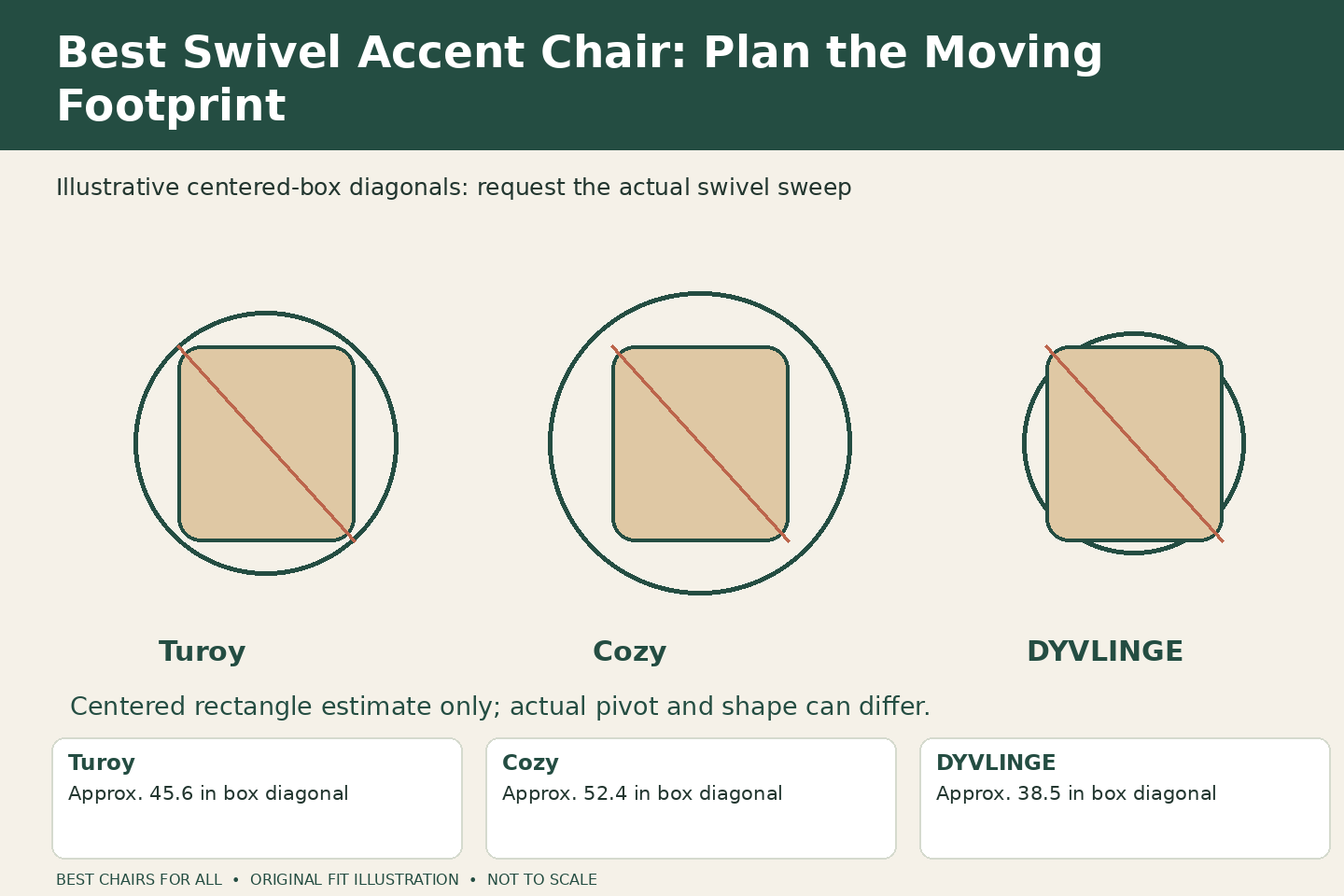
For a conservative screening illustration, imagine a rectangle rotating about its own center. The corner-to-corner distance is the square root of width squared plus depth squared. Turoy’s 32.5-by-32-inch rectangle has a diagonal of about 45.6 inches. Cozy’s 38.6-by-35.4-inch rectangle has a diagonal of about 52.4 inches. These are mathematical bounding estimates for centered rectangles, not manufacturer-required clearances or actual chair sweep diameters.
DYVLINGE’s 24.75-by-29.5-inch rectangle has a diagonal of about 38.5 inches under the same assumption. Its shaped upholstery may occupy less than the corners of a box, while its pivot or base could change the sweep. Use the estimate to flag a tight corner, then request a dimensional drawing or test the actual chair. Do not cut a layout to an estimated minimum.
A showroom test can be more direct. Sit normally, turn between the two intended views, and notice how much space your feet require. Check whether you must push against a fragile table or twist around an arm to initiate movement. These observations are personal fit information; our comparison does not claim a preferred or measured turning force for any model.
Low and deep versus higher and shallower
Turoy lists an 18.5-inch seat height and 22.5-inch seat depth. Cozy lists 16.5 and 24.8 inches respectively. DYVLINGE lists 16.875 and 18.5 inches. Those are three different sitting relationships. The broadest chair is also the deepest listed seat, while the smallest overall chair has the shallowest listed depth.
If you sit with both feet down while talking, compare the measurements with a chair you already find comfortable. If you prefer a curled-up position, investigate usable seat width and arm shape as well as depth. Cozy publishes a 29.5-inch seat width. Equivalent clear-width figures were not established for the other two selected models, so do not estimate them from the outside dimensions.
Overall back height is another distinction: Turoy is 28.5 inches, Cozy 28.7, and DYVLINGE 26.75. These are low visual profiles, not promises of head support. A person seeking contact high on the back should try the chair or consider a different style. Adding a pillow can change effective depth and comfort but does not turn a low back into a documented high-back design.
Base appearance can conceal a floor conflict
Turoy uses a discreet steel swivel base. Cozy also hides much of its movement under the upholstered form. DYVLINGE exposes a five-leg base, making the mechanism a visible part of the design. A hidden base may look quieter, but it is not evidence of a smaller moving footprint or better operation on every floor.
Check the rug edge in the actual position. A base partly on a rug and partly on hard flooring can create an uneven setup; follow the manufacturer’s placement instructions and establish a stable, level arrangement. Do not add improvised blocks, casters, or a second rotating platform to fix a layout problem. Ask the manufacturer about compatible floor protection instead.
Consider the cleaning route too. A tightly placed chair can make it hard to remove debris around the base or see a loose object beneath it. Keep cords and small items out of moving areas. These are reasons to leave workable access around a swivel, not an instruction to open or lubricate a mechanism without a manual.
What the published load figures do and do not say
Article lists Turoy as tested to 300 pounds. IKEA describes DYVLINGE’s strength testing as based on people up to 242 pounds. We did not establish a load figure on the reviewed Cozy page. These wordings are retained rather than converted into a uniform safety rating. Ask the manufacturer when body weight or a particular use is close to a deciding limit.
A load figure cannot tell you whether the clear seat width fits, whether you can get up comfortably, or how easy the rotation feels. A wide chair is not automatically rated for a higher load. Likewise, a swiveling lounge chair is not transfer-assistance equipment. If you need medical seating or help transferring, these ordinary furniture comparisons are insufficient for that selection.
Upholstery makes a second decision
Turoy’s Wicklow Gray fabric combines polyester, acrylic, and a small proportion of wool. Article permits gentle-detergent spot cleaning and recommends professional help for persistent stains. Cozy’s chosen bouclé and DYVLINGE’s Kelinge cover need their own instructions. Do not assume that similar-looking nubby or ribbed textures share a cleaning method.
DYVLINGE’s selected cover is nonremovable; its care directions include vacuuming and a damp cloth rather than washing. Cozy is offered in multiple upholstery families, so retain the Deluxe Boucle selection and obtain the exact label. A rotating chair may receive hand contact along the arms or back as people turn it; choose a care routine you can follow at those contact points.
Take photographs of the proposed two-view layout with an ordinary temporary chair in position. Include the room at its busiest, with the table and lamp where they normally remain. If the chair’s intended turn only works after moving those items, decide whether that rearrangement is realistic every day.
Choose Turoy when the higher seat and compact rounded form suit your fit. Choose Cozy when a broad, deep low seat is the objective and its larger moving area fits. Choose DYVLINGE when the small low form and exposed base are part of the appeal. Whichever you prefer, verify the sweep and the seated movement before treating the swivel as a solved room-layout problem.
Something unclear or out of date? Send a correction with this article’s title and the detail to check.
Sources, research & corrections policy ↗