As an Amazon Associate, we earn from qualifying purchases; see our affiliate disclosure.
For a larger beachgoer, the Shibumi Tall Chair is the first model to investigate here because its manufacturer lists a 400-pound capacity and a seventeen-inch seat. PARKIT’s Voyager is the stronger alternative when you want a published seat width and depth, provided its 350-pound capacity covers the intended use. Shibumi’s Classic Chair supplies a lower, lighter option with a 300-pound limit. The phrase big guys does not describe one body size, so capacity and physical clearance must be checked separately.
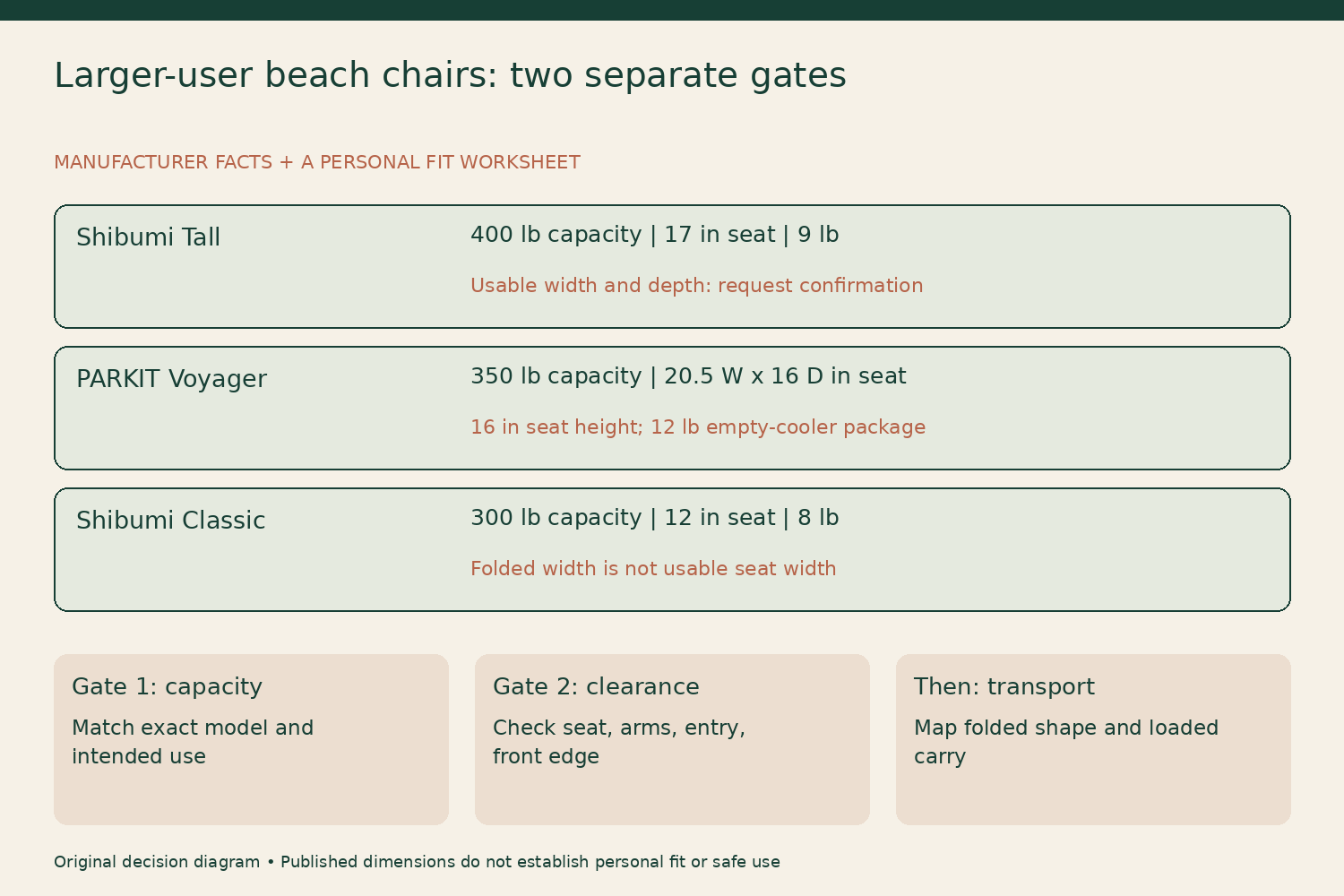
These selections come from current manufacturer pages reviewed in November 2026, not load testing or hands-on evaluation. We do not promise comfort, extra structural margin, or stability for any particular person. No model here is recommended for use above its published capacity. If the intended user is above 400 pounds, this shortlist has no documented match. Requesting a different documented product is more useful than assuming that an advertised rating is conservative or that extra reinforcement will make a smaller chair suitable.
Two separate gates before features matter
The first gate is the exact model’s published single-person limit. The second is the actual usable seating and entry space. Passing one does not pass the other. A frame can have a high weight rating and a seat that feels too narrow; a roomy-looking seat can have a low rating. Do not use photographs, broad brand claims, or the word heavy-duty to stand in for either piece of information. Record the rating source and the clearance source in different columns.
For capacity, match the exact name on the manufacturer page, retailer listing, packaging, and instructions. Shibumi’s Classic and Tall are a particularly clear example: the former is rated at 300 pounds and the latter at 400 pounds. The brand name alone cannot identify which number applies. Similarly, PARKIT’s overall frame width is not its seating width. A shopper should be able to trace each important figure to its own label, rather than combining the most favorable figures from several versions.
What the official pages actually establish
The Shibumi Tall Chair page lists a 400-pound capacity, a seventeen-inch seat height, nine pounds of chair weight, four reclining positions, and padded backpack straps. Its folded dimensions are 36.75 by 24.5 by 3.95 inches. The page does not provide an unambiguous usable seat width or seat depth in the retrieved specifications. Those are unresolved fitting questions rather than permission to call it extra-wide.
The PARKIT Voyager Midnight page lists a 350-pound capacity, a 20.5-inch seating width, a sixteen-inch seating depth, and a sixteen-inch seating height. Its overall width is 24.5 inches, demonstrating the difference between outer frame size and seating surface. The chair’s twelve-pound quoted weight includes an empty cooler. Its 21-inch backrest and backpack straps make it a distinct folding design; this guide does not infer adjustable reclining positions from its lounging angle.
The Shibumi Classic Chair page lists a 300-pound capacity, a twelve-inch seat, an eight-pound chair, and four positions. Its folded size is 30.7 by 24.8 by 3.75 inches. That folded width is not proof of a 24.8-inch seating area. It belongs in the packing comparison, while the missing usable width belongs in a question to Shibumi before purchase.
1. Shibumi Tall Chair
Best for: Highest capacity in this shortlist.
Begin here when the higher documented limit is a necessary screening requirement.
The Tall model has four positions and backpack straps, but its product page does not resolve usable seating width and depth.
Product Details
| Brand | Shibumi |
|---|---|
| Capacity | 400 lb |
| Seat height | 17 in |
| Chair weight | 9 lb |
Pros
- 400-pound model-specific rating.
Cons
- Seat clearance requires a manufacturer inquiry or trial.
Treat it as the leading inquiry, not a guaranteed extra-wide fit.
2. PARKIT Voyager Midnight Chair
Best for: Most complete seat dimensions here.
A useful option when knowing the actual published seat surface is more important than maximizing the rating.
The 24.5-inch overall width includes frame space outside its 20.5-inch seating width.
Product Details
| Brand | PARKIT |
|---|---|
| Capacity | 350 lb |
| Seat | 20.5 W x 16 D x 16 H in |
| Package weight | 12 lb with empty cooler |
Pros
- Documented width and depth.
Cons
- A lower capacity than Shibumi Tall and heavier listed package.
Confirm the exact frame revision and current color stock.
3. Shibumi Classic Chair
Best for: Lower-seat alternative.
Consider only if the lower beach posture is desirable and the 300-pound limit covers the intended use.
Its four positions and thinner folded package appeal to a different seating preference from the Tall model.
Product Details
| Brand | Shibumi |
|---|---|
| Capacity | 300 lb |
| Seat height | 12 in |
| Chair weight | 8 lb |
Pros
- Lightest listed chair in this group.
Cons
- The Tall model rating does not apply to Classic.
Obtain usable seat dimensions before assuming a roomy fit.
Make a capacity-and-clearance card
Use a card with six fields: exact model, published limit, user requirement, usable width, usable depth, and unresolved questions. Fill the first three from reliable information rather than guessing. Fill the width and depth only when the measurement definition is known. A blank field is valuable: it shows what could still block the purchase. Do not hide missing dimensions with a general claim that a chair fits larger people because of its rating.
For PARKIT, write 350 pounds, 20.5 inches of seating width, and sixteen inches of seating depth. For Shibumi Tall, write 400 pounds and ask for both usable seating measurements. For Classic, write 300 pounds and ask the same questions. This produces three honest records, not three equally complete records. It also makes clear why the tallest capacity is a useful screening advantage without automatically becoming the best physical fit.
A hypothetical buyer who needs a documented limit above 350 pounds would eliminate both PARKIT and Classic from this shortlist before comparing cupholders or colors. A different buyer below 300 pounds might still reject all three on width or depth after obtaining measurements. These are examples of the decision sequence, not claims that a particular weight predicts a particular body shape. Avoid assigning a universal clearance allowance or a made-up safety multiplier that the manufacturer has not specified.
Measure the person and the reference seat respectfully
The most useful reference may be a chair the intended user already finds comfortable. Measure its clear seated width, the narrowest arm opening, and its usable depth; note whether its seat is firm or a sling. Use those dimensions to explain the user’s preferences to the manufacturer. This does not establish an engineering requirement or guarantee that a similarly sized beach seat feels the same. It makes the inquiry specific enough to obtain a meaningful response.
If direct personal measurements are helpful, let the user choose how to record them privately and comfortably. Beach clothing, pockets, and a cover-up can change clearance. A seller’s outer frame width does not establish hip space between arms, and an unloaded fabric width may not describe the occupied shape. Ask where the narrowest point lies and whether crossbars or hardware project into the sitting area. These details can matter more than a single width printed without a diagram.
Depth also changes the experience. PARKIT’s sixteen-inch seated depth is a documented starting point, not a promise of full thigh support for every larger user. The Shibumi pages leave that dimension unresolved. Request the usable seated depth in the intended back position, and ask whether the front edge or sling shape changes across adjustments. A larger capacity cannot tell you where the front edge falls on a person’s legs.
Choose seat height as an independent preference
Shibumi Tall’s seventeen-inch height, PARKIT’s sixteen inches, and Classic’s twelve inches create substantially different seating arrangements. Someone who enjoys a low beach posture may prefer the Classic if its capacity and clearances fit. Someone who wants to avoid a deep descent may investigate Tall first. Neither preference follows automatically from body weight. Try the actual chair according to its instructions rather than deciding that bigger must mean higher.
During a permitted trial, notice the normal entry path, where the arms sit, and whether the front of the seat restricts a comfortable position. Avoid bouncing or dropping into the frame as a form of testing. Do not use a chair with damaged joints or uncertain model identity. A static published rating is not a license to apply impact loads, stand on the seat, or use it as a two-person bench. The current manual determines the permitted use.
Carrying a wider frame is a separate task
The eight-pound Classic, nine-pound Tall, and twelve-pound Voyager package should not be compared without naming what each figure includes. PARKIT’s cooler is empty in its quoted twelve pounds. Loading it adds mass; removing it may change the configuration, but do not invent a reduced chair-only weight without a manufacturer figure or an actual measurement of your own unit. Compare the load you intend to take to the beach.
The Tall’s folded length of 36.75 inches may be more awkward in a small trunk than Classic’s 30.7-inch length, despite only one pound of listed chair difference. Use the actual trunk opening and planned storage location for a packing check. PARKIT’s published open size cannot fill an absent folded-size field. Ask for its current folded dimensions if car fit is tight, and include handles and cooler clearance rather than measuring only the seating panel.
Backpack straps can make carrying more convenient for some people, but strap adjustment range and frame contact still need a trial. Do not infer wearer suitability from seating capacity: the rating concerns the opened chair, not what an individual should lift or carry. Assign a companion or a suitable permitted transport method when needed. A carry plan should account for the full day, including a loaded cooler and other beach gear on the return walk.
Avoid three misleading shortcuts
First, do not rank models by the largest number anywhere on the page. Capacity, overall width, folded width, and seat height measure different things. Second, do not assume an unusually broad seat surface is comfortable without checking the narrower entry or arm opening. Third, do not turn manufacturer marketing about rust resistance or beach readiness into a claim that a chair requires no inspection or that every sandy slope is suitable. Use the current setup and care instructions.
If a retailer conflicts with the manufacturer, ask for the exact revision and written clarification. A screen capture of a 400-pound Tall listing cannot validate a 300-pound Classic delivered under a mixed listing. Check the product identity when the package arrives and before the first outing. Keep the normal folding, locks, fabric attachments, and feet in the condition the instructions require; do not modify the frame to gain width or reinforce a rating.
The most useful choice depends on the unresolved dimension
Choose Shibumi Tall as the first inquiry when its higher capacity is necessary, then resolve usable width and depth before committing. Choose PARKIT when a 350-pound limit is sufficient and its documented 20.5-by-sixteen-inch seating surface suits the user’s preferences, with the heavier cooler package accepted. Choose Classic when the lower twelve-inch position is wanted and its 300-pound limit and confirmed clearances fit. If any crucial field remains unanswered, keep the purchase conditional.
The matching retailer searches below help locate the named models but can include unrelated accessories or versions. Confirm current stock, returns, and the manufacturer specifications for the listing you select. A good purchase record ends with three clear statements: the exact rating covers the intended use, the actual seating geometry works for the person, and the complete folded package fits the trip. That record is more dependable than a generic label aimed at big guys.
Something unclear or out of date? Send a correction with this article’s title and the detail to check.
Sources, research & corrections policy ↗