As an Amazon Associate, we earn from qualifying purchases. Read our affiliate disclosure. Amazon links below are model-name searches; verify the seller, exact variant, and specifications before ordering.
The best armchair for reading is the one that supports your ordinary reading position while leaving the page, light, and side table easy to use. Start with IKEA’s UPPLAND if you want a broad upholstered chair and removable cover. Consider POÄNG with the specified Grann cushion for a narrower bentwood arrangement. Investigate Pottery Barn’s Champlain when a shallower seat and taller back are closer to your preferred fit.
This shortlist is based on manufacturer dimensions and construction, checked on November 6, 2026. We have not tested these chairs or measured reading comfort over time. The recommendations are conditional on your fit and room plan, with no claims about treating back or neck symptoms. Obtain the current delivered quote for the exact covering; no fixed budget or local-stock promise is made here.
Bring the reading task into the comparison
A novel, large hardback, tablet, and e-reader create different holding positions. Bring the item you actually use to a permitted showroom trial. Notice where your forearms rest, whether the book remains readable without leaning forward, and where your feet sit when your back is supported. A chair that feels comfortable for a minute with empty hands may behave differently when you hold a heavy book.
| Reading candidate | Overall W × D × H | Seat height / depth | Reason to investigate |
|---|---|---|---|
| IKEA UPPLAND, Blekinge white | 43 1/4 × 36 1/4 × 36 1/4 in, including back cushions | 18 1/2 / 22 7/8 in | Broad upholstered chair, removable cover |
| IKEA POÄNG, black/Grann black | 26 3/4 × 32 1/4 × 39 3/8 in | 16 1/2 / 19 5/8 in | Narrower frame, high back, resilient bentwood construction |
| Pottery Barn Champlain | 31 × 37 × 44 in | 19 / 18 in | Shallower sitting area with rolled arms |
These measurements describe different sitting arrangements rather than a simple quality ladder. A deeper chair can suit sideways lounging while making upright reading harder for someone with shorter legs. A high overall back may not meet your head in the right place. We did not find equivalent stated user-load limits across the reviewed pages; ask the manufacturer if a particular rating is a requirement, and do not invent one from the chair’s size.
IKEA UPPLAND: space to settle with a removable-cover routine
The UPPLAND Blekinge white page lists a 43 1/4-inch width, 22 7/8-inch seat depth, and 18 1/2-inch seat height. The selected configuration includes a removable cover with separate care instructions. It is the candidate here for someone who wants a substantial upholstered chair and a cover that can be maintained according to its wash label. Its broad appearance also works when the reading corner is intended to feel like a small room within the room.
The principal limitation is the space and depth. The outside width does not equal the usable cushion width, and the listed depth may encourage a laid-back position rather than upright page holding. Try your book before concluding that generous means comfortable for you. If you habitually slide forward in deep seats, identify that problem explicitly instead of assuming the soft back cushion will resolve it.
Blekinge white is a specific covering, not a universal recommendation that pale upholstery stays clean. Check the chosen cover’s material, washing instructions, drying space, and replacement availability. The washable outer layer does not make the cushion foam or frame washable. If another UPPLAND color is selected, preserve its own care label rather than applying the white cover’s instructions by memory.
Check matching IKEA UPPLAND armchair Blekinge white listings on Amazon (paid link)
IKEA POÄNG in Grann: a narrower frame for a smaller nook
The POÄNG black/Grann black specification gives a 26 3/4-inch overall width and a 19 5/8-inch seat depth. It uses a layer-glued wood frame and the selected treated top-grain leather cushion. Consider it when a broad upholstered chair crowds the nook and you prefer the exposed-frame style. Its 16 1/2-inch seat height is the lowest here, so compare it with a chair you already use comfortably.
The reading-specific tradeoff is the arm surface. Exposed bentwood arms do not feel or function like wide padded rolled arms. With your ordinary book, check whether you rest the forearms comfortably or end up holding the page higher without support. The resilient frame may also feel different as you turn pages or reach for a table. Specifications cannot establish your preference for that movement.
An ottoman can be considered separately if the complete arrangement works, but it increases floor use and changes leg support. Do not assume the ottoman is included because a photograph shows one. Verify the exact cushion and frame combination on the order; POÄNG is available with different coverings, and a fabric listing is not the same Grann configuration assessed here.
Check matching IKEA POANG Grann leather armchair listings on Amazon (paid link)
Pottery Barn Champlain: a shallower seat to test for upright reading
The Champlain specifications list an 18-inch inside seat depth, 19-inch seat height, and 21-inch inside width. Its tight back and rolled arms create a different candidate from the deeper UPPLAND. Investigate it if a shallower supported sitting area is close to your reference chair and you want a tall traditional outline. It is a dimension-based recommendation to test, not a guarantee of posture or comfort.
The higher seat can be a mismatch when your feet do not have a stable resting surface. Check that relationship while holding the book rather than perching forward to reach the floor. A tall winged back can also affect the placement of a reading lamp or the view toward someone else in the room. The chair’s dramatic profile should support the reading corner’s function instead of making every reach more complicated.
The leather finish requires its own care, and the page cautions against common treatment products. Read the selected covering’s care card before buying a cleaner or assuming all leather behaves alike. Confirm cushion options, delivery, and custom-order terms in the quote. A different finish may be attractive but should not silently change the product and purchase conditions you evaluated.
Check matching Pottery Barn Champlain reading armchair listings on Amazon (paid link)
Run an ordinary-page trial
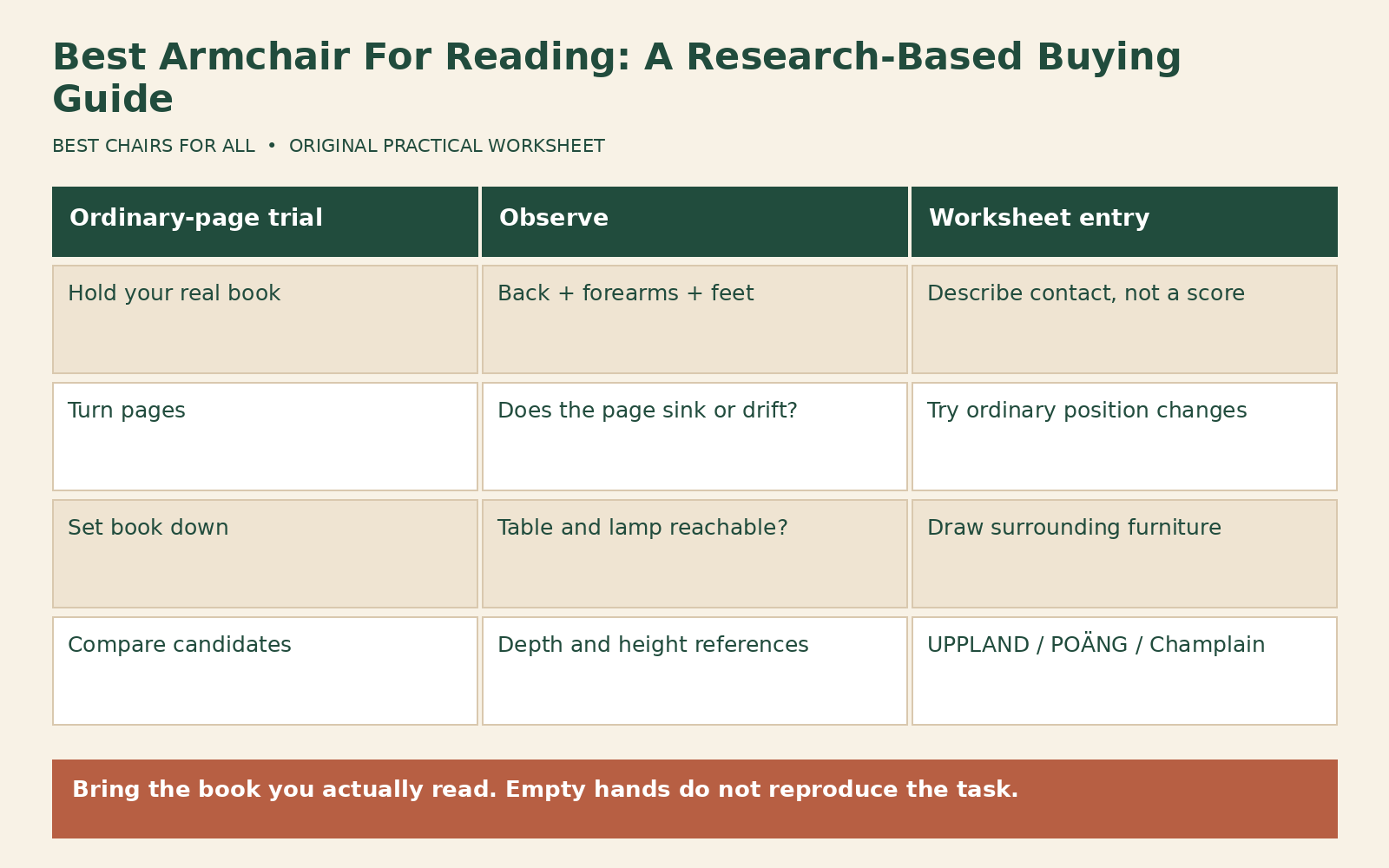
Use a familiar passage and your usual reading item. Begin with feet supported and your back against the intended surface. Read normally, turn several pages, and notice whether the book steadily sinks into your lap or whether your shoulders rise to keep it visible. Do not hold an artificially perfect pose for the test. Stop if the position is uncomfortable; the goal is to observe normal use, not endurance.
Next set the book down on the proposed table, pick it up, and reach the lamp control. Keep those actions ordinary and unhurried. If the table is only reachable by leaning far around an arm, move the table in the plan before blaming the chair. If no practical table location remains, that chair may be too large or incorrectly oriented for the nook. The reading setup includes the surrounding furniture.
Finally compare a second position you genuinely use, such as slightly reclined against the back or sitting sideways where the chair is designed to accommodate it. Do not assume every chair supports every lounging posture. Record whether the arms, cushion edges, or back shape obstruct that change. A reading chair should allow the ordinary position changes you need, rather than requiring one fixed pose to remain tolerable.
Make a book-and-chair fit worksheet
Create columns for chair, book type, back contact, forearm contact, feet, page view, and table reach. In each cell, use a brief observation: “back supported,” “arms too far apart,” “page readable without leaning,” or “table blocked by arm.” Avoid a single comfort score that conceals why a chair works or fails. Keep material preference in a separate column so an attractive fabric cannot erase an unresolved fit issue.
For a hypothetical depth comparison, your comfortable reference seat is 20 inches deep. UPPLAND’s listed 22 7/8 inches is 2 7/8 inches deeper, POÄNG’s 19 5/8 is 3/8 inch shorter, and Champlain’s 18 is two inches shorter. Those differences identify what to test. They do not predict comfort because back angle, cushion compression, and measurement location also affect the usable position.
Add a simple room calculation. If your furniture zone is 48 inches wide, a 43 1/4-inch UPPLAND leaves 4 3/4 inches within that rectangle before a table or access route is added. The 26 3/4-inch POÄNG leaves 21 1/4 inches. That remainder is not automatically a suitable passage. Draw the table, lamp base, and door swing independently, keeping required routes subject to applicable requirements.
Fit the light to the page you use
Position a lamp so the page is readable from the supported chair position without placing the bulb in your direct view. Check glare on a tablet separately from light on paper. A room that is pleasant for conversation may leave a printed page poorly lit. Move the light through its intended adjustments and test at the time of day when you usually read, if possible.
Keep lamp and charging cords away from the route into the chair and from any foot support. A long lead stretched across the floor is not a finished solution. Choose a stable table for drinks and glasses rather than balancing them on the chair arm. If reading is shared with a partner or household member, check each person’s view and access instead of arranging every item around one seated height.
Make maintenance and purchase details practical
Think about the actual reading habit: tea beside the chair, pets joining the nook, denim contact, or bright window light. Those habits help choose a covering and placement, but they do not justify claims that a material is pet-proof or stain-proof. Follow the exact care page and request swatches where available. A removable cover can simplify one task while requiring space and time for laundering.
Price the complete reading corner, including any separate ottoman, table, lamp, delivery, and assembly. Confirm the model and covering on the invoice, and read return conditions for custom finishes. Keep a copy of the dimension page and trial worksheet. A well-chosen chair can still be inconvenient if the supporting items were omitted from the plan.
Choose UPPLAND for the broad upholstered arrangement, POÄNG for the narrower exposed-frame setup, or Champlain for a shallower seat only after the ordinary-page trial supports it. The best result is a reading corner where you can settle, see the page, set the book down, and change position comfortably. A product name or plush photograph cannot establish that combination by itself.
Something unclear or out of date? Send a correction with this article’s title and the detail to check.
Sources, research & corrections policy ↗