As an Amazon Associate, we earn from qualifying purchases. Read our affiliate disclosure. Amazon buttons search for matching listings; they do not confirm the exact model, seller, price, or stock.
The best modern accent chair depends on what your room needs the chair to do visually. An open wooden frame can break up a large upholstered sofa. A low swivel chair can connect two conversation areas. A deep lounge seat can make an otherwise formal arrangement feel more relaxed. Calling all three “modern” does little to help until those differences become measurable.
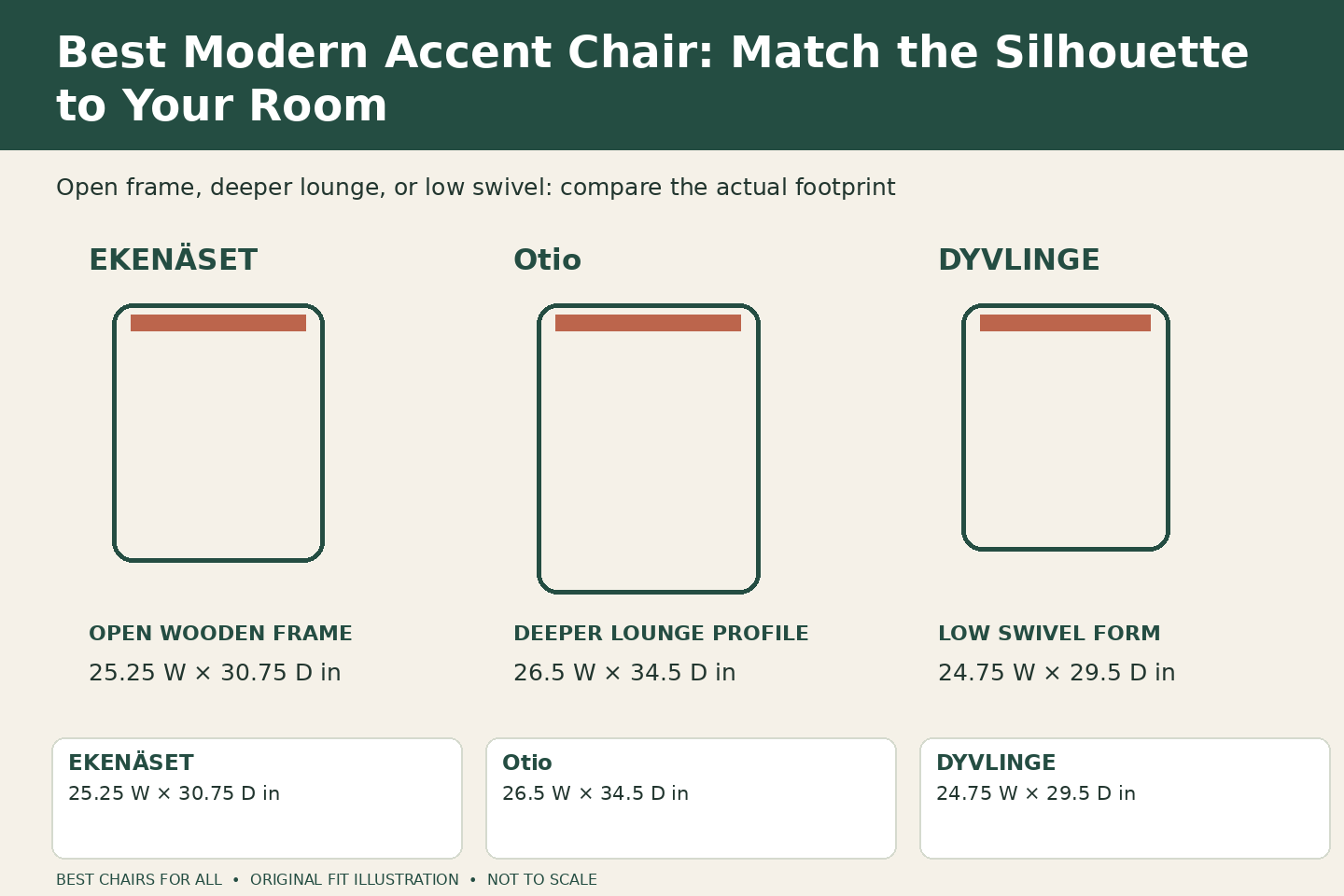
Our shortlist is IKEA EKENÄSET in Kilanda light beige for an exposed frame with compact width, Article Otio in Walnut and Welsh Taupe for a deeper wooden lounge profile, and IKEA DYVLINGE in Kelinge green for a low sculptural swivel. These are recommendations from published US specifications, not chairs we have physically tested. None is universally comfortable, and a photograph cannot establish whether your feet reach the floor or your shoulders find the back.
Start with the view from your doorway
Stand where you normally enter the room and identify the largest uninterrupted shape. It may be the sofa back, a dark entertainment unit, or a bank of cabinets. Place a folded sheet roughly where the new chair would stand. If another upholstered block makes the arrangement look congested, consider an open frame. The empty space below and between rails contributes to its appearance even though that space is not available for walking.
EKENÄSET and Otio both expose wood around an upholstered seat. Their outlines are related, but their proportions are different. The former is 25.25 inches wide and 30.75 inches deep. The latter is 26.5 inches wide and 34.5 inches deep. Otio asks for only 1.25 additional inches across the room while using 3.75 more inches toward its center. A narrow corner can still be too shallow for it.
DYVLINGE measures 24.75 inches wide, 29.5 deep, and 26.75 high. Its low rounded body and visible star base create a different relationship to a rectangular sofa. Choose it because you want that low, turning form. Do not assume a smaller published rectangle means it can rotate next to a wall without a clearance check.
The three researched options
Verify the exact variants in the manufacturer references: IKEA EKENÄSET armchair, Kilanda light beige; Article Otio 26 lounge chair, Walnut and Welsh Taupe; IKEA DYVLINGE swivel chair, Kelinge green. Specifications were checked November 6, 2026.
1. IKEA EKENÄSET armchair, Kilanda light beige
Best for: Exposed frame for compact layouts.
EKENÄSET makes sense beside a substantial sofa when you want visible wood and open space around the seat. Its 25.25-inch overall width and 22-inch published seat width distinguish usable seating from the frame around it.
The angled fixed back and stationary upholstery suit a deliberately placed occasional seat. The 30.75-inch depth needs a full floor outline; it is not a shallow dining chair. The selected light-beige variant was marked for clearance, so local supply deserves checking.
Product Details
| Brand | IKEA |
|---|---|
| Overall dimensions | 25 1/4 W × 30 3/4 D × 29 7/8 H in |
| Seat height | 17 3/4 in |
| Manufacturer load wording | Tests based on use by people up to 242 lb |
| Materials | Solid wood frame; lacquered beech arms; polyester upholstery |
Pros
- Open wooden arms reduce visual bulk
- Published seat width and depth aid comparison
Cons
- Cover is not removable for washing
- Fixed position offers no swivel or recline
Choose it for its frame and proportions after checking the actual sitting angle.
2. Article Otio 26 lounge chair, Walnut and Welsh Taupe
Best for: Deeper walnut lounge profile.
Otio pairs a 33-inch overall height with a 20.5-inch-deep seat and an exposed black-walnut frame. It is our option when a modern accent chair should feel like a dedicated lounge destination rather than a spare upright seat.
At 34.5 inches deep it projects farther into a room than its 26.5-inch width suggests. Article lists an 18.5-inch seat height, 22-inch arms, and a 300-pound tested figure. Its fabric blend should be cleaned according to the Welsh Taupe instructions.
Product Details
| Brand | Article |
|---|---|
| Overall dimensions | 26.5 W × 34.5 D × 33 H in |
| Seat height | 18.5 in |
| Manufacturer load wording | 300 lb tested |
| Materials | Solid black walnut; foam; polyester/viscose/linen/cotton blend |
Pros
- Distinctive exposed solid-walnut frame
- Useful published seat and arm measurements
Cons
- Deep footprint for a narrow-looking chair
- Lower arms may not suit every task
Prefer it when you can allocate depth as generously as width.
3. IKEA DYVLINGE swivel chair, Kelinge green
Best for: Low sculptural swivel.
DYVLINGE offers a rounded green seat over a five-leg star base. Its 26.75-inch overall height makes it an option when a chair should stay below the main sightline across a room.
The selected US version lists a 16.875-inch seat height and 18.5-inch seat depth. Check the base and the moving chair in your layout. IKEA describes strength tests based on people up to 242 pounds; that wording is not presented here as a transfer-assistance rating.
Product Details
| Brand | IKEA |
|---|---|
| Overall dimensions | 24 3/4 W × 29 1/2 D × 26 3/4 H in |
| Seat height | 16 7/8 in |
| Manufacturer load wording | Tests based on use by people up to 242 lb |
| Materials | Steel frame and five-leg base; foam; polypropylene cover |
Pros
- Swivel function suits two conversation directions
- Compact published width and depth
Cons
- Low seat requires a personal fit check
- No verified rotation angle quoted here
Choose the movement and silhouette together, leaving room for both.
A silhouette worksheet for a real living room
Draw your sofa and the proposed chair as simple boxes on paper. Write three numbers beside each: overall height, depth, and seat height. Then circle the characteristic that you want the chair to contribute: an exposed frame, a relaxed long profile, or a rounded turning seat. This prevents buying another copy of the sofa’s shape by accident.
Consider a hypothetical 32-inch-deep recess beside a sofa. EKENÄSET’s 30.75-inch published depth leaves 1.25 inches within that recess before any wall gap, molding, or positioning tolerance. Otio’s 34.5-inch depth exceeds it by 2.5 inches. DYVLINGE’s 29.5-inch depth leaves 2.5 inches inside the same rectangle, but the swivel path remains a separate question. These are footprint calculations, not permission to squeeze furniture against a wall.
Now imagine the recess is 37 inches deep. Both wooden chairs fit the nominal depth, so their seat characteristics become more relevant. EKENÄSET lists a 19.625-inch seat depth and 17.75-inch seat height. Otio lists 20.5 and 18.5 inches respectively. That difference is small on a ruler yet may affect where a particular person contacts the back. Compare those figures with a chair you already use comfortably instead of assigning them to a height category.
Keep the measured opening, the proposed gap behind the chair, and your preferred front position as separate entries. If the arithmetic leaves no room for any gap, the layout needs revisiting. A drawing that works only with the chair pushed to an exact line is especially vulnerable to baseboards, uneven walls, and a slightly angled placement.
Match wood by role rather than a misleading name
A walnut-colored table does not guarantee a match to a chair described as walnut. Otio specifies solid black walnut, while EKENÄSET uses a different wood construction and dark tinted finish. Natural grain, the direction of daylight, and the amount of finish visible can make two supposedly coordinated pieces look unrelated. Inspect the selected finish rather than relying on a search thumbnail.
Decide whether the chair should repeat an existing finish or deliberately introduce another one. Repetition works best when the room already has a clear wood family and the new piece is sufficiently similar in tone. A deliberate second wood can work when it appears more than once, perhaps in a lamp base or small table. These are design choices, not evidence of better construction.
Avoid buying a chair merely because the legs match a sofa photograph. In a small room the arm rail may be much more visible than the legs. In a room viewed from behind, the back construction can matter more than either. Ask for a rear view and a close-up of the actual finish if the maker’s page does not make those clear.
Low backs, sightlines, and actual support
A lower chair can preserve a view across a room. That benefit has a physical tradeoff: it may give less contact near the upper back than a taller design. Overall height alone does not locate the top of the back relative to a seated person, because seat height, cushion compression, and recline all intervene. Try the actual configuration when upper-back contact is important.
DYVLINGE’s 16.875-inch seat is lower than either wooden option. Its 18.5-inch published seat depth is shallower than Otio’s, but its curved form should still be tried rather than treated as an upright dining seat. IKEA’s US page confirms a swivel function; we do not infer a specific rotation angle from other markets or retailer descriptions. Its five-leg base also deserves a tape outline because feet can project beyond what the upholstered body suggests visually.
EKENÄSET offers exposed armrests at 24.75 inches above the floor. Otio lists 22-inch arms. To compare them, subtract seat height: the nominal difference above the seat is seven inches for EKENÄSET and 3.5 for Otio. Those calculations help identify different arm relationships; they do not prove which suits your elbows, because arm length and the slope of the chair matter too.
Upholstery changes the maintenance commitment
A modern appearance does not make a fabric washable. EKENÄSET’s Kilanda cover is stationary. IKEA instructs vacuuming and wiping with a damp cloth for the frame and nonremovable cover. Otio’s Welsh Taupe fabric combines polyester, viscose, linen, and cotton; Article’s instructions include blotting spills, air drying, and avoiding chemical cleaners. DYVLINGE’s selected US Kelinge cover is also nonremovable. Follow its own label rather than treating its ribbed appearance as proof of a particular fiber or cleaning method.
If an open frame appeals because it seems easier to maintain, consider the exposed rails too. They add surfaces that can collect dust and receive contact from rings or vacuum tools. Conversely, a fully upholstered chair has more fabric to inspect after spills. Neither form eliminates maintenance; each moves it to different places.
Use swatches near both the window and the evening lamp. A muted beige in a showroom may look yellow beside a cool sofa. A green seat can become the strongest element in the room after sunset. The question is whether you still like that relationship across your actual day, not whether the isolated swatch looks fashionable.
Decide what happens when people visit
A chair used mainly for conversation should face another seat without forcing its occupant to twist. A turning base can help reconnect to a second part of the room, but it needs space for the person’s knees as well as the chair. A fixed wooden chair may be easier to position deliberately at an angle and leave there. Avoid assuming every visitor will move a chair to make your layout work.
Test the approach with a dining chair or cardboard stand-in before ordering. Walk from the doorway to the sofa, place a drink on the proposed side table, and sit facing the television and another person in turn. Keep the everyday arrangement in the test: an open cabinet door or a floor lamp can expose a conflict that disappears in an empty floor plan.
For this shortlist, choose EKENÄSET when the priority is a relatively narrow exposed-frame chair with a shallower overall profile than Otio. Choose Otio when the deeper lounge footprint and walnut frame are welcome. Choose DYVLINGE when the low rounded form and swivel function are central to the room. If none meets both the layout and the seated fit, change the silhouette you are shopping for instead of hoping a different upholstery color will solve the geometry.
Something unclear or out of date? Send a correction with this article’s title and the detail to check.
Sources, research & corrections policy ↗