As an Amazon Associate, we earn from qualifying purchases. Read our affiliate disclosure. Retailer links below search for matching listings; verify the exact model and seller before ordering.
For back support on bleachers, I would compare the regular Cascade Mountain Tech Ultralight for a defined padded frame, the GCI BleacherBack for adjustable backrest behavior, and the TravelChair 1669 for a different steel-frame support shape. The best chair is the one that lets you use the backrest normally while its attachment and the bench remain within the manufacturer’s instructions. A thick cushion or a tall back alone does not establish that fit.
These are research-based choices checked on November 6, 2026. We did not test posture, pressure, durability, or pain outcomes. Back support here means an intact recreational backrest that you can comfortably contact in the supported setup. It is not a medical treatment claim, and all three listed capacities are 250 pounds.
Compare documented features before comfort language
We used the Cascade regular Ultralight specifications, GCI’s current BleacherBack page, and TravelChair’s 1669 information. The Cascade stadium-seat FAQ is also useful for separating named products’ fixed-angle behavior from a general assumption that folding means reclining.
Use exact model information when contacting a seller. Similar-looking memory-foam, extra-wide, and steel versions can differ from the regular aluminum model. We do not treat a search listing’s comfort score, reviews, or family name as proof that the dimensions and attachment match the named seat below.
Three backrest designs to evaluate
1. Cascade Mountain Tech Ultralight Stadium Seat Regular Width
Best for: a defined padded backrest and hook system on a compatible bench.
I would start with the regular Cascade seat when the main requirement is a documented padded backrest in a rigid folding frame, and the underside hook matches the bench. The manufacturer identifies a 15-inch backrest and a 17-by-14-inch seating outline. Those figures make the support geometry easier to discuss than a product described only as extra comfortable.
The maker’s stadium-seat information distinguishes fixed-angle products from adjustable designs, so confirm the exact current model’s recline behavior rather than assuming every backrest reclines. If you need a different torso angle, no amount of additional padding creates an intended adjustment. Its 5.3-pound weight is also a real part of the purchase, especially when climbing stairs or carrying a second seat.
Product Details
| Brand | Cascade Mountain Tech |
|---|---|
| Model | Ultralight Stadium Seat for Bleachers, regular width |
| Listed dimensions W × D × H | 17 × 14 × 15 inches |
| Listed weight / capacity | 5.3 lb / 250 lb |
| Frame / cushion | Aluminum / canvas |
| Bench attachment | Underside bleacher hook |
| Carry method | Shoulder strap and cushioned handle |
Additional Product Information
| Size boundary | Not the 20-inch Extra-Wide version |
|---|
Pros
- Specific backrest and seat dimensions from the manufacturer.
- Hook attachment gives a clear compatibility question to resolve.
Cons
- Do not assume adjustable recline from the presence of a folding joint.
- Heavier listed carry load than the two buckle-seat alternatives.
Choose when its supported angle, back contact, and hook engagement work on the actual bench. Pass if you must lean outside the intended setup to reach the backrest.
2. GCI Outdoor BleacherBack Stadium Seat
Best for: a buyer who needs an adjustable backrest in a lighter package.
The BleacherBack is the alternative I would compare when backrest adjustment is important and the venue permits the chair’s pocket and strap arrangement. Its current listing identifies an adjustable backrest rather than merely a folding back. That makes it relevant for a seated-fit comparison where one fixed angle did not suit the user.
The bench and the attachment remain part of the support system. Confirm that the single-buckle security strap can follow the required route and that the bench offers the intended supporting surface. Its stated chair height is not a published measurement of lumbar support location. An older unit also needs the specific PO-number recall check described below before it can enter the fit trial.
Product Details
| Brand | GCI Outdoor |
|---|---|
| Model | BleacherBack; current product listing |
| Open dimensions W × D × H | 16 × 12.3 × 16.7 inches |
| Folded dimensions W × D × H | 16 × 16.7 × 3.5 inches |
| Listed weight / capacity | 2.9 lb / 250 lb |
| Bench attachment | Single-buckle security strap |
| Carry method | Shoulder strap; flat fold |
Additional Product Information
| Backrest | Adjustable |
|---|
Pros
- Manufacturer identifies adjustable backrest behavior and a securing strap.
- Lower listed weight can help a buyer who carries the backrest between events.
Cons
- Adjustment does not guarantee a particular medical or comfort outcome.
- Current dimensions cannot establish the history of an older used unit.
Choose if the actual backrest adjustment and bench fit work for you. Keep a medical-support requirement separate from a general recreational-chair recommendation and obtain appropriate guidance where needed.
3. TravelChair Stadium Seat Model 1669
Best for: a steel-frame padded-back alternative after exact fit confirmation.
The 1669 rounds out the back-support shortlist with a steel frame, padded back, and the manufacturer’s described S-bend frame shape. I would consider it for someone who has not found the other two support shapes suitable and wants another documented bench-seat design to try. The frame description is a design fact, not evidence that it corrects posture.
Its listed 1.5-inch seat height is an addition above the supporting bench, not a complete floor-to-seat height. Include the bench itself when evaluating foot support. Confirm the open dimension axes and buckle routing from the current instructions, and check an actual matching offer because the manufacturer page showed out of stock at research. A frame shape that looks promising is insufficient if the attachment or capacity fails.
Product Details
| Brand | TravelChair |
|---|---|
| Model | 1669 Stadium Seat |
| Maker open dimensions | 12 × 17 × 19 inches; confirm axis order |
| Maker closed dimensions | 5 × 17 × 18 inches; confirm axis order |
| Listed weight / capacity | 3.2 lb / 250 lb |
| Listed seat height | 1.5 inches above supporting surface |
| Frame | Powder-coated steel |
Additional Product Information
| Bench attachment | Oversized securing buckles; follow current instructions |
|---|
Pros
- Manufacturer gives a specific model, 250-pound capacity, and padded-back construction.
- Listed seat rise provides a useful question for the complete bench-height check.
Cons
- Exact fit still requires clarified dimensional orientation and current instructions.
- Manufacturer stock was absent; current retailer availability is not verified here.
Buy only after a permitted fit trial or adequate measurements resolve the support and attachment questions. Do not infer clinical lumbar support from the S-bend marketing description.
Start with the complete bench height
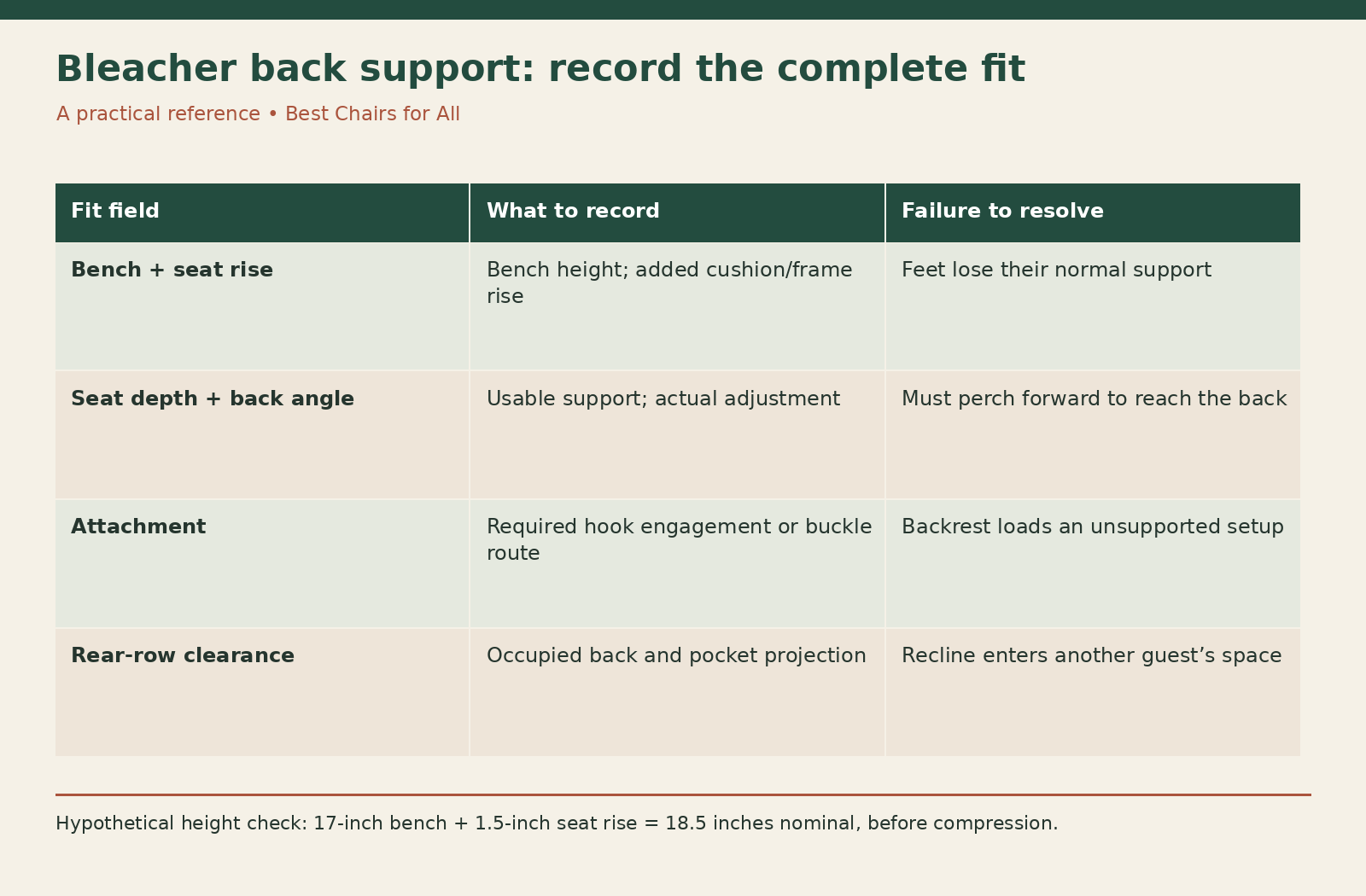
A stadium seat rests on an existing bench. Add the seat’s documented rise to the bench height when considering your occupied position, while allowing for how the cushion is actually measured and compressed. Do not substitute a product’s overall backrest height for the distance your feet must reach.
For a hypothetical bench 17 inches above its foot-support surface and a seat adding 1.5 inches, the unloaded nominal sitting level is 18.5 inches. That simple sum does not predict compressed height or establish that the user’s feet will be supported. It tells you why bench height and seat rise belong together on the worksheet.
If the new position leaves you perched forward or unable to contact the backrest normally, a thicker pad may worsen the mismatch. Check an allowed lower-profile option or ask the venue about its seating arrangements. Avoid loose stacked pads and unsupported foot objects in a row or aisle.
Use a back-contact worksheet
Make five fields: bench and foot-support height; usable seat depth; backrest angle or adjustment; the point where your back contacts it; and the attachment’s normal behavior. Record the setting used and the clothing worn. The aim is to identify whether you can actually rest against the supported back without shifting the chair or crowding the row behind.
Check each dimension independently. A seat can have adequate width but too much depth for your legs. A backrest can be tall enough while meeting you at an unsuitable angle. An adjustable backrest can offer several positions while none works on a bench with limited rear clearance.
Try only within the product’s instructions, preferably on an appropriate low bench where a trial is practical. Do not use a high bleacher edge as a place to experiment with attachment strength. Stop if the seat slips, a buckle loosens, a hook does not engage fully, or a frame is damaged.
Confirm how the support reaches the bench
A backrest creates forces through the chair’s frame and intended attachment. Match the securing method to the actual bench profile rather than assuming that any strap or hook will do. Ask for limits on the underside clearance, edge shape, or strap route where the product page does not provide them.
The Cascade hook needs its intended engagement, while the GCI and TravelChair designs describe buckle-based securing arrangements. None of those descriptions gives permission to loop a carry strap around an unrelated rail or tie the chair to another seat. Use the supplied attachment components and instructions.
If the bench is enclosed underneath or the required route is blocked by a support member, get a manufacturer answer before purchase. A product that cannot be attached as intended fails the back-support comparison regardless of how good the padding feels. Do not lean harder to compensate for a poorly seated hook.
Check the venue and row behind you
Backrest chairs can be prohibited even when simple pads are allowed. The Michigan Stadium safety policy is one official example that excludes backrests and several attachment or storage features. Check the actual event’s current policy rather than transferring an admission decision from a different school or sport.
Where a seat is permitted, its occupied dimensions still need to respect the allocated space. Check whether the backrest projects into the row behind, whether adjustment changes that projection, and whether pockets or straps hang into foot space. Permission to bring a chair is separate from permission to recline it in every position.
If back support is connected to an accessibility need, contact the venue’s designated service before the event and follow its process. Do not assume a retail chair label establishes an accommodation or entry exception. Our buying comparison cannot grant permission that belongs to the event organizer.
Include the historical recall in an older-unit check
The official CPSC BleacherBack notice identifies particular older PO-number units and a backrest-failure hazard. Affected owners are told to stop use and obtain the specified repair. Check that notice for a used or long-stored seat before attempting a back-contact trial.
Keep the distinction precise: a historical notice about specified units is not a declaration that all currently listed BleacherBacks are recalled. Conversely, a current product page cannot clear an old unidentified seat. Ask GCI about an unreadable or missing tag rather than relying on age estimates or fabric condition.
Inspect any seat’s frame, stitching, attachment, and supplied hardware before each use according to its instructions. A cover can conceal deterioration without restoring support. Do not replace a damaged structural or attachment component with an unverified part from another brand.
Separate comfort, care, and carrying needs
A backrest that suits you in a short trial still needs a practical carry and care plan. The Cascade’s heavier listed weight may be acceptable for a nearby bench but inconvenient over stairs. The lighter GCI and TravelChair choices can be worth comparing when the route itself is a major constraint.
Ask how the material should be cleaned and fully dried. Food, sunscreen, damp clothing, and grit can affect the contact surface and hardware. Avoid whole-seat soaking or heat drying unless the exact instructions permit it. A water-resistant description is not a guarantee that the foam and frame can be stored wet.
Do not extend a successful recreational fit into a promise of symptom relief. If a persistent physical concern determines the purchase, obtain appropriate advice and evaluate the complete seating arrangement. A chair specification provides dimensions and features, not an individual clinical assessment.
Pick the design that passes the fit record
Choose the Cascade if its documented padded frame and hook work on your bench and its normal back angle suits you. Compare the BleacherBack if adjustment improves actual contact and its strap, pocket, and unit history pass the relevant checks. Consider the TravelChair when its support shape, dimensions, and current matching offer can be confirmed.
Keep policy, capacity, attachment, back contact, and carrying as separate pass conditions. The best purchase does not need the highest back or thickest foam; it needs the supported configuration that works for your body and bench without creating a new clearance or entry problem.
Something unclear or out of date? Send a correction with this article’s title and the detail to check.
Sources, research & corrections policy ↗